Impulse

Last Saturday, I took a trip down to Takeda, south of Kyoto station. It takes quite a while to get there from my place, and it’s not really the nicest part of town to visit, so I waited for the perfect timing to go to three events and not just one.

First, I visited Jonan-gu Shrine. It has a beautiful garden in two parts, and last weekend was the Nagoshi-no-Harae summer purification. Usually, this ancient event takes place only on June 30th, but Jonan-gu is one of the few shrines where they have a hitogata ceremony the week before. The ceremony is easy and DIY: you take one piece of paper in human shape, touch your body with it (left shoulder, right shoulder, then blow on it) and then you set it afloat in the shrine’s stream. The idea is that all your illnesses of the previous six months will be taken down to the sea together with the paper.

So I went there for the purification ceremony and it was easy and fun to watch the paper dolls float down the stream. They would never make it to the ocean though since they were fished out at the end of the garden. The paper will then be dried again and ritually burned, so there is some ceremony involved in their disposal. Unfortunately, I don’t have pictures of this. Although I brought my camera, I had a scatterbrained moment and didn’t load the SD card…
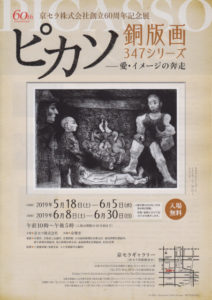
flyer of picasso exhibitionAt the next stop, photos were not allowed anyway. I went to the Kyocera gallery were they had an exhibition of their Picasso collection. In summer 1968, Picasso made 347 prints featuring women and sex, and the Kyocera gallery owns a full set (the second printing out of 50). Even though at this time there was only the second half on display (Japanese museums often change their exhibits midway through an exhibition), I found the images very interesting. They were numbered chronologically and you could see the shifting interest of Picasso throughout these months.

In the second floor of the Kyocera building there is the Kyocera Museum of Fine Ceramics, but you will not find many vases and tea bowls there. Fine ceramics are industrial type ceramics used for example in cars, rockets, solar panels etc. Making them requires high precision and more knowledge of chemistry than the regular potter will ever need. Since I am a science nerd, I loved the exhibition. There was so much to see – including a full-time line of Kyocera – that I was overwhelmed quickly and had to leave. I will come back though, promised!

My last stop was at the Kyoto Antique Fair. I love browsing through the many different stalls and looking at (if not for) things. I have been there several times, and it seems that there are some sort of waves as to what is for sale there. This time, I found a huge number of cloisonné items, something I only now recognise after I did the piece on the Namikawa Cloisonné Museum for What’s Up in Kyoto. And, wouldn’t you believe it, there was even one booth selling pieces made by Namikawa Yasuyuki!

Seeing them up close in all their glory was mind-boggling! How did he manage so much fine detail 100 years ago? The seller said that they didn’t really know, and that even nowadays, his art is unmatched. Of couse, since Namikawa Yasuyuki was the Japanese cloisonné artist, his pieces were completely out of my price range. Just to give you an idea: the smallest vase they had, about 5 cm in height, went for 1.6 million yen. Not just pocket money, is it…

Well, I did not come home empty-handed after all. There were a few things that tempted me and that were still within my price range. And I went for something unusual. For me, at least. But, I mentioned it before somewhere, I am fascinated by shakuhachi, traditional Japanese bamboo flutes. And, so I bought a very cheap second-hand one for just 7000 yen.

My shakuhachi.I have heard that playing the shakuhachi is extremely difficult, and indeed, I am trying to get a sound of this thing since last Saturday. Sometimes it works, and then I try to cover a single hole and then I have to start again. Fun fact: I am not a very musical person, the only thing I am good at playing is CDs. Also, one of my friends once called me tone-deaf. Which is not going to make things easier. But hey, what is life without a good challenge every now and then. So, let’s try this and see what happens!

Encounters With Kyoto

I have reason to celebrate: I can now call myself a “published author”. Yay!

As I mentioned before, since last November, I am a member of the group Writers in Kyoto, as the name suggests, a small group of writers who live in (or around) Kyoto or have some other connection to Kyoto and who write in English.

This year, for the third time altogether, the group has put out an anthology to which the members of the group were invited to contribute. There was also a writing competition that was free for everybody to join. About half of the Writers in Kyoto members have sent in short stories or poems or non-fiction essays – and I’m one of them!

Cover of Writers in Kyoto Anthology, Vol. 3And, our book “Encounters With Kyoto – Writers in Kyoto Anthology 3” is now available on amazon in paperback! An e-book version is in preparation and there’s lots of fun stories to read. For example, there is a very interesting non-fiction piece on ropes made with human hair that were used to lift the wooden beams of Higashi Honganji Temple – some of the ropes are still on display there. Or the lovely poems full of childhood memories by a local Kyoto lady. And then there’s my essay about a Japanese garden I was not supposed to enter… My personal favourite is a fun piece on an encounter with yakuza – in the sento to boot!

Last Saturday the group met for the official book launch in Umekoji park near Kyoto station. We had sake and local and international snacks and then some of the authors went on to read their pieces from the anthology. It was my first time at a group meeting, so I decided to read my piece by way of introduction. People seemed to like it, or at least the liked my reading, so we had something to talk about afterwards, thank goodness.

It was fun to meet other English speakers in Kyoto, some of whom have lived here for decades, some of whom have just arrived; some of whom I have heard about from friends, others I would have never known otherwise. And it was fun to meet so many different people – and to find out interesting things we have in common regardless.

I realise that this self-promotion is a bit of an unusual book post for a Sunday, but I really enjoyed working on my essay and reading the other contributions. If you’d like to check it out – and I promise there are better writers in it than me –  as I said, it’s available internationally on amazon.

Kanji Island

I’m still engaged in studying Japanese, and slowly, oh so slowly I might be getting somewhere… Part of the problem is that while I’m getting better at understanding, speaking is still quite difficult. There are lots of interesting grammar constructs that I am learning, but it is not easy to get them from passive knowledge into active speaking… At least I am beginning to understand more, so that’s something.

I keep struggling with Kanji though, so I’m jumping at opportunities to learn those, the more painless, the better. Recently I found cute coloring sheets for Kanji, called “Treasure Island of Kanji”. It’s for elementary students and all the 1006 Kanji they learn during their six grades. Each sheet shows the appropriate shape of an island with squiggly “paths” drawn that actually contain all the needed Kanji. The idea is to find and paint the Kanji one by one in different colors, and in the end, every bit of path belongs to one and only one Kanji. Here’s the sheet for the first grade, containing 80 Kanji:

Treasure Island of Kanji

The difficulty lies in the fact that the lines have no real endings, and that Kanji may consist of several disconnected part. So you really have to know how the Kanji look like and what all their parts are. For example, in the lower left corner, I can see the Kanji for book, year, and eye very clearly, and there might be the ten Kanji in it, but I have no idea where the rest of the lines should go.

The biggest problem with this is that you really need to know the Kanji that are sought, and they are not given anywhere. So it’s a bit more difficult for non-Japanese who may study Kanji in a different order than elementary school kids.

It is a cute little game though, and the inventor, Yuji Baba, has made many more card games to study Kanji and other stuff. Check out his homepage. 

Some of those games are for sale on this page of the Okunakaruta Online Shop, but you’ll have to navigate the Japanese to begin with, and I’m not sure if they ship abroad at all.

Reinvited

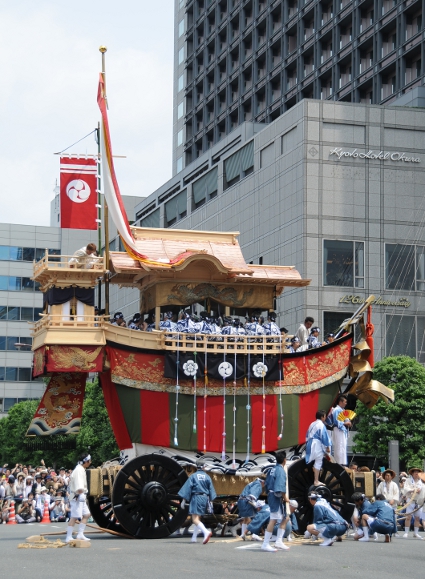
I am so excited! Just yesterday, I received a phone call where I was once more invited to help out during Gion Matsuri! Just like last year, I will work at the Ofunehoko, the very last float in the second parade on July 24th. I will sell chimaki and tenugui and put people’s shoes away when they enter the building from which you can enter the hoko itself…

The boat shaped O-fune hoko ending the procession

It doesn’t sound like much, but I am really excited! Last year, I met a member of the Writers in Kyoto group which turned out very nice indeed (more about that in the weekend), so who knows whom I will be meeting this year…

Cafe Breaks

With summer approaching and my apartment still being without aircondition, I will probably be forced out of my home every now and then in the coming months. I am slowly building a list of cafes where I can go and work in dire circumstances because I don’t want to go to the same ones all the time. So far, my favourites are the following:

  • The Cafe in the Ogaki Bookstore on Kitaoji Street. It’s the closest to my home, they have small meals and excellent matcha latte. When I need a break, I can simply walk among the books in the store. Con: No wifi.
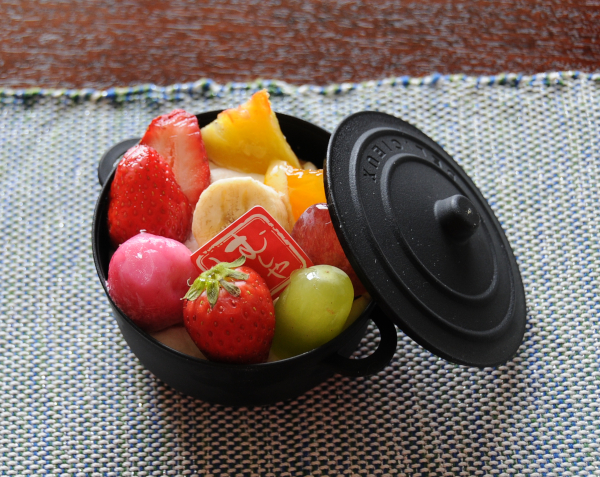
  • The Mushiyashinai, a vegan cafe near Ichijoji Station on the Eiden railway to Kurama. While I don’t care much that it’s vegan as such, their soymilk lassi is absolutely addictive. They have nice little cakes to take home too, and as a bonus: the young man working there is very cute… Con: a bit expensive.take-home fruit cake from the Mushiyashinai
  • The Nama Chocolat in Okazaki, run by a friend of mine. Pretty quiet (except for weekends) and located in a lovely old house. Excellent home-made chocolate, a real treat together with matcha. Con: I always end up chatting with my friend rather than working…
  • The Mo-an Cafe on top of Yoshida hill. Rustic and quiet atmosphere, with a nice view over Kyoto. Serves small meals for lunch, not many people (busy in the weekends and during lunch time though). Con: Tricky to access by bicycle. You should leave it somewhere at the foot of the hill.
  • Matsunosuke near the Museum of Kyoto. A bit far from my place but their sweets are worth it. Best pancakes in town. Con: Not really a place to work since it’s quite busy. Pancakes are delicious but take an eternity to make…
  • The Lec Court Cafe in the Kyoto Hotel Okura. Excellent desserts, excellent service in very stylish ambience. Tea is served in large pots to about three cups. Con: Expensive. And they would probably frown upon laptop use – not that they would complain though!
  • The Lipton Tea House on Sanjo Dori. Fluffy cakes to die for (and for takeout), a large selection of tea and wonderful hot chocolate. Refined ambience, friendly staff and reasonable prices. Con: Like in the Okura, it doesn’t feel right to take out a laptop. Bustling with tourists.

These are my favourite cafes in Kyoto when I want to work away from my office, or when I just want a break. There are hundreds more that want to be tried of course. The nice thing about cafes in Japan is their great Austrian approach to it: Order one coffee, and you can stay forever. I prefer not to go on the weekends when these places are usually busy with many customers, but during the week, when there’s nobody else, they are fair game. Who knows, I might be seeing you there!

Cool Days

I don’t know where you are living, but I have the feeling that it’s much cooler than usual in Kyoto. Right now, the tsuyu rainy season should be starting with lots of rain that drives up the humidity, and at the end of it, it should be almost unbearably hot.

But, nothing of the sort, for the time being at least. Although it is pretty overcast, there is not much rain and definitely not the downpour we should be having. Temperatures are in the usual range just below 30 degrees, but in the nights it cools down pleasantly. Humidity is okay, you only sweat when you’re actually moving, so that’s definitely good.

raindrops on a windowI usually don’t think much of these things because it’s easy to fall into the “last year everything was different” trap, and it’s not as if I keep track of the weather over the years. But today, my Japanese teacher mentioned that it was rather cool outside for the season, and I was happy to agree with him.

In fact, I have the feeling that the whole year is a bit “later” than usual, starting with the sakura already. Of course, there is always some sort of variation to weather phenomena, so that’s nothing unusual. Still it seems as if global warming is creeping up on us, even here in Japan…

Gotōchi Formcard

A modern post office goes beyond selling stamps and being a place where to send parcels and letters. Nowadays, you can also buy stationary, postcards, cardboard boxes to pack your stuff in it…

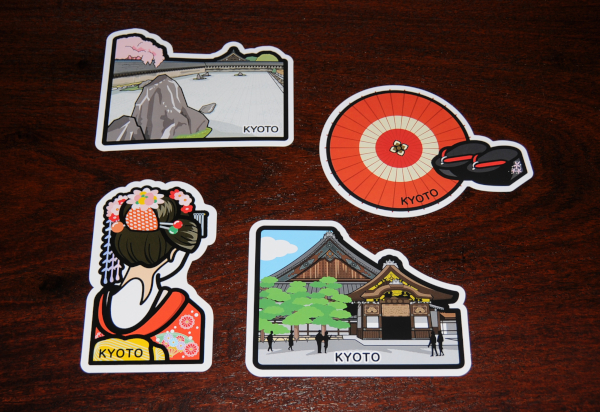
In Japan, every post office in a city that is frequented by tourists – whether Japanese or from abroad – sells special postcards called gotōchi forumukādo (ご当地フォルムカード). Literally that means “local formcard”, and these are fun postcards that depict some of the most iconic tourist spots or things of that particular city and are often shaped accordingly.

In Kyoto, these formcards of course have something to do with Geisha, and there are also a few of Kyoto’s most iconic temples and even tsukemono, which are pickles and the main souvenir from Kyoto, for Japanese tourists, that is. What do you think of these? Do you recognise the two places?

Gotoji Formcards from KyotoPostage varies according to size, but these cards can be sent abroad as well. However, the clerk at the post office suggested using an envelope for destinations outside of Japan, just to make sure they arrive unharmed.

Closing

Nearby my home there is a big shopping centre that is being even further enlarged at the moment. In the basement there is a supermarket and a food court with a number of small eateries, and the first and second floor houses mainly clothing stores, a book shop, opticians, and a pet store selling cats and dogs and smaller pets like birds.

In the last few weeks there have been closing sales at no less than seven shops, all of which have been open since at least the time I moved in here. Five of them sell shoes and clothing, but one of them is a store for handbags and luggage, and another one is a 100 YEN shop. I am baffled and I’m seriously wondering about the reason for this.

Is the economy going downhill again? But none of these stores were especially expensive, and that the 100 YEN shop is closing does not speak for this theory. Maybe the owner of the shopping center has raised the rents? That is possible, but the new extension will not open before December, it seems awfully early to raise the rents now already.

running shoes on display in a shopIn any case, I’m getting plenty of goodies out of those closing sales. Many of my T-shirts are in their final death throes, and a pair of new sneakers was equally welcome. Apparently, there is a silver lining to everything…

Hakodate

I’m back! 😉 You probably didn’t catch the book reference, but last weekend I visited Hakodate on Hokkaido, which is just on the other side of the Tsugaru Strait, where Ozamu Dazai walked in the 1940s.

Hakodate, founded in 1454, is the former capital of Hokkaido, at a time when the island was still called Yezo and was mostly unexplored and inhabited by “scary” Ainu, the people indigenous to Japan. Hakodate is an interesting city because in 1854 it was the first port to be opened to foreign trade and thus it had a large influx of foreigners from many countries.

This can be seen in two ways: In the old town, there are houses that are distinctly Western style, and made from bricks even. The old quarter also has many churches and foreign consulates, unfortunately, not all of the old houses are in a good state, although there are some renovation efforts going on. For Westerners, the houses look nice but not something we haven’t seen before, but the Japanese love visiting Hakodate for the “foreign flair”.

Russian Orthodox Church in Hakodate

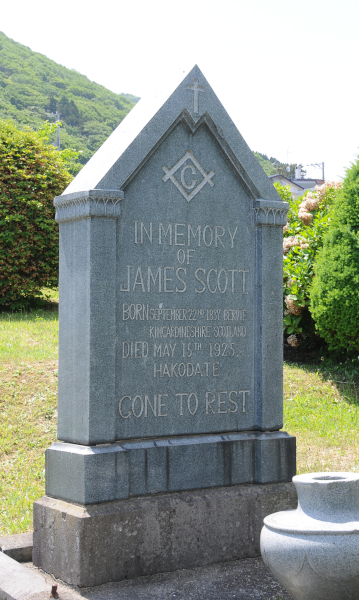
At the edge of the old town, there are several cemeteries for foreigners, strictly separated by country of origin or religion. There is the Russian cemetery, the Chinese cemetery, a catholic cemetery (which also has graves of local Japanese Christians – as I said, there are many churches here) and a cemetery for foreigners in general.

Tombstone on the foreign cemetery in Hakodate

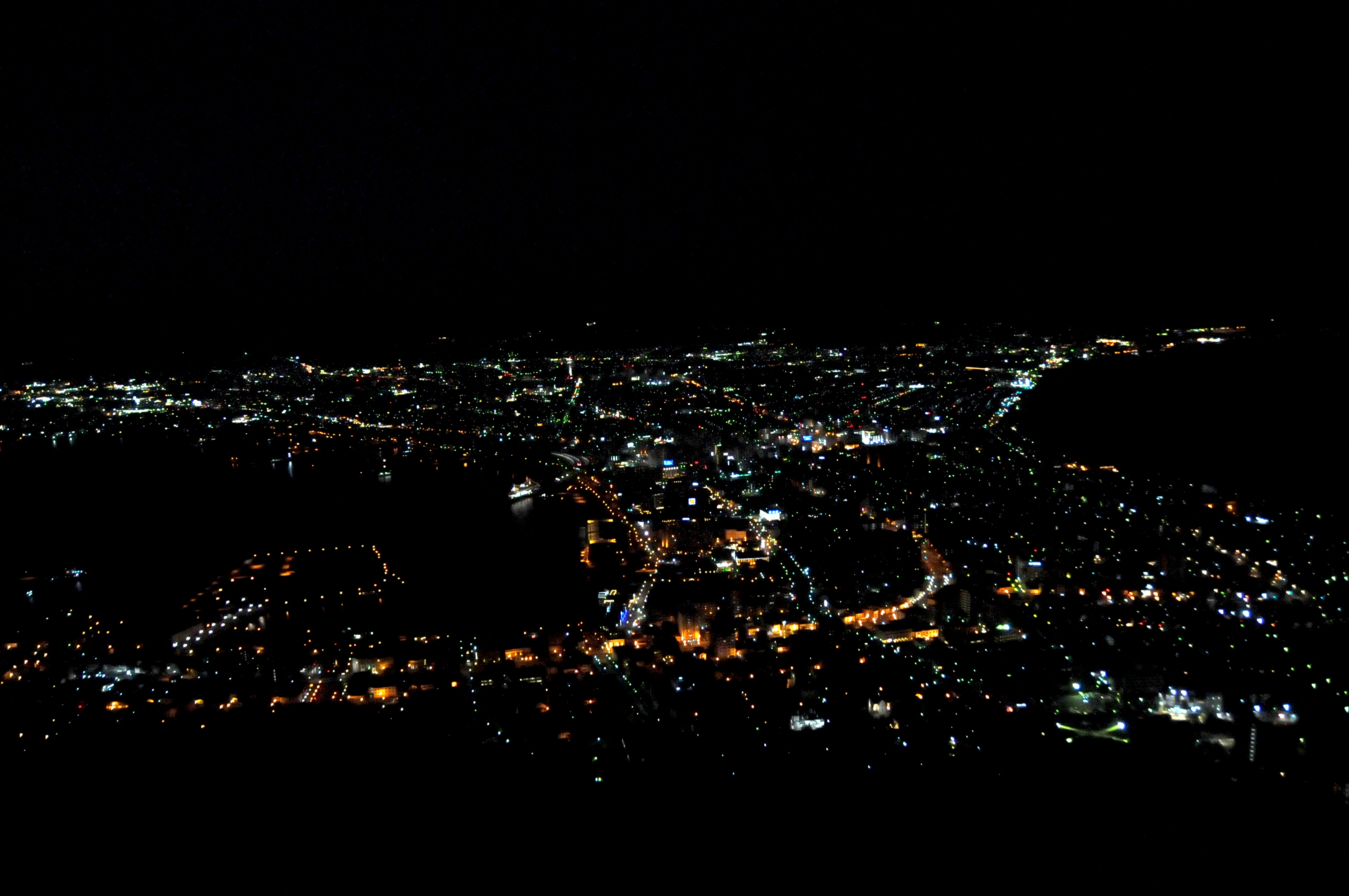
Another interesting part of the old town is down at the harbour, where there are old warehouses made from red bricks, that now are home to a great number of (souvenir) shops and other stores. From there, it is not far to Mount Hakodate which has a wonderful view over the city which is especially beautiful in the night. Of course, we went up there as well, and we could even see the lights of Aomori on the “main land” of Japan.

Night View over Hakodate

My personal favourite, however, was the Goryokaku Fort, a traditional star fort built a bit more inland that was meant to protect the government offices that were relocated inside, once the fort was finished. It reminded me of similar forts I had visited in the Netherlands, but it seems that such forts have been built all over the world, from Europe to the US and even Asia (probably during European colonisation).

Old Magistrate Building in the Goryokaku in Hakodate

My friend and I had a great time even though we had to cram all of the sights into less than two days. We have seen almost all of them and on Sunday, we walked altogether 14 km… At first, the idea was to walk up Mt. Hakodate for the nightly view, but in the end we decided to just take the cable car. We also visited the Museum of Northern Peoples with interesting exhibits of not just the Ainu, but other peoples from northeast Russia as well.

Ainu Clothing

There are two things I’m slightly miffed about: First, I don’t think I got enough fish and seafood on my trip, something Hakodate is famous for. Unfortunately, my friend doesn’t like fish at all, so we had to compromise. She would have been fine with eating onigiri all the time while I had my fish, but that’s not fair; after all, I can have seafood everywhere else. I also wanted to stock up on cheese which is really expensive in Japan, and since Hokkaido is famous for its dairy products, I was hoping for lots of choice for a fair price. Not so! It seems that they prefer to make sweet things (like cheesecake) out of their milk, and the little that is turned into “real” cheese is still almost prohibitively expensive…

Altogether, I had a great trip though. My friend is fun to be with, and we have a similar way of approaching sightseeing, so that was perfect (even though she is in better physical shape than I was). This was my second time in Hokkaido, and I found it very pleasant. I guess I’ll be back, eventually… To finish this already long post, here’s a list of some striking things I noticed in Hakodate:

  • the air is so clear and fresh!
  • private houses have a closed glass porch before their entrance door (and indeed, it was quite windy)
  • there are people smoking on the streets (you don’t see much of them in Kyoto)
  • there is SO MUCH SPACE! Wide streets, buildings with gardens…
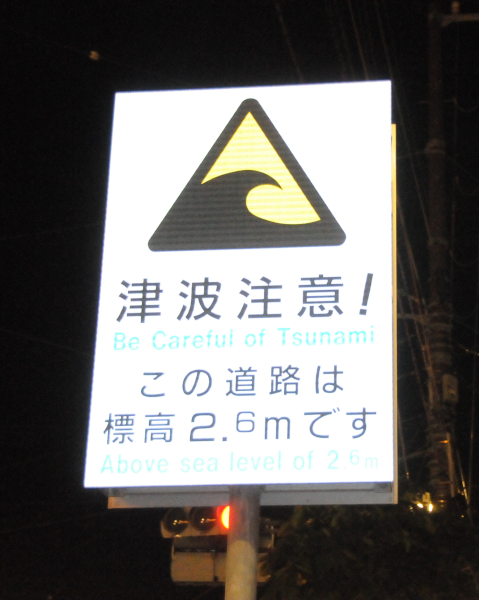
  • In case of a tsunami, much of Hakodate would be flooded.

Tsunami Warning in Hakodate

Return to Tsugaru

Return to Tsugaru
Osamu Dazai

Return to Tsugaru

Tsugaru is the old name of the northernmost peninsula of Honshu, which today makes up part of Aomori prefecture. The people in Tsugaru have always been poor and, as the part of Japan from which to set sail for Hokkaido, has had a reputation of a certain backwardness in cities like Tokyo.

Osamu Dazai, considered among the foremost Japanese authors of the 20th century, was born in Kanagi, a small town on the Tsugaru peninsula. In this memoir from 1944, he takes us on a trip to his hometown and nearby places, like the castle town Hirosaki, the village where he went to school, etc. Travelling chiefly on foot, he pays visits to family members and relatives, as well as old friends, where he is always welcome and served sake and crabs, his favourite food.

This book is part travelogue, part history – both of Tsugaru and his own family – part commentary on current events and the wartime of 1944. Throughout the book shines Dazai’s deep love for the land and the people living there.

Osamu Dazai was the pseudonym of Shuji Tsushima, born in 1909 as the eighth (surviving) child of a man from humble origins who eventually became a respected local politician. From an early age on, Shuji wanted to become a writer, and he eventually moved to Tokyo as a student of French literature. Aged only 26, he was nominated for the very first Akutagawa Prize, and although he did not receive it, his reputation was made. His most important works were published after WWII. Always the family’s enfant terrible, he finally committed suicide with his mistress in 1948, at only 39 years of age.

This book is a classic, and after all these years, it is still available on amazon.