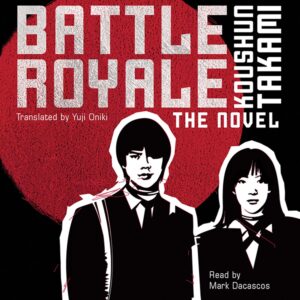
Battle Royale

Koshun Takami

Instead of going on a school trip, 42 junior high school students from the small town of Shiroiwa find themselves on a tiny island in Japan’s Inland Sea. There, they are told that they were chosen for “The Program”, an annual competition where they have to fight each other to the death until only one is left alive. Each of them is given rations for a few days and a randomly chosen weapon and sent off, the game starting immediately.

New, uneasy alliances are forged and old friendships are broken as each one of the 15-year-olds struggles with their conscience, their fear, and raw survival instinct. But who will make it out – the smartest, the most ruthless, or those who can fly under the radar until the end?

This is a fast-paced thriller where I never knew what to expect next. I was worried of losing track of the students’ names, but the author’s choice of introducing them only when they become relevant (i.e., when they get into their first fight) helps to avoid confusion. He also describes the thought processes of the students in realistic terms, with all their juvenile flaws and misplaced confidence and flashes of both brilliant insight and childish ignorance. The deaths were all described in bloody detail, but overall, this didn’t bother me too much, and the twist at the end is satisfying.

What I found most interesting was the setting in a dystopian Japan. While depictions of authoritarian governments in fiction are nothing new, the author lets Japan fall from the Edo period (and the opening of the country) straight into a totalitarian system. Set in modern times when the kids have mobile phones and computers, unfettered access to information, in particular from abroad, is forbidden, just like free travel or rock music. In some ways, it reminded me of the situation in countries like China (in particular Hong Kong) or Iran: As long as you stay within the government-approved mould, you’ll be just fine. Quite worrisome, somehow…

Koshun Takami was born in 1969 in Amagasaki and grew up in Shikoku. After obtaining a degree in literature from Osaka University, he worked as a reporter for the Shikoku Shimbun for five years. Battle Royale, published in 1999 is his first, and so far only novel. Although its violent premise caused it to lose out on a literature prize, the controversy surrounding it made it an instant bestseller. It was adapted into manga and film.

Given the number of dead people in the end, I wouldn’t call this “light reading” or “enjoyable” by any stretch, but it’s a book worth reading. Get it from amazon in many different versions.

The Last Empress of Japan

As it is well known, the imperial house of Japan is (still) facing a succession crisis. With male heirs to the throne in short supply for many years, the entire burden of producing a son is currently resting on a single youth, currently 20 years of age.

While there is no imminent pressure to reproduce for the young prince, the burden might be lessened quite a bit if the Succession Law were to be changed to absolute primogeniture, and women were allowed to ascend to the throne.

There are powerful arguments on both sides, and on the opposing one, one famous story is cited over and over again: That of Shōtoku, the 6th and last “real” Empress of Japan, and her involvement with a certain monk called Dōkyō.

Read the story, which is really nothing more than a juicy 8th century palace intrigue, over on Yamato, it’s a freebie!

Weekend Project # 9

Spring is approaching (with a few setbacks, it rained all day today) and on the warmer days I don’t need to heat anymore. Meaning: I’m free(er) to move around the house instead of hunkering down at my desk.

And one of the things I have waited for all winter – or, to be precise: ever since I got my sewing machine repaired – is to do some sewing projects. I’ve already fixed the pocket of my favourite jacket for spring and a few pants that needed hemming, which I’m going to wear at home soon. Two of my beloved jinbei also need repairs, but since these are real summer outfits, that can still wait a little.

In a sense the biggest project took all Sunday afternoon: I made a new mouse pad for my office. It’s three old T-shirts sewn together strategically, with a fourth for the back and some red piping all around. Even though I still don’t really know how to work with bias tape, it turned out all right methinks. Pumpkin seems to approve at least. And if you remember my last weekend project, you may recognize the colors.

Anyway, on to the next project!

Stranger Cats

It’s an exciting week: a friend of mine is on vacation and has allowed me to help with catsitting. She has two cats, Tora and Ko-chan (short for Kotora, little Tora), and I visit them once a day.

Ko-chan is very friendly, she needed just a few minutes (and a few treats) to warm up to me. She now purrs and sits next to me, even gives little head butts and makes biscuits… Lovely little one.

Tora on the other hand is quite suspicious of me. He runs upstairs when I come, but eventually peers in from the door to check on what’s going on with Ko-chan. Today he even came into the livingroom for a bit, but he did not stray far from the door, just to stay safe.

It’s a fun thing to do, and my friend is very generous – she even left treats for me on her kitchen table. I’m happy to do this any time again!

Busy Again

Sorry for not writing, I’m quite busy again, with writing for elsewhere…

However, I’m taking some time off tonight for – you guessed it – a BATI-HOLIC concert. This time, it’s with two bands visiting from Australia. I’m expecting great music and a lot of fun. I do need the mood-lift…

Tim Tam

Last Saturday was Valentine’s Day and I treated myself to my very own shinkansen, and I tried to mimic its natural habitat. For a short while. Ahem.

In general, I stick to the cheaper options, however. And a few years ago, I have discovered Tim Tam, chocolate cookies, pardon: biscuits from Australia.

They are two rectangular biscuits with chocolate cream in between and covered in more chocolate (double and even triple coats are available). As a side note, I just found out that in Australia, there is a “National Tim Tam Day”, conveniently just after Valentine’s Day on February 16.

They were created in 1964 and are still made by Arnotts exclusively in Australia. According to wikipedia, at their Sydney bakery, the production line turns out about 3,000 Tim Tams per minute and uses 20 tonnes of cream filling and 27 tons of chocolate coating each work day. Sounds like heaven.

I liked them from the beginning, but I never thought that they were that special. And then I discovered the Tim Tam Slam.

This is a special way of eating the cookies that involves coffee (traditional) or milk tea (my choice) or probably anything else as long as it’s hot. So, first, bite off two diagonal corners of your Tim Tam. Then use the Tim Tam as a straw with which to suck the beverage. When the biscuit is all soggy, you’re allowed to eat it. In fact, you have to slam it – eat it in a single bite – before it falls apart.

And you know what: This tastes absolutely fabulous! The melted chocolate and the soft cookies are heated just enough to create a veritable taste explosion and go perfectly with the hot tea. It got so far that now, I cannot imagine eating Tim Tams in any other way.

Great. As if my chocolate addiction needed an upgrade…

Cold Spell

It’s that time of the year when it’s freezing in Kyoto, literally. After it snowed all day last Sunday, we’ve had temperatures around and just below zero since then.

Monday night at around 2 in the morning, the temperature must have dropped considerably, because that’s when my alarm clock stopped. When I woke up, there was a beautiful white gleam coming from the outside, and the room temperature was exactly zero degrees.

Pumpkin stays as close as possible to me, during the day he sleeps in his kitty bed in the living room which is equipped with a heating pad. Right now, he sleeps in his bed in my office, and he will come upstairs with me later to snuggle next to me just in case.

Even though I don’t like the cold, I love the snow, but by now, everything has melted again, thanks to the rain we had all day. For the next two weeks, the temperatures are forecast to rise again, up to 17 degrees this Sunday. I’m sure the people running and watching the Kyoto Marathon will appreciate this.

Anyway, on Monday last week, I went to Yoshida Shrine for their setsubun festival. We went around noon for lunch at the food stalls – I desperately wanted karaage fried chicken and ichigo daifuku and of course, there were baby castera as well. We all ate too much. It was glorious.

Yoshida shrine has the largest setsubun festival in Kyoto, and they always have a large lottery with goods from local companies. Prizes vary: sake and food items, household items like glassware, cutlery, electrical appliances like heaters or rice cookers… The main prize was a (small) car.

My friends and I all bought a ticket, and we jokingly agreed to “share” – I wouldn’t know what to do with a car anyway, but the bicycle on the other hand… Sadly, none of us won anything, not even a pack of pickles. Maybe we all should’ve bought more tickets?

The Ogura Hyakunin Isshu Love Poems

Having lived in 6 countries, there’s one thing I’ve learned: people aren’t that different, really. Our emotions are the same, just the expressions thereof are determined by culture, upbringing, sex… And the fun thing is that these human emotions haven’t changed much in the last, say 1000 years.

Case in point: Japanese love poems from the Heian period.

The Ogura Hyakunin Isshu, compiled in 1235 by Fujiwara-no-Teika, is a collection of 100 poems by 100 Japanese poets who lived from the Asuka period (7th century) to the Heian period (late 12th century). Most of them were aristocrats (the only Japanese who could read and write at the time), but even though their lives are so vastly different from ours, their emotional poetry still strikes a chord.

Read my new take on the Hyakunin Isshu over on Yamato (it’s a free post): https://yamatomagazine.substack.com/p/love-poems-for-eternity-the-ogura-hyakunin-isshu, an old one from this blog is here.

Foreigner Tax

Japanese currency

The yen has been quite weak for several years now, causing two things: price hikes in Japan and a huge influx of foreign visitors – a record of 42.7 million visitors in 2025. For them, the Japanese prices seem cheap, and they spent a total of 9.5 trillion yen in the country last year. Not bad at all!

I have heard that some places have raised their prices for foreigners, claiming extra costs in translating menus or hiring staff that can speak English. The only place I have come across this is the KYOCERA Museum in Kyoto, where Kyoto residents get a discount in their “Collection Gallery” exhibition. I feel this is a bit different from raising prices just for foreigners, also the discount is 210 yen.

However, through WUIK, I’ve come across a more egregious case, where an event has a surcharge for foreigners: with ticket prices for Japanese starting at 10,000 yen already, everybody else pays 15,000 yen.

And on their website, they rather nonchalantly mention:

Local discounts are applied to Japanese, so the ticket prices are different. Thank you for your understanding.

“Local discounts”? In other words: the tax subsidies for the event are so hefty that foreigners pay 50% more? It also appears that they check ID upon entering, which does make me wonder if they would accept my residence card if I buy the cheaper tickets.

In any case, I find this all very unpleasant, both from my perspective as a foreign resident in Japan, but also from a business point of view. Usually, in my listings on What’s up in Kyoto, I include ticket prices, but in this case, I left this information out. I really don’t want to be blamed if and when people find out that Japanese pay so much less for the same experience.

So Different, So… Otrovert?

On New Year’s Eve, a friend of mine sent me one of his rare emails, in which he told me essentially that I wasn’t an introvert at all. Translating and paraphrasing a little, he stated:

No introvert starts a new life in a foreign country, and approaches strange cultures with complete openness.

Then he proceeded to introduce a new concept, that of an “otrovert”. I did some research, and according to wikipedia:

An otrovert is someone who feels like an eternal outsider in groups, even when they are friendly and socially capable.

The Otherness Institute (founded by the researcher who coined the term) lists traits of otroverts as

  • non-belonging
  • difficulties with group or communal norms
  • free thinking
  • intense need for privacy

Hmm. Some of the traits listed (intense need for independence, internally rebellious but confrontation-averse, abhors noisy/crowded places, does not like attention) definitely fit. And interestingly, I never had a problem with public speaking or leading a group (teaching at uni or now guiding the tours), as the website suggests.

I also have no problem talking to a single person. In fact, at my concerts, I’m trying to say hi to one new person every time and take it from there. At the same time, I feel intensely awkward when I have to approach a whole group. The self-introductory “hi, I’m the new one” is the start to my worst nightmares.

So, could there be something to this? Maybe – that’s what an otrovert would say. 😉 I took the test on the website above, and I score 230/280 on the otrovert scale.

You can read more about being an otrovert on the website above. There is also the book “The Gift of Not Belonging” by Rami Kaminski who coined the term otrovert. I haven’t read it yet, so I can’t say anything about it. While most of the ratings are positive, some people say that the book lacks scientific rigour and is based on (the author’s) personal anecdotes. One person even says that this is not a new concept, just the Myers-Briggs INTJ in a new guise.

To me, it sounds definitely interesting and I will investigate further.