Exports

So, I’m home again in Japan, and I have (almost) overcome my jet lag. Having to deal with all the things that accumulated over the last weeks did help with that one. I’m ready to go again!

Back in Austria, a friend of mine asked what I missed about Japan, and I didn’t really have an answer. Mostly because it was just a holiday and my return was already fixed, the question was difficult to answer. Maybe it’s green tea cookies? Japanese put matcha powder into so many things that are not available in Europe at all. Sushi is okay by now, in the bigger cities at least, even though really good sushi places are still rare (try the tuna fish first: If this is good, the rest will be just fine!).

Latella Yuzu-LemonOne thing I could find in Austria which I did not expect was yuzu. Yuzu is a kind of citrus fruit with a very strong smell and distinctive flavour, and all the foreigners I have met love the taste. Yuzu grow only in Japan, Korea, and parts of China, so imagine my surprise when I saw a “Latella” (a whey based drink) with lemon and yuzu! I was slightly disappointed by the taste because the lemon was a bit overpowering, so the yuzu flavour didn’t get out fully. However, it’s a start. And who knows, when I’m back next time, they may even sell the drink in the proper winter season instead as “summer edition”…

Returned!

I’m back, both figuratively and literally speaking.

The thing that happened at the end of May was the death of my grandmother. I spent the last three weeks in Austria taking care of her funeral and related things.

VerabschiedungMy grandmother was 99 years old, so her death did not come as a big surprise. Although she had had some episodes before where she was weaker than usual (in particular around Christmas two years ago), we all more or less expected her to live and celebrate her 100th birthday next January. But, not so. She fell asleep for good on May 24th. And with her, my family is gone. All I have left now are relatives… The realisation of what that really means has not yet hit me. In fact, I feel strangely detached still. I guess the pain and grief will catch up with me whenever I am ready. Not sure when that will be, but for now, I’ll keep up my life as I have laid it out for myself here in Kyoto.

Extension

We have a new construction site in the neighbourhood. Once upon a time, way before I moved here, there was a hotel just north of my apartment block. Since it had been demolished, there were discussions on what to build on that empty space instead. For many years, the neighbourhood associations have fought against a pachinko parlour, apparently one of the main contestants for a building permit.

The fight is over, and, glad to say, the neighbourhood associations have won it: Instead of the gambling hall, there will be an extension of the shopping centre, situated right next to the spot. The extension will add about 50% of floor space to the shopping centre, which is already enormous now. I am wondering what kind of shops will come there, and if there will be new ones or just the current ones enlarged. Probably a bit of both. Also, there is another shopping centre two blocks away, which belongs to the same chain – maybe they are planning to get rid of that one, since it is very old already.

Anyway, construction has already started last month, and according to the schedule I have received (since I live in an area affected by the noise, this seems to be mandatory), they want to be done with construction by the end of July. I am curious if this will work out, but if they say so…

Neighborhood construction siteIn the picture above you see the current state of the construction. There will be a one floor deep basement, and they are now getting rid of the concrete remains of the hotel’s basement, and drill a few holes of their own. What I noticed when going shopping in the evenings (the big brown building on the left is the current shopping centre), is that the frogs are gone. A few weeks ago still, there were frogs in the ponds built inside the old basement to the left, and they were happily croaking away. Now, everything is quiet, and looking at the picture, you can see no more water anywhere on the grounds. It seems the Japanese don’t care much about things like this, they probably just filled in the old basement and let the frogs fend for themselves. This would be unimaginable in modern Europe. I hope some of the frogs survived…

Growth Spurt

Just a quick update on the sad trees I posted a month ago: Even though I did not think they would make it after the extreme cut they received, they absolutely did! They don’t look as good as the trees on the other side of my house, but still, it is nothing short of a miracle: The same trees as a month ago

Eight Views of Omi

The Eight Views of Omi is a series of woodblock prints from the Edo Period, depicting scenes from places around Lake Biwa. The Biwako is the largest sweet water lake in Japan, its southernmost tip is only some 20 minutes east of Kyoto. Historically, the province in which Lake Biwa is located was called Omi, and many little towns around the lake still have Omi as part of their name.

8 Views of Omi - all in oneThe idea of the Eight Views goes back to China, in particular to the 11th century paintings Eight Views of Xiaoxiang. Eight Views were considered the most beautiful or significant scenes of an area, and since many artists made images like that, these can be seen as an early version of visual advertisements. The idea came to Japan in the 15th century and inspired prince Konoe Masaie and his son Naomichi to a series of poems about eight scenic places on nearby Biwako. In the early 18th century, woodblock printer Nishimura Shigenaga took Konoe’s poetry and turned it back into images, his Eight Views thus becoming one of the first series of landscapes made in Japanese woodblock printing art.

From there on, many different artists took up the theme and produced at least one series of Eight Views of Omi. However, the most prolific of all artists was Hiroshige, who made at least 20 different series over a number of years. The topic was popular until well into the 20th century, when the modern shin-hanga style of woodblock printing evolved from the old ukiyo-e. For example, Ito Shinsui produced a series of Eight Views of Omi as late as 1917. Note that there is also a series of images called The Eight Views of Lake Biwa, however, this refers to a modern version with some different locations created in 1949 by the government of Shiga Prefecture (the modern name of the area around Lake Biwa).

The Eight Views of Omi are usually called by the following titles:

  • Returning Sails at Yabase Yabase is a former harbour on the east side of Biwako. Situated near the Tokaido (the main road between Kyoto and Edo), people could use boats to go down to Otsu, thus speeding their journey. Yabase harbour was abandoned when the first railway between Tokyo and Kyoto was opened. (Harunobu, ca. 1760) 8 Views of Omi - Yabase
  • Evening Rain at Karasaki Karasaki is but a small cape reaching into the lake, with a single large pine tree. The enormous tree has been replaced a number of times, the current one was planted in the 20th century. (Ryuryukyo Shinsai, ca. 1820)8 Views of Omi - Karasaki
  • Evening Bell at Miidera Founded in the 8th century, Miidera temple is home to one of the three great bells of Japan, with a height of more than 3 metres. (Hiroshige, 1852)8 Views of Omi - Miidera
  • Wild Geese Returning Home at Katata Rather than geese, the recurring image is that of Ukimido Temple, which stands on piles in the lake and is accessible by a bridge. (Nishimura Shigenaga, ca. 1730)
    8 Views of Omi - Katata
  • Clear Breeze at Awazu Awazu is famous for its pine forest. On some old prints the castle of Zeze can still be seen, however, it was dismantled in the early Meiji period.8 Views of Omi - Awazu
  • Autumn Moon at Ishiyama Ishiyama Temple is located a bit south of Biwako and was built into a steep slope, somewhat reminiscent of Kyoto’s Kiyomizudera Temple (Ito Shinsui, 1917)
    8 Views of Omi - Ishiyama
  • Evening Glow at Seta These images usually show the great bridge crossing the Seta river, which was once part of the Tokaido. The modern bridge is made from concrete, but its original Chinese style has been kept. (Hiroshige,1835) 8 Views of Omi - Seta
  • Evening Snow at Hira Mount Hira on the west side of Biwako is the highest mountain of the chain and in winter is always tipped with snow. (Hokusai, 1802)
    8 Views of Omi - Hirayama

The Eight Views of Omi were very popular, and many artists have taken the concept and transplanted it to other regions of Japan in what the Japanese call mitate. For example, there are Eight Views of Kanazawa, Samani, near Edo… Many of those prints copied the underlying ideas of the original images, like “evening glow” or “clear breeze” and transported them to suitable other locations. Yet other artists have taken the theme a bit further and produced Eight Views that parody the original, for example the Eight Views of Beautiful Shields by Utagawa Kuniyoshi, showing samurai, or his Eight Views of Wise Women. Isoda Koryusai produced Eight Elegant Views of Fukugawa, depicting beautiful women. In 1927, a set of modern Eight Views were introduced, showcasing scenic landscapes from all over Japan.

Passing On

One of mz elderly friends is still full of energy, but she says she wants to prepare for old age, and tries to make things more easy for her. For example, she moved her bedroom to the ground floor of her house and had a very small kitchen installed there. She says, in case she’s sick, bed, bath, and kitchen are now all within 20 steps of each other, so she can stay at home. Another way to prepare for her is to get rid of stuff. She is not quite as sentimental as I am, but still, she prefers to give her things away to people who would use them further, rather than just throwing them away.

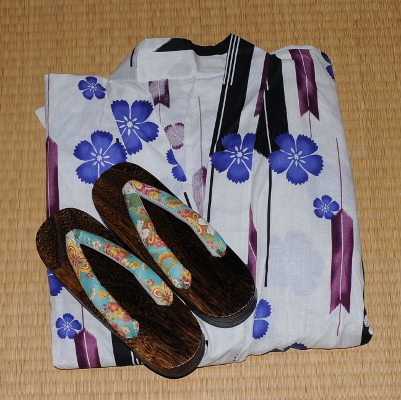
Poster for MitsukoshiAnd this is how I came into the possession of 12 of her old kimono. Not expensive, formal silk kimono, of course, but rather casual ones from cotton and similar light fabrics, mostly intended for summer. I have made it clear that I cannot wear them –  besides having the wrong body shape, she is much smaller than me – but she says it’s fine if I cut them up and use the fabrics to make something else. So, I have made rough plans for one jinbei, one pair of summer pants, three dresses, and two jackets. And one lovely summer yukata I will keep for myself, even though it is a bit on the small side. The rest I am not sure about, there is one with a really strong pattern that should be kept intact if possible.

So far my plans. I have talked about my unexpected gifts to my English students, and they were quite excited about it. So, I invited one of them over last week to have a look at the kimono and maybe give advice on what to do with them. And when I was unpacking them one by one and put them in front of here, there was one she went all crazy about: “Oh, how beautiful!” She was so excited about it, that I asked her to try it on – and when it fit, I gave it to her. That’s the nice thing about kimono: As long as the fabric is holding up, age does not matter at all. In fact, many expensive kimono are passed on through generations of women! Size does not matter much either, so it really boils down to whether you like the pattern and color or not.

And with one simple act, I have made two of my friends happy: By taking from the one, and by giving to the other. If life were so simple all the time!

Efficient

Last Saturday I went out with my friend to see this year’s Kyotographie Photo Exhibition. It was spread out over the inner city, so we had a lot of walking to do all day and in the evening we were both exhausted…

Anyway, on our way to one of the venues, there were lots of fire engines going in the same direction, and we noticed all of a sudden six or seven helicopters hovering over the part of the city we were heading towards. And then, we saw the smoke.

A huge sand-colored cloud of smoke blew through the streets and hung over the low buildings of Gion. Nearby Shijo street – one of the main thoroughfares – was closed for all traffic, there were at least 15 fire engines, two firemen were perched on a long ladder to get an overview, and a few others were sitting on a nearby roof as well. However, the main action happened somewhere deep inside the narrow side streets of Gion. At first we thought that one of the temples was burning, but we asked a policeman and he said that it was just a normal house.

In Japan, fires are extremely dangerous. Even nowadays, many private homes are still made of wood, and in a typical modern residential area, the houses sit next to each other almost touching wall-to-wall. One of the first new words I learnt when moving into the old guest house was “kaji”, the Japanese word for blazing fire. Especially old houses burn very quickly, often, there is no time to attempt putting it out yourself. It’s best and safest for everyone just to get out of the building, alert the neighbours and call the firefighters.

The ones of Kyoto must be especially well-trained and efficient, because when we passed by the spot on our way back less than an hour later, everything was over already. When I checked the paper later that night, it said that in total six houses were damaged, but nobody got hurt. The fire had started in a restaurant – a quite famous one to boot with three Michelin stars – when they had closed after lunch service.

Equally efficient were the media (immediately present with camera teams on nearby buildings and in the helicopters I mentioned), as well as google. When I looked for the restaurant later that night on google maps it said already “Permanently Closed”.

Izumi Miyazaki

Izumi Miyazaki
copyright: Izumi Miyzaki

Izumi Miyazaki, born 1994 in Yamanashi Prefecture, is a Japanese photographer. Her works are colorful self portraits amongst every day items – all with a surreal twist.

Izumi Miyazaki
copyright: Izumi Miyazaki

She started with photography in a highschool photo club, and later went to Musashino Art University in Tokyo, graduating with a major in Imaging Arts in 2016. Already during her student days, she took surreal pictures and posted them online on Tumblr, where she was almost an instant hit. Her first solo show Cute & Cruel, was in Luxembourg 2016, her first solo show in Japan followed (stand-in, in Tokyo, 2016). She was also invited to participate in the group show Give Me Yesterday (Milan, 2016–17), and her work is one of 40 photographers featured in the book Girl on Girl: Art and Photography in the Age of the Female Gaze by Charlotte Jansen.

Izumi Miyazaki
copyright: Izumi Miyazaki

As Izumi Miyazaki says in an interview with CNN Style, she never liked to be catalogued or categorized, and doesn’t mind to be on her own. Her work is carefully crafted and designed, but even though she is the only model in her photos, she feels as if that person were somebody else. Again, when asked for her style, she says that she doesn’t really have one, only tries to work inthe moment. However, she hopes that the viewers approach her photos with an open mind.

Izumi Miyazaki
copyright: Izumi Miyazaki

Links:
Many more of Izumi Miyazaki’s surreal photos can be found on her Tumblr page.
The full CNN interview mentioned above.
Get the book Girl on Girl from amazon.

Izumi Miyazaki
copyright: Izumi Miyazaki

Philosophy

A friend of mine has come back to Kyoto for two weeks or so, and we spent yesterday afternoon strolling around the Arashiyama and Higashiyama mountains of Kyoto. It is always nice talking to him, mostly because we learn from and challenge each other. He, as another mathematician, is also very observant, something I’m not used to anymore in my other friends.

For example, he said that when we were walking around at Higashiyama, that he could feel that this was “my” part of town; he said that I was “walking differently”. I thought about this and indeed, I felt more relaxed there than in Arashiyama where we had gone before. Altogether, I have been to Arashiyama only three or four times. It is quite far from my place (about an hour away, no matter how I’d go there) and it is always very crowded, which I don’t like at any time – it stresses me. This is probably because the interesting area of Arashiyama (especially to the east of Togetsukyo bridge) is rather small, and there are not many other routes where you could avoid all the people. And then I also wanted to see the bamboo forest, which is essentially only a single long path winding beneath huge bamboo trees (?), so again, no place to avoid all the selfie-shooting people. At least we went during the week…

We had matcha and chocolate at my friend’s cafe, and dinner at a tiny little fish restaurant. And for some reason, we started talking about the purpose of life. I am against the motion that everybody has a specific, earth-moving purpose in life, like so many people seem to think. What if not – that doesn’t mean life is wasted. Maybe somebody’s purpose is simply to drive a bus in a tiny town for 25 years. What’s wrong with that? Besides, if there’s that huge purpose you’ve made out for yourself – what happens if you can’t achieve it for whatever reason? Can you change your purpose? I prefer John Lennon’s take on this:

“Life is what happens to you while you’re busy making other plans.”

We also talked about the funny ways life takes sometimes. He says he goes with the flow, and that he thinks I’m trying to fight it. I’m not sure he is right. I do like to be in control, and I always liked to do my own thing, but at the same time, the first truly independent and conscious decision I made was to give up academia and settle in Japan. Before that, I did the things as they showed up, sometimes put in front of me by other people. Maybe I’m now trying to compensate for that former lack of control? I’m not sure. Japan has changed me, I am much more self-confident now than I was ever before. I cannot change all the circumstances, but I still try to do my own thing.

And he said: “I’m not sure that you are where you should be and that you’re doing what you should be doing.” Actually, I’m not sure about the latter either. I could pour much more effort into things, but something is indeed holding me back, and I don’t know what it is. However, I do believe that at least right now, Japan indeed is the place to be for me. I feel safe here, a very peaceful feeling. Probably my personal growth spurt has something to do with that.