Friends

Japan is a dangerous country, it has this tendency of sucking you in and never letting you go again. This week alone I have heard from two friends whom I have met at my old house and who want to see me again. One of them returns to Japan every two years or so for a month or two; the other was my housemate at Ebisu’s, who returned to his country after five years in Japan. Both of them are in Kyoto right now, and I think both of them will keep returning here for the rest of their lives, unless they finally give in and settle here for good. I am curious to see them again, and as they will stay for at least a month, there will be ample opportunity to catch up.

Another friend of mine – who had stayed in Kobe for a year – has also returned to Japan, but only for a two-week business trip. As he is Austrian, and he had mentioned that he would travel with an essentially empty suitcase, I took the liberty of giving him a long list of things that are hard or impossible to get in Japan. The list of goodies he unpacked this morning on my kitchen table comprised the usual jar of Nutella and other sweets; special bakery goods from Austria including Lebkuchen, a type of gingerbread; and some odds and ends like my favourite Austrian wine, a small bottle of Kernoel (pumpkin seed oil), and other delicacies essential for (Austrian) cooking. I had a hard time deciding which sweets to eat first – and I settled on a bit of Lebkuchen, it’s the right season, after all.

And then, when I was already elated about all the nice things I had received and was busy putting them away, a postman brought a large and heavy parcel from another friend in Austria, with two more bottles of my favourite wine, and three enormous jars of Nutella. And a very sweet letter on top of it.

I am an intrGoodies from Austriaovert, I have troubles meeting people, and being surrounded by too many strangers – at parties for example – stresses me out. As such a person, when living abroad where even basic communication is difficult, it is easy to feel alone and unloved sometimes.

Not today though. Thank you so much. I love you too!

Extra

Yesterday I spent a very long day in Osaka. A friend of mine and me did another friend of mine a favour, and this is how we two ended up as extras in a Japanese movie…

movie camera iconI am not sure whether I am allowed to reveal which movie it is, but it is the film adaptation of a well-known Japanese novel (so, not another remake of Godzilla). The scenes that were filmed yesterday required a large audience of about 100 non-Japanese, and this is how my friend and I got considered in the first place.

Getting the job was relatively straightforward: Our friend gave us an internet link where we signed up, we received a request for a photo, and afterwards a phone call telling us that we had been chosen and were expected in Osaka on Tuesday morning. About half the people present came through this route, but the other half had apparently signed up with some film or model agency; it seems that acting or modeling is one of the few professions that foreigners can do in Japan that requires no knowledge of Japanese and is still quite well paid.

The whole experience was interesting. We met at about 8 am in Osaka and the film crew brought us to the filming location, a very nicely decorated reception room with high ceiling and large windows in an otherwise empty building, which was designated either for renovation or demolition. The plan was to shoot three different scenes where we were to watch the performance of different Japanese arts and act as the enraptured spectators. So far so good.

In the course of yesterday, I have learnt quite a bit about how to make a movie. For once, I was not aware that every different camera angle requires a repetition of the whole scene, from beginning to end. One performance was shot from three different angles, so it had to be done three times from beginning to end, plus one time for a detailed close up, plus two extra repetitions because something went wrong and somebody did not turn off his phone. Not to forget the rehearsal in the very beginning. Hence, what will end up in the movie as a well-cut sequence of a few minutes at most, required us to stand there on the same spot for 1.5 hours.

I was surprised that nobody really cared about our outfit or makeup etc. While the performers were professionally made up and styled, and their clothes received a quick brush or tuck between each take, all we had was the instruction to come in “formal clothing”, which, to my surprise, some people took rather loosely. After all, we were just people somewhere in the back, warm bodies to fill the void.

I was also unprepared for the extreme wait between the scenes, while the room was set up again for the next shot. We could relax in a nearby room, but unless you brought something with you to read or do, nobody cared what you did between the shots, as long as you were available when they needed you. Tea and coffee were provided, as well as cup noodles and senbei crackers as afternoon snack, but besides that you were on your own. We also had to be very quiet at times because apparently, something else was filmed, or at least set up, at those times. And if you were not needed for a particular scene, you had to sit through that one as well.

Interestingly, although the waiting time was considerable, people did not talk much to each other. Some of those that had come through an agency knew each other and quickly formed groups, but the others remained alone, staring into space or onto their mobiles. To be honest though, with a single exception, there was nobody there I would have liked to get to know more closely anyway.

Altogether the experience took 13 hours (including travel time to Osaka); I had to be there for two of the scenes which in total took less than 2 hours, and the final end product will probably be not more than 5-10 minutes overall. We received a bento box for lunch and dinner, a compensation for travel expenses, and a small souvenir; and I took home an important realisation: I am not patient enough to be a movie star…

Tidying

As you know, I have received all my things from Europe – 42 boxes – a month ago. Today, I finally finished tidying and putting away and cleaning things! All my rooms are clean again, the things I don’t want out at this point are put away, and I even had some energy left to go through some of the paperwork I brought and which needed to be sorted.

What surprised me was that, with one exception, I will not need any new storage items. Although the apartment is small and the layout seems a bit unpractical, I could put away all of my things somewhere. Especially the kitchen cabinets proved to be quite large, there is even one which is still empty (okay, this one is so high that I can’t reach it anyway, but still). Some of the things I have no use for right now have been stored away in those large closets that are usually used for futons, but everything I need is accessible rightaway.

Interestingly, I have not regretted bringing anything, although I regret throwing so many things away in Germany. I should not have sold all my wine glasses or given away all my vases; and let’s not start talking about my hundreds of books that went to the library please…

High bookshelf in Vienna National LibraryThe books that remain are the only thing I have not touched yet. They fill six boxes that are piled in one corner of my living room, and I have not yet decided where to put them. I always wanted a large library, but this apartment does not lend itself to it. The only three walls that would be suitable for a room high bookshelf are in my bedroom and in my designated guest room, and just in case there is an earthquake, it’s probably better not to get buried under books. Hence, I have to find another solution. A friend of mine gave me an idea, but I’ll still have to see if this is feasible. In any case, until I become a real rich person who can afford a decent library in a decent place, I shall dream of – or shall I say: drool over – The Walker Library of the History of Human Imagination

Hobby

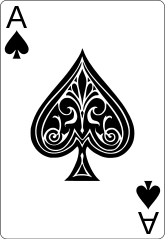
The Ace of SpadesBetween all the work for setting up the company and moving and unpacking, I had time to pick up a new hobby: For the last two months or so I have been playing Contract Bridge. For all of you who don’t know what that is: It is a card game for four players – playing together in two pairs across the table – originally adopted from a Russian game by the British.

What is interesting about it is that it is not so much about luck and not at all about bluffing your way through it, but that all four players have a rough idea about the hands of the others and from there, with elaborate guesswork, each pair tries to take more “tricks” than the other. In the beginning you have to say how many tricks you think you can win, and if you can, you get a number of points, and if you lose, your opponents get points, very roughly speaking.

I find the game intriguing, there are many rules how to tell your partner about your hand, and how far to go in this “bidding” step. It is rather difficult and overwhelming at the beginning, and there are lots of exceptions and special meanings to certain bids; and even playing a certain card later on may tell your partner something about your hand and help him in deciding how to play himself.

The group I am playing with is essentially a bunch of (mostly) old Japanese ladies, who meet in a home in my neighbourhood. Many of them have lived abroad, in countries as different as Canada, the US, China, Myanmar, Australia … and all of them are decidedly un-Japanese in their behaviour and attitude. They are loud and boisterous and funny and open and although I am an introvert and don’t cherish being amongst people very much, I feel very welcome and accepted.

I think I was allowed to actually play the third time I came; I have now played once a week for about two months, and I feel like an idiot, as there is so much to know and learn and I keep forgetting stuff. Still, although I make many mistakes, my partners are very polite and kind and keep praising my efforts a lot. Hence, I shall keep going for the time being and see how long I can learn something. So far, I’m having great fun.

Cynical

I went to Osaka today to meet a friend of mine I hadn’t seen in a while. He’s also Austrian and has been in Japan for 5 years now. It was very interesting to see him again, I remembered him as a lighthearted and fun person, and while he is still outgoing and philosophical in all the wrong places, he has changed quite a bit.

He seemed very tired and exhausted; the last time I met him he was working for a brand new little Japanese start-up, but because there were discrepancies in their views on how to conduct work (something much more grave than simply working hours), he quit. Since then he has opened up his own company with quite a lofty idea behind it, but because this is not a product that can be sold, but is more a way to build a community, he has troubles getting people interested.

All these experiences have made him quite cynical, and he even admits that. He told me a few stories, and a large complaint of his is that the Japanese are not friendly at all. Apparently, in a business setting, they expect you to fit in perfectly, without making any mistakes. This is of course impossible, and the fact that nobody tells you that you have just overstepped a line is not conducive to learning how to do it better the next time.

As to my objection that as an obvious – meaning: non-Asian – foreigner, there is always a certain bonus you have and people must realise that you cannot understand every single nuance, he said that was not true. The Japanese accept a number of mistakes, but if you have made one too many, they simply cut you off without further explanation or apology. Yes, even if that means they are losing business.

He is right, I have seen that with the very first real estate agent I went to this year when I looked for a new apartment. I am not aware of a mistake on my side (other than refusing to get a mobile phone), but at some point he apparently thought I was more trouble than I was worth and he stopped responding to my inquiries altogether.

I am very sad that my friend has become so cynical and negative, and I hope that’s just a phase and that it will be better once he finds acceptance with his new line of work. But as there is another friend of mine who has had similar experiences as a foreigner in Japan, I wonder what I will have to say once I have been here as long as they have. I have been a cynical asshole for long enough, I would really not like having to go back to that stage of my life…

Autumn

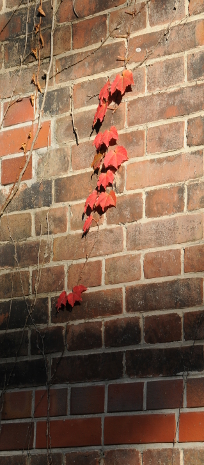
red ivy leaves on a brick wallFinally, autumn has arrived. Although during the days we still have around 20 degrees, the nights are very cool. Today was the first time I felt cold when I opened my windows in the morning, and indeed, it was only around 10 degrees. It is still too warm for the koyo autumn colours, which are mainly made up of the momiji maple trees; but this last part of autumn will come soon. Usually it is towards mid or end of November, but this year it might be earlier, as the temperatures have not been that high all through the year.

In the weekend I finally went out to explore the part of Higashiyama that is east of my house. Unfortunately it is quite residential, and there are no nice shrines where I could just sit and write like there were near my old house. I have found a few small temples though which I will revisit in a few weeks to take pictures of the koyo. For today, you get only a single photo, which was taken not far from my house.

Insulation

Since my boxes arrived 19 days ago, I have been steadily unpacking and putting stuff away. By now I have whittled down the amount of boxes to 7 – all of them containing books – and the amount of extra stacks to… well, not too many. As the books will have to wait for a little while longer, and the stacks contain rather daunting papers, I took a break to do some more home improvement.

outlets for air conditioningIn all three rooms in my apartment where there are tatami, there are also interesting outlets in the walls, covered with plastic. If you unscrew that cover, you will see a hole in the wall leading out to the respective balcony. The hole is lined with plastic all the way, with another cover that can be opened on the outside. As I have one myself (courtesy of the previous occupant of my apartment) I assume that these are holes to more easily connect the air conditioners that stand on almost every balcony in my apartment complex. After all, the walls here are concrete, and it kind of defies the idea of an airco (which is here also used as heating in the winter) to need a window half open to use it.

In any case, the picture I took above shows the problem – the hole is empty. There is no insulation inside whatsoever. As I have been bravely unpacking however, I have lots of styrofoam and similar stuff left over, which I reused to fill up the three holes in my walls. Yes, you are right, it will not make any kind of difference with respect to the temperature in my house in winter, but surely, there must be some kind of placebo effect here as well. I for sure already feel much warmer!

Komai House

A few weeks ago, I have once again indulged my love for old houses by visiting Komai House, one of the designated cultural properties of Kyoto. It was built in 1927, in the second year of Showa, by the American William M. Vories, who was a bit of everything: educator, missionary, entrepreneur, and architect. In Japan, he was mainly working as the latter and his style was some sort of fusion between Western and Japanese style, which was very popular in that time. Komai house - view from the gardenThe owner of the house was Taku Komai, a Japanese biologist and geneticist, who was working for Kyoto University. He only died in 1972, and although the house was used by the American occupation forces after WWII, and somewhat remodeled by them, the building is in almost original state.

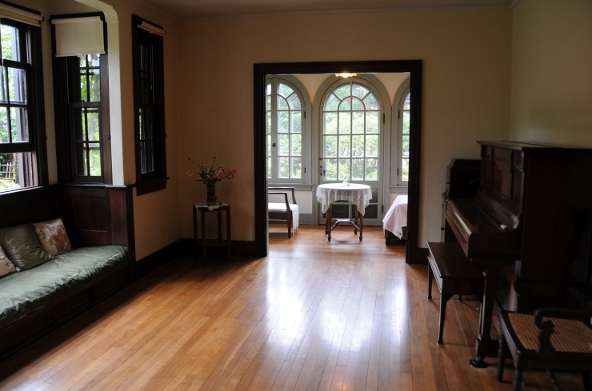
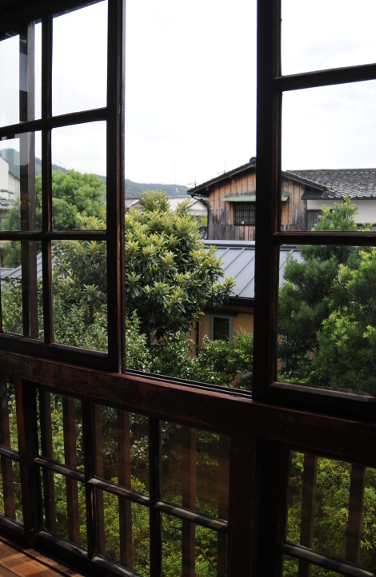
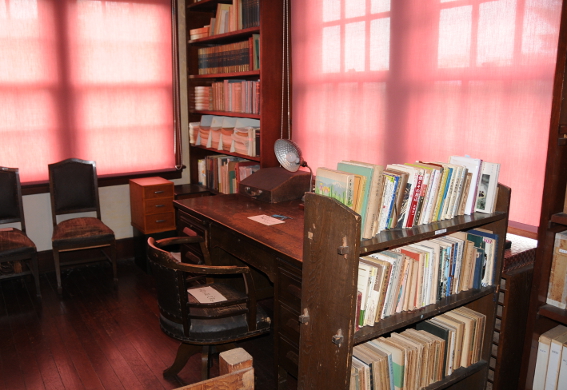
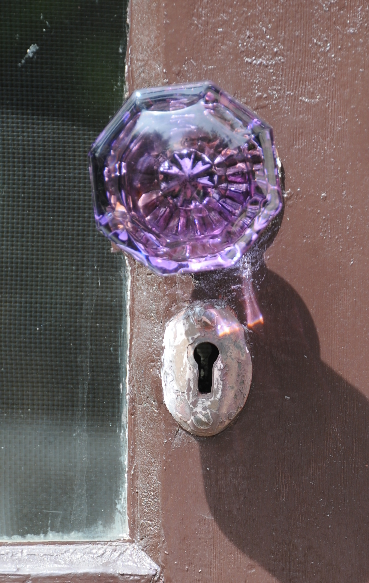
The house has two floors; on the ground floor are the public rooms: livingroom and diningroom, as well as a tatami room in front. There is also the main bathroom and the kitchen, and, unusual for a Japanese house, a large terrace leading out into the garden. livingroomOn the second floor are the private rooms: guest room and bedroom, formerly with tatami, and an attached verandah, formerly a balcony, from which you can see the neighbour’s house. This neighbour was also a professor from Kyoto university; in fact, the whole neighbourhood was some sort of professor’s village since it was, and still is, situated conveniently close to the university. View from the verandahOn the second floor also is the professor’s study, and on the left hand side, there is a large bookcase, filled with books about genetics in many languages from the obvious Japanese, to English, French, and even German. The red blinds are not original, they are used to protect the books, which are still in their original place where the late professor put them, from direct sunlight. Study with deskThe house is quite large, with three rooms upstairs and four downstairs, and all of them have a good size, even by modern standards. Additionally, there is a large annex building, which was used as a kind of student’s dorm – at that time, professors were obliged to take really good care of their students, including providing lodgings at their own houses! And then, there is also a greenhouse, which Komai had built because Darwin also had one. It was used as a cafe at some point. GreenhouseThe garden is quite large too, and when the house was built, the surroundings must have been very peaceful. You can even see directly to the daimonji hill, it must be fantastic watching the fire from so close. However, what I liked best about the house were the little details, testimony to the architect’s good eye. There are arched windows with stained glass, roof tiles were used as ornament in the balustrade at the entrance, and, especially cute: door knobs from purple crystal. Doorknob from purple crystalThe house is lovely, and as I said, in a very good state. One could move in immediately, it has a very pleasant, almost modern feel to it. Yes I know… hey, a girl can dream, no?

Strandbeest

This weekend, from the 15th to the 18th of October, the Kyoto International Art and Film Festival takes place, only the second edition of the festival which has been created to balance all the things that happen in Tokyo. If you are interested and in Kyoto, the schedule is here: http://2015.kiff.kyoto.jp/en/schedule/

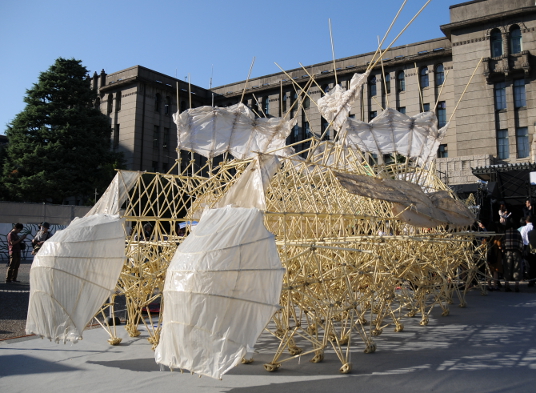
Like many of these things here where you already have to know about them to find them online, I have stumbled upon this festival by pure chance, yesterday, when I was in town. There is a wonderful exhibition on the square in front of City Hall, in fact this is a mixture of art and science: Theo Jansen’s Strandbeest. Theo Jansen is a Dutch artist cum scientist who builds large, autonomously moving mechanisms which he calls Strandbeesten, Beachbeasts. Those animals are propelled by the wind and he sets them free on Dutch beaches where they may wander around as long as the wind is blowing, and yes, it is blowing there very long, hard, and often… Strandbeest in KyotoI came across the strandbeesten about 4 years ago when I was on summer holiday in Japan and I watched TV at a friend’s place. The interesting thing is that the whole mechanism moves purely kinetic, the legs are constructed in a way that there is a single degree of freedom, and they are essentially only folding over to create the movement. Think of a simple folding rule with only two parts – if you hold it at one end and then gently swing it left and right, the lower part will move as well, but only in a very specific way. Anyway, I bought a small assembly kit online at that time and stunned the students in my class on folding with this odd thing that moves. I was very happy to see a real one for once, and they move quite as beautifully – although you need quite a bit of wind…

If you want more information, including a video with several of the strandbeesten, here is Theo Jansen’s homepage:
http://www.strandbeest.com/index.php
and here is his youtube channel:
https://www.youtube.com/user/strandbeestfilm

And no, I’m not getting anything for this advertisement – I’m just a fangirl. And I think I’ll be off playing with mine for a while… 😉

Otsu Matsuri

Last Sunday I spent in Otsu, the capital of Shiga province, which lies on the shore of Lake Biwa, maybe 30 minutes east of Kyoto. Otsu, for a short period in the 7th century the capital of Japan, is still home to the largest harbour on Lake Biwa, which itself is the largest freshwater lake in Japan. However, the city is rather stretched out along the shore, and thus has the feeling of a little town despite its 350.000 inhabitants. There are a number of famous sites there, but I did not do any sightseeing this time.

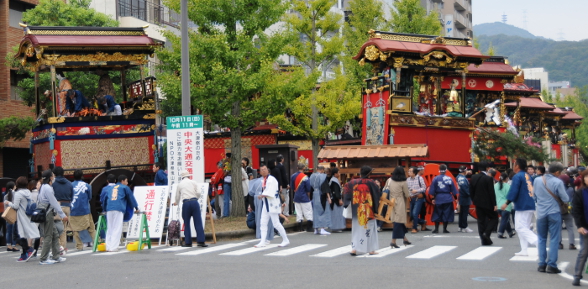
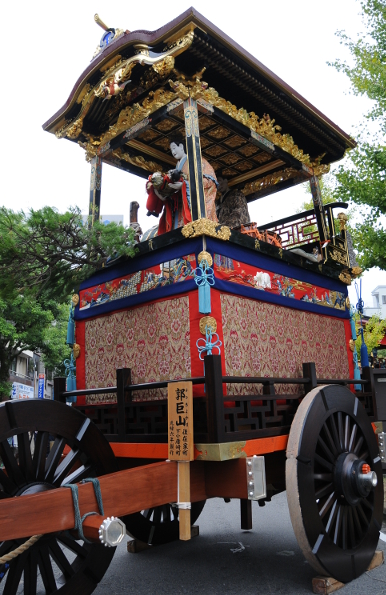
Instead I went to enjoy Otsu matsuri with some friends of mine. Otsu matsuri has its origins at the beginning of the Edo period at the turn of the 17th century; the first time it was officially recorded was 1624. It is similar to Gion matsuri in that there are large floats that are paraded through the city, but there are also differences. All floats of Otsu MatsuriThe hikiyama of Otsu matsuri are about two storeys high, that’s somewhere between the size of the yama and hoko floats of Gion, and they are similarly decorated with beautiful tapestries on the outside. They only have three large wheels, which makes them more easy to manoeuvre by the people who are pulling them – yes, I have seen some women doing that as well!

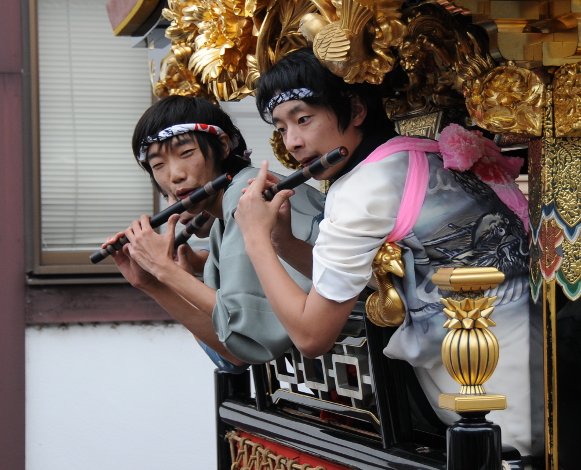
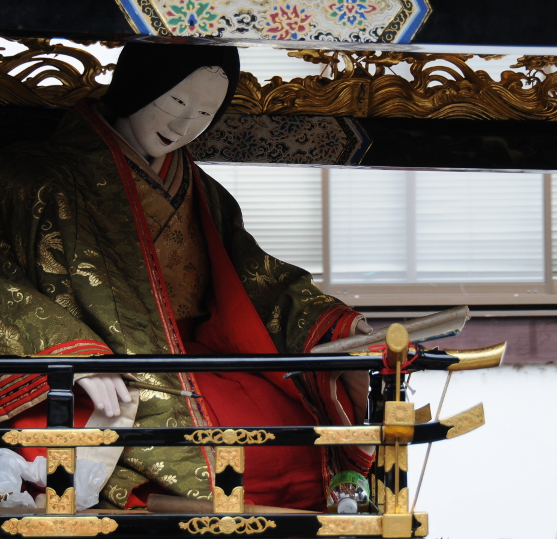
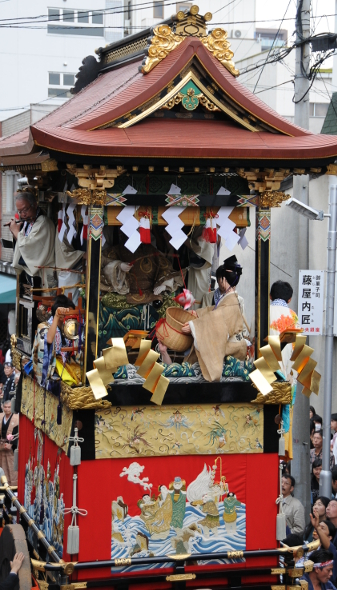
A hikiyamaOn the second floor of the hikiyama, which can be reached by a staircase at the inside, only men are allowed though. Traditionally, only the first sons of families that lived around the storage house of each hikiyama were allowed to take part in the matsuri, but this has changed recently, and other young men may now participate too. When the floats are moving, they play a tune with flutes and drums that is similar to the one at Gion matsuri – to my ears, at least.Young men playing flutesThe most interesting part of the 13 hikiyama however, are the wooden displays on the second floor. Those are karakuri ningyō, mechanical dolls, and they depict, or rather, act out, a scene from a well-known fairytale or story, mostl of them originating in China.Saikyo Sakura Tanuki Yama One of the exceptions is a float with a doll representing Murasaki Shikibu, the authoress of the famous Tale of Genji. It is said that it was in Otsu – more precisely in Ishiyama Temple – where she began writing on her novel some time in the beginning of the 11th century. Murasaki ShikibuWe were invited to one of the houses that “own” one of the floats, and we could go to a second floor balcony and watch the parade from there, meaning that we were eye-to-eye with the dolls and the men playing the instruments. From such an elevated postion you can see that the dolls were operated manually as the men crouched down, but that did not take away the beauty of the performance. I especially liked the one depicting how to catch a Tai (a lucky fish of golden colour), and because each performance was repeated twice in front of our balcony, I could even catch the decisive moment on camera. Catching a fish