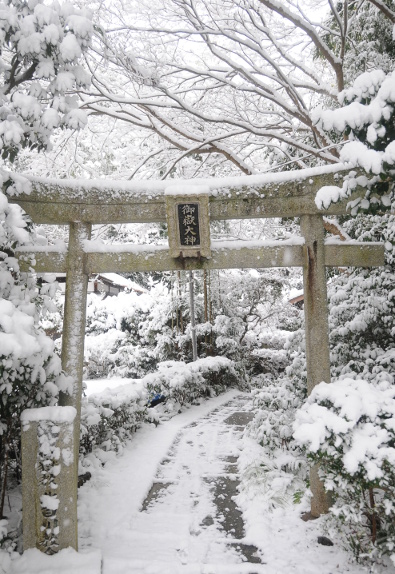
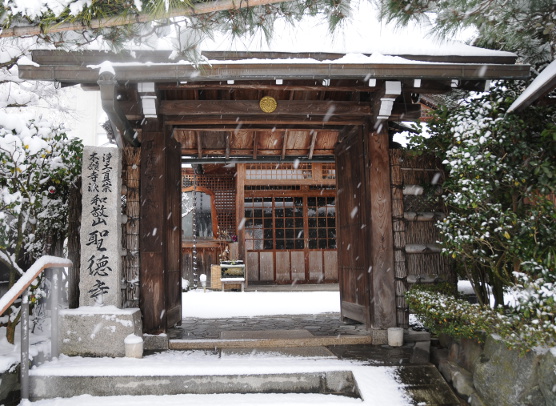
What a wonderful weekend! It was snowing for the first time this winter! And because it is quite cold at the moment, there is still snow in Kyoto today – I LOVE IT!
It started snowing Saturday afternoon, and on Sunday morning, when it was snowing quite heavily, I went out for some two hours or so, and then had breakfast in a cafe (something I rarely do) before going home again. I did not take that many pictures because it was mainly gray anyway, but I’m happy to share some of the better ones.
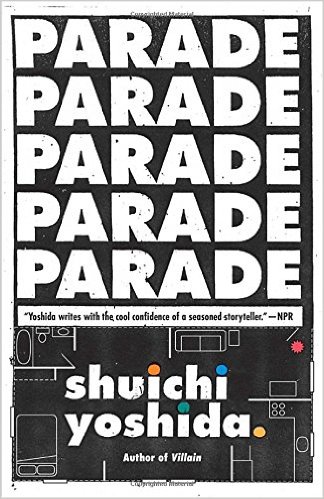
In a small apartment in Tokyo live four young people in their twenties: Ryosuke, a student whose favourite pastime is to wash his car. Kotomi, who faithfully waits in front of the telephone for her lover to call. Mirai, manager of an import company who spends her nights getting drunk in gay bars. Naoki, who works for a film distributor and goes running for stress release. Although they live together in rather cramped conditions with boys and girls sharing one bedroom respectively, each of them more or less remains to themselves.
Then Satoru is brought home by Mirai, and the 18-year-old who “works in the night” stays on the couch in the living room. His sudden appearance promptly upsets the fragile balance of the roommates, and cracks begin to show…
The book is written in five parts – one from the viewpoint of each protagonist. Although the story stays chronological, this change of viewpoint makes it feel a bit fragmented. Also the fact that the four roommates are “good at playing friends” without actually being so – as Satoru observes – did not make me care for the characters or draw me into the story. And the end – a shocking revelation about one of the five, which was shrugged away and covered up by the others – left me very dissatisfied. This can’t be how young people live these days?
Shuichi Yoshida was born in Nagasaki in 1968. He began writing very early, and received the Bungakukai Prize for New Writers in 1997, and the prestigious Akutagawa prize in 2002. Today, he has published 15 novels and 11 collections of short stories, however, only two of his novels have as yet been translated into English. Parade was his first novel, published in 2002 and translated in 2014.
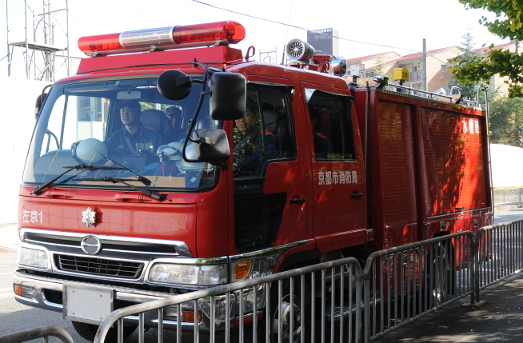
As I mentioned fire insurance in my last post, I thought I would continue in the same vein with telling you about my latest unexpected visitor from the local fire department.
Last week or so, a young man in dark blue uniform knocked on my door and started to talk rapidly, in Japanese, of course. On seeing my bewildered look, he paused to think and came up with the most stereotypical question ever: Do you have a Japanese husband? (And where the hell is he?? – okay, he didn’t say that out loud but I’m sure he thought it.) He understood quickly that that question hadn’t gone down very well, so he resorted to use his mobile phone as interpreter, and I finally found out what he wanted: He was here to inspect my apartment with respect to fire safety.
Now I know that interestingly, I only need two fire alarms, one in my bedroom, and the other one in my kitchen. Probably two alarms are enough because my apartment is that small, it may be different for larger houses. Lo and behold: I am almost safe because I already have two fire alarms – thanks to whomever lived here before – and they are even working!
I say I’m almost safe because while one of the alarms is indeed in my bedroom, the other one is not in my kitchen but in my office. Even though the firefighter urged me to move it to my kitchen, in my office it will stay. That’s because I think that a cable fire in my office with all the electrical appliances and paperwork around will be, if not more likely, then at least more dangerous than any fire in a kitchen that I hardly use. Besides, the kitchen is directly next to my bedroom where surely that fire alarm would pick up the smoke or heat of a fire, so I am feeling safe in any case.
Do you realise that I have been living in this apartment for almost two years already? I did not, at least not until I received a letter from my fire insurance telling me that I had to renew their contract. They recommended me to visit the agency that set up the insurance contract in the first place, and get everything settled.
So, that’s what I did today, also because I thought something needed to be done with respect to my rental contract. I had to wait a bit for an agent that spoke English (the one I made the contract with is long gone) but then everything went smoothly. I was told that I could simply transfer the money for the next two years (15.000 YEN) to renew my insurance. Then the agent called my landlord to tell him that I wanted to extend my contract, and since my landlord agreed on the spot, that’s all that needed to be done. There are no contract renewal fees, there will be no raise in rent (for now at least), and since I will not even get a new contract with a new expiration date so to speak, it seems that I can stay in this apartment for an unlimited time – or at least until I move out on my own accord.
Celebrations are in order!
The fun thing about this is that although I now have a permanent home, it’s far from finished. There are still lamps missing all over the place, and the non-tatami part of my livingroom is still empty, lacking all furniture. Honestly, I enjoy all that free space; and since I have always loved sitting on the floor, a few cushions on the tatami will do just fine. That’s one of the good things of living alone – you’re completely free to choose your environment.
Speaking of which, I have finally found a lamp for my bedside table… umm… futonside piece of tatami. It took me ages, but I gave myself a nice Christmas present, and I think it is perfect, exactly what I wanted. The base is black wood (hard to see in the picture), and the lamp shade is made from thin, twisted bamboo slats. It is wonderful, and now I can finally announce that: my bedroom is completely finished. Give or take a picture or two on the wall…
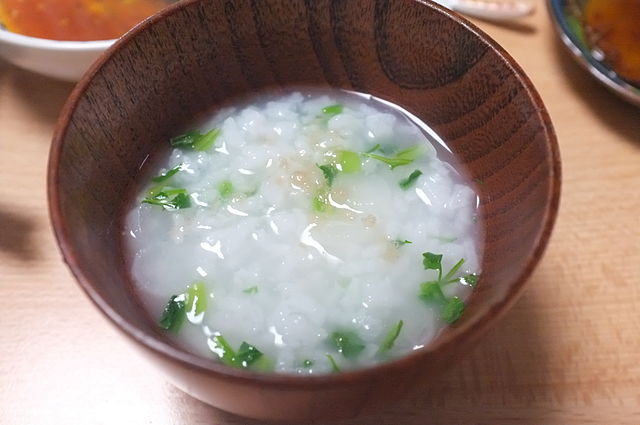
January 7th, also called jinjitsu, traditionally marks the last day of the New Year’s festivities, and of course the Japanese celebrate it with special food. In this case, they eat nanakusa gayu – seven herb soup – which gives an alternative name to this day: nanakusa no sekku, the Festival of Seven Herbs. Eating nanakusa gayu is supposed to promote health during winter, and give one a long life, of course.
Besides that, after all the gluttony of New Year’s feasting, nanakusa gayu is also meant to rest the stomach a bit, and indeed, the soup is based on okayu, a simple, soft, and very bland rice porridge that people usually eat when they are sick. They then add the following seven herbs to the soup: water dropwort (seri), shepherd’s purse (nazuna), cudweed (hahagokusa), chickweed (hakobe), nipplewort (koonitabiraku), turnip (kabu), and radish (daikon).
Of course, it is now in the middle of winter, and these herbs are not easy to be gathered outside; note that in ancient times however, the festival would have been on the seventh day of the first month according to the lunar calendar, that is, about two months later than today. In any case, the modern Japanese do not forage outside, but rather in their nearest supermarket, where nanakusa can be bought in conveniently sized packs – or even, as I found out, as a dried mixture or in reheatable plastic bags complete with the finished rice porridge.
Even though my cooking skills are not exemplary, I did not stoop that low, but indeed bought the smallest pack of fresh nanakusa I could find and made my own rice porridge. The result was rather bland to be honest, but the tastes of the different herbs did come out very well this way.
Below is the recipe I used to make the nanakusa gayu from scratch. I will not post it in my washoku category because the herbs are pretty much impossible to find outside of Japan. However, if you feel like trying it anyway, you can use other herbs that you like or can find.
Recipe for nanakusa gayu, seven herbs rice porridge (for two people)
– 2 cups rice (Japanese or risotto rice) – 8 cups water – 1 piece of kelp (optional) – salt Boil the rice with the water and salt until it has a very soft texture. There should still be some water left at the end. (Optional: you can add a piece of kelp to add some flavour, but remove it when the water starts boiling so the taste will not get bitter.)
– 1 cup of nanakusa or seven other herbs (nanakusa are: Japanese water dropwort, shepherd’s purse, cudweed, chickweed, nipplewort, turnip, and radish) Clean the herbs and blanch them in boiling water, then drain, rinse, and cut in small pieces.
When the rice is finished, gently stir in the herbs and let them heat up for a minute or two. (*) That’s it! Enjoy!
(*) Alternatively, you can forgo the blanching if you add the herbs to the rice a bit earlier. I did it that way, and it tasted fine to me, which does not necessarily mean anything though…
It has been a surprisingly mild winter so far, with up to 13 degrees during sunny days in December. Now it is getting cold in earnest though, and I need to use my space heater more extensively. Especially during the night it can get very cold now, and because I hate going to bed in an icy room, I have consolidated right after Christmas:
I have moved both my office (meaning: my laptop and some writing materials) and my futon into my guest room. Well, that’s the part of the living room with the 6 tatami, and as such it is a bit bigger than both my office and my bedroom. However, since it is facing south and the sun is low enough to shine into that room for a good part of the afternoon, it is comparatively warm and easy to heat. And when I go to bed and turn off the heater, it stays warm enough until I can fall asleep – no more cold toes!
So, it feels very much like my first home here in Kyoto: Again, I sit on the floor before my table and wrap myself in a blanket to stay warm. As such, it feels very authentic Japanese – and indeed, I have heard that many families here do the same and try to heat as few rooms as possible. I guess I will live like this for the next 10 weeks or so, during the worst of the winter. I hope it’s over soon…
A New Year has begun, and again, I have tried yet a few more of the hundreds of traditions that surround this time of the year in Japan.
Unfortunately, I have been rather sick since Christmas, so instead of going out for the joya-no-kane ringing of the temple bells, I stayed in bed. I could hear the bells from there, however, and even so, it gives a wonderfully spiritual feeling to the quiet night.
I tried two of the food related Japanese New Year traditions though: On New Year’s Eve, I ate what is called toshi-koshi-soba, year crossing soba. Soba are buckwheat noodles, and depending on who you ask, you will get a different version of their significance in the dish: The noodles are long and symbolise a long life; but they are also easy to cut, so they make you let go of the hardships of the past year; and since the buckwheat plant is very hardy, this is a representation of strength and resilience (something I can definitely use right now).
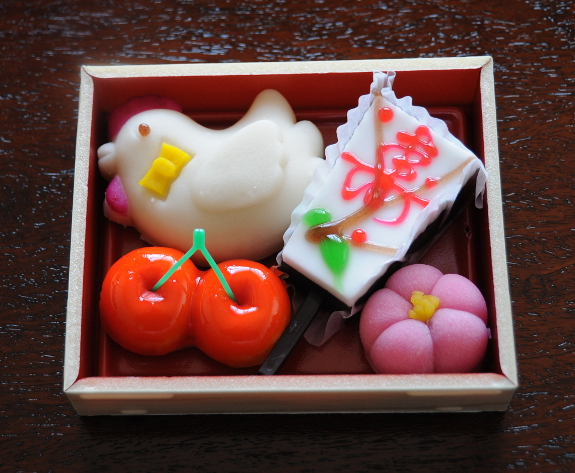
For New Year’s Day, I had bought not a full Osechi menu, but only the sweets that come with it. The rooster is a symbol of this year, and the long flat thing is a paddle that’s used for hanetsuki, a type of old Japanese shuttlecock I have written about before. Interestingly, only half of the pieces had anko in it – I was very happy about that!
Besides that, I bought a rooster for my home. Not a real one of course, but a small ceramic statue that is usually displayed near the entrance. Since I don’t have space there however, I put it in my living room – one of the few things that are decorative there at the moment. It is my first such zodiac animal and according to a friend, you should not reuse an old statue (the zodiac repeats itself every 12 years), but always buy a new one, to attract new good luck to your home, so to speak. Well, this is a nice tradition to start in my home I guess, and it’s neither expensive, nor does it take too much space, so…
This was a very, very busy week for me. From Tuesday on, I had two meetings every single day, effectively meaning that I was out all day, only returning after dark. I usually try to avoid this, one appointment per day is plenty, but in December, there are so many things to be done, so many people to meet one last time in the old year… I took care that I’ll have the next two weeks off, meaning without appointments at least, although I’ll still have to get some work done.
However, I will lay low for the next two weeks, including taking a break from posting here until the end of the year at least. So, even though it’s a day early, I’m shutting down for Christmas in my usual style:
Happy Holidays to everyone! I hope you’ll have a nice time, regardless of your plans.
As mentioned a week or two ago, at the end of November I went to a sake tasting. The person who conducted it was an American, and to be honest, I was slightly disappointed in the beginning. However, he turned out to really know his stuff and he was good at explaining things, so I was very happy in the end.
For example, I learned why on each bottle of sake there are two percentages given: The larger percentage indicates the milling rate, that is, how much the rice used was polished. The idea is that the smaller that milling rate (50% and lower, indicating more polishing), the more smooth the alcohol should taste. I say “should” because it is not always that clear-cut, or maybe my taste buds are not that refined. The smaller percentage indicated the alcohol percentage. Anything between 15 and 20% is standard, but recently, very light sake with around 8% alcohol only are produced as well, mostly to attract female customers.
Also, I have learnt that sake consists of rice, water, mold, and yeast. That means that the usual translation of sake as “rice wine” is misleading, it would be more accurate to speak of “rice beer”. Mostly, special rice is used for brewing, different to the one that is eaten. Interestingly, there is red rice that can be used for making sake. The result is something that has a very interesting taste – like European liqueur with a hint of soy sauce. It also has a distinctive red colour, most normal sake is colourless or at most slightly yellow only.
There are many sake breweries all over Japan, but Hyogo prefecture with the capital Kobe has the most. In Kyoto city, there are a number of sake breweries in Fushimi, and people claim that the water from there is especially good. Unfortunately, there are not many sake breweries that allow visitors, but every now and then, guided tours are offered. I will definitely look for one of those!
Sake brewing season is in winter when the rice has been harvested, from October to March. Over summer, the sake rests, and is afterwards bottled. The year and month of doing this is always noted on the bottle, and sake is best consumed within a month after bottling. It does not seem to age well since even our guide said the taste becomes “different” without going into details. That probably means it is awful for all but the biggest aficionados…
The most interesting information for me was that there are no sake sommeliers – you just drink it as you like it, hot or cold, with food or without… The most popular food to go with sake are tsukemono, Japanese pickles, apparently the equivalent to wine and cheese, or, more appropriately: beer and chips.
By the way: sake as we call it in the west simply means “alcohol” in Japanese, so if you want to order it here, you’ll have to use the term nihon shu, Japanese alcohol.

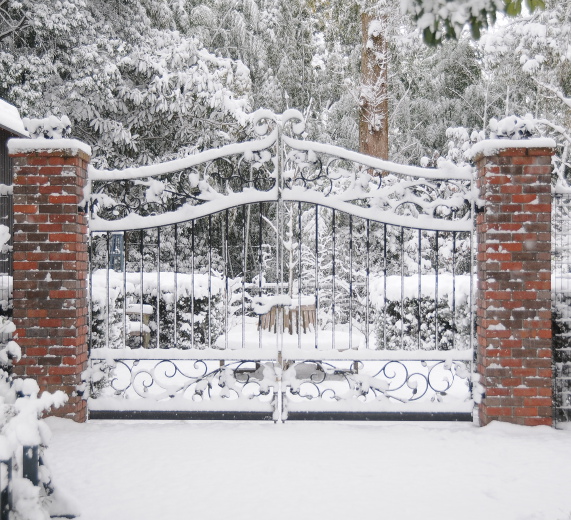 It started snowing Saturday afternoon, and on Sunday morning, when it was snowing quite heavily, I went out for some two hours or so, and then had breakfast in a cafe (something I rarely do) before going home again. I did not take that many pictures because it was mainly gray anyway, but I’m happy to share some of the better ones.