Katsudon

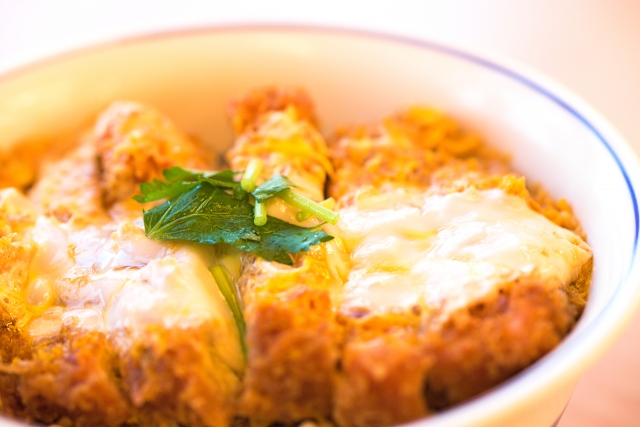
Time for another recipe! And this time, I am so proud: I have learnt how to make katsudon! Katsudon is short for tonkatsu donburi, which essentially is a tonkatsu pork cutlet on top of a bowl of rice. It is easy and quick to make, a kind of Japanese comfort food if you want so.

Bonus for Austrians: Tonkatsu is essentially a very thick Wienerschnitzel, so if you ever have leftover Schnitzels, this is what you can do with it on the next day (if you’re not just making a Schnitzelsemmel, of course).

katsudon

Recipe for Katsudon
(1 person)

– 1 bowl of boiled rice, preferably white

– 1 small onion
– a tablespoon of cooking oil
Cut the onion in half and then in slices. Put the oil into the pan and gently fry the onions.

– 1 tonkatsu (or Schnitzel) fresh or left over, cut in strips
Add to the pan and let it reheat.

– about 100 ml dashi or any kind of soup
– 1 tablespoon soy sauce, 1 tablespoon cooking sake (* optional, but it adds to the flavour if the soup doesn’t have much.)
Add the soup and soy sauce to the pan. The soup should not cover the meat, so you should flip the meat over at some point.

– 1 large egg
Mix the eggs just until the yolks are broken up. Pour them over the meat with the soup and let it set. Ideally, you let the egg cook until it is still a bit slimy, the hot rice in the bowl will do the rest.

Put the rice into a bowl and let the mixture slowly slide out of the pan on top of it. Ideally, the egg is still intact on the rice. (That never happens for me, though.) Garnish with spring onions, chives, or pieces of nori seaweed.

Busy Again!

Whew, I had a busy day yesterday… Much of it was fun though, for once.

Yoshida Hiroshi - Kurobe RiverVery first thing in the morning I visited the Eki Museum in the Isetan Department store next to Kyoto station. The museum is small, but it has excellent exhibitions. Until the end of July, they show early shin-hanga woodblock prints, featuring the works of several artists. However, the exhibition focuses on landscapes, in particular those of Yoshida Hiroda and Kawase Hasui. Most of the times, I only buy postcards at the museum shop, but this time I splurged on a book of prints by Hashiguchi Goyo (my favourite shin-hanga artist) and a somewhat larger reprint of a scene at Kuroba River by Yoshida Hiroda. I bought it because it reminds me of Austria…

Afterwards I went to Nitori, a kind of Japanese version of IKEA. They sell furniture and all sorts of home furnishings… I didn’t buy much, but I love walking through the aisles of such shops wondering “what is THIS thing good for?”

Next stop: bank. I needed to pay expenses for my grandmother’s funeral, which means: international bank transfers… This is always a painful experience with silly questions like “where did you get all that money from?” and “what the hell are you going to use it for?”, which is really not anyone’s business – it’s MY money after all. However, this is the Japanese government’s way of trying to curb money laundering and illegal immigration (the latter by making it hard for immigrants to get money back to their countries) as if those people wouldn’t have a way to forge documents etc. This is not my first time to transfer (my) money abroad, so I came prepared, but the Australian lady on the counter next to mine wasn’t quite so patient. I guess after spending two hours at the bank and getting nothing done because they keep asking for yet another document, I wouldn’t be cool anymore either…

On my way home, I dropped by at Yasaka Shrine. There were no more food stalls unfortunately; the speed with which the Japanese clean up after their festivals always amazes me. Nearby, I bought some cheese cake from a famous bakery. I haven’t tried it yet – it’s really too hot to eat anything – but I’ll have it for breakfast tomorrow.

After a full day out in the heat, I was exhausted. The next three days I have no meetings, but still plenty to do in the office and at home. And then, on Monday, my very own Gion Matsuri, I’m very excited already… I’ll tell you all about that on Tuesday!

Heat Wave

Have I complained about the heat already this year? It’s hot. Very hot, and as you can see, it will stay like this for at least another week: current temperature in KyotoWell, this is quite usual around the time of Gion Matsuri. In fact, during the Gion Ato Matsuri, where the highlight will be next Tuesday, there always seems to be a peak in the heat wave. Speaking of Gion Matsuri: I went last night to the yoiyama, where the inner city changes into a party zone. This year, I wanted to see the kagura – a sort of sacred dance/theatre – performed in Yasaka Shrine. I was not disappointed, even though I came a bit late and had to watch from way far back. Kagura is a bit like Noh when it comes to the masks and costumes, but much more dynamic. I think half of the plays I watched consisted of people mock-fighting each other with swords, and dancing around each other for the main part of the play. And that at more than 30 degrees – the actors must have been exhausted at the end!

I certainly was, so when the performance ended at about 9:30, I decided not to go further to the inner city. Crowds are not something I enjoy, and there were enough food stalls at Yasaka Shrine already to eat my fill. The only thing missing were the baby kasutera that I love so much, but there will be another opportunity to get those, I’m sure.

Chimaki

It is almost time for the highlight of this year’s Gion Matsuri – the main saki parade will be on July 17. Yesterday, today, and tomorrow night are the yoiyama, the nights preceding the festival which means essentially a huge party in the inner city of Kyoto. Not only are people celebrating summer, they also visit the floats that will be shown in the parade on Tuesday to buy souvenirs.

chimaki charmAnd one of those souvenirs are chimaki. “Souvenir” is actually not correct, chimaki are protective charms made from bamboo leaves. People put them up at the entrance of their homes or businesses to ward off evil and to prevent sickness. But only for one year – you’ll have to buy a new one at the next Gion Matsuri!

Traditionally, chimaki were thrown from the large hoko floats into the gathered crowds, but nowadays, they are sold during the days (and nights) of the yoiyama. Every float has their own chimaki, with slightly different properties, but the chimaki of the Naginata hoko, which always leads the saki parade, is considered the most powerful and thus extremely popular among the locals.

The story behind the chimaki is ancient and it goes like this: A long, long time ago, the god Susanoo (the brother of the sun goddess) was travelling in disguise through Japan. One evening, he looked for shelter, but was refused entry to all of the wealthy houses of the town. But when he knocked at poor Somin Shorai’s home, he was welcomed and treated with great respect. When Susanoo left the next day, he gave Somin Shorai a bundle of cogon grass to wear at his waist for protection, which was the origin of today’s chimaki. (*) To this day, some chimaki have an extra red strip of paper attached saying “I am a descendant of Somin Shorai”, which is believed to offer extra protection against evil.

(*) Other versions of the story say he received a small wreath of miscanthus reeds, the origin of today’s chinowa wreath, which is used in the Nagoshi no Harae summer purification.

It seems that these kind of chimaki are a speciality of Kyoto or Gion Matsuri in particular. This may be because Susanoo is the main god enshrined at Yasaka Shrine, for which Gion Matsuri is held. When researching this topic, most of the websites about chimaki pointed to a type of sweet rice dumpling wrapped in bamboo leaves, that are eaten at Boy’s Day in May. But that’s a topic for another weekend post.

PS: I cannot for the heck of it find the photos of my own chimaki at the moment. It’s too late to take new ones, so I’ll add them tomorrow. Thanks for your patience!


Gion Matsuri – Building Phase

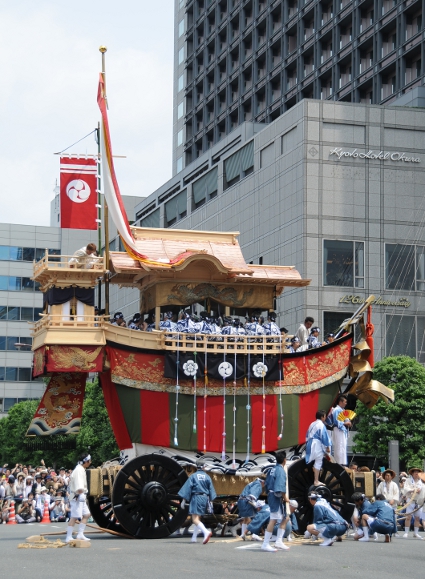
In Kyoto, all through July, there is Gion Matsuri, what I like to call “the biggest party in Japan”. While the main party night is on July 16th, i.e., next Monday, people are getting ready: The yamaboko floats for the saki matsuri parade on July 17th are being built right now.

Today, I went with two of my friends to get a glimpse at the new floats. Building of the biggest ones has already started, but the smaller ones are not out yet. We first had lunch in a tiny restaurant serving excellent sashimi, then we walked around the inner city and watched five of the big floats being built. Although they weigh more than 10 tons, there is not a single nail used anywhere, they are held together by elaborately tied, nay: woven ropes of rice straw. The whole frame is then covered with beautiful tapestries, the originals of which are hundreds of years old and are on display during the three days of yoiyama, starting on July 14th. Below is the building of the Kikusui Hoko, one of the large and popular ones.

Building Kikusui HokoOne of the favourite things for Kyotoites to do during Gion Matsuri is shopping. For yukata and obi, but also towels and new handbags… anything cloth-related, really. So, we went to one of the Yukata shops nearby the Kikusui Hoko to have a look around. Gion Matsuri is the one and only occasion where I am wearing a yukata – a summer kimono – myself, and while I am interested in the patterns, I didn’t really want to buy one: I already have two, and I’m not a big fan of pink flowery clothes.

My brand new Yukata! However, my friends decided on the spot to buy a new yukata for me! Isn’t it lovely? (I know that this is not the correct way to fold it!) I think these are bell flowers and some sort of feathers, a rather common pattern. I got dressed in my new yukata on the spot (and I hope I can remember the correct way of doing so) and could spend the rest of the afternoon looking really nice and mature (according to my friends), and I did get a number of approving looks as well. I also bought a new pair of geta – summer sandals – mostly because the straps on my old ones are broken and cannot be repaired. I am not a huge fan of the new pattern on the geta, but now that they are proper Japanese ones and not “made in China”, I can have them replaced at any time.

So, I had a fantastic afternoon at Gion Matsuri! To my friends (who are reading this): Thank you for spending today with me, thanks for the lunch and the tea, and, of course: Thank you so much for the beautiful yukata!

Dry

rainbow over Kyoto, taken from my windowSince so many of you have asked: I’m fine, don’t worry!

Even though it rained for two weeks straight here in Kyoto city, the only thing affected here were the walking paths on the river banks, which had to be closed throughout. In the western part of Kyoto city, Arashiyama, there were a few mudslides, but nothing serious. Four people did die in more rural areas of Kyoto province, though.

The most affected areas were in Kyushu and around Hiroshima. Even today, there are places nobody could get to so far, so there is serious concern that the death toll will rise beyond the current 150 people or so. Apparently this was the worst rainfall in decades throughout the country, and efforts to clean up will take a long time, even though there are 75.000 people helping right now.

In Kyoto city, the rain has stopped on Sunday already; literally over night, just like somebody closed a faucet. It is now time to get hot and humid all over Japan, but I hope that people in southern Honshu, Kyushu and Shikoku will be safe.

Umenomiya Taisha

Umenomiya Taisha is a rather small shrine with a very large garden tucked away in a residential area in Arashiyama. It was founded about 1300 years ago by Agata Inukai no Michiyo (or Tachibana Michiyo) as a shrine for her ancestors, in a little place in the rural parts of Kyoto prefecture. With the rise of the Tachibana family into imperial ranks, the shrine was moved twice before it was relocated to Kyoto around the year 800 to the place where it still stands today.

Romon Gate of Umenomiya ShrineUmenomiya Taisha enshrines the mountain god Oyamazumi-no-kami and his daughter Konohana-no-sakuyahime, the goddess of life. Legend says, that Oyamazumi-no-kami was so pleased when his daughter gave birth to his first grandson, that he invented sake to celebrate the occasion. Furthermore, it is said that her delivery took place one day after her marriage, and it was a quick and easy one. For these reasons, the shrine is still popular with sake brewers and couples hoping for children.

The main entrance of the shrine is through the red torii and the two storey Romon gate in the south. The two zuishin warriors placed inside the gate are rather common; the special feature are the rows of sake barrels stacked on the second floor.

tree in Umenomiya TaishaDirectly behind the Romon gate lies the haiden dance stage. Just like the gate, it was rebuilt in 1828 and is a Kyoto prefecture registered cultural property. To the right of the Romon gate, there is a large and interesting pine tree whose stem has been twisted around itself by the gardeners. I don’t know how old it is, but it does look very impressive.

honden prayer hall of Umenomiya TaishaThe honden prayer hall at the very north dates from 1700 and is the oldest building of the shrine, with a beautiful cypress-bark roof. Beyond the honden, surrounded by ancient trees, lies the actual sanctuaries of the gods. Also back there, and not generally accessible, lie the Matage-ishi stones, that come with the following legend: Empress Danrin, who had moved the shrine to Kyoto, had difficulties conceiving until she came to Umenomiya Taisha and stepped over the stones, upon which she was immediately blessed with a son. The story goes further that she took sand from the shrine and spread it under her bed, aiding in an easy delivery. To this day, many couples who want children come to the shrine to perform the Matage-ishi ceremony, and some of the shrine’s omamori talismans allegedly contain sand surrounding the Matage-ishi stones.

Umenomiya Taisha has a large garden that can be entered through the Higashi Mon, the eastern gate. It looks less perfectly laid out as some of the other shrine gardens, but the slightly unkempt appearance has a lovely charm to it that is worth experiencing. The so-called Shin-en gardens contain two ponds: Directly behind the gate, in the east gardens, lies Sakuya Ike, where different types of Iris and lotus greet the visitors. Inside the pond, that is teeming with colourful carp, is an island with the little tea house Ikenaka-tei, built in 1852 by wealthy Minamoto-no-Morokata who lived in the area.

tea house in Umenomiya Taisha's gardensFurther along the path, in the north garden, lies Magatama Ike. It has the shape of a comma, resembling the ancient magatama jewels made from jade. Again, it is filled with Iris and lotus flowers, and surrounded by plum and cherry trees. There is no prominent pond in the west garden, but instead, there are many little paths among colourful hydrangea bushes and peaceful trees.

west garden of Umenomiya TaishaThe best time to visit the gardens is in the first half of the year, where different flowers mark the passage of time, starting with plums and cherries, iris and lotus flowers and azaleas and hydrangeas. Spring is especially lovely when the 500 plum trees of 40 varieties in different colors from bright white to dark crimson are in bloom. Although less interesting in summer and autumn, the west garden has many hidden paths with quiet benches, where you can sit in the shade and enjoy the solitude.

Umenomiya Taisha is a hidden gem worth visiting for all those who like to venture off the beaten tracks. It should also be on the list for cat lovers since the family of the shrine’s priest is taking care of a large colony of very photogenic cats. They seem to be very popular with even renowned photographers, and there are postcards of the cats for sale at the shrine. Yet more unconventional shrine souvenirs are umeboshi, pickled plums, made from the very plums that grow in the gardens, or a bottle of sake that is specially made for the shrine – although probably not by the gods any more.

Leave Luck to Heaven

Sorry for not posting last Tuesday. After being out all day, I came home with a bad headache, took two aspirin and went straight to bed. Instead of waking up an hour or so later as I had hoped, I slept until Wednesday morning…

So, I have to tell my Tuesday story today: I met one of my English students then and we started to talk about the big companies that have their headquarters in Kyoto instead of in Tokyo. Among them are Wacoal (women’s underwear), ROHM (semiconductors), Kyocera (printers, phones, solar cells) and, probably most famous world-wide: Nintendo. We got to talk about the early history of Nintendo, something most people don’t know about, and my student asked me to share the information – and I’m happy to do this today.

Nintendo 1889 logoNintendo is a very old company, founded in 1889 in Kyoto. The name’s Kanji can be translated as “leave luck to heaven”. At first, the company produced handmade hanafuda playing cards, which were quite popular because of their simple design. However, those cards were almost always used for gambling, something the government tried to restrict, especially from the Meiji period. One way out of this was to produce different sets of cards every time one particular game became illegal. However, in 1959, Nintendo had a brilliant idea: They made a deal with the Disney company, allowing them to use Disney designs on their playing cards. In this way, the cards could be marketed to families with children – and in one year, more than 600.000 packs were sold.

Eventually, from 1966, when the market for playing cards was saturated, Nintendo became a toy company, and in the early 1970s, Nintendo started to produce electronic games. The rest is history. 😉

I did not know about the early beginnings of Nintendo, but I will look more into the hanafuda playing cards and the (illegal) games one would play with those. I love learning something new!

Japan Sinks

Japan Sinks
Sakyo Komatsu

Cover to Japan SinksIn a single night, a tiny, unnamed island of Japan sinks into the ocean and disappears forever. Nearby, long dormant volcanoes erupt again, one by one, And an inspection of the ocean’s floor at a depth of some 10.000 metres discovers signs of strange, almost inexplicable phenomena. Only Prof. Tadokoro has an idea of what’s going on: Japan – every last one of its islands – will sink into the ocean, destroyed by the same force that once has created it by splitting it off Asia. When evidence mounts that Day X is not more than two years away, there begins a frantic struggle of scientists and the government to make sure the nation of Japan and its people have some way of surviving.

This book does not dwell on the disastrous effects of almost constant earthquakes and volcanic eruptions on the Japanese citizens, but a sense of terror and urgency is conveyed throughout. We follow a few scientists and politicians in producing evacuation plans, fully understanding that the death toll will rise to the hundreds of thousands, regardless. Another touching scene is a secret meeting with the Australian prime minister, who is presented with a priceless, 800 year old artifact while being asked to consider accepting one million Japanese refugees. “Our shrines and temples are full of such statues”, says the negotiator.

Even though the book was written back in 1973, it does not show its age. Written in a realistic manner without sensationalist effects, it brings up a number of timeless, interesting questions: What is a “nation” and how important is the actual land on which it was founded? What are the indispensable parts of a culture and how many – and which – artifacts should you try to save facing certain destruction? And how many people are required in one spot to make sure said culture is not doomed altogether?

Sakyo Komatsu (1931 – 2011) was a Japanese screenwriter and considered one of the Japanese masters of science fiction. Born in Osaka, he studied Italian literature at Kyoto University and worked at a number of different jobs afterwards. His career as fiction writer started in 1960, and he published Japan Sinks in 1973 after nine years of writing. The book received the Mystery Writers of Japan Award and the Seiun Award, and was subsequently turned into a movie and a television series.

A wonderful and timeless book, available on amazon.

Similarities

It is always interesting to me how cultures so different as the Japanese and European ones can be so similar sometimes. Two of my friends, whom I have told about the death of my grandmother gave me little gifts to aid in remembering: A set of candles and some incense. 2 candles and 2 packs of incense. We do use candles in Europe as well to remember the deceased, but the Japanese ones that are burnt in Buddhist temples are much, much smaller, barely 10 cm long, and more delicate. The ones I received are hand painted with lotus flowers – a popular Buddhist theme where people are believed to be born again on the other side on a lotus flower (and may even share it with their loved ones for all eternity).

Outside of church and some very special occasions, using incense is not common in Europe. Here, however, people burn it in temples and in front of the family tomb at certain holidays. Also, even in the cities, many Japanese people still have a butsudan in their homes, a small shrine where they keep a Buddha statue or image and tablets bearing the names of their dead family members. When praying in front of the butsudan, both candles and incense are used.

It’s always nice to see different ways of dealing with the same problems. And it’s nice that my friends think of me – and teach me the Japanese ways.