Week Off

Yesterday morning, when checking my schedule for this week, I noticed that I don’t have a single work-related appointment this week. Even my Japanese teacher has called a holiday. This hasn’t happened since New Year! So, I decided to take the week off. I’m not going anywhere, and there are still a few things I need to do (because it’s the end of the month), but I have decided to take it extremely slowly this week.

It helps that it’s very hot as well right now. Summer has arrived with about 36 degrees for the rest of the week, so it’s not as if this is a good time to work anyway. I have a few personal projects I’d like to push forward and I’d like to go out with friends. Today I already visited one of my favourite cafes where I did some serious flirting with the cute waiter (who casully asked me to show him on google maps where in Austria I was from, and even more casually mentioned that he was married to the owner of the cafe. Talk about sending mixed signals?) And on Thursday I will be visiting the Tamayuran again to see off Kyoichiro. I’m curious how much he’s grown.

I’m not sure if I’ll be posting the rest of the week (it’s nice to have a break from posting too every now and then), but you can definitely expect a new post next Tuesday. Have a great week too!

Summer!

It’s much later than usual, but finally today we had the first day of summer! It was sufficiently hot (36 degrees), humid (75%) and sunny (I even got a sunburn on my way to the city) to be called a decent summer day. And there was a nice shower in the late afternoon to cool everything down before the evening  – I’m calling this a perfect day!

And it started off well too. I went to one of the museums I’d like to feature as a What’s up in Kyoto monthly highlight soon, and everything went incredibly smoothly. I had my own tour guide even before I had explained why I was coming, everything went easily in English, and when I asked for an interview with the museum’s director I got an immediate “consider it done”. All I need now is to come up with a time and date. Perfect!

Afterwards, I went to a local gallery that has a large rack full of flyers and event advertisements. I only recently discovered the place because it’s a bit out of the way of my usual haunts, but these are the places where I can leave my own postcards for my website. So I went there, scoured the flyers for new ones, and then went to the office to ask if I could leave my own. “Sure,” the man in charge said. Usually, these places have a limit on the number of flyers or postcards they take, but when I pulled out my pack of about 50 cards, he said “oh, just give me all of them, it’s fine.” Perfect!

In the afternoon, I went with a friend of mine to Shimogamo Shrine where the yearly Mitarashi Festival is ongoing. You have to wade through the cold stream, light a candle on the way and place it before the shrine at the end of the pond. It was very nice and refreshing, just as planned. Perfect!

And afterwards, we went to my favourite chocolate place to buy just before they are closing down for their summer holidays in August. We even got 20% off because there are only a few days left and they want to get rid of as many chocolates as possible, obviously. Perfect!

So you see, my first day of summer this year couldn’t have been better. Let’s hope it’ll stay this way!

Ofunehoko

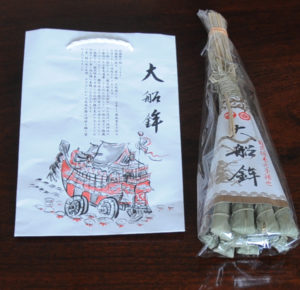
Yesterday, for the second year, I was working as a volunteer at the Ofunehoko, the last big float of the second Gion Matsuri Parade that is taking place on July 24th in the morning.

I felt a bit more confident this year, being there before and most of the things we had to do were the same. This year, the visitors to the second floor of the Ofunehoko house and the Ofunehoko itself had to take care of their own shoes, which was a great relief since this was a very stressful job last year. Also, every one of us could spend some time inside the Ofunehoko house, which meant: sitting down for a while! Even if it’s just sitting in seiza, taking the weight off the wooden geta and not having to stand for 6 hours straight is quite a relief.

Even though there were much fewer people this year (probably because of the bad weather), it was still fun to sell the chimaki and the upstairs tickets and the tenugui… Interestingly, most of the foreigners dropping by yesterday were Italians. Unfortunately, only a single one of my friends visited me, but it was the one who introduced me to the Miyakogusa group and made the whole thing possible in the first place. I felt quite honored that he would come and see me.

A chimaki from the OfunehokoAs a reward for our work, we all received a free chimaki upon leaving – the paper bag that goes with it is almost more interesting. A chimaki is a charm that is usually put up at the entrance door or in the genkan of a Japanese house to prevent evil from entering. Interestingly, there were even young Japanese people who asked about the meaning of the chimaki, which I found a bit odd – it seems such a fundamental thing here in Kyoto that I can’t believe this is not done everywhere else in Japan. I will investigate…

A Midsummer’s Equation

A Midsummer’s Equation
Keigo Higashino

Cover for A Midsummer's EquationHari Cove is a sleepy resort town that has seen better days. The most exciting thing happening at the moment is the plan for underwater mining just off the coast, which has divided the people still living there and has brought physicist Prof. Yukawa to the town. But then, after one of the mining company’s meetings, a man is found dead and is later declared murdered. He turns out to have been a retired policeman from Tokyo, and thus Yukawa is drawn into the case. He finds himself unveiling a well-kept secret and, against his usual inclinations, must consider protecting the guilty – not just of this crime, but of another one from many years before…

Another first class crime novel by Higashino. I loved the twists and turns that brought me from Hari Cove to Tokyo and back again, and back and forth in time for more than 20 years. As usual in a Higashino novel, what really happened is only revealed on the last few pages and comes as a surprise. However, when reading the novel carefully (or a second time), you cannot help wonder if Yukawa hadn’t figured out everything right from the start already.

Keigo Higashino was born 1958 in Osaka and started writing while still working as an engineer for a Japanese automotive company. Already his first novel won the prestigious Edogawa Rampo Award and he was able to write professionally. Since then he has written more than 60 novels and collections of short stories, his books have been made into movies and TV series, and he has won many more awards, mostly for his crime fiction.

If you’re keen on solving a Midsummer’s Equation in your own holidays – it’s available on amazon.

Gion Matsuri Shinko-sai

I actually made it to the Shinko-sai of Gion Matsuri last night! The Shinko-sai is the first part of Gion Matsuri (or actually, many of the shrine festivals in Kyoto and elsewhere), where first, the gods of Yasaka shrine are moved from their seats in the shrine to the portable mikoshi. Then, the mikoshi are paraded through the neighborhoods by enthusiastic people before they are placed in their temporary resting place, the so-called Otabisho. In Kyoto, the Otabisho for Yasaka Shrine is directly on the corner of Shijo dori and Shinkyogoku dori, which are both very popular shopping streets.

Yesterday, after my meeting, I went down to the Otabisho, where I arrived around 19:30. From 20:00, Shijo dori was closed for traffic (Shinkyogoku is a pedestrian area to begin with), and people were anxiously waiting for something to happen. Around 20:30, a parade arrived with musicians and gifts for the gods and people on horseback accompanying the chigo, a young boy who is representing a god or the gods during the whole of Gion Matsuri. He is the most important figure during Gion Matsuri with special duties and is not allowed to touch the ground or any woman, including his mother, for example.
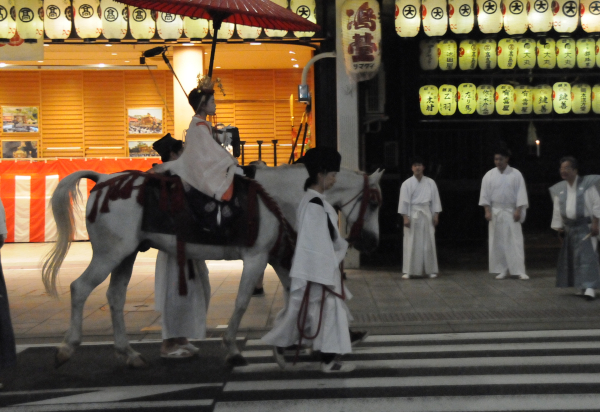
Chigo on HorsebackAbout 45 minutes later, the first of three mikoshi arrived. In front was a group of children, all dressed up like the adults, and all happily yelling hotoi to cheer on those who would carry the mikoshi behind them.

Row of children in front of the mikoshiThen, finally, the first mikoshi arrived, accompanied by over 100 people who carried it on their shoulders. And, as if this portable shrine was not heavy enough as it is, it is very important to jump up and down with it, accompanied by shouts of hotoi throughout. The jumping looks almost choreographed with special steps, and the men carrying the mikoshi are changing all the time, which is also done very carefully.

Hotoi - Mikoshi amongst its carriersIn the end, the mikoshi made two full turns in front of the Otabisho on outstretched hands, which is quite a feat.
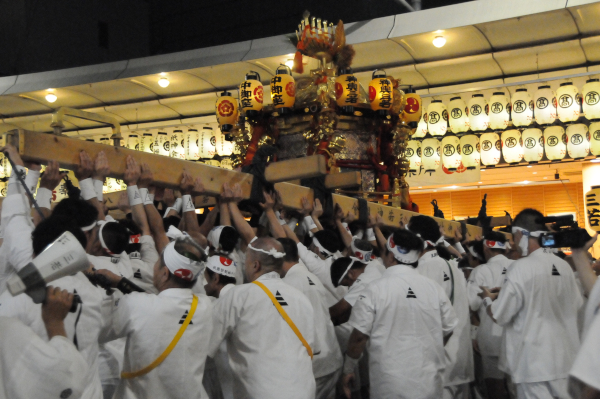
Turning the mikoshi around in front of the OtabishoFinally, the mikoshi was set down in front of the shrine next to the Otabisho. There, prayers were said – probably to welcome the kami to its resting place – and finally, everybody clapped happily for a job well done.
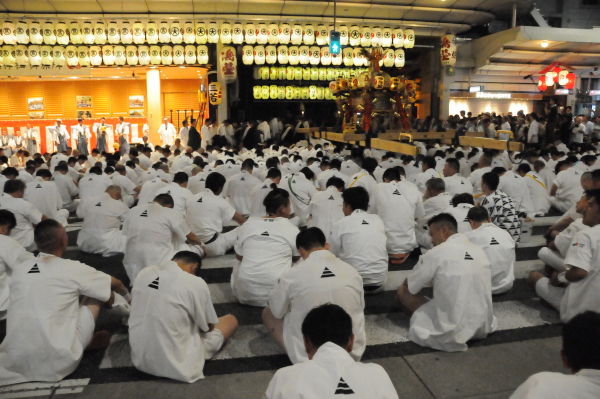
A last prayer for the gods before everything is over.While the first mikoshi was dismantled and put up in the Otabisho, the second one already waited a bit further down Shijo dori, but by now it was 22:00, and to be very honest, after more than 2 hours of standing on the hot asphalt, my feet hurt quite a bit. So I decided to go home, leaving the clapping and shouting for the other two mikoshi to the remaining spectators. Interestingly, also the men who carried the first shrine did not stick around. On my way back to my bicycle, I could see them walking home in small groups, obviously even more exhausted than me.

Gion Matsuri

gion matsuri gifGion Matsuri, probably the biggest party in Japan, is going on right now. Today is yoiyama, the night before the big parade with food stalls and music and fun throughout the inner city – and I didn’t go. I guess I’m getting old…

Or maybe it’s because I’m involved in the second half of the Gion Matsuri now myself, or because it really is so traditional that things don’t change anymore, or because I’d like to see a few things I didn’t so far and have to be careful with my work and free time…

However, I am planning to go to town tomorrow evening, when the shinko-sai is taking place and the gods of Yasaka Shrine will be moved to their temporary resting place in the Otabisho. I have an appointment nearby just before and if it is not raining, it will be fun to watch the people of the neighborhoods walking with the mikoshi and yelling “washoi” to spur each other on.

Tamayuran

This afternoon I had my weekly English class, and we usually meet in the shopping mall next door. As I mentioned before, the mall is being extended, and many shops are closed, even at parts of the mall that have nothing to do with the extension. They want to have the big “renewal open” in December, and I’m looking forward to it! At the moment the place looks like a ghost town with large parts dark and closed off. It’s not a nice place to have English classes …

Additionally, today it was very noisy, so we decided to go elsewhere. My student/friend suggested to visit the Tamayuran, a small cafe near Kyoto University. The owner rescues cats of all ages, and my friend picked up a 10 year old cat there a couple of months ago, which is how she got to know the Tamayuran in the first place.

So, we went to see cats. And: I’m in love! It is the season for baby cats, and there were six or seven in the cafe, from youngsters who are a couple of months old and very playful to a tiny little one that’s probably less than four weeks at the moment. Here is little “Kyoichiro Yoshida”:

https://www.instagram.com/p/ByuPa6spJ50/

He’s a bit bigger now, some two handfuls of kitten, but sooo cute and lovely and he was first sleeping and then crawling around in the big box he was in and when I picked him up he started crying but then he liked being stroked and got cuddly and he’s so tiny still with blue eyes and …

*cough* Sorry.

So yes, he’s very cute, but already spoken for! Somebody from Tokyo will come down next month and get him. Personally, I like cats of all sizes, but I think grown-ups are easier to care for, especially if they are potty-trained already. But since I’m not allowed to have cats here anyway, the point is rather moot.

Even without the cats, the cafe is definitely worth visiting. I had a wonderful milk tea and my friend and I shared a enormous peach parfait. It was delicious! The Tamayuran is open from 12:00 – 18:00, closed on Wednesdays. They serve a daily lunch, toast and sandwiches, and the seasonal parfaits are to die for (says my friend). I will definitely visit again, I think what the owner is doing is commendable and I’m happy to support her.

Find lots of pictures of the Tamayuran – with a certain focus on cats and food – on their instagram page above.

Recognition

Last Sunday, I had a fun work-related experience that I just need to share! So, I went to my monthly soroban class for foreigners at the Int. Community House and sometimes there are new people other than the usual suspects. That’s because my teacher is taking part in a “cultural experience” that allows people to come and try a variety of Japanese traditions, like wearing a yukata, or learning about tea, or doing soroban.

This time, there were two students from Italy who are spending a month in Kyoto, and I asked how they knew about the soroban class and if it was because of the cultural experience thing.

What's up in Kyoto square logo“No, we found out about the class on the internet.”

“The internet is pretty big, you know…”

“Oh, there is this site, it’s called What’s up in Kyoto…”

*joyous squeal*

In that moment, I felt so good. Finally I could see that all that work has some benefit for somebody! And when she said that she loves the calendar because there are all those events where there are barely any tourists, and that she’s checking in “religiously”, I was over the moon. Totally.

So yes, it’s always nice to hear from a happy customer, especially from one you didn’t even know you had. More reasons to keep it up! I just found a few regular zazen classes that I entered into the calendar, and today I have written a small piece for the experiences page about sento and onsen that I’ll put online within the next days. And then, maybe and finally, I’ll get over my inertia and get the page on vegetarian/vegan restaurants up that I have been planning for ages already…

Words for Each Day

On Friday, I went with a friend to Daisen-in, a subtemple of Daitokuji in the north-western part of Kyoto. We got a special tour through the grounds, and  apparently, the current abbot of Daisen-in is quite a famous figure in Kyoto or Zen Buddhism. We were both deeply touched by his  “Words for Each Day”, so I’ll give them to you and wish you a nice Sunday!


Each Day in Life is Training
Training for Myself
Though Failure is Possible
Living Each Moment
Equal to Anything
Ready for Everything

I am Alive – I am This Moment
    My Future is Here and Now

For If I cannot Endure Today
When and Where Will I

Soen Ozeki


KimOhNo!

As you probably know, a certain self-absorbed woman (whom I shall not name) from the US has recently announced a new line of underwear that she wanted to name “kimono”, of all things. I’m definitely not one who’s waving flags on the “cultural appropriation” bandwagon, but even I would say that was a bad idea to begin with. And as if it couldn’t get worse, said self-absorbed woman from the US had plans to get the name trademarked. Don’t even get me started on that one…

Anyway, the idea caused a veritable shitstorm on the internet, and many of the people involved were Japanese, who otherwise let foreigners get away with murder. But not with naming stuff “kimono”, apparently. The outcry was bad and loud enough that even Daisaku Kadokawa, the current mayor of Kyoto got involved in the issue. Even though modern Japanese don’t wear kimono in their daily life anymore, and many of the cheap summer kimono are now made in China, Kyoto is still the main producer of high-end kimono in Japan. As in former days, the Nishijin district where kimono are painted and obi are woven is still a major part of Kyoto’s industry.

So, it is only natural that the mayor of Kyoto got involved, I think. Especially since he is one of the few men who are still wearing a traditional kimono every singe day. And in the end, he – and all the other Japanese who complained – won an earned victory. Of course, part of the appeal of modern society is that you do things publicly, and therefore, he posted a number of letters pertaining to the affair on his facebook page. Here are four letters, in English, and in chronological order, the last one a letter to the League of Historical Cities, which is interesting in itself.

https://www.facebook.com/kadokawadaisaku/photos/a.722619441108370/2318978978139067/
https://www.facebook.com/kadokawadaisaku/photos/a.722619441108370/2325711274132504/
https://www.facebook.com/kadokawadaisaku/photos/a.722619441108370/2325713274132304/
https://www.facebook.com/kadokawadaisaku/photos/a.722619441108370/2327444103959221/