
Giving Up

A Man presses a "reject" buttionEven though I kept trying many times, I had to realise this morning that I’m not a fashion expert. Not even a fashion person. And definitely not a fashion writer.

You may know that I regularly write articles for various online businesses. To name a few, I have written about smartphones, doctors, hotels… This is all managed by another company for whom I work freelance, and they keep sending me invitations for new projects.

The way this works is that you need to sign up, you get invitations for a project. If you like the project, you send a writing sample (usually according to a given brief), and if you are chosen to work on the project, you will get all the further details. And payment further down the line.

Several times now, I have tried to get work writing for fashion brands or retailers online. I do not know anything about fashion, but I did write very successfully about smartphones without owning one, so I thought this would be in the same category. Well, I never got picked, and this morning I finally understood why.

As the test, I had to write a 300-word article about a well-known fashion brand. And, being me, I took the nerdy approach: a bit of history, a bit of innovations, a bit of types of clothes and a bit about the big-name designers they currently work with. I wrote it last night and let it sit, which is always a good idea when it comes to this type of writing, at least in the beginning.

This morning, I went online to a link I was given, and all the way down, there was an introduction to the brand. (Before you ask why I need to write this when it’s already there, I guess they are regularly updating the writing on the pages to make it seem more dynamic?) And that intro took the fashionista approach, talking about shoes and hoodies and leggings and sportswear and bras and socks and caps and backpacks and accessories and of course that it will feel wonderful when you wear it.

Note that this was on the bottom of a page already showing photos of all these things (minus the wonderful feelings of course) plus: the writing brief stated explicitly not do get sales-y. There were two sentences unique about the brand (one of them talking about their latest designer), but everything else was completely interchangeable with any other brand out there.

I didn’t even bother sending in my sample. Obviously this type of writing is so far out of my natural habitat, that it is a complete waste of time to even consider learning the how-to. So: I am calling a strategic retreat and cut my losses. Best to stick to stuff that I know something about. Serious nerdy stuff. Like smartphones. πŸ˜‰

Shibori

Shibori is the Japanese method of tie-dyeing, a type of resist dyeing where parts of the fabric are prepared (in this case: tightly tied with thread) before dyeing so that the tied parts of the fabric remain the original color.

Shibori, or rather: tie-dyeing or resist dyeing methods have sprung up all over the world and can be traced back to as early as the 2nd century. Simple methods of resist dyeing meant simply crumpling up the cloth before dyeing, but methods have evolved to include the use of wax or stencils etc. Tie-dyeing came to Japan from China in the 7th century and has been refined to create the art of shibori.

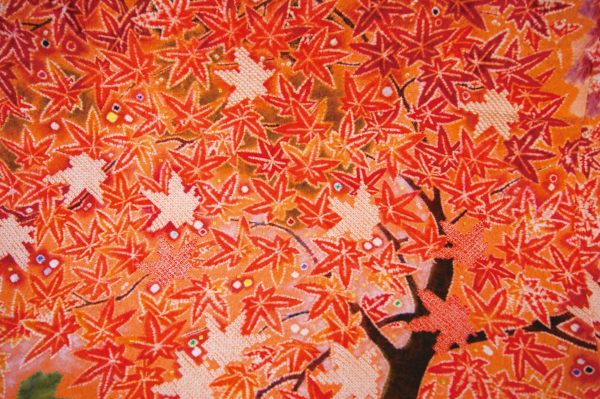
A multi-colored piece of Shibori

Shibori with its tiny and delicate patterns reached its peak in the Edo period, where shibori fabric was produced in many places of Japan. Especially farmers would work in the shibori industry – meaning: binding the cloth – during the off-season when there was not much work to do on the farm. Unfortunately, nowadays, shibori is only produced in Nagoya and Kyoto, and because it is still largely a very time-consuming handicraft, the number of craftsmen and -women who can do it is declining.

Shibori comes in many different forms, depending on the way the fabric is tied. The most delicate type of binding the fabric is called hon-hitta shibori, the finished tied beads are only 2mm in size; this is entirely handmade and an experienced craftsperson can make around 300 of these beads per day.

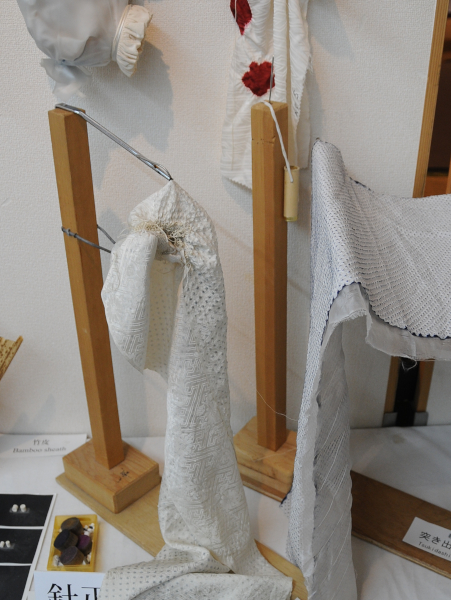
This was the standard type of shibori before the machine-type hari-bitta shibori was introduced, “machine” being simply a metal holder with a needle to help pinching the fabric before tying it. While the process is still a handicraft, this tool has sped up production to about 3000 beads per day.

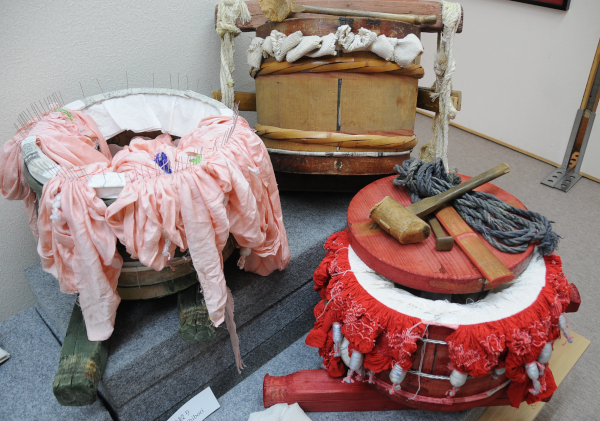
Tool for needle shiboriOther methods that fall under the shibori umbrella are tie-dyeing with larger objects like plugs made from wood or acrylic; using wooden boards like a stencil; sewing patterns into the fabric with strong thread etc. Probably the most interesting one is where the cloth is placed carefully in and outside of a wooden tub, the parts inside the tub remain white while the ones outside will be dyed in the respective color. This so-called oke-shibori technique can produce very striking, large-scale patterns.

Tub shiboriThe shibori process is very involved and takes a number of steps, each of which is carried out by a specialist. First, a pattern is created and from it, a stencil is made. Using the stencil and a special type of water-soluble dye, the pattern is transferred to the fabric. Then, the fabric is tied according to the pattern. If there are different types of shibori to be included, each one is given to a specialist in the respective type of binding. However, no matter how large the piece is, one type of binding is always given to a single craftsperson because to achieve a uniform appearance in the final piece, the strength of the binding must be the same throughout.

Once all the fabric is tied it is called a shirome and now it is given to the person who is actually dyeing it. Again, this is a handicraft, and the color depends on factors like the type and heat of the dye and the amount of time the fabric stays in it. Only after the piece is completely dry will the fabric be unbound (again by an expert) and afterwards, it will be steamed to make it flat. With this method, a finished piece of shibori will never be completely flat but will retain a bit of a 3D structure, which is the hallmark of good shibori.

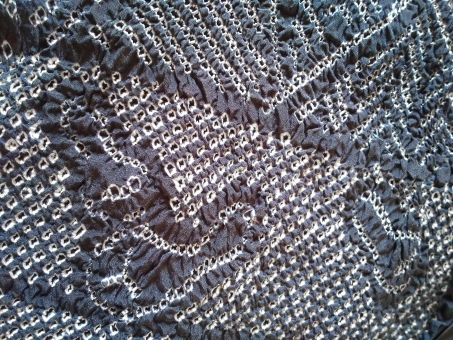
Simple Shibori FabricAs mentioned above, nowadays shibori is only produced in Nagoya and in Kyoto (and a few surrounding places). Nagoya shibori is made on various materials including cotton, but the kyo kanoko shibori of Kyoto only uses silk fabric. Because of the fact that they are still handmade, shibori items are rather expensive, but it does depend on the pattern and the dyeing. The more intricate the pattern, the more colors, the more expensive. Still, given that a whole kimono done in hon-hitta shibori can have up to 200,000 of little tied beads and can take years to complete, the prices are understandable.An affordable shibori kimono.For more information on shibori, visit the Kyoto Shibori Museum. Their exhibits are stunning and they also offer short classes to make your own (simple) shibori piece.

Hawk Show

Last Saturday, I took the day off to go to Arashiyama in the western part of Kyoto. It once was a kind of country retreat for the city’s aristocrats, and even though distances have shrunk thanks to modern travel, it still takes me more than an hour to get there. That means, I don’t really like to go there – unless there is something very special going on.

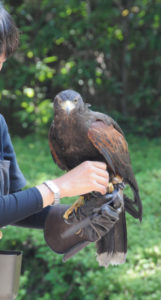
HawkLike a hawk show. The Saga Arashiyama Museum of Arts and Culture is holding a special exhibition at the moment with paintings of birds. And to make things interesting beyond the usual talk of art experts, they invited a falconer to come and show us his hawks.

First, there was a talk, of course. In Japan, falconry is called takagiri and it goes back as a sport for the nobles to the 4th century, when it was introduced from Korea. Tokugawa Ieyasu was particularly fond of hawking and put together a string of laws to govern its use during the Edo period. After the Meiji Restoration, however, takagiri was mostly discontinued, and today it is practised by a private clubs.

When a hawk is hatched, it takes about two months until it reaches the size of an adult. At this point, the training begins, first with very short sessions of 5 minutes a day, increasing to 10 minutes, 15 minutes… up to 4 hours of training a day. Interestingly, female hawks are larger than male ones, and they are easier to train for some reason. Hawks are flown daily and there is no retirement for them; they have a life span of 20 – 30 years.

Most of the training is based on incentives with food. Unfortunately, I did not quite understand what exactly they are fed, but the falconer stated that it’s not as simple as going to the supermarket and buying meat there. An interesting tidbit is that Japanese falconers fly their birds from the left hand, while in China the right hand is used. Part of it is that most people are right-handed, but part of it is that in Japan, the samurai still needed to be able to draw a sword…

After the talk, we were treated to a hawk show. There were two hawks present, and one of them was flown indoors between two people. After one or two how-to’s, visitors were invited to try themselves (with the help of a falconer, of course). Finally, we went outside for a more authentic experience. This time only the falconers worked with the birds though, but we saw how a hawk would hunt for a flying object, and it is amazing how fast these animals really are.

Hawk Show

Playdate

Last week my friend and I once more went to the Tamayuran Cafe to see the cats and little Yoshida Kyoichiro in particular. He has grown quite a bit in the last month, and although he is still very small for his age (he’s about 3 months old now), he has developed into a very sweet and playful kitten.

While we were having drinks, we had Kyoichiro play on our table for more than an hour, and although I prefer somewhat older cats because they are generally easier to care for, I cannot deny that I’m totally in love with him.

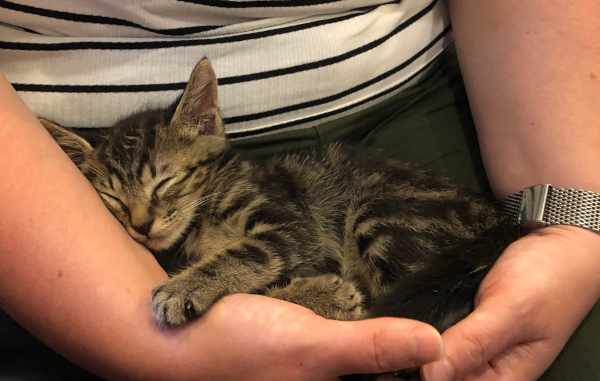
At the end of our playdate-threesome, he fell asleep in my arms, and although you can’t see it here, I’m just as happy as he is!

Yoshida Kyoichiro the kitten

Cicadas

Summer in Japan means essentially three things: heat, humidity and cicadas. There are about 3000 different species of cicadas worldwide, and Japan itself is home to around 30 species, which can be easily distinguished by their different songs.

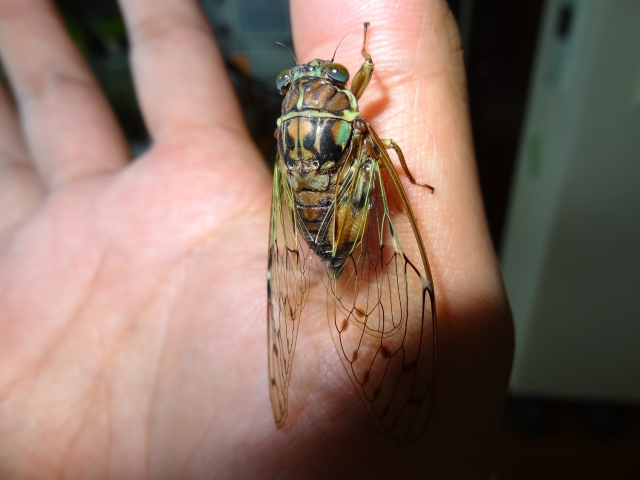
The most common cicadas in Japan are the so-called abura semi which literally means “oily cicada”, since their song resembles the sound of frying oil (to the Japanese at least). Even though abura semi are among the largest cicadas here – they measure up to 40 mm – and you hear them everywhere in summer, they blend perfectly into the trees and are very hard to see.Abura semi in tree

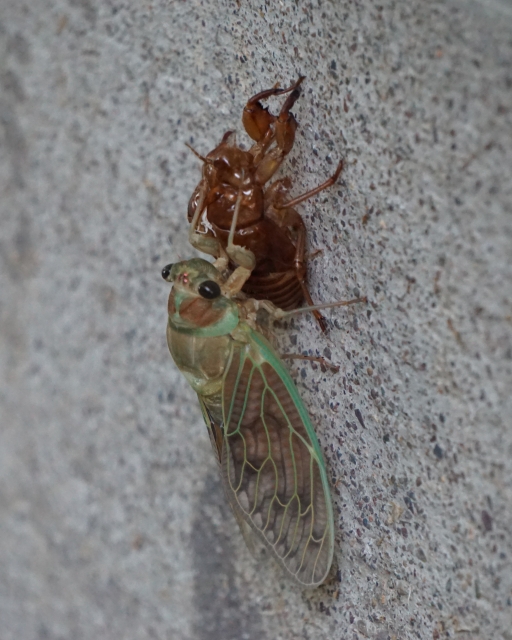
The Japanese abura semi are a yearly species. They emerge in mid July as adults (imago) and from then on live, sing, and mate until late August to early September. Their larvae survive in the ground where they feed off tree roots until they emerge again in the next summer. This is when there are many empty shells left on low leafs and bushes, and it is easy to see that summer has started.A molting cicada

Cicadas don’t come alone, they sit in trees and bushes by the hundreds and sing together to attract females. Every species has its individual song, and they can be extremely loud. Some species can generate up to 120 dB, among the loudest of all sounds produced by insects, rivaling chain saws. And as cicadas can sing for hours, it can get very annoying over time, and it seems a bit unfair (although totally understandable from an evolutionary point of view) that males can disable their “ears” while singing to prevent hearing loss.

How the cicada’s song is produced is very interesting: Essentially it’s by training their muscles! Male cicadas have so-called tymbals (noisemakers) in their abdomens, and they click every time the internal muscles are flexed, and a second time upon relaxing them again. In addition, the abdomen of male cicadas is pretty much hollow, which amplifies each click. When many cicadas come together, these clicks blend together to a single soundscape where individual clicks or even a single insect are not distinguishable at all.

Another interesting tidbit about cicadas is that they cannot jump, but they do fly. They are not dangerous at all to humans, but when one of those large abura semi comes right at you with a deep buzz, it can be quite scary. Besides their perfect mimicry which makes them hard to see on the trees they sit on, they also practice “playing dead” when they are being disturbed. In the last weeks, I have nudged quite a few cicadas that were lying on their backs in front of my apartment, just to have them fly off again with some extra indignant clicks.A young cicada

As mentioned above, cicadas are one of those beloved Japanese insects that are often used to denote a season in art. While the Japanese don’t eat them like the Chinese do, they are significant in Japanese culture. And although they may not make quite as pretty a motif for paintings as the grasshopper, cicadas have inspired many poets over the ages because they signify the shortness of existence.

The song of the cicadas leaves nothing visible from their near death.
Basho

Summer Greetings

shochu mimaiThe week or two before Obon is considered the height of summer in Japan, and it’s definitely hot enough for it! Although Obon is not a public holiday, many shops and companies, especially the smaller ones, are closed for at least a few days leading up to August 16.

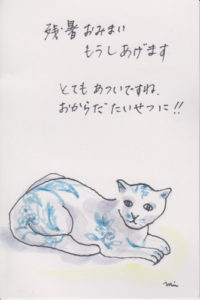
One of the traditional “must dos” during these days is to send shochu-mimai, summer greetings. Just like the kanchu-mimai in winter, these are simple postcards with a suitable motif to wish people good health to get through it all. In Japan, the hot summer days have traditionally been of greater concern than the cold winter days.

Speaking of tradition: These mimai once were actual visits to people in the hottest (or coldest) time of the year, but if you couldn’t visit somebody, it was acceptable to send greeting cards instead. A related custom is the sending of ochugen summer gifts to family and business partners, but this is not as wide-spread nowadays as the still ubiquitous oseibo year-end presents.

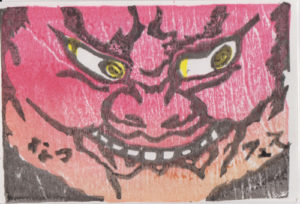
a summer greeting cardMaybe because of modern air-conditioning that is taking the edge off the heat, the sending of shochu mimai has declined. I am not sending any myself, but I have received some from friends. Just like the nengajo that are sent for New Year’s Day, these seasonal greeting cards are often handmade by the more artistically inclined people – like my friends. The cat really doesn’t need much explanation for anyone who knows me, and the demon’s face is popular at summery lantern festivals like the Aomori Nebuta Festival.

Service?

As you know, from this (fiscal) year on, I am enrolled in Japan’s national pension and health insurance, which costs me more than 60.000 yen every month (I have complained about this, I’m sure). Signing up for the service went very smoothly, and now I’m getting a monthly letter from them indicating how much I have paid for pension/health insurance. Not that this is necessary, since I can see that in my company bank book, but the Japanese love paperwork.

One evening about two weeks ago, I received a phone call, and it took me a while to understand that it was from the Japanese Pension Service in Kyoto. The following is a short version of the weirdest phone conversation I ever had:

“We have sent you a letter,” the woman on the other end of the line announced proudly.

“Oh? I didn’t receive anything yet.”

“Yes, it can take a week or so until you receive it. But please read the letter when it comes. Thank you!”

Ummm… okay. Mind you that she didn’t say what the letter was about. Fast forward about a week when indeed I got a letter from Japan Pension Service. Essentially it said “We just want to tell you that this is indeed your yearly income (amount goes here)”. Well, yeah, this is what I have entered on the form I gave you when I enrolled in the service, so…?

I am not sure what the letter was good for to begin with, since it told me what I already knew. But the phone call before that takes the cake. I mean, does Japan Pension Service call every single company when they send them paperwork? Or am I getting the special foreigner treatment? Well, as long as this extra work is not deducted from my pension in the end…

Yama-no-hi

Today is a holiday: Yama-no-hi or Mountain Day. The idea is to give the Japanese a (or rather: another) reason to go hiking in the mountains. The largest mountain ranges of non-volcanic origin in Japan lie in central Honshu, the main island, and encompass the Hida, Kiso, and Akaishi mountains. These mountain ranges include the highest mountains in Japan (except Mt. Fuji) with a height of more than 3100 m. Some of them even have what are called “active glaciers”, meaning their ice is flowing.

Anyway, the tallest mountain in Japan is Mt. Fuji. Since ancient times it has been the most revered mountain in Japan, and since 2013 it is on the UNESCO World Heritage list, drawing even more people to its top on a sort of modern pilgrimage.

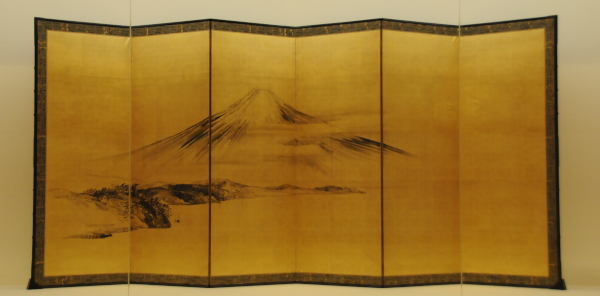
Anyway, I’d like to share a picture of this fantastic gold screen painting of Mt. Fuji that was on display at the Saga Arashiyama Museum of Arts and Culture when I was visiting it for their last exhibition. It was painted by Shibata Gito (1780 – 1819) from Okayama, which means so much as “edge of the mountain”, which is quite fitting the theme, don’t you think?

Golden Screen with Mt. Fuji by Shibata Gito

Eruption

When people hear about a natural disaster happening in Japan, they most often assume that it’s another earthquake. And with an earthquake happening almost every day, they are mostly guessing correctly. What is often forgotten however, is that Japan is also the home of many volcanoes, and most of them are just dormant and can erupt again at any time.

This is just what happened late yesterday night, when Mt. Asama erupted and sent a pillar of smoke some 1800 metres into the sky. Mt. Asama is 2568 metres high and one of the most active volcanoes in Japan; the last eruption was 10 years ago. Since the volcano is on the borders of Gunma and Nagano prefecture, it is a popular hiking spot, but the region is not very densely populated.

Still, the government has forbidden access to the volcano as a whole, and is trying to evacuate all hikers that are in the area. Judging from the youtube video below, taken today, the situation has cooled down a little.

See also this interesting article at Kyodo News, which is relatively level-headed and includes a great map of the many other (and so far quiet) volcanoes in the area and a link to the Japan Meteorological Agency and their volcanic warning page just below the map.

Inspirational

I’m back from my “holiday” that I spent at home – and at a number of cafes just to get out of my apartment for a few hours in the hottest part of the afternoons at least. I was relatively lazy last week (up to 38 degrees didn’t help) but I read a few books, did some apartment maintenance (aka ironing and cleaning), and spent too much time on youtube.

I also got busy looking at color schemes for future website improvement and I now have a new list of “things I’d like to do for What’s up in Kyoto“. As if I needed a new and improved – and significantly longer – list there…

An interesting highlight was meeting a friend of mine and catching up with her. The last time we met was several weeks ago at a small cafe where neither of us had been before, and where they happened to look for part-time staff. Now my friend is working there! She spends maybe half the year abroad, so she needed something flexible, job-wise. Interestingly, she was considering another, more corporate job as a translator as well at the time, but chose the cafe after all. She said she had never worked in a restaurant before and wanted to make that experience and try it out.

We had talked before how I came to Japan and how I left everything behind, and that if it didn’t work out, I could always do something else. So, she knew about my journey to Kyoto. And then she suddenly said: “You inspired me to try something completely new as well!”

I am amazed and humbled and a bit embarrassed to inspire people to do anything. Probably because there are many days when I don’t feel particularly inspired myself.