Hobonichi Techo

Japanese people love notebooks and daily planners. Virtually everybody has a smart/mobile phone these days where you can list your appointments and other stuff. And yet, virtually everybody still owns a diary in book form too.

There are dozens of different types to choose from, from the simple monthly planners that fit into every pocket to the large daily ones that are not meant to leave an executive’s desk. Plus they often come with different covers as well, showing cute animals or famous Disney characters, or they are simply bound in real leather.

It is never too early to get your diary for the next year if you want to have the biggest selection, and in fact, my local book store has started displaying 2020 diaries already a couple of weeks ago. And, wouldn’t you believe it: I just bought a 2020 diary myself today…

Mostly, I am quite practically inclined: As long as the thing is doing what I want it to do, I don’t mind the design; function before form at any time. Also, if something works, I am a very faithful customer, and I will keep coming back to the same thing. For example, my diary for appointments is a small and lightweight affair that I (try to) take with me everywhere. Its simple weekly layout is straightforward and has just enough space for the few appointments I have.

However, I also need a larger planner for my daily and monthly to-do lists and long-term plans etc., and this one stays on my desk at all times. This year, I have been using two separate planners for this, plus another list to keep track of my spending, plus another notebook for random ideas plus a countless number of loose papers for all sorts of things I want to remember or note down for later. Like most of my nerdy friends, I love paper, but it’s a mess, really.

So, I have decided to find a single planner that can hold all my daily writings, from to-do-lists to interesting quotes I find online, from birthday reminders to weight tracking… I went to one of the larger stationery stores in town and spent about an hour looking through most of the planners on display and being slightly dissatisfied with each and every one of them. But just before I was ready to settle for something not-quite-right-but-almost-there, I took one more turn and found the thing:

The Hobonichi Techo. (*)

It’s a nerd’s dream of a daily planner, very simple, and yet with a huge amount of space to write in. It has lots of practical little features, and the smell of the fresh paper… heavenly, I tell you! It comes with a little manga (of course) to explain how to get the most out of it, and the company even has youtube videos to do the same, like this one for the 2020 version:

I haven’t even used the thing yet, and I’m already a fan (that smell alone!) And I’m not the only one, judging from the large amount of unboxing videos for the Hobonichi Techo on youtube. Check out the company website, it’s very interesting, especially the timeline of the last 19 years showing how the Techo started out with 12,000 copies in 2001 and has reached 850,000 copies this year. Fascinating! I can’t wait to use it – and it’s 3 months still to go!

(*) Hobonichi means something like “almost every day” and techo is the Japanese word for notebook or diary. Note that techo is pronounced with a cho like in… chocolate and not like in the English word tech.
Storage

It is a well-known fact that Japanese homes are small, in particular those in the big cities. I can consider myself lucky that I can afford a nice apartment with 60 square meters, which does meet all my storage needs so far. In all my rooms except the kitchen/dining room, I have what is called an oshiire, a large closet that is 80 cm deep and as high as the room. The name literally means “to push/shove in”, and in the olden days, when everybody still slept on a futon, they were mainly used to store the family’s bedding during the day.

The oshiire in my apartment have two large compartments at the bottom that reach up to about 175 cm, and another smaller one on top of that reaching to the ceiling. Because I am rather short, this is where I store things I don’t need often; in case of the oshiire in my bedroom, I put my out-of season clothing up there, as well as currently unused bedding and linens etc.

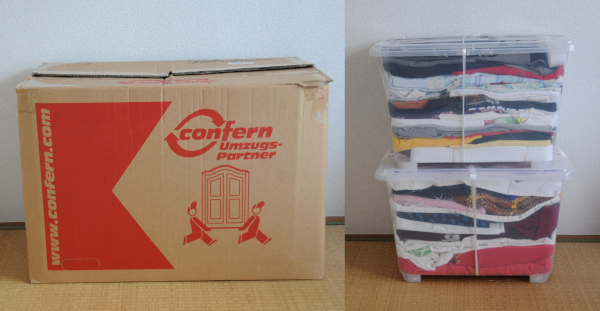
I guess I have to confess that I’m a bit stingy – I avoid buying stuff that I don’t strictly need, for example if I already own something that can be repurposed, I’d rather go with that cheap option. In the case of boxes to put in my unused clothes, I simply used the moving boxes they came in 5 years ago – a perfectly good solution. Or so it seems, until you find out that those boxes are rather large (around 1/4 of a cubic metre for the big ones) and can weigh up to 20 kilos. And it’s no fun to lift them up over your head while balancing on a stool so you can push them into the top of that oshiire…

I am nothing but stubborn, so I did that for two of these large boxes – 40 kilos in total – twice a year in spring and late autumn. But now, the time has come, I’ve finally had enough of this, especially as the moving boxes are now finally breaking apart anyway – that’s me dropping them every now and then because they got too heavy to balance over my head.

So, after 5 years of living here I have given in and bought rather standard plastic storage boxes that are half the size and thus much easier to handle and lift, while still fitting all of what I need to pack away each season. I’m feeling mightily accomplished and like a real adult! Here’s the before and after – I’m wondering what’s next on my list of adult things to buy…

storage boxes before and after

Paprika

Paprika
Yasutaka Tsutsui

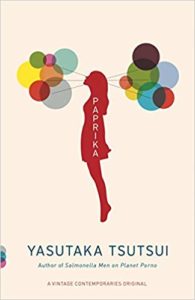
Cover for "Paprika"Atsuko Chiba has it all: The beautiful and brilliant psychiatrist is on the way to win a Nobel Prize for her work with mentally ill patients, using the PT device invented by her colleague Kosaku Tokita. As her alter ego, the “dream detective” Paprika, she uses the new machines to visit the dreams of patients, where she tries to find out the source behind their problems and attempts to cure them. This part of Atsuko’s work is illegal, but Paprika keeps being called upon by the rich and powerful in need of clandestine treatment.

When a greatly improved version of the PT device, the DC Mini, goes missing, Atsuko and Paprika are quickly drawn into an abyss of unhealthy dreams that take over the minds of colleagues and friends. Together, they need all the help they can get to keep the dream world and its nightmares from invading the real world…

I’m in two minds about this book. I greatly enjoyed the premise and the smart way of mixing dreams and reality. Towards the end of the book, you really don’t know where you are anymore. Unfortunately, Atsuko/Paprika was a typical Mary Sue character: beautiful, highly intelligent, every man would fall in love with her the moment he laid eyes upon her… It got too much pretty soon. Also, despite having a “strong” female main character, the book was full of misogyny. Part of it are the personalities of the two main antagonists, but part of it appears to be the views of the writer too, unfortunately. Saving grace in this respect is that the book was published back in 1993, and hopefully, Japanese views on women have changed in the last 15 years. Not really a recommendation, read at your own peril!

Yasutaka Tsutsui was born in Osaka in 1934 and lives in Tokyo. His works have laid the basis for Japanese postmodern science fiction and he often integrates psychoanalysis, surrealism, time travel, dream worlds etc. A number of his books have been adapted for tv or cinema. He is the recipient of the renowned Tanizaki Prize (1987) and the Kawabata Prize (1989), among others.

Probably the most controversial book I have posted on here. Make up your own mind with a copy from amazon.

Opportunities

What's up in Kyoto square logoI have been very busy with moving What’s up in Kyoto to the next level. So far, I did all of that work on that website for free, a very time-consuming hobby indeed. But now I am gearing up to allow advertising on the site, and a friend of mine has helped me draft some letters for various businesses that I’ll get translated into Japanese and then start sending off in the hope of getting some income.

Also, I have devised a cunning plan to drive more visitors to the website, but I’ll need to do a little bit more research on this one. Essentially it is involving all the international conferences that are organised locally by universities; scientists are curious and would appreciate a list of things to do in Kyoto, I’m sure.

On top of that, to bridge the money chasm while I’m waiting for all those advertisements to come in, I have applied for a writer’s position at a local English magazine geared towards foreign visitors. That was some two months ago, and: I received a no.

However, I still went there today for an interview. The people in charge were impressed with the What’s up in Kyoto website and all the other experience I have concerning social media and online publishing, so they are considering me as their new, actually: their very first webmistress!

Their current website and online presence has been quite neglected, and we were talking  how to put it on better feet for now. I left with a good feeling and quite some excitement about me getting to learn all sorts of new things. And I kinda sorta got invited to their next staff meeting. Does that mean that I’m hired already?

Moon Viewing

Last Friday night was a full moon, and the full moon in September is considered the most beautiful by Japanese people. That’s why there are many moon viewing parties going on everywhere, from the expensive dinners and tea ceremonies in quiet gardens to festival-like events with food stalls in shrines and temples, and there are some people who just go out with a can of beer and organise their own moon-viewing picnic.

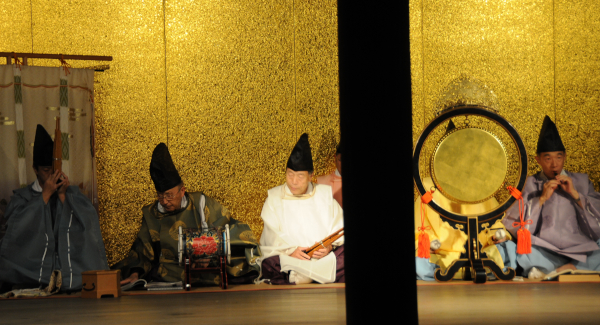
This year, I took some time out to visit Shimogamo Shrine for their moon viewing event. I live very close to the shrine, so it’s easy to get to, and my choice was partly driven by the cloudy skies that looked like it would start to rain any moment. At Shimogamo Shrine, the full moon is a rather minor accessory to the events, the big thing is a concert of traditional Japanese music. It lasts for three hours, and there are a number of participants. I am not sure if they are the same every year, but this year we had:

Five people playing the shakuhachi to kick off the concert. I was very pleased about that, and I found it quite interesting that my own shakuhachi sounds so much deeper than the ones they played. I’m wondering if I’m doing something wrong, actually, that’s very likely since most of the times, I cannot get a tone out of it anyway…Gagaku Musicians

Afterwards we had a gagaku concert – traditional Japanese court music. It is still not my thing, I find it excruciatingly boring, and I am wondering if the people back in Heian times really and honestly enjoyed this kind of music.

Then, a large troupe of koto players took the stage, and this was the part I enjoyed most. They played very lively and modern sounding pieces, but from the reaction of the spectators next to me who could hum the tunes alongside the musicians, I guess that the pieces must have been very old and popular ones.

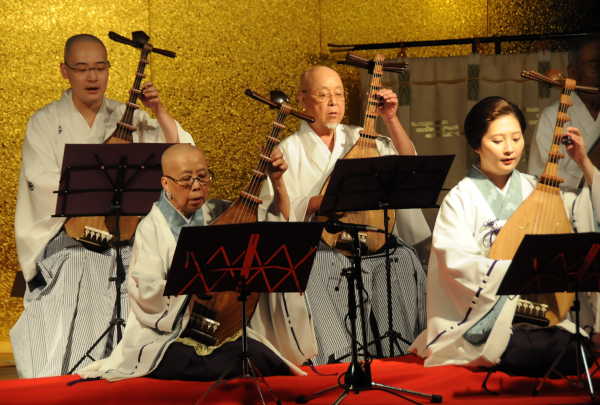
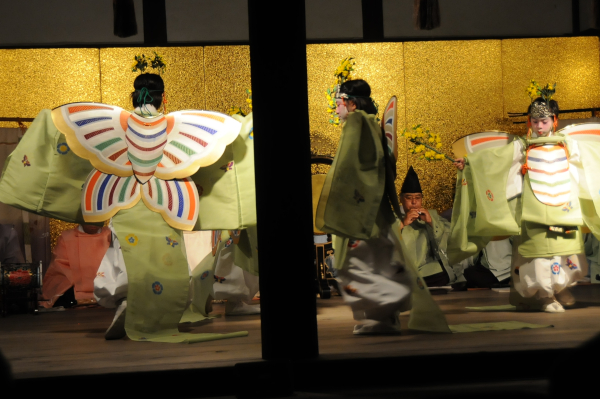
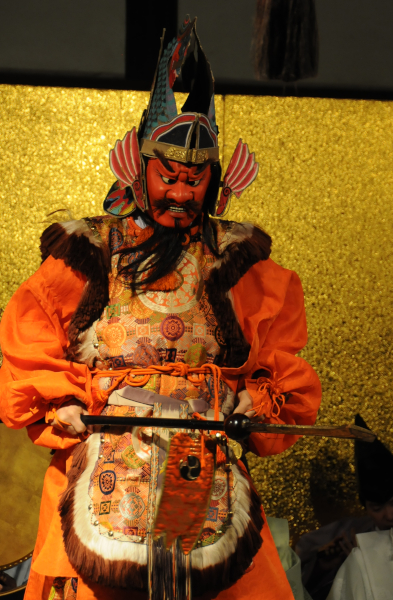
The biwa music that followed was less exciting to be honest, but still my fellow spectators knew the tunes. I could not help wondering whether half of the musicians were Buddhist priests or nuns – shaved heads and all.biwa musiciansAfter a biwa solo recital and one more fun koto part, we got to the highlight of the evening: another gagaku concert. This time, however, the music accompanied dancers, which made the whole experience much more bearable. We had three dances, first four children dressed in butterfly outfits, then two men who might have been courtiers, and finally, a single performance of a demon, complete with mask, sword, and spear.Kids dancing as butterflies.

The dance movements were extremely formalised, almost stiff, to be honest, the dancers didn’t look very graceful. Only the demon at the end was allowed to brandish his spear in a more realistic way, it must have been a part for a very advanced performer. Still, all the costumes were fantastic and elaborately decorated, it was a joy to just look at all the details. I am sure the colors and embroidery have some hidden meaning, but even so, they were lost on me.Demon Dance

I bought a ticket for reserved seats in front of the stage and I did not regret it – standing for three hours is no fun at all. The ticket also included a cup of green tea with sweets, but I would have had to leave my seat to get it. I thought about it and, looking back, I should have just gone during the first gagaku concert, but it was fine anyway. In the end, I had a nice evening – and when I walked home, the moon came out from behind the clouds for a brief “good night”.

Gas Check

Yesterday afternoon I had a visit from the gas company; they wanted to check my gas equipment. I have a gas heater for hot water in my kitchen, and also the kitchen stove is using gas.

The service man checked the heater for damaged parts and when he turned on the hot water, he used a mirror to look outside and check if the exhaust fan is working. He also checked the gas faucet that connects to my stove, and advised me to move the stove a bit away from the back wall because there is a rubber tube connection that might get burned otherwise.

In the end, he also said that if I ever smelled gas the very first thing to do was to open the windows. I have a gas detector in one corner of the kitchen and showed it to him. Apparently it’s a rather old model and I could get it replaced with a rental one for 350 YEN/month. I declined because it’s not my apartment, and old doesn’t automatically mean not working.

The whole check was over in 10 minutes or so, but I have learnt something interesting: In one corner of each of my rooms, there is a little terminal, for what I didn’t find out until yesterday: It’s extra gas supply! So, in the winter, you can use a gas heater and connect it there rather than using liquid gas which I find very unsafe to be honest.

I’m not using gas heaters and I have no plans of doing so. Ever so often, there are accidents where people are poisoned by carbon monoxide (CO). I would need some sort of heating in my bedroom where I sleep on the floor – and CO is heavier than air… Just to be on the safe side, I’ll pass on any kinds of gas heaters and keep using my electric one, even though this is much more expensive than using gas. Yes, I have said that I want to stay in Japan until I die, and I’m still planning to do so, but there’s no need to hasten the arrival of that day…

Nishijin Asagi Museum

As I mentioned in my last post, I fell down a craft hole last week, and one of the places I visited was the Nishijin Asagi Museum, one of the very small private museums that are often only accessible via prior reservation.

As the name suggests, this museum is dedicated to Nishijin weaving, an old Japanese handicraft where colored threads of silk are used to produce patterns in the final fabric. This technique is not unique to Japan, mind you, but Nishijin ori takes the whole thing up a notch – and has done so for centuries. Besides carefully dyed silk, the use of real gold, silver, or platinum is one of the hallmarks of Nishijin ori. This makes the coloring of the fabric last for a long time, but also prevents an obi or kimono from being washed.

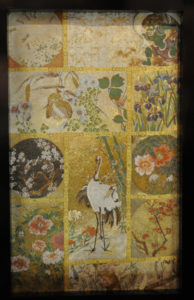
Rimpa paintings - nishijin oriNishijin ori is known for its delicate images that are woven into the fabric, and the Asagi Museum has a large collection of fantastic pieces that look like painted. In fact, many of the pieces on display are recreations of famous paintings from the Japanese Rimpa school to Buddhist images to Western Impressionism.

It’s a bit hard to talk about the topic, so I will just share some of my images. If you want to know more about the museum, or see many more pictures, here’s their homepage (unfortunately only in Japanese…): http://asagi-museum.jp/

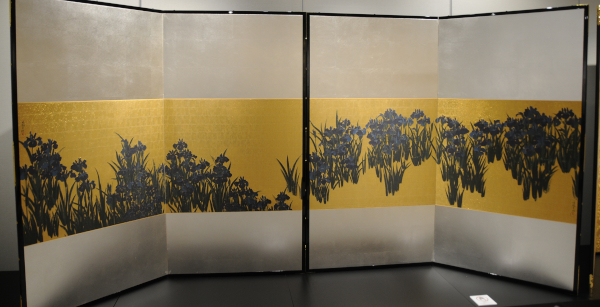
Rimpa school - irises - in nishijin ori

The above is a reproduction of a famous painting by Ogata Korin. These two folding screens “Irises” from the 17th century are a National Treasure and rarely exhibited; in the original they each measure 1.5 by 3.3 meters, and to be  honest, don’t look quite as neat as these here.

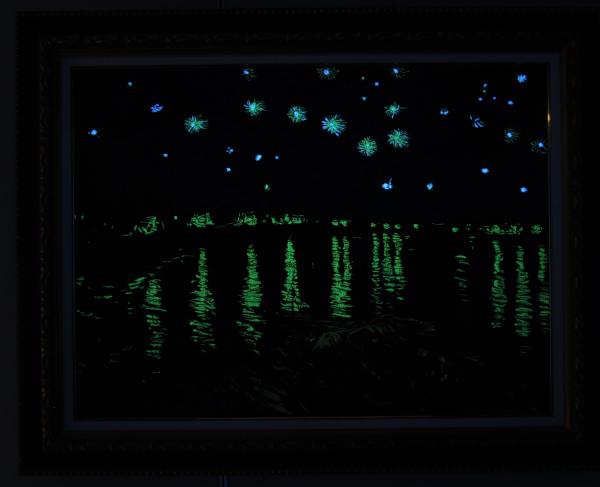
Van Gogh Starry Night in nishijin ori

Van Gogh’s Starry Night is a famous painting, and this is a reproduction in silk fabric. It was displayed in a darkened room with only fluorescent light, hence the interesting coloring of this image.

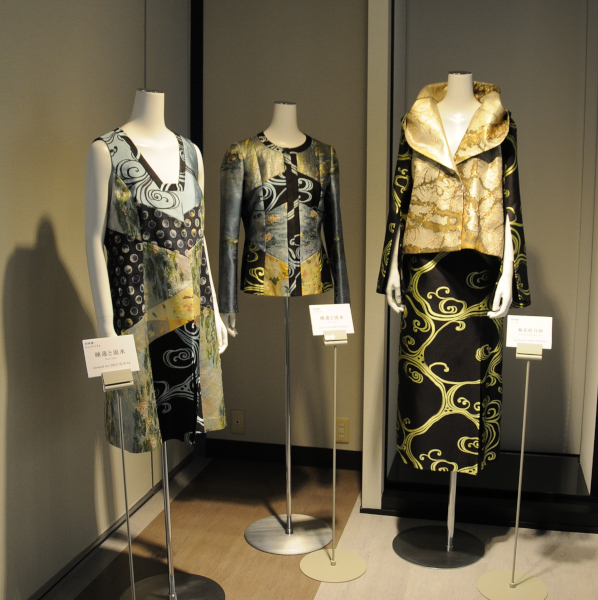
Clothing with Nishijin Fabric

This is taking Nishijin fabric into the modern age. Pieces of different fabrics were used to make these clothes. I did not dare touch them, but I am wondering how they would feel to wear; my impression of Nishijin fabric is that it is rather stiff. It’s probably okay for the jacket in the middle (I could see myself wearing this), but the dress, I’m not so sure.

Kyoto Crafts

Sorry for not posting on Tuesday – I fell into a craft-shaped hole… Let me explain: The last three days there was the “Tradition and Innovation – Culture and Industry” exhibition at the Miyakomesse in Kyoto, and it was promised that a number of Kyoto artisans would exhibit their work and actually be present to do and explain some work there.

Since my Tuesday Japanese class is just next door, I decided to drop in and have a look at the craftsmen and the exhibition. I thought it would take maybe an hour, because how big can such an event be, really. Boy was I wrong!

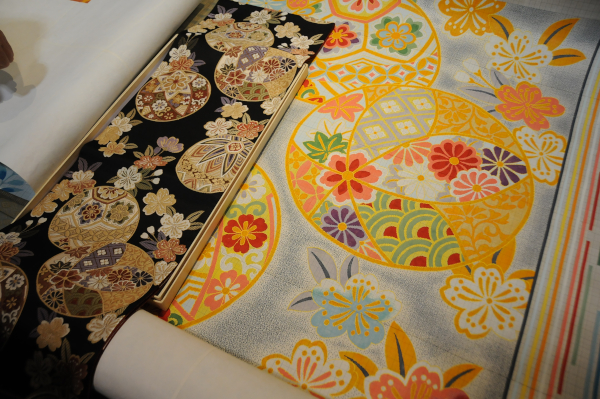
There were 40 little booths with a large variety of crafts. Most of the space was devoted to the different steps of nishijin weaving – nowadays used to make an obi for kimono – from the design on plotting paper and the dyeing of the silk to the threading of the silk onto the loom to the actual weaving. There were other textile arts like yuzen dyeing – painting or printing onto silk – embroidery and weaving decorative ropes.

An obi from start to finish

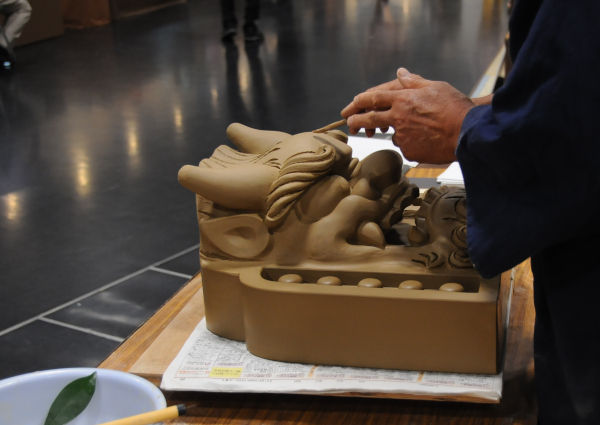
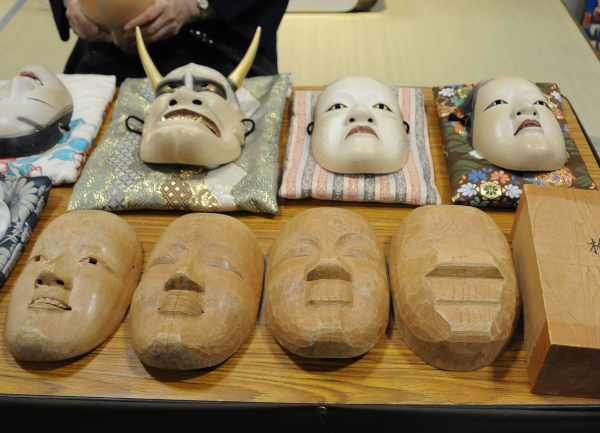
Then there were decorative arts like woodcrafts, bamboo weaving, lacquerware, cloisonné, damascene work, making umbrellas and carving Noh masks; and finally things necessary for a traditional Japanese house like bamboo blinds for in- and outdoors, bamboo fences and even roof tiles.

Making an end tile.

There were places set aside for exhibitions of ikebana and calligraphy, and a large place for tea ceremony; and of course there were stalls to buy Kyoto food and sweets.

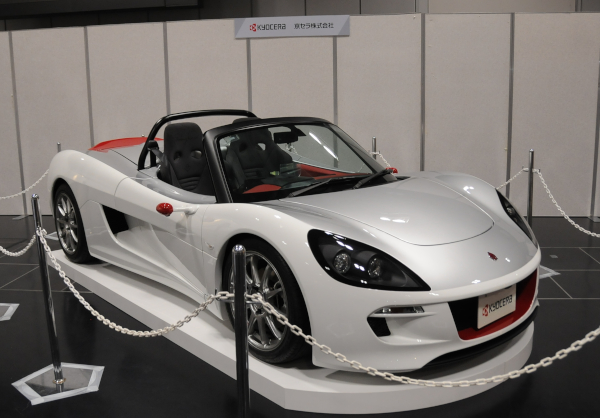
The “Innovation” part of the exhibition showed a few interesting pieces of modern inventions by companies that did traditional crafts; for example there was one traditional producer of gold leaf which is now making ultra thin sheets of copper (think micrometres) for modern electronics. And the experimental kyocera car where the mirrors are replaced by cameras.

Kyocera Car

So yes, that one hour that I had planned turned into three. Partly because I wanted to learn as much as possible, which was aided by the fact that there was an English interpretation service. And partly because I happened to be the only foreigner there on Tuesday afternoon, so it seemed that people were extra friendly and talkative and wanted to show/explain everything in extra detail.

For example, I was invited to try hikizome, a type of yuzen dyeing, and I was asked if I wanted to put on a kimono and pose with one of the “Miss Kimono” already present. And I had to try dashi, fish broth, apparently made by one of the best kaiseki haute cuisine chefs in town. And I got photographed a lot that afternoon. By the end of it, I was so exhausted, I even forgot to buy the ginger mochi I like so much.

Noh Masks.

But, no matter, I went there again today. Not for the ginger mochi only, although I did buy a pack. I went there to pick up my new hanko! One of the crafts on display was seal-carving. I  started chatting with the artist, I mentioned that I always wanted a hanko with my name in katakana. When I wrote down my name, he quickly came up with a nice design – and I ordered a hanko on the spot. I received it today – complete with a little silk bag and some red ink – and I’m absolutely thrilled about it.

I was also thrilled to meet two friends there, rather by accident, which was nice. Also, I handed out postcards promoting whatsupinkyoto.com to everybody who asked about my job. And, as an extra bonus I can now tell you that my (business) acquaintances include the Deputy General Manager of the Kyoto Chamber of Commerce and Industry. Who knows what this might lead to…

Gray Men

Gray Men
Tomotake Ishikawa

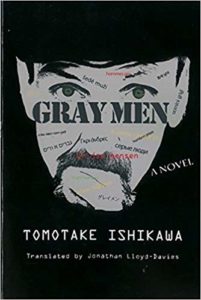
Gray Men book coverRyotaro has had enough of the relentless bullying at his workplace. As he is sitting on a park bench ready to commit suicide, a mysterious man in a gray suit sits down next to him, claims to be able to see what Ryotaro is up to and convinces him otherwise. After Ryotaro has helped the man with a jewellery heist in broad daylight, he is introduced to other people who were saved from the brink of death. Together, they are ready to implement and even die for Gray’s plan to destroy the current rule of the One Percent and to give power back to the disenfranchised of society.

This is an extraordinary thriller I found hard to put down. The things the rich and powerful do – and get away with – are depicted in gory detail at times. And when at the end push comes to shove and Gray threatens to take it all away from them, you see the real lengths they are willing to go through to protect who they are and what they have. You are left wondering how far fiction goes and what might really go on behind those expensive facades.

Tomotake Ishikawa, born in 1985, works in an office as a salaryman like millions of other Japanese. He writes in his spare time and on commutes. Gray Men is his debut novel and in 2011 won the Grand Prize of the second annual Golden Elephant Award (an open literature award for full-length novels written in Japanese).

If you need something quick and easy (and a bit disturbing at times), Gray Men is available at amazon.

Venues

On Thursday afternoon, I usually meet with my English students. For the last few years, we had our class in the “gourmet court” at my shopping center, a large open space in the basement surrounded by a number of small fast food places. The atmosphere is not very stylish, but it is one of the few public places indoors where people can meet and chat without being forced to consume. And there is free water too.

But, as you know, the shopping center is currently being enlarged and renovated, and many of the shops have closed already. In the basement floor, the food court was closed 2 weeks ago, the drug store will follow on Sunday, and even the supermarket will close for two weeks during November. The grand opening of the new shopping center will be in December, no doubt just in time for Christmas and New Year’s shopping sprees.

Anyway, until then we will have to find a new place to meet. Cafes are nice, but you can’t just sit there without drinking anything; outside is not an option, neither are libraries. And while I’d love to visit the Tamayuran more often, every week is a bit much… We’ll figure something out.

Today, we went to Jissoin, a little temple in Iwakura, the northern part of Kyoto. Jissoin is famous for the paintings on its sliding doors and for one room where the wooden floor is so highly polished that the maples of the garden outside are reflected in it. You’re not allowed to take pictures inside the temple, and the garden with the momiji is not accessible, so I’ll link you to the website of the temple with nice pictures during the seasons:

http://www.jissoin.com/information/

Another highlight of this visit were two large maps from 19th century China. One of them was a beautiful star map, but because each culture tends to find their own pictures in the constellations, it is hard even for astronomers to make sense of them. I think I was able to see the Big Dipper though.

And then there was the big map of China from 1825 painted in blue ink (indigo?), an impressive piece of workmanship, mounted onto a large folding screen. Now that I can compare it with a modern map, I am amazed at how accurate it is. The big wall is in the north (depicted in brown), you can make out the Korean Peninsula and the Indochinese Peninsula… Again, no pictures allowed, but if you have time, you have two more days to see the map for yourself.