Reachability

A Japanese address is much longer than a Western one. Generally, it can have the following parts:

satellite photo of Japan

JAPAN
Name of Region (-fu)
Postcode and Name of Town (-shi)
Name of City District (-ku)
Name of City Subdistrict
Name (and number) of Neighborhood (-cho)
Number (and name) of building (and/or apartment)
Name of Person

Note that this from-large-to-small approach is the normal way of writing a Japanese address, very much along the idea that the group is everything and the individual is nothing. Also, in Japan, there are hardly any street names, and if there are any, they are rarely used in an address. Instead, the neighborhood (-cho) and the number of the building are used. Of course, building numbers are not given out consecutively along a road, but consecutively according to the date of building the house…

As you can see, instead of the usual Person-Street-City address that takes up only three lines, the important parts of my address take up six, if I ignore the first two lines which are not really needed for a large city like Kyoto. With a bit of squeezing, I can get it down to five lines, but it is still too much for the average Western database.

I still have an account in Germany and I am still using their credit card, mostly for online purchases. Unfortunately, my German bank insists on sending me physical, paper credit card bills instead of electronic ones, and they just cannot wrap their mind around my address. The last three letters I have received from my German bank used three different subsets of the six lines of my address, but never the complete one.

Once the city district and subdistrict were missing, which is not too bad because the postcode is very specific and this is part of the coding. Another time the building name and number were missing. Thank goodness, the neighborhoods in Japan are very small, and my neighborhood only comprises an apartment complex with a management office, so it is still possible to find me. And so far, only a single time the full post code was present, but luckily the last and thus most important of the seven digits were always there.

I have no idea how this can happen, I have already had several email exchanges with my assistant at the bank about this. It fascinates me that the mail still reaches me, although somewhat delayed of course. Thank goodness the letters are never urgent, and thank goodness there is a post office worker somewhere in Japan, possibly in Kyoto, who goes through all the trouble to find out the correct address so I can receive my mail.

Still, I wish it would be simpler and faster, and I would not cause any extra work for anybody. I will contact my bank in Germany about this. Again…

3rd Kyu!

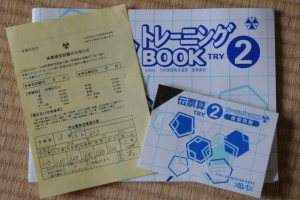
3rd kyu certificate and 2nd kyu exercise booksLast Saturday was my 3rd kyu soroban  test. For the second and third levels, the test ist not during normal classes anymore, but in a special meeting only for those who take the test. It is still in the normal soroban school; from first kyu on and throughout the dan levels, the test will be administered somewhere else with even more official feeling.

Well, yes, I have passed this test, and now I am a third kyu level in soroban. I did quite well, in fact, I passed every one of the six parts of the test. Besides the usual multiplication, division, and addition/subtraction – all three must be passed – there are three more tests on mental calculation, word problems, and denpyou, where you may fail one of the three and still get an overall passing grade. I usually have problems with the mental calculations – I am too slow – but as I used a slightly different method in the test than the recommended one, I even managed to pass this part of the test.

I think I did quite well, passing four exams in only one year, but I did homework every day, and I believe that from now on the tests will be more difficult. The word problems especially become more difficult, for example on third kyu level all of them boil down to very basic arithmethic, but for second kyu there are now exercises involving percentages and rounding, and more than one simple operation. The other problems stay essentially the same, only the numbers are getting larger. Still, that means a considerable speed up to be able to finish enough exercises in the allotted time.

The next exam will be in two months. I don’t know whether I will become fast enough to try the next level then. We’ll see.

Curtain Call

a bundle of ethernet cablesWouldn’t you believe it? After all I have been through (by proxy through my friend) to get internet, one would think that everything was finally sorted and done, finished, file closed. Well, not really… My internet problems got a final curtain call:

Last week I received my first internet bill, and I wanted to set up automatic payment as I did for my other utilities. I was already familiar with the necessary form and I knew that there was an extra space for NTT. So, I took the bill to my bank, filled in the standard form and – that’s where the problems started.

NTT is traditionally a telephone provider, and the form for automatic payment is simple; all you have to fill in is the phone number of your landline. However, strictly speaking, I don’t have a landline. I have a VoIP internet telephone as part of my internet package that I bought through NTT. So, while I could give the phone number on the form, said number is never mentioned on the bill, interestingly. All the bill mentions is my NTT customer ID, but there is no space for that on the form, obviously.

Panic ensued among the clerks, but, this being Japan, I was asked to sit down and wait as usual. From my spot on the couch I could watch the clerk who was serving me repeatedly scratch her head, look unhappily from the bill to the form and back, ask for advice from other clerks… Finally she gave up and with a face of resignation sat down on a desk and made a phone call – presumably to NTT.

Banking in Japan – unless you do it online – is never a speedy business, even if you do not have to wait in line. For that reason, all Japanese banks provide seats and sometimes even newspapers and other reading material. However, with almost an hour for such a simple transaction I must have set a new record.

When I finally received all my paperwork back – with the assurance that everything had turned out alright – the clerk explained to me that the problem was the combined internet/phone bill, but apparently they have found a way to deal with this. Well, I will see next month if it indeed worked…

Expired

Today is cogwheelsthe last day my current visa is valid. And the new one is nowhere in sight… There is no reason to panic just yet, because I am allowed to stay however long the visa application process will take. So, there should be no problems for now.

However, being at the mercy of some random person somewhere in the centre of bureaucracy is not a good feeling… Let’s hope the wheels will turn fast – and smoothly.

Tired

sleeping cat at Toshogu ShrineWow, today was a busy day. I had three different appointments in different parts of the city, something I don’t really enjoy doing, partly because I don’t like to see so many people in one day, and partly because I don’t like rushing from one place to another.

In the morning, I had my German-Japanese tandem meeting. It still goes well after more than a year, but I think my Japanese friend is a better student than I am. Today I had a list of things I wanted to ask him – about an advertisement for a sports club nearby and some very specialised vocabulary for my upcoming shopping trip – and we had an interesting misunderstanding about the German word “zu” which often has the meaning of “to” in English (zu tun means to do), but sometimes is also used as a prefix (as in zuhoeren – listen or zusehen – watch). I’m glad we could clear that up in the end.

Afterwards I took the subway to Kyoto station, where Yodobashi Camera is located. I needed a case for the hard drive I had removed from my old laptop, and although I thought I had chosen the correct one (a SATA) there seems to be a tiny variation in the pins that I could not account for. Thus the disk cannot be connected to the case, which means I will have to go back to Yodobashi tomorrow and try to find another one.

Then, I had a very quick lunch with sandwiches from a convenience store and after I had finished, I went to an appointment with another friend of mine. She is a very nice Japanese lady, and although long retired, she has the energy of a teenager. Talking with her – both in English and Japanese – is lots of fun, even if the topic does not centre around men…

Breakdown

Xray of a laptopIt seems that my old trusty laptop, who was with me for the last eight years (pretty much on the day) has finally completely given up the ghost. Apparently the graphics card is bust, now the external monitor does not get a signal any longer, after the laptop screen broke down some time in March.

Of course, I made a backup of all the files then, and most of them are now safe on my new laptop, but I have used the old one still for a few things here and there, so hopefully I can access those new files I have made over the last month or two. Serves me well not to do a decent backup more often…

Rest in Peace, my dear old HP Pavillion Entertainment PC. I’ll miss you!

Debugging

Summer is slowly coming and with it all sorts of insects… I have already stated that I am neither fond of spiders nor happy with moths eating my sweaters, so it is time to make sure that should they find their way up to myapartment, they will not make their home here.

There are mosquito screens at all my windows which help already. Also, my apartment is almost empty so far and thus easy to clean, with one exception: the tatami. Those are all real tatami made of rice straw and other natural fibres, and they can harbour enormous amounts of insects. Obviously, this is more of an issue on the ground floor of a traditional Japanese house – where said floor is more a lattice of rough planks on which the tatami are laid directly – than in the 5th floor of a modern building of reinforced concrete. Still, I have squished a moth or two in my bedroom already, and there is no need to make them welcome at all.

spray to kill bugs inside tatamiHence, I went out – armed with detailed instructions of a friend of mine – to buy anti bug spray, specially made to be used in tatami. Yes, you have read correctly: in the tatami. The spray, which allegedly kills a variety of bugs, has a needle attached to the can with a tiny tube. The idea is to push the needle into the tatami at regular intervals (six spots per tatami) and then spray as usual, for three seconds. It is very easy and straightforward, and I finished my bedroom in less than five minutes.

So far, this is the only room I have thus treated, because I am not fond of spending time steeped in poisonous fumes. For that reason I will sleep for at least one night in that part of the living room that is designated as the guest room. I wanted to know anyway how noisy this part of the apartment is during the night. The rest of the rooms will be treated in the next few days. My friend suggests doing this both in the beginning and the end of summer. Isn’t it interesting how different climates beget different routines?

Randomised

Only yesterday, I have made another step towards my goal of becoming a good resident of Japan. Behold, ladies and gentlemen: A random citizen of Kyoto!

You’re not getting it, are you? Well, yesterday I have received a letter from the mayor of Kyoto (or at least his office) containing the “Kyoto Citizen’s Social Interactions Survey”.

letter attached to the surveyI am one of only 3000 citizens of Kyoto that were randomly chosen to take part in the survey. It has around 100 questions touching different areas: Actual Social Experience in 27 different fields like environment, human rights, culture, pedestrian friendly city, housing; Importance of Kyoto city policies with respect to the above, and personal interest in city administration. The final question is especially interesting: “Do you think you are happy now?”

Well, yes for sure, thank you! No matter where I lived before, I was never deemed random enough to be asked to take part in such a survey. I cannot help wondering how random it really is though. The envelope contained four sets of questionnaires, in Japanese, English, Korean, and Chinese, which is something that is very rare indeed in Japan. The question is whether there are really so many foreigners living in Kyoto that a survey sent to a random one out of 500 citizens would warrant such a measure? But then again, I was never good at statistics…

Samurai Photographs

Yesterday I went to a photography exhibition, titled “Last Samurais, First Photographs” near the Imperial Palace. A number of 150-100 year old photographs of samurai were display, and I found them very interesting and beautiful.

Apparently, photography was introduced to Japan only in the last decade of the Edo period (late 1850s), but it spread relatively quickly, and by the late 19th century, there were both foreign and Japanese photographers working in Japan. The exhibition – from the collections of the French Guimet National Museum of Asian Arts – showed photos for example from the Japanese photographer Kusakabe Kimbei, a protegé of the Austrian photographer Baron Raimund von Stillfried who worked in Yokohama for 20 years until he returned to Europe in 1883.

Of course, at that time photographs were black and white, but almost all of the exhibits were carefully hand colored, which gave them a somewhat dreamy appearance. The interesting part about this is that they show the samurai’s armor as very bright and colorful in yellow, red, and blue, with brightly patterned kimono underneath.

Although the exhibition started with two photographs of the then shogun Tokugawa Yoshinobu, most of the pictures did not show real samurai, because they had been taken after the shogunate had ended and the samurai class was abolished. Although the armor is real, the people wearing them were normal people without samurai ancestry, or actors of the kabuki or noh theatre.

This can also be seen by the choice of subject. Most of the photos were just portraits, focusing on the armor and different weapons. However, a whole album was on display that depicted – again, in carefully hand colored photographs – the famous story of the 47 ronin, who avenged their master who had been forced to commit suicide. Once they had achieved their goal, they went to his grave and also committed seppuku. Another example is the photo below. It depicts two famous people from the Heike Monogatari. At the left is the accomplished female warrior Tomoe Gozen, who followed her lover Minamoto Yoshinaka (right) into the war with the Taira.

Exhibition Postcard with photo.As I said, the exhibition, although small, is certainly worthwhile. It takes place in the Toraya Gallery on Ichijo dori, near the crossing with Karasuma dori, and will be open until the end of May.

Shipping

I have been working on the basics of my company webpage today. Although I am planning nothing spectacularly difficult, I realised that as the whole world (except myself) is now using mobile phones to go online, I would need to catch up with the latest mobile design and programming models, unless I want to become the last dinosaur on the web. Or maybe the first?

Anyway, I decided to throw some money at the problem and to get myself a decent book on the matter. Yes I know how that sounds. Remember: I’m a non-mobile phone owning, actual book reading dinosaur. So, I was browsing a bit and settled on something that seemed reasonable and I can order it from amazon.

satellite photo of Japan

Of course, shipping stuff to Japan is prohibitively expensive, you get used to that, but what really riled me up was the estimated duration of the shipping: 3 – 6 weeks. Excuse me, how long? People, it’s a book. One single book! I know that Japan is an island, but I am sure you’re not hiring a personal swimmer even though this would explain the price… Come on people, 6 weeks is ridiculous! Shipping all my 42 boxes from Germany – on a real container ship – will not take longer than that, and yes, my things will have to go through customs as well.

Okay, I thought, let’s look at amazon Japan. I’m glad to say that they have the book too and there they have free shipping, but delivery will take just as long. Obviously they are buying the book in America themselves. I’m deeply sorry I can’t read textbooks in Japanese, although, given the subject matter, half of the book will be English words and phrases anyway.

I have resigned to not buy the book as I wanted to be finished with the site by the time the book should arrive. Although not a big fan of learning things that way, I will look for some tutorials on the web, which will hopefully do the trick. Alternatively, I can always have a look at Kyoto University’s library, I know they have a fairly good English section for the sciences.