Tea Ceremony

Every year in August, Kodai-ji Temple holds a special Cool Night Yukata Tea Ceremony in the weekends and this year, I convinced a friend of mine to go together with me.

Of course, we both had to wear Yukata for the occasion, mainly because it is nice, but also because we wanted to get the 500 yen discount that was offered for people wearing yukata. Of course, if you’re wearing traditional Japanese clothing at a traditional Japanese event, you need to go all the way: When making the reservation, we were informed that we needed to wear tabi, white Japanese socks with separate big toe. This is actually standard since it is rude to enter a room (in particular one with tatami) barefoot.

So, one day before the tea ceremony, I went to a special tabi shop on Sanjo dori to buy me some traditional footwear. And: I failed. Problem is that tabi are made of relatively stiff cotton that is not flexible at all, so they are closed at the inside of the ankle with some sort of buttons, for lack of a better word. And, while my feet are the rather standard Japanese size  of 24.5 cm, my ankles are not…

Anyway, the next day in the evening I showed up at my friend’s place with the yukata she gave to me a few years back, a whole pile of assorted accessories including obi and geta and a pair of white socks to put on at the tea ceremony proper. I had hoped that my friend would be able to help me putting on the obi – which alone takes me 30 minutes every time – but it turned out that she hasn’t got a clue how to do this since she only wears a very simplified version that doesn’t require wrapping a piece of cloth the length of an anaconda around your waist… At least she could hold some of the pieces in place while I squirmed into them, her extra pair of hands did help.

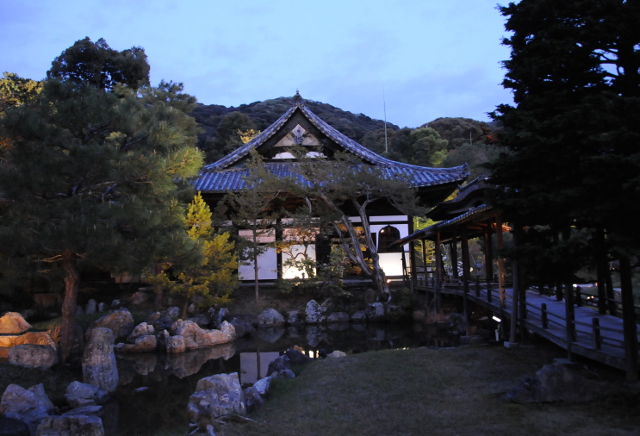
Kodaiji in the nightWhen we arrived at Kodai-ji, it turned out to be a very small tea ceremony with only seven people in total. The setting was less formal that I had expected (and dressed for), we were sitting on little chairs on a low table instead of kneeling on the floor in seiza. The room was beautifully decorated according to the theme – glass – and all the tea utensils down to the tea scoop were made from glass (except the tea kettle, of course).

Since I had been at tea ceremonies before, I roughly knew what to do – there’s a lot of bowing involved – but once again, I completely missed the preparation of the tea. In tea ceremonies for larger groups, the main host is entertaining the guests by smalltalk or explaining the tea utensils or the art used in the tokonoma. Meanwhile, another person actually makes the tea for the top one or two guests, and all the other guests get their tea served from behind the scenes.

I found the sweets that were offered before the matcha a bit tasteless, but they looked like a heart placed behind glass to fit the theme. What I really like about tea ceremonies is that afterwards, you are invited to inspect the room and check out all the tea bowls and other utensils and the tokonoma as well. Sadly, I didn’t expect that it was allowed to take photos at that time, so I didn’t bring my camera…

Oh well. In any case I had fun and spent a nice evening at the temple, although it was very hot outside even after the sun went down. The yukata didn’t help with that either. One thing I still have to figure out is how my Japanese friend can look all cool and poised and relaxed at a hot night like this while I look like I’ve just emerged out of a steam bath and getting ready to burst into flame…  I shall investigate.

Ayu

From the time I was a child, I’ve always liked eating fish. This is interesting, since Austria has no access to the sea, and we chiefly subsist on pork and potatoes. As a child, fish was mainly those deep frozen/fried fish-stick kind of things, and when I was a bit older, we occasionally got fresh trout from a family member who had a fish rearing pond.

So, now that I’m in Japan, one would think that I’d eat a lot of fish. Well, yes I do… kinda. Sadly, I mainly stick to sushi and salmon. To be honest, although the fish and seafood section in my supermarket is huge, I am a bit intimidated – I mean, I have no idea how to cook this properly!

But of course, now I am an adult with lots of curiosity and said supermarket next door plus: enter the internet! I am proud to report tha I have already cooked myself spicy clams with spaghetti, and even though I probably got the wrong kind of clams (it was an Italian recipe) I was very happy with the outcome. My proudest moment, however, was when I tried the ayu.
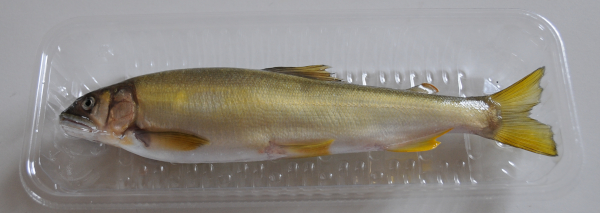
Ayu, also called sweetfish, are small freshwater fish that are very popular in Japan and other parts of Asia. They are eaten throughout summer and are available at almost any matsuri where they are grilled over an open fire.

So when I saw the fish above, I was intrigued but also a bit worried. As you can see, this is a complete fish, bones and innards and all – do I have to do that cutting that stuff out myself? So I asked one of the staff at the supermarket, an elderly man. First of all, he explained that this was indeed an ayu (there are many kanji for this fish, none of which I can read: 鮎, 年魚, 香魚) and then he said that no, Japanese people eat the whole thing. Really.

After some deliberation, I thought, oh well, let’s try this. Thankfully, not having to cut off any pieces made cooking it very easy – I simply put it on the little fish grill of my gas stove. And because ayu are maybe 20 cm long at most, it took only around 10 minutes until it was done.

Overall verdict: The term “sweetfish” is accurate, the meat was tender and very delicious. I only used a bit of salt to cook it and put some lemon juice on it before eating. Full disclosure, I did not eat the whole fish after all, leaving the spine, head and innards, but it may be something I’m willing to try at a later point, of which there will definitely be many!   

Summer Joys

Yesterday, after my physio therapy session in the morning, I went down to Nijo Castle. The old residence of the Shoguns is on eof my favourite places in Kyoto and over summer, offer a special treat: Visitors are allowed to enter some of the rooms of the Ninomaru palace and see the famoous fusuma paintings of the Kano School close-up!

Of course I had to go and I was very excited when I went there – just to find out that the palace was closed for the day and only the gardens were accessible… Yes, it’s my job to know these things, but even I am not infallible… I didn’t enter after all, I like the palace gardens but I don’t consider them spectacular and worth a visit without seeing the palace. So much for my treat!

Although, to be fair, I did have another treat: Yesterday was doyo-ushi-no-hi, the day of the ox in midsummer, traditionally considered the hottest day in summer, even though this year the heat and especially the humidity is very bearable.

Tradition dictates that on this day of the ox you eat eel – unagi – and I am lucky enough to have a little Japanese restaurant nearby which was selling take-out unadon (a ricebowl topped with unagi) for lunch. Doesn’t look like much, but it was delicious, much better than the stuff I would have gotten at the supermarket!

In the evening I discovered that my trip to Nijo Castle had left me with a slight sunburn on my arms, which is the usual way for me to get tanned at all. So yes, the joys of summer… 😉

Tsuyu

raindrops on a windowIt’s tsuyu – rainy season – in Japan. It’s been raining almost every day for at least two weeks and everything is grey and annoying – and surprisingly cool. Usually, the rainy season is the beginning of the sweltering summer heat, but so far, it has been comparatively cool with maximum temperatures of around 30 degrees, and it is also comparatively dry. Summer will be coming soon though, two days ago I have heard the first cicadas singing.

The constant grey outlook from my window doesn’t really help with anything right now, and on top of that people are still cautious because of the Corona Virus. In Tokyo, the infections are rising, with more than 100 newly infected people daily for the last week. Most of these new cases seem to center around entertainment districts and thus affect younger people. It appears that Tokyo is heading for a second wave already, and they have just raised its alert for the novel coronavirus pandemic to the highest level of four. I am not sure what this means, but I hope that we don’t have to go into a stricter shutdown again. Not until I’ve bunkered enough chocolate, that is.

Kyoto’s Finest

Two weeks ago, on the way to town, I had a little accident. I usually cycle along the river, and there was an old man walking smack in the middle of the path. It was narrow there because of uncompleted road works and I didn’t know whether to pass him left or right, so I pulled the brakes. Unfortunately, the gravel left on the path from said road works made me slip and fall.

The result: bloody abrasions on my right knee and elbow. Before doing anything else, I would have to wash off the dirt and the blood. But where? I looked at the river but finally decided to go to the nearby subway station at City Hall to clean myself and assess the damage.

There, in the women’s toilet, a friendly lady asked if she could help, but I told her that I was just fine, thank you. She did not believe me, apparently, because a few minutes after she had left, two station staff came to look for the – literally – “bloody foreigner”.

Suddenly, I felt nauseous and that’s when the guys put me in a wheelchair and wheeled me to the station office, a thankfully short, but still humiliating experience with plenty of passengers staring at me. In the office, they patched me up with gauze, bandages, and tape. All the staff were very helpful and friendly and made just the right amount of fuss about my wellbeing before sending me on my way again.

I am happy to report that my wounds were very shallow and have since completely healed. I can only recommend Kyoto’s finest – and hope that we won’t meet again any time soon…

New Rules

The other day, I had to go to the hospital for my quarterly checkup and medication refills. This means that first, I have to get a bloodtest before I can see the doctor a few days later. While I have a fixed appointment for the doctor’s visit, the bloodtest is simply walk-in, which means that it is impossible to predict how long it will take overall. The longest it took was close to two hours if I remember correctly.

However, last week, everything was said and done in 20 minutes, from the time I walked into the building to the moment I walked out again with a hole in my arm and the bill in my pocket. Never before, in all the 6 years I’ve been going there for the procedure have I been that fast!

So, when I saw the doctor three days later, I mentioned it. And he explained that the hospital is now giving out medication for long-term patients whose conditions are stable without them having to come to the hospital. All they need is to fill in a form, fax it to the hospital, and they receive the prescription and can go to their pharmacy without seeing a doctor.

Great. Why do I always hear of these things when it is too late already? This would have saved me 3000 yen this month. Anyway, I have one of these forms now, but I guess by the time my next appointment rolls around in September, the measure will have been scrapped again. We’re not going to live with the Corona crisis for another three months. Right?

Back to Normal

So, here we are, on the other end of the Corona pandemic, and things are getting back to normal. How I know this? I’m getting advertisements in the mail again, beyond take out menus I mean.

Also, just last Friday, I received the two face masks that Shinzo Abe promised, what, 2 months ago? They are of surprisingly good quality, the fabric looks thick and sturdy and it’s in 2 layers. The only downside is that they are a bit small, only about 75% of the width of a usual facemask. But we may not be needing them soon anymore.

Maybe I should quickly recap what I was doing the last seven weeks instead of working full time:

  • Since the lockdown was not strictly enforced, I visited a few new places in Kyoto: Tenryu-ji (I mentioned that), Mibu-dera (not worth it), and Kenkun shrine (very cute). And I did that Haunted House thing which turned out surprisingly fun.
  • I finished some long-overdue sewing projects, like a new noren for my living room, new mousepad and pillow cases and I made a new cover for an old notebook. Besides that, I fixed some clothing too.
  • I did some smaller repairs in the apartment, including cleaning it thoroughly and sorting through paperwork, the latter did no produce as smaller a pile as I had expected, but I did throw something away, which is always difficult for me for some reason.
  • I did do some work-related stuff too, like updating the 2017 archives over on What’s up in Kyoto (except for June because that’s a mess and I’m not sure how to deal with it), and I’m also all but ready to launch a new website for my overall business (since the event calendar is just a part of it). And of course the daily facebook posts of the Kyoto places to visit instead of the usual events and constantly updating what is closed/cancelled, which took a whole lot of time and was very frustrating.

So yes, I have started working again “full time” since yesterday, but I’ll have to take tomorrow off already because I have two doctor’s appointments, need to get my bicycle fixed and I need to see my hairdresser, desperately. Things are off to a good start, no?

Stepping Out

I had a wonderful and rather busy weekend, now that we can finally go out again!

On Saturday, I was invited to visit a haunted house in the middle of Kyoto. I thought it would be fun and indeed, it exceeded my expectations! The theme was “abandoned school”, apparently that’s very popular in Japan, and a whole basement was turned into a dark labyrinth with black curtains and old lockers. There were mannequins and lots of severed heads with long black hair waving after them, and a coffin with a skeleton as the center piece.

Of course, if you go in there as an adult, you think: Oh well, how scary can it possibly be? But when you’re down there in the dark with nothing but a tiny flash light in your hands, navigating the corridors that get more and more narrow…. and then something comes at you from the darkness… It was scary indeed, and I needed a few minutes afterwards to normalise my heartbeat. Very simple methods, and very well done!

And yesterday, I went all the way to Arashiyama in the western outskirts of Kyoto. In general, I don’t like going there at all because it is one of the most crowded tourist spots in Kyoto. Now, however…

I was there just before 10 in the morning, and I went to Tenryu-ji first. This temple is part of Kyoto’s UNESCO World Heritage, but to be very honest, I’m not entirely sure why. I loved the dragon painting on the ceiling of the main hall, but it’s a modern one, around 25 years old only. The abbot’s quarters I didn’t find very exiting either. The gardens were nice though, and I spent time exploring all of it. They must be fantastic during the koyo, and there is an enormous weeping cherry at the center of it that is surely beautiful too.

Afterwards, I visited the Saga Arashiyama Museum for Arts and Culture again. They have an exhibition comparing works of Maruyama Okyo and his student Nagasawa Rosetsu, both painters of the Edo period. The museum is not very large, but the pieces on display are exquisit. I especially liked a Rosetsu painting, where he shows a single cicada on a bamboo; the insect has so much detail, you have the impression it might take off any moment.

Kyoto's Bamboo Forest, completely empty.

Finally, before I went home, I took a stroll in the famous bamboo forest. As I said before, I dread going there because it is so crowded all the time, but this time, it was practically empty. I’m sharing one of the photos I took there, this was around noon time! I’m not sure if I should wish for tourism to pick up again (for business reasons) or to stay like this for a while (for my personal pleasure).

Speaking of pleasure: I will probably start posting here “full time” next month again. I hope that I will finally have something to tell you again, and more motivation to write about it too. Until then!

Neue Lage: 20 Tage

Well, 19 days left of the state of emergency if we’re crossing off today already.

I’m sorry, I have no idea what to tell you. I’m sitting at home except for twice a week when I go shopping and that’s that. I’m spending lots of time talking to myself, but that doesn’t provide many new insights or talking points, really.

Outside the situation seems the same. Many restaurants and larger shops are closed while the smaller ones stay open.When I went for my physiotherapy yesterday, all the therapists were wearing plastic shields additionally to the face masks and gloves they had donned 3 weeks ago already. It makes for a rather surreal feeling, I’m lying on my back, getting my leg massaged while the therapist stares at me from behind that plastic shield, like looking at a guinnea pig. Given that I’m not sure whether the therapy helps – I have pain-free days and others where I can barely walk – I would say the feeling is quite accurate.

I keep doing little things around the house and for work. I even created a special “Big Corona-Quarantine To-Do List” and I am actually getting things done. I’m mighty proud of myself. Other than that, I’m counting the days. Mostly because I hope my general outlook will improve again. Hopefully.

Extension

Just as expected, Japan’s government has extended the national state of emergency until the end of May. That’s what we know for now; there will be a review of the situation around May 15. It seems that there are discussions about opening some public venues sooner, like museums and libraries etc. if measures for disinfection and social distancing can be maintained. We’ll see.

For now, things are very quiet still, but then again, it’s Golden Week now anyway. Many temples are closed, but smaller shrines work as usual. Last week I visited Kenkun Shrine, a modern one (merely 150 years old) on top of Funaokayama, which is a small local park and fun to visit in itself.

Other than that, I’m staying home more or less, and I’m trying to do some long-open projects both for work and in my private life that I never got done. I am also cooking a lot now, and with a little trick (do the dishes while your food is cooking), my kitchen has never been so clean.

My friend from recent bath-salts fame has sent me another little package: Matcha cookies and waffles from a seller in Uji, where the most famous Japanese green tea comes from. So yes, I’d say I’m doing just fine. Not better, but definitely not worse. For now.

3 types of matcha cookies