Green Tea

Even though more and more Japanese people enjoy drinking coffee – specialty cafes are everywhere now – the staple drink is still green tea in all its forms. Come summer, the Japanese will drink it as their main refreshment when out and about, and in many restaurants, you get free green tea as a drink right away upon being seated.

The first tea seeds were imported from China back in the 9th century, and green tea was first used as medicine. Around the 12th century, aristocrats and monks picked up the habit of drinking tea, and finally everybody did it. Note that here I don’t mean powdered matcha, this is a completely different animal I will talk about some other day.

There are a few different types of tea plants, but mostly, the Japanese green tea you can buy is blended from the Yabukita cultivar leaves grown in different regions in Japan. What is most important with respect to taste is whether plant grows in the shade or in the sun. Tea that is grown under protective black netting is said to taste sweeter and also has a stronger green color. This type of tea can be very expensive and is often used to make matcha in Japan.
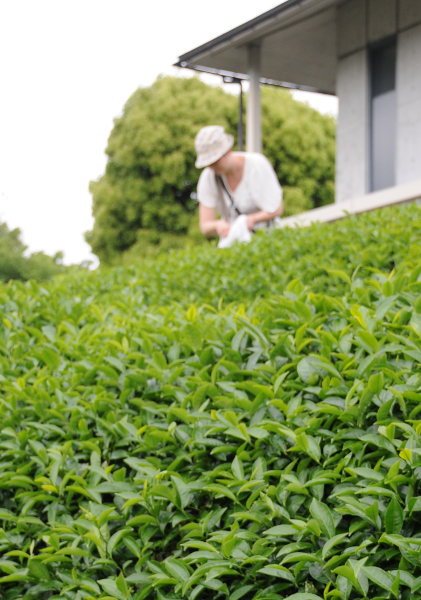
Picking fresh green tea leaves

Now, how to make green tea? First, there is the tea picking. Fresh leaves begin to come out in April/May (called: first flush, usually the most expensive tea is first flush) and what is picked is not more than the top two or three leaves of each branch. These leaves should be light-green and relatively small compared to the larger and darker leaves towards the bottom of the tea-plant.

The freshly picked leaves have barely any smell at all and as the very first (traditional) step, they are roasted at 180° C in a pan for example. This prevents the leaves from oxidation and is an important step of making green tea instead of black tea.
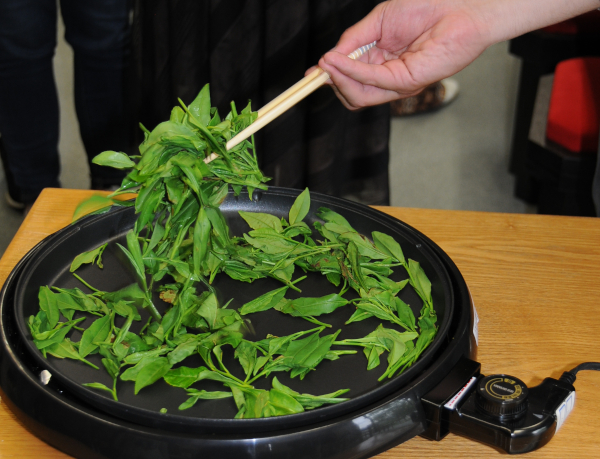
Making green tea - roasting the leaves

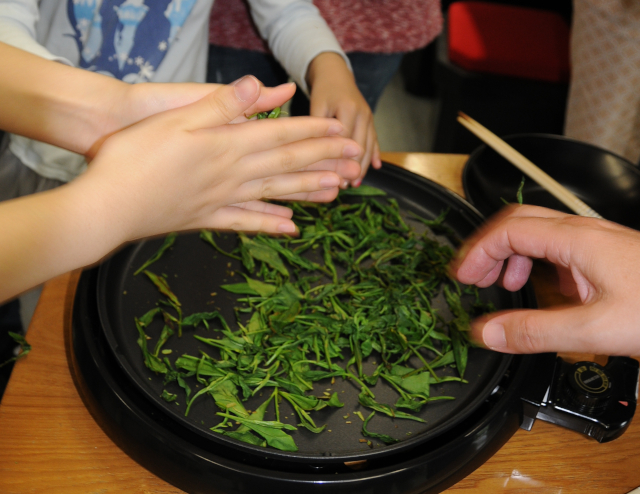
Cooling the tea leaves and reducing the heat of the pan to about 80° C, the next step is called “tea rolling”. Traditionally, people would pick up the tea leaves from the pan and roll them with their hands, all the while keeping the leaves nice and hot. This rolling is meant to break up the leaves and reduce their moisture, and even for very small quantities, it can take 20 minutes and more.Manual tea rolling
After the tea rolling, the temperature is reduced to about 70° C and the tea is slowly and fully dried. The leaves have now a uniform size and they give off the typical smell of green tea. They may be rolled and dried again, but in principle, no further steps are necessary, and the tea can be drunk right away or blended into special brands.

Matcha – powdered green tea – is made from dried tea leaves as above by simply grinding them to a powder. Other than standard sencha, matcha is rather delicate and cannot be kept for too long. This is why matcha is sold in rather small quantities.Freshly dried green tea
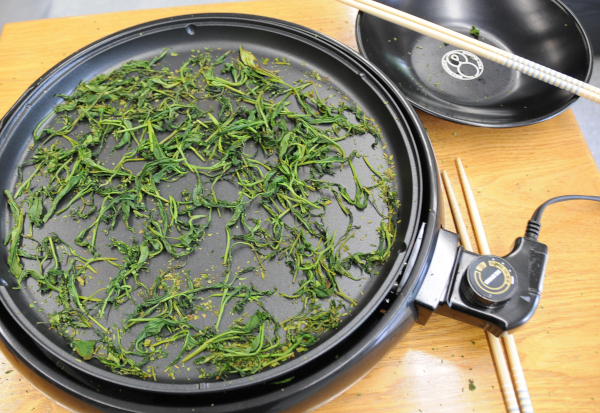
Even today, the three steps above are still done by hand for the most expensive brands. On an industrial scale, the heating of the tea leaves is mainly done by steaming in Japan. Still, overall, the procedure of making green tea is quite simple, and there are many opportunities in Japan to pick and produce your own tea.

Each year, Japan produces about 85 000 tons of green tea (exclusively). As mentioned above, there are a number of regions where green tea is produced, but most tea comes from Shizuoka prefecture. In Kyoto, tea from Uji has a special ring to it; Uji is very close to Kyoto and there, the first tea plants were grown from the seeds brought from China. Tea from Uji is mostly made into matcha that is used at Kyoto’s many tea ceremonies.

Both matcha and standard green tea come in many price ranges, but I have yet to find out where the difference lies. In the meanwhile, I can definitely recommend green tea as the perfect souvenir from Japan, no matter the price.
My Sweet Request

As I mentioned about a month ago, during my fasting I kept buying chocolate because Meiji had those special wrapping entitled “my sweet request” for my favourite chocolate bars.

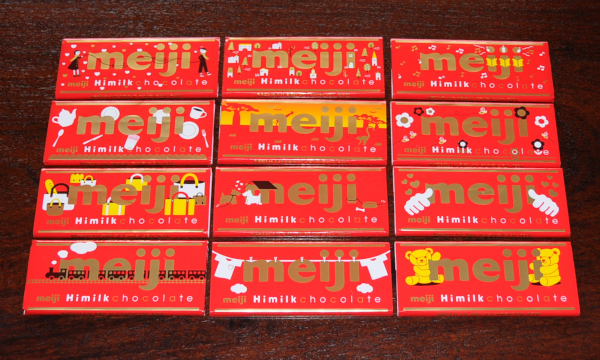
As you can see on the outside, there is a picture of something people may want, and on the inside of the wrapper, there is written a “sweet request”. There were in total 36 different wrappers for the hi-milk, standard, and bitter chocolate bars, but since I don’t eat the latter, I did not buy any of them except for a single one that said “I would like to live with a cute cat.” Yeah, definitely true that one!

meiji hi milk chocolate

It took me a while to gather all 12 different requests on the red Hi-Milk Meiji chocolates, and it took me yet more time to eat all that chocolate to find out what the sweet requests actually were (no cheating allowed!) Here they are – can you guess to which wrapping they belong?

  • I want to take photos inside the Hiroichi flower garden that continues to the Ikedaira line.
  • I want weird T-shirts.
  • My dream is to live in a house with a pool.
  • If you only had one day off, where would you like to go?
  • Would you like to have a relaxing chat at afternoon tea?
  • I want to become a person who looks good with a trendy tote bag.
  • I would like to live with a stuffed toy that is more merry than myself.
  • I have a stiff shoulder – I’m glad if somebody has a look at it.
  • Everything is fine, so I’m waiting for the best thing in the world.
  • I want you to invite me on a date where we go to a concert where we have to dress up.
  • I want to squeeze a cute dog.
  • I will cry for joy when I can go and see the big baobab trees.

Preoccupied

Flags of Austria and JapanI had a great Saturday – I went to a small city near Nara to pick tea – right until the moment when I came home late at night and decided to check emails and news online. And what news there were!

Austria’s vice-chancellor had just resigned over what is now known as #ibizagate – just look it up. Finally there was something grave enough even he couldn’t just shrug it off (although he and his party definitely tried and keep trying!)

So, in light of the developments, I spent the night watching Austrian news and reading live tickers about the affair while drinking a bottle of my favourite Austrian wine. (Now that I think of it, I always drink that wine when there’s something political going on in Austria… hmmm…) Rinse and repeat on Sunday and Monday, and i would have done the same today had it not been for several appointments.

As you might guess, I’m a bit preoccupied with Austrian politics at the moment. It has already been decided that we’ll have new elections in September. It can only go uphill from there!

Sugimoto Residence

As I mentioned in my post last Tuesday, the highlight of my extra long Golden Week vacation was my visit to the old Sugimoto family home to see an exhibition of Boy’s Day decorations. Unfortunately, it was not allowed to take photos in the house, but here is the homepage of the Sugimotoke with a lovely gallery of the building and its gardens:

http://en.sugimotoke.or.jp/about-sugimoto-residence/introduction/

The Sugimoto family were merchants who sold fabric for kimono and their old machiya – built in 1870 is open to the public at very special occasions only. The house is quite large, even for a wealthy family, and it has a number of special features that I haven’t seen elsewhere before:

A special room where a visiting priest could wait and get changed into formal clothing before praying at the family altar. This room lies on the other end of a corridor which, to honor the status of the priest that came from the Nishi Honganji Temple, is laid out with tatami. This is highly unusual, since corridors in kyo-machiya or other old houses tend to be from wood.

The room with the family altar is considered the main room of the house, and having a private prayer room in a commoner’s house is highly unusual. The altar is located in a small two-tatami space that can be closed with fusuma and seems to me rather usual, but the interesting bit is the room itself. It has a small cellar underneath made from stone, where the altar could be moved in case of a fire. Basements like this are very rare, especially in such an old house, but this one was – thankfully – never needed.

The other interesting feature of the house was in the large main guest room, and I don’t even mean the lacquered tokonoma that was only uncovered at special occasions. The guest room is an already impressive 10 tatami room, and as usual, just by removing the sliding doors to the adjacent room, it can be enlarged by another 6 tatami. The interesting part is that the wooden grooves for the fusuma (in Japanese they are called shikii), can be taken out of the floor. The tatami from the adjacent room would be moved up and thus create a space of 16 unbroken tatami for very large events. When the event was over, the tatami, grooves, and fusuma would be put in place again, and normal life could be resumed.

There is also an interesting Western-style drawing room near the entrance that was built in 1929 and has cork flooring, modern furniture, and a piano. The low ceiling was taken out and the room now covers what has once been two floors at once, with an extra window on the former second floor. This makes the room feel very spacious, airy, and bright.

Unfortunately, it is not possible to enter the gardens or to see the three kura storehouses. Still, just sitting in the rooms gazing out the large windows grants a nice and relaxing frame of mind.
The Sugimoto Residence is one of the largest kyo-machiya still existing in Kyoto. In 1990, the house was designated as a Tangible Cultural Asset by Kyoto City and in 2010, it was designated as a National Important Cultural Property. One year later, its garden was designated as a National Site of Scenic Beauty.
As I said, it is only open for special occasions and it’s not possible to take photos inside. But if you are in Kyoto and even remotely interested in old houses, this is definitely one to visit!

Going Pro

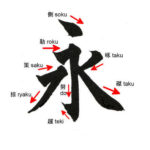
8 strokes of eternity
taken from www.japanvisitor.com

As I probably mentioned somewhere, for the last two years or so, I have been going to Japanese class once a week with a very nice and dedicated teacher. We have gone through several book by now, focusing on the detailed aspects of Japanese grammar, mostly. By now I can more or less survive the daily intricacies of life, ask for help if needed, and in extreme cases where I have time enough to prepare for I am still handing out written requests.

Still I feel that I’m not getting anywhere with my language skills. Part of it is certainly that I am not very good at studying. I do my homework mostly, but then there’s always something to do for work and by the time it’s evening I am too tired or whatnot. I am very good at making excuses!

However, it cannot go on like this. This is my 6th year in the country and I really need to get up to speed with the language. I want to live here, after all, and even more so: I want to work here. My friends are very helpful, but I cannot keep relying on them forever.

So, I have decided to make my Japanese studies a part of my daily work routine. I am now setting aside one hour each workday to study Japanese. At the moment, work has slowed down a little, so this is easy; clearly I cannot keep it up if I ever get another month of 13-hour workdays, but that’s not for now to worry about. I am not sure if I should set myself a goal, like taking the JLPT Japanese test in December. For now, I just need to get back onto that horse again and get my studies going properly again. We can discuss testing later.

End of Hiatus

Hi, I’m back – remember me? Sorry for not posting last week, I needed a break from writing for a while… I’m fine so don’t worry and now I’m back in full glory and with a bit more energy – hopefully even enough to start my weekend posts again…

My Golden Week holiday turned out to be a mix of work and fun stuff. In the first weekend, I went with friends to Kyotographie, a large international photography exhibition event. And because said friends came from Kobe and Osaka, we were determined to see all the venues in just two days. And we managed: 11 venues with art by various international photographers, all in less than 30 hours. It was fun – and very exhausting, but we’re planning to go again next year!

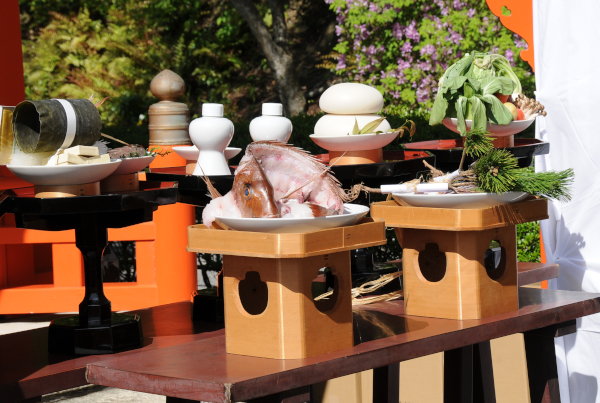
Later that week, I visited three exhibitions and one traditional event at Yoshida Shrine. This was a so-called shiki bouchou ceremony where a large fish is cut and offered to the gods – in this case, the God of cutlery. The interesting twist here is that the fish is only touched with two large metal chopsticks and a large knife. There are a lot of specific movements and (forgive my language) waving of the knife before the first cut into the fish is made. At the end, the fish is put onto a plate and served to the gods.

Offerings to the gods

I had seen a shiki-bouchou ceremony before and to be very honest, I was slightly disappointed. When I saw the ceremony the first time, the movements and cuts were very smooth and executed with a lot of confidence. This time, I had the feeling that the priest performing the ceremony was very nervous, and although I did not have the best view, I could see his hands tremble on occasion. Whether this was because he was unfamiliar with the task or because of the film team directly in front of him, I can only guess.

The ceremony was a relatively small affair, but the first two rows of seats were reserved for dignitaries somehow connected to Kyoto’s food industry, like the “Head of the Kyoto Kaiseki Organisation” and suchlike. They were allowed to pay their respects to the gods at the end of the ceremony, obviously in return for making a significant donation to the shrine.

The ceremony took about one hour overall, and afterwards my friend and I were left wondering what would happen to the food that was just offered to the gods, the fruit, rice, and vegetables in particular. I guess nowadays it would just be thrown away, but I would not be surprised if, in the olden times, the priests would eat the leftovers after the gods had partaken…

Anyway, although I had fun at this ceremony, it was not the highlight of my last two weeks. That one came at the end of the Golden Week: A visit to the Sugimoto Family Residence. However, this one deserves a post of its own, possibly in the weekend. 😉

The Beginning of Reiwa

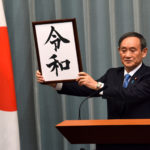
Yoshihide Suga , Chief Cabinet Secretary announces the name of Japan’s forthcoming new eraYesterday a new era has begun with the ascension of Emperor Naruhito to the chrysanthemum throne of Japan. The era name  is Reiwa, and there is much hope that it will be just as peaceful as the preceding one.

Usually, the ascension of a new emperor is a somewhat solemn affair because it also means the death of the previous emperor, so you don’t really know whether to celebrate the occasion or not. This time, people were free to celebrate: They stayed up all night, celebrating at midnight at May 1st; they visited popular spots to watch the sun rise in the new era, which is a popular thing to do on New Year, by the way; or they visited the imperial palace in Tokyo to try catch a glimpse of the new emperor and his wife.

I’m wondering if and how things will change with the new emperor. I am especially curious which role the new empress will take. She didn’t have an easy time adjusting to the ceremonial overload in the palace, but now her status has changed and she may just be able to go out and expand her role beyond the traditional ones. Time will tell if she becomes just as beloved as the Michiko, Empress Emerita.

The End of Heisei

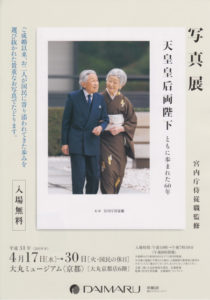
60 years imperial coupleToday is the last day of the Heisei era. Emperor Akihito abdicated and is now the “Emperor Emeritus”. This sounds a bit funny to my ears, because I’ve only every heard “emeritus” in an academic setting. Of course, most members of the Japanese imperial family have a university degree or other, and honorary degrees as well. But that’s just as an aside.

The Heisei era spanned 30 years of peace for the Japanese, and the Emperor Emeritus, who grew up during WWII and its aftermath has expressed his gratitude for that. Together with his wife, he has visited many countries and has tried to make amends for war crimes not of his own doing. Also in Japan itself, the imperial couple has travelled widely, visiting many smaller communities over the years. This and their attempt to position the imperial family closer to the people has endeared them to many Japanese of all ages Especially their visits to shelters for refugees after the Fukushima tragedy in 2011 are memorable in this respect (even if they are not the only ones). We will see if the new emperor, who formally ascends to the throne tomorrow, will be able to follow in his father’s footsteps.

I would like to say something about the general mood in Japan right now, but I am not sure what it is. Certainly everyone has an opinion, but which one is hard to gauge, especially for the younger ones. It appears that many people are happy for the Emperor Emeritus and wish him a long and peaceful retirement. Some people treat the occasion like a New Year and will stay up and celebrate the beginning of the new era at midnight.

I myself am curious what will happen now. While the emperor plays a minor role politically, it is a new beginning after all, and people do get energised by that fact alone.


Fast Work!

stack of papersI must have mentioned it a number of times before, but still: Japanese efficiency never ceases to amaze me! In the beginning of April, I mentioned that I now need new pension and health insurance and that I went to the pension office to subscribe. The nice young lady told me it would take them 3 weeks to process my application, but they were even faster than this! I received all my paperwork back after two weeks and two days. As part of the paperwork, I received a nice blue insurance card and stickers that I can put on the card to indicate that I’m fine in receiving generic medication, something I have not decided yet.

Anyway, I’m now officially enrolled in national health insurance and pension plan. That meant that I needed to go to my ward office and cancel Kyoto city’s health insurance that I had until now, so I would not end up paying twice. I went there last Tuesday with some trepidation, because the last time I had had to go there, there was nobody who spoke English… But everything turned out to be super easy: I simply handed over both insurance cards, the clerk entered something into his computer, made a copy of both cards and returned the blue one to me: “Finished,” he said, and that was that. The whole procedure took less than 5 minutes, including the wait.

Still, I cannot help being a bit cynical now: Officially, I enrolled in national health insurance on April 11. Does that mean, I’ll have to pay the first 10 days of April to Kyoto city’s insurance while at the same time getting a reduction of national insurance for April? Honestly, given the way how Japanese are sticklers for even the tiniest details, I would not be surprised…

Fasting Aftermath…

Happy Easter! Okay, yes, that was last weekend, but still I am very happy: I survived my chocolate-free time! And I actually did binge on chocolate on Easter Sunday… Here’s a recap of the last weeks:

It’s good to know that I can do things if I truly want them. That’s not big news, really, but it’s nice to have  a reminder every now and then. Interestingly, I did not have massive chocolate cravings during my fasting, but that may have been because I had the outlet of eating other sweets. I learned that I “need” chocolate when I’m feeling down, when I’m really stressed, or when I want to celebrate something. That’s not much news either since for me, chocolate is indeed the epitome of “sweets”. Other stuff just doesn’t cut it.

And that’s probably the reason why I didn’t lose any weight at all in the last weeks: I simply ate other sweets, and because I find them less satisfying, I ate more of those than I should have. Interesting to know for future reference. I’m not sure if I’ll do this challenge again next year – and then not eating any sweets – but we’ll see.

One good thing is that I could finally save all the 12 different Meiji chocolate wrappings that they have out at the moment. Each wrapping is different, they are called “my sweet request” and inside of the wrapping, there is a special wish written. On the one in the middle of the top row, it says “My dream is to live in a house with a pool”. I’m curious what the others have to say, but I’ll try not to eat them all at once. I know how to refrain by now. 😉meiji hi milk chocolate