Kisen de Oden

Sorry for not writing on Sunday. First I was occupied and later incapacitated…

A friend of mine took me out to Otsu, some 30 minutes east of Kyoto. Otsu is the capital of Shiga prefecture and the largest city situated on Lake Biwa which in its turn is the largest freshwater lake of Japan. Both Otsu and Lake Biwa are popular day trip destinations from Kyoto, and there is even a path over the mountains from Kyoto to Lake Biwa, but it is probably not for the weak of limb…

Anyway, we went to Otsu on Sunday evening for a Kisen-de-Oden. Oden is a soup or rather a hot pot that is eaten throughout Japan during winter: in a light broth various types of fish cake are boiling, together with a whole egg, some daikon radish, and konyaku. It’s a bit like shabu-shabu with the difference that the ingredients are already pre-cooked and just heated in the hot pot.

Kisen means boat in Japanese, and Kisen-de-Oden thus means that you eat Oden while riding in a boat somewhere on the lake. Well, it didn’t work out like that exactly, but still: There was a short trip by boat from the main harbour of Otsu to the little landing at the old Biwako Otsukan hotel. This is a lovely building situated directly on the lake with a beautiful garden right next to it. Of course, when we arrived it was dark already and neither the building nor the garden could be seen. However, Otsu lies on the southern tip of Lake Biwa, and surrounds a good part of it, so there was a wonderful view of lit up Otsu from Otsu across the lake.
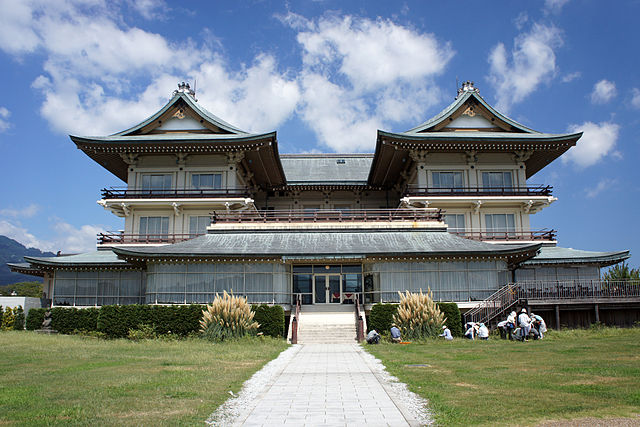
Old Otsu Hotel at Lake Biwa(photo by 663highland on Wikimedia commons)

The Oden was an interesting mix of French and Japanese cuisine. We had cooked beef in sauce, some hearty egg pudding, and foie gras as appetizers. Then the pot for the oden was heated on our table, and we were supposed to eat it – and top it off with the grated cheese that was provided. When the oden was finished we put a fried, plain onigiri rice ball into the remaining soup to make our own risotto. My overall impression was: interesting combination, but delicious.

With these sort of things I am never sure whether they are meant for the food or for the drinks. Together with the ticket, you got three coupons for free drinks (I chose three glasses of wine) plus an additional glass of hot wine on the trip plus another additional glass of wine upon arrival. That’s 5 glasses of wine – within 90 minutes, not for the weak of stamina… Of course, as usual in Japan, the whole evening was minutely planned, and executed as well, and while the waiters held themselves in the background, you still had the feeling of being rushed a little. 30 minutes more would not have been amiss.

After 75 minutes in the restaurant we had to leave and were taken by boat back to Otsu harbour again. My friend forgot to order dessert (which was a good thing because there wasn’t time enough for another course anyway), so we went to have pancakes in a Hawaiian restaurant (of all places) near the train station.

Altogether I had a nice evening in Otsu. The place looks peaceful in the night and worth examining further. I have been there before for Otsu matsuri (with the same friend) and this time we kinda sorta got invited to return for the Otsu fireworks in summer. But that’s still five months to go, and with a bit of luck I will go there earlier.


Appeal

Just before the end of last year, I did my tax return for the time I spent in Germany. I have five years to do them, so I was just in time. In 2012, I had spent about 5.000 EUR on my grandmother’s move to a nursing home, and I expected a hefty return because of that.

I received the tax return a few weeks ago and, what do you think, how much did I get back? Nothing. Nothing at all; in fact, I even owe the German government 4,32 EUR on taxes for 2012. The reasoning for this was twofold: First, that my grandmother’s move was “not extraordinary” (sure, since she’s 90, she’s moving every 3 months, her final hobby…); and second, that the government kind of expects people to take care of their immediate family, another way of saying: Your private problem, honey.

I am furious. Because let’s assume that I spend 50 EUR on somebody to unclog my toilet. Or 500 EUR on membership fees for a church. Both I would classify as private problems as well, but in Germany both are perfectly deductible. Heck, the church taxes would probably be deducted automatically without any further input of mine.

stack of papersSo, I waited until I was not fuming quite so hard anymore, and after having a not-so-good day already last Monday, I made a phonecall to the tax office. Of course people were unfriendly – it’s part of the job description of a German government employee – but after some 10 minutes of back-and-forth we might have found a way of recouping at least some of my money. Maybe.

I have already filed an appeal, thanks to them accepting emails (one good thing of German government), and now it means: waiting. For at least half a year. Who knows what’s taking them so long, but I hope for the best. Nothing else I can do anyway.

Year End

Today is the last day of the second fiscal year of my company. The detailed numbers are not in yet, but as far as I can tell, I have made a little profit – I hope my accountant agrees! That’s very good news because it means that my next visa renewal (due in July) should go much, much smoother than any I have done so far. In fact, this time celebrations are certainly in order, but I better wait for the final verdict of my accountant, due in some two months’ time.

Although the above sounds all nice and rosy, being self-employed is really hard work! It’s not so much the work that you actually end up doing (although I could certainly do without all the overhead on paperwork). The most difficult thing for me is getting customers in the first place. Word of mouth can only get you so far, and even then you still have to sell yourself. And that’s something I always had problems with.

I mean, I am very confident in what I know and what I can do, but standing there and telling people that I am great indeed is something that’s beyond me. Part of it is surely because I am a nerdy introvert; another part may be that if I am not absolutely convinced of something myself, it is neigh impossible for me to sell it.

There are people who could sell sand in the desert. While it would be interesting to find out how they do that, I’m not even sure I’d want to go down that path. On the other hand, being at least able to sell water in the desert should not be that difficult to learn, no?

Anyway, on to the next year – it can only get better!

Baby Kasutera

One of the great things of Japanese festivals of a certain size is the fast food sold there. From very simple grilled meat – on sticks – and very elaborate pancakes with different toppings – rolled around sticks – to the all time favourites of yakisoba and okonomiyaki. Sweets are either caramelised fruit like apples or strawberries – on sticks – or bananas – on sticks – dipped in chocolate and sprinkles.

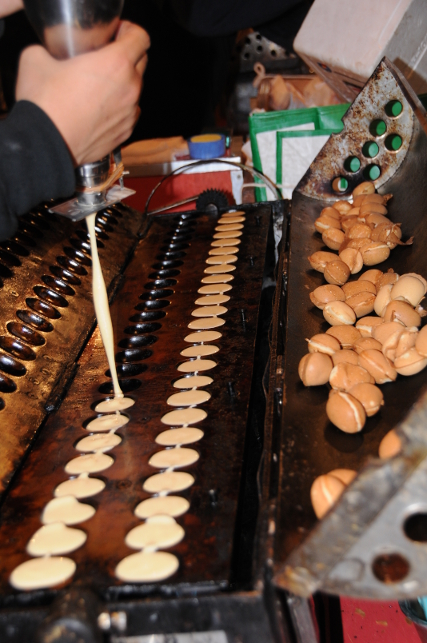
And then there are Kasutera. They are hard to describe, little oval balls made from simple pancake batter (I think) and baked in a special mold. They are not very sweet as there is no sugar added (although is there certainly some in the batter), and they are best when eaten fresh and really hot.

Making Baby KasuteraBaby Kasutera like this seem to be a speciality of matsuri, I have never seen them sold elsewhere. Also it seems that at least in Kyoto there is a monopoly on Kasutera. No matter what festival, and no matter how large, there is a single Kasutera booth only and it is always the same company. So, if you come visit a Kyoto festival, try to find the Kasutera booth, they are certainly worth it!

By the way, there is also a sponge-like cake called Kasutera, but the taste is a bit different. Don’t mistake those two, although the Kasutera cake is not usually sold at matsuri anyway.

Precision

Last week I visited a friend I hadn’t seen since Christmas. We usually meet twice a month, but because we both were sick during the last months and because of other circumstances, we had a six week break.

In that time I sent her a letter, which she showed me at my last visit: A strip of paper was glued onto the envelope, informing us that the envelope did not meet the specifications since it was smaller than the required size of at least 9 x 14 cm.

My friend and I couldn’t believe it, especially since I had sent her letters with that type of envelope before, and there had been no problems with it. Interesting also that the size did not get any mention by the clerk when I posted it in person at my post office. So we measured the envelope, and indeed: it had a size of only 10 x 13,5 cm…

Even my friend – an otherwise extremely proper Japanese woman – found that ridiculous. I can see that too small envelopes may wreak havoc with the modern machines used for sorting mail these days, but since I wrote the address in Western alphabet, it was very likely that a real person had to handle the letter anyway. A real person with obviously too much time on their hands…

By the way, the little note also said that “as a courtesy, we forwarded this letter regardless of the size issue”. Sorry guys, but I call bullshit on that one: The only reason you had to forward the letter instead of returning it to me was that I didn’t include a return address…

Nail House

You have heard of nail houses or holdouts, right? Those are houses or rather the property on which it stands that did not become a part of a larger development (a shopping centre, public building, etc) because the owners refused to sell. Nail houses is a relatively new term for these properties, many of them are in China and there are plenty of photos online.

Recently, there is a lot of building going on in Kyoto. Lots of beautiful old buildings, many with large gardens, are torn down to make room for a brand-new mansion – I positively hate them! Often, a number of houses in a neighborhood are bought up by a developer to be able to build even bigger mansions… When you are walking down the roads in Kyoto in 20 years or so, all you will see are mansions and parking lots, with a few convenience stores strewn in between, I swear. The old buildings that will be left at that time will feel like a zoo because nobody will live in them anymore, they will be just cafes and souvenir shops…

Anyway, I wanted to write about a nail house near the old place where I lived. The owner refused to sell to one of those huge mansion developers, and now her house is surrounded on three sides by the mansion, the fourth side is facing the road. While I commend her guts to stand up to the guys with the big money, I have to say I wouldn’t want to live like that…

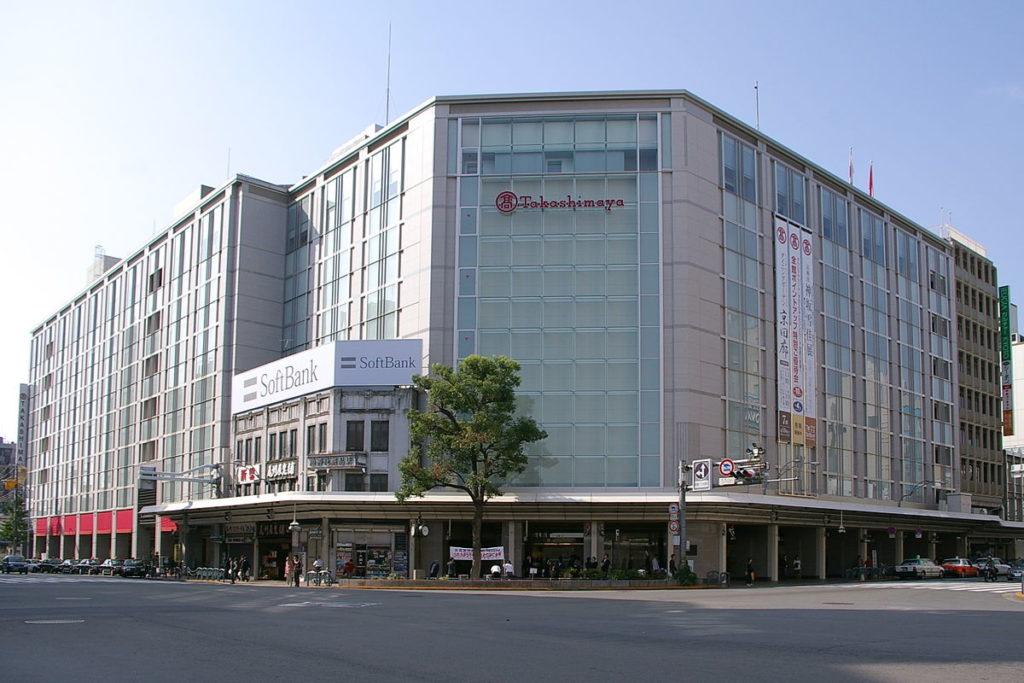
But then I realised that there is an even more prominent nail house in Kyoto. It is smack on one of the busiest corners in inner city, at Shijo-Kawaramachi, and it is this:

Kyoto Takashimaya Building, 2006The big building is the Kyoto Takashimaya, one of the largest department store chains in Japan. It was founded in Kyoto in 1831 and moved to this prominent spot in 1948. And at that point already, the owner of the little house on the corner refused to sell to the big developers, and you can see what happened then: Just like what would happen nowadays. You see, in Japan, it’s all about tradition… 😉

DNA

Every living being on the planet comes with its own genetic code all neatly tucked away in its DNA. It’s a fascinating and unique piece of information, but it is not really useful in daily life. I mean, of course, DNA evidence comes handy in paternity disputes and similar crimes, when trying to find a match for a lung transplant, or simply to make sure that the arm that has just been fished out of the sewers is not the one missing from your body.

But other than that, human DNA has not been really commercialised on a large scale, an interesting oversight in today’s economy. But never fret, the Japanese – ever eager to create the latest novelty – are trying to fill that gaping hole. Recently I became aware of two different commercial uses of one’s DNA that I will present below.

DNA Hanko

A hanko is a seal that is used in Japan instead of a signature whenever one makes an important legal contract; buying houses, opening companies, or getting married for example. They are usually exquisitely carved in wood or even stone and show the kanji of the owner’s name, often in a design that is based on ancient writings of those kanji that are undecipherable today even for educated Japanese.

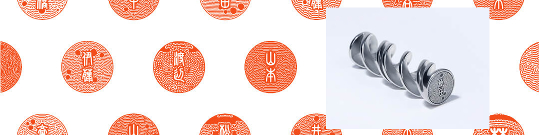
The company Hankoya, the largest producer of hanko in Japan, has come up with a way of encoding one’s DNA into a hanko. Obviously not into the kanji themselves, but a hancode as they call it uses a sample of the owner’s DNA to create a unique background for the seal, on which a rather standard rendition of the name kanji is placed. The seal itself is made from titanium and resembles a double helix, and it looks something like this:

DNA seal and imprintsOf course, all this glory comes at a rather hefty price: First of all, one personal DNA seal takes months to make; when you order one, you receive a DNA sampling kit which you use on yourself and then return to the company. There, your DNA will be extracted and an algorithm will produce from it the background of your seal. Second, the cost of one hancode is 75.000 YEN at the moment, not too shabby, although I have to say that I find the idea with the double helix quite fascinating!

The main drawback of the hanko in general has not been solved though: That it can be stolen and used by anyone. Even though the owner’s DNA is encoded in it, there is no way of verifying whether the person who is using it to sell away his soul is the owner of both the hanko and the matching DNA. But who knows what the Japanese will come up with next…

DNA Glass

A much less serious application for DNA comes from beer and whiskey producer Suntory: The DNA Glass for beer. They say that in one person’s DNA they can identify five traits that are then translated into the size and shape of a beer glass:

Alcohol tolerance is encoded as capacity,
sensitivity to hops bitterness as rim thickness,
sensitivity to malt aroma as top diameter,
stimulation preference as sharpness, and
sociability as complexity of the glass.

The overall result is a glass from the 3D printer looking like this:

DNA GlassSomehow this sounds like fun and I wonder if they could find out that I don’t like beer very much. I could not find a link to purchase such a glass, but maybe there will be one later. Here is a link to a design rules I have given above: http://en.dna.glass/howtocreate/ The main page starts with a very noisy video, so go there at your own peril: http://en.dna.glass/

Customer Service

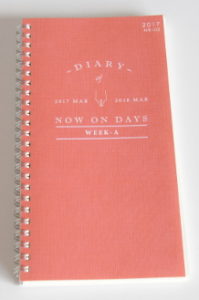
My Diary for 1917It’s that time of the year again where I go shopping for a new diary. I have found a very particular one that I like (lots of space for each day, small size, and cheap to boot), but it is not always available at the stores I go to, so this year once again I had to order it.

Since I’m in town on Tuesdays anyway, I went to Tokyu Hands to order the diary. I received a phone call on Sunday telling me – in perfect English! – that it had arrived and that I could come and pick it up any time. I made sure to compliment the young lady on the phone on her perfect English and this Tuesday, I went to the store again.

The clerk there looked for his copy of the order sheet and there the mystery of the perfect English phone call otherwise so uncommon in Japan was revealed: A piece of paper attached to the order sheet spelling out exactly what to say on the phone in English! This means that the young lady who did phone me in the weekend just had to read the words, no understanding necessary… Honestly, I don’t mind that at all, I find it rather cute, actually. That’s what customer service means, after all. I love Japan!

Valentine’s Day

Today is Valentine’s Day and depending on where you live, you will get your loves ones Valentine’s cards (US), flowers (Austria) or chocolates (Japan). Obviously, I prefer the Japanese type of gift to all the others, but then again: I will not receive one. That’s not because I’m single, mind you, no woman in Japan will receive any Valentine’s gift today.

That’s because in Japan, Valentine’s Day is an occasion for women to buy chocolate for men. And not the other way around. Also, it’s “men” in general, not just lovers or husbands. So, today many Japanese girls bring chocolates for their colleagues and bosses as well; and, given that many more men are in the workforce than women, especially in traditional companies, this can become very expensive.

Surely this is the reason why many supermarkets have had standard chocolate products for sale for weeks already, and mine even allocated extra space for a special display of Valentine’s chocolates – from cheap single pieces to very expensive family size boxes.

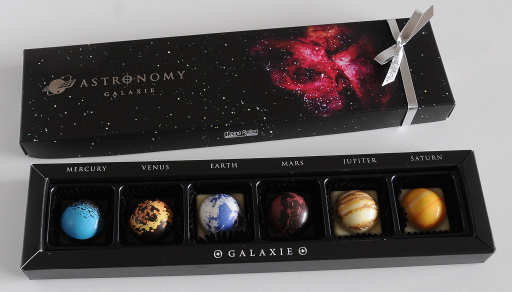
Anyway, I thought I could easily get over the fact that I won’t get any chocolates today, but then I found this: An exquisite “galaxy” chocolate box containing six planets of our solar system:

Valentine's chocolate galaxyIsn’t that the perfect gift for any nerd? I’m seriously jealous! Not because I had to buy them myself, but because by the time it is White Day – March 14th – where men should reciprocate and buy chocolates for women, the only thing to be had then will be hearts and flowers and Hello Kitty shaped stuff, all in pink and cute and boring. Why would I want that?

Creation of Japan

Yesterday was Kenkoku Kinen No Hi, the National Foundation Day, which is a perfect opportunity to have a look at the Japanese creation myth. The source used for my summary here is the Kojiki from 712, a fascinating account of Japanese myth that later turns into history, and the oldest surviving Japanese book.

In the beginning, there was chaos. But then, the light and the particles separated and ascended, but because the particles were heavier than the light, they could not rise that high – this is why the light is above everything else, and then there are the heavens and the seas and lands below it.

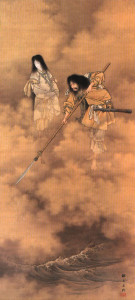
Five generations of heavenly deities and two generations of earthly deities came into existence, they were neither male nor female, and hid shortly after. Then, five pairs of deities  – brother and sister – came into being, the last pair were called Izanagi and Izanami, respectively. To these two the older deities gave the order to make, consolidate, and give birth to the land now known as Japan, and they handed the two siblings a bejewelled spear to do so.

Izanami and IzanagiIzanagi took the spear and stirred the oceans with it, and when he lifted the spear out of the waters again, the drops falling from it formed the island Onogoro. On that island, Izanagi and Izanami built a palace with a mighty pillar in its middle. They then decided to procreate as they had been ordered, and to do so, they first circled the pillar in opposite directions.

When they met on the other side, Izanami spoke first: “Oh, what a beautiful and kind youth indeed!” and Izanagi answered his sister in the same words: “Oh, what a most beautiful and kind youth!” Izanami then went on to bear two children, but they were both misshapen. So, they went back to the heavens to inquire the reason for this, and the elder gods said: “This is because the woman spoke first when you met at the opposite side of the pillar”.

Izanagi and Izanami returned to Onogoro and repeated the ritual of circling the pillar, now taking care that Izanagi spoke first, and henceforth, Izanami bore many healthy children. Their first eight children were the Oyashima, the (then known) major islands of Japan: Awaji, Shikoku, the Oki Islands, Kyushu, Iki Island, Tsushima, Sadoshima, and finally Honshu.

Afterwards, Izanami bore six more islands of Japan, and then began to give birth to a plethora of different gods and goddesses, until she died of the wounds she suffered at the birth of the God of Fire. But that’s another story that’s starting here…

I find this creation story quite interesting. Of course, there are many themes we have seen before: A chaos giving way to order, the first gods coming out of nowhere and giving birth to the land (and many more gods). The interesting part is the story of Izanagi (male-who-invites) and Izanami (female-who-invites), and I am not aware of a similar one.

Even though ordered to procreate, Izanami voluntarily agrees – after an inspection of each other’s bodies – to Izanagi putting “his excess into her scarcity”, a scene that must be so raunchy in the original that the first English translation dares only reproduce it in Latin (for the sake of the reading ladies, obviously). This is a far cry from the common rape and abduction scenes and even the “oh, by the way, you’ll be having God’s child” of Christianity. And even though it is punished immediately, it is the female Izanami who speaks first at what could be interpreted as a wedding ceremony. The story is almost feminist, which I find quite exceptional.

Anyway, the list of eight major islands mentioned in the Kojiki shows its age: At the time it was compiled, Okinawa had not been discovered (that would take another 60 years). And Honshu’s north was so scarcely populated, that even the existence of Hokkaido does not seem to have been common knowledge until the Nihon Shoki – the second oldest book in Japan, also a myth/history compilation – was completed in 720.

If you want to read further in the Kojiki, you can read the very first, 1882, translation into English at Sacred Texts. The footnotes are extensive, but not really needed if you are simply interested in the (hi-) story of Japan. In any case, I might come back at a later time and tell some more Japanese myths.