Excursion

When looking for events for the What’s up in Kyoto event calendar, I came across a tiny little exhibition in an old machiya in Kyoto. And because me and my English students all are interested in old houses, we went there this afternoon and had a look.

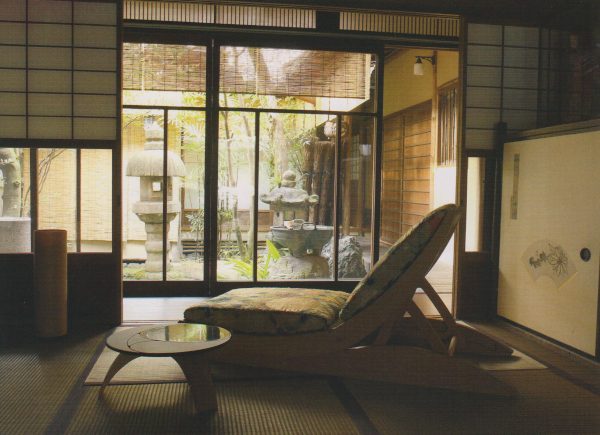
Yoko Hoshino ExhibitionIt was a tiny exhibition of only three pieces of furniture, made as a graduation project by a student of one of the local art universities. There was a large round floor lamp (made from very thin wood that let the light shine through just a little), a small round table with lacquerware and a large chaise longue type of chair (with cushions made from an old curtain. Really!). The motto of the exhibition was “Waiting for the Moon Life” and the designer played with light and shadows in the furniture and in the house itself.

The house was a machiya, some 100 years old, with a typical part in front, then an inner garden, and a tea room in the back, that belonged to the designer’s family. She said that she remembers coming here as a child when things were still a bit different, the house was gently remodeled in the 1970s, and sadly, a parking lot now replaces the front garden.We were allowed to see all ground floor and finally ended up sitting in the living room where we were chatting with a cup of tea.

What I found so interesting was the fact that she deliberately kept the lights off in all the house. The darkness indeed had a calming effect on all of us, and always surprising, the house was almost completely quiet, even though there was a big road with heavy traffic nearby. She said that Japanese houses were meant to be pretty dark inside, lit only by candles, and that this was the way she wanted to exhibit her work in the first place. Only now that she has done it this way, she feels her work is complete..

A fun thing was that she was talking about a book by Junichiro Tanizaki “In Praise of Shadows”, where he describes the influence on darkness and shadows on Japanese culture. Fun because this is the book I am reading right now! Small world, full of coincidences…

Expanding

a hamster running in a wheelSorry for not writing in the weekend, I’ve been pretty busy with the business… There are a lot of things to do at the moment: I need new web hosting for the What’s up in Kyoto site. While I have no technical issues with my current host, they do expect me to pay for every little thing extra, which I find annoying. In particular, SSL access (does the httpS thing in a web address) I would have to pay for – even though there are free programs out there. So, I have decided to change web hosting, and I have to do it now because I would have to renew by the end of the month. At least, transferring the website is not very difficult (since it’s only simple files and no database), and I have very few emails in the associated mailbox. I don’t expect major problems, but it is a hassle.

I am also trying to find out how to place ads on the website. I don’t want to go with things like Google Adsense, but rather sell ad space to individual, local companies. This is rather tricky: I have no idea as to the proper pricing, and I am not entirely sure how to place an ad that would be recognised by an Adblocker (yes, I do want to be nice to people using them). And that’s on top of my “let’s talk to people” issues… Oh well, I’ll figure it out. Sooner than later, I hope.

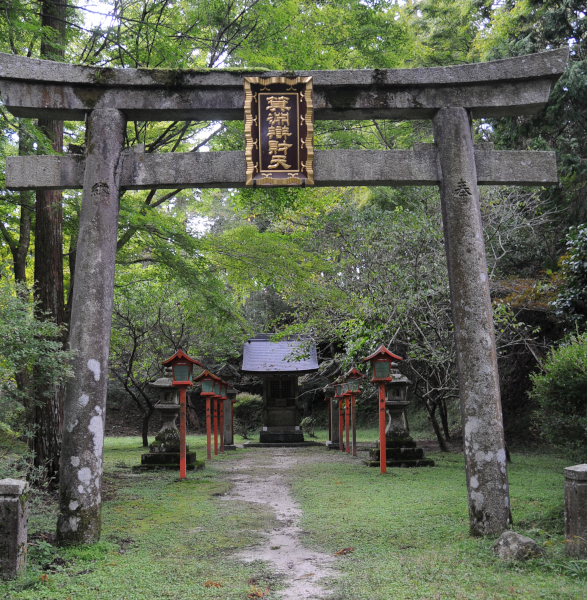
In the meanwhile, I visited the highlight shrine for next month. It’s much, much smaller than I had expected – it will end up being the smallest shrine featured as a highlight. I can only guess that they have a proper shrine office somewhere off the premises, there were also no priests or miko shrine maidens to be seen. I will present it to you this or maybe next weekend.

More on Jebi

Jebi, this season’s 21st typhoon has moved on, and I am fine – thank you to all my friends who have inquired the last two days. However, the damage in Kyoto (and the rest of Japan) is bigger than I had expected by just looking out of my own window.

I went to town today for a meeting, and along the river, many of the cherries there have lost at least small branches, and two were toppled altogether. Those are old trees, one of the uprooted ones had a girth of at least one metre! More trees were uprooted along the Imperial Palace, and this caused huge traffic disruptions in the city. Nijo castle has lost a number of its beautiful ornaments and will be closed for the time being. A big drama happened in Hirano shrine, which is famous for its cherry trees: Many of the trees were destroyed, together with one of the buildings that was a designated national treasure. All of its pillars broke in the storm, and the heavy roof now sits directly on the floor of the collapsed building.

Hirano Jinja - photo copyright of Kyoto Shimbun
Hirano Shrine – photo copyright of Kyoto Shimbun

Things were especially bad in Arashiyama, the western part of Kyoto city. There, many buildings are nearby the mountains, and the area is prone to floodings and landslides even without any typhoons. The famous Togetsukyo bridge lost its handrail for about half of its length, and there was a blackout on Tuesday evening because a number of electricity poles fell down. I hope nothing much has happened to Nonomiya Shrine – it will be the What’s up in Kyoto highlight for next month…

Outside of Kyoto, I think that Osaka and Kobe got hit worst. Kansai airport is still flooded, and I am sure you have seen the tanker that crashed into the bridge connecting the airport with the mainland. The repairs at the airport are estimated to take two to three weeks, but officials are confident that at least domestic flights will begin earlier. I don’t know how long it will take to repair the bridge though, and people are talking about rerouting international flights to Kobe or Itami (the old airport of Osaka/Kyoto).

However, repairs and cleanup have already begun. Even the bicycle path next to the river has been freed of branches, although they have just been moved aside. Homeowners also get ready to fix things, for example the building opposite of mine seems to have sustained some damage to its roof. So, things are being fixed (temporarily, I hope) in the typical Japanese manner: by duct-taping a large plastic tarp over the hole…

fixing the roof with ducttape

Jebi: Typhoon #21

Not even two weeks after the last one (actually: the last two) we’re having another typhoon! Jebi, typhoon #21 of this season has made landfall on Japan at around noon, and it is the strongest one to hit Japan since 1993. It will move directly over Kansai – Kobe, Osaka, Kyoto – one of the most densely populated areas in Japan.

There have been severe weather warnings, some places were even called to evacuate, and apparently, Kansai airport (which is situated on an island in Osaka Bay) is already flooded. Many places came prepared though, railway lines were closed this morning already, and many shops – even big department stores – were not even opened, as were Kyoto Zoo, Nijo Castle, the Film Studio Park, and other big tourist venues in Kyoto.

As for me, I am home and I won’t go out until this is over. The wind here is so strong that it pushes water through tiny gaps in the seals of my windows. The trees outside my building are mauled by the wind, and there are leaves everywhere on my balcony. I have removed the few things I had on there, but the heavy aircondition unit has been pushed all the way to the edge. Just some ten minutes ago I received a phone call from a friend who advised me to get some water in a bucket in case electricity is disrupted – something I hadn’t thought of myself. Obviously.

Okay, I’ll hunker down for the time being. I hope things will not get too bad. If you want further updates on the Jebi situation, head over to twitter and follow the special Jebi typhoon #21 hashtag: #台風21号 https://twitter.com/hashtag/台風21号

Update at 8:30 pm:
It’s over here in Kyoto. The worst wind and rain was at around 3 pm, but it seems that all in all, the typhoon passed Kyoto by in the west. By now everything is quiet again. I took a quick walk along the river to Demachiyanagi, there are lots of leaves and big branches on the ground, but that seems to be all. I did read that some people were injured at Kyoto station, where a tile of the glass ceiling fell down.

It seems to have been much worse in Kobe and Osaka: 2 people dead, many injured, some 600.000 households (temporary) without electricity. A large tanker was pushed into the bridge connecting Kansai airport with Osaka. The bridge is heavily damaged, one section got pushed out of alignment by a whole two lanes! The railroad there seems damaged too. It will take ages until this is repaired – if you’re going to/from Kansai airport any time soon, there will be enormous delays!

The Samurai Banner of Furin Kazan

The Samurai Banner of Furin Kazan
Yasushi Inoue

cover for The Samurai Banner of Furin KazanTakeda Shingen is the daimyo of Kai province in central Japan and one of the greatest warriors of the Sengoku period. This book tells his story as seen through the eyes of Kansuke Yamamoto, one of Shingen’s 24 generals. The crippled, disfigured Kansuke is an excellent swordsman and a brilliant strategist, and his shrewd ideas win many a battle for his master.

Not only the men are scheming in this period though, the women are their equals, and sometimes even their betters. Princess Yuu, who wanted to kill herself upon her father’s defeat, becomes Shingen’s concubine, and, through a number of open and hidden plots, she secures the succession of her son as Shingen’s heir.

In the end, Kansuke dies in the battle of Kawanajima in what would turn out to be his greatest victory. Shingen himself however, is ultimately killed by the armies supporting Oda Nobunaga, one of the major players of unification of Japan.

Takeda Harunobu, 1521 – 1573, later named Shingen, was one of the strongest warriors in the Sengoku period, a time of uproar and fighting throughout Japan. The shogunate was very weak at that time, and the hierarchical order broke down, so that anyone who had the power and ability could aspire to lead and rise through the ranks. The banner Shingen carried in his campaigns bore the four characters fu-rin-ka-zan from Sun Tsu’s “The Art of War”, which can be translated as: Be as swift as the wind, as silent as the wood, attack as fiercely as fire, be as composed as the mountain.

The book starts shortly before Yamamoto Kansuke entered Shingen’s services and ends with his death on the battlefield. The main focus lies on the battles that Shingen fought with Kansuke’s help, but we also get some insight into the daily lives of the people of this period. Interesting to see is how Shingen keeps acquiring women as concubines for his pleasure – very much to the dismay of Kansuke, who is very devoted to Princess Yuu, maybe even more so than to Shingen.

Yasushi Inoue (1907 – 1991) was known as the master of historical fiction in Japan. Before becoming an author, he worked as a journalist, and already his first novel Togyu (A Bullfight) received the renowned Akutagawa prize.

If you’re interested in historical fiction, this book is for you – of course available on amazon.

Overpriced

I haven’t mentioned it in a while, but I am still interested in buying a house, eventually. A house with a garden, that is, because that’s how I grew up and that’s how I think people should live.

So, I am checking all the advertisements for housing that are put into my mailbox very carefully. And this is what I got last week or so:

2 million apartmentNot a house, an apartment with not even 90 square meters. (And they may be counting the balcony with that.) It has only two independent rooms, but the living room and dining room (the LD in the picture) is a whooping 40 square metres or thereabouts. I looked up the area in which this apartment is, and yes, it is a very nice and quiet one – opposite of the building is a row of temples with lush green gardens in summer (and many tourists as well I guess).

All in all not too bad, except for the price: 2 million. Not Japanese Yen – we’re talking about 2 million EUR, more or less, including all the fees and taxes and whatnot. And I’m wondering: WHO ON EARTH does have so much money? For an apartment that is 10 years old and shows the typical Japanese “long and thin” layout. Well, at least, here, all the rooms have a window, even though the second one could have been made larger by moving the toilet further down… It seems that Japanese apartments are all the same – not suitable for (western style) habitation.

Going Out

Last Thursday, one of my English students took me out to one of his favourite restaurants in town. It was a relatively large restaurant in inner city, with three storeys of different sized rooms, and we took a small private compartment on the first floor. The restaurant (sorry, I forgot its name and didn’t take a business card either) boasts 100 different dishes, from the very simple kara age fried chicken available at food stalls at every festival to the most elaborate Japanese dishes.

We – or rather, my student, because I have no idea about Japanese food – chose a la carte and ate a seven course meal, together with a large bottle of (cold) sake. I wrote down the name of every dish, so I could remember it, and below I am sharing a few pictures. We did eat faster than I could take photos, sorry ’bout that.

We started out with sashimi, of course, and hari hari salad, a kind of vegetable. sashimi and harihari saladThen we had kara age, fried chicken, and, popular among the Japanese, beef in red wine sauce together with fried potatoes and onions (which were very tasty). kara age and red wine beefMy student also ordered tomorokoshi, fried corn, he said it reminded him of his grandmother who made this dish very often just for him. The most exciting dish, however, was tai no kabuto, sea bream’s head (literally: tai’s helmet). I love fish in general, and tai is one of the dishes that are served on very special occasions when people have reason to celebrate. That’s why this fish is sometimes jokingly called omedettai (omedetto means congratulations). tai no kabuto - tai's helmetAs the final dish, we had ochazuke with salmon. Ochazuke is simply rice with green tea, and if you are served this soup by somebody in Kyoto, it is a more or less covert way of telling you to get up and leave. Obviously, the meaning is different if you order it yourself in a restaurant, but it is still supposed to be the last dish of the evening. ochazukeI had a lovely evening, my student is very knowledgeable about Japanese history, and we had a lot of fun together. I really hope we can do this again soon, he certainly did promise…

Tempura

Tempura is probably the best known Japanese dish after sushi and sashimi. However, strictly speaking, tempura is not of Japanese origin: It was the Portuguese who brought tempura here, back in the 16th century. Since then, however, it has undergone a transformation and is now considered one of the most iconic Japanese dishes. Tempura seems very easy to make, but there are a few tricks that need to be mastered to make it come out just right.
Tempura can also be served on top of a bowl of rice, making it the popular tempuradon.

It should be relatively easy to make: cut the veggies, throw in batter, fry in hot oil, but what I have heard, it appears to be rather tricky to get the consistency and taste just right. To be honest, at this point, I have not tried making tempura myself. However, I did look up tempura recipes, and one of them you can find below. Happy frying!

Tempura

Basic Ingredients

Tentsuyu Tempura Sauce
200 ml water
– 2-3 tablespoons soy sauce
– 2-3 tablespoons mirin
– 5 g bonito flakes (optional)
Mix together and put aside until eating.

Things to fry
– vegetables (bell peppers, eggplant, (sweet) potatoes, pumpkin, mushrooms, carrots…)
fish fillets, squid, or shrimp
Cut into small, even sized pieces that can be eaten with a bite or two. Seafood should be cleaned and everything inedible, like shells or bones, should be removed.

Batter
100 g flour
200 ml cold water (the colder the better, the tempura will absorb less oil)
1 egg
Lightly break up the egg and add the water and the flour. Mix together quickly, it is okay (even desired) if there are still some clumps of flour left. Don’t make the batter in advance. It should be the last thing prepared before the frying.

Heat a large pan with cooking oil. The oil should be at a stable temperature of about 170 degrees throughout the whole process to ensure the best outcome. Temperature for seafood should be about 190 degrees.

Lightly coat the vegetables or seafood with the batter. Don’t use too much, the result should be crispy. Fry each piece for about 1 – 2 minutes on each side (or use enough oil to deep fry), then put them on a kitchen towel to drain the oil.

Eat as hot as possible with salt, lemon or the tentsuyu sauce above.

Shutdown

Today, Kyoto has shut down much earlier than usual. I went to town in the afternoon, and many smaller shops on Shijo street – one of the main shopping streets downtown – were closed already, and many more closed by 17:00. The cafe, where I usually meet my English student, closed much earlier than usual at 18:00.

Why? A typhoon is approaching Kyoto, and people wanted to go home safely. In fact, there are two typhoons approaching Japan, one, number 20, from the southeast, that will make landfall some time tonight, and the other one, number 19, is southwest of Korea right now, also moving towards Japan (although there, Korea lies on its path first, so it may lose force there before hitting Japan).Right now, there is not much rain, but we have wind speeds of 30 km/h with gusts of at max. 55 km/h. It doesn’t sound good up here in 5th floor, and I think it is a better idea to close all my windows over night. I hope everything will be over tomorrow. Typhoons 19 and 20, 2018

Compliments

Last Sunday, after a hiatus of about three months, I visited the soroban class in the Int. Community House (KOKOKA) again. I did not do quite as badly as I had expected, but I do need to start practising regularly again if I don’t want to give up that 1st Dan degree altogether…

Anyway, I was also very happy to see that one of my friends was working at the information counter that day, and because it was an unusually quiet Sunday, we had the opportunity for a long chat and even an extended lunch together. She had said it before, but she repeated it again: “You always look so happy. Every time you come here, you light up my day!”

Afterwards, on my way home, I dropped in another friend’s place. She owns a lovely cafe and sells hand-made chocolates (which was what attracted me to her cafe in the first place). Usually, I don’t visit her cafe in the weekends, because it is very busy, but it appeared to be a very slow day all over Kyoto, so I went in for matcha and chocolates and a chat. Again, I received a compliment: “You know, other people who have lived here for a while usually get bogged down by the mundane and it shows. You don’t – you still sparkle!”

Thank you so much – to both of you! It always surprises me when somebody says something nice about me or to me. I guess I don’t expect this because I don’t like people much myself – not as a mass phenomenon, at least. But maybe I’m learning how to pick the right individuals, those who don’t feed on bringing others down. It’s been long overdue anyway.