Sending Opportunities

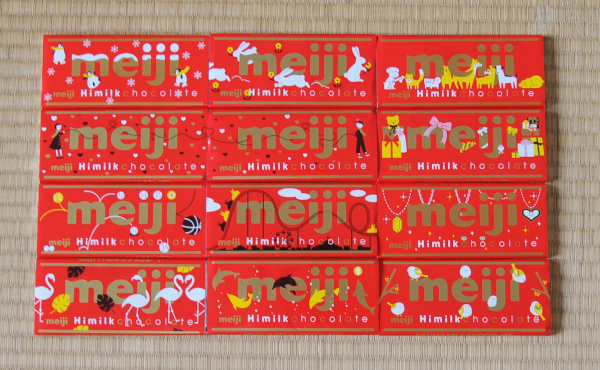
About a year back or so, Meiji Chocolate had a special wrapping for all their chocolate bars. They called it “My Sweet Request” and I made a point of collecting all 12 wrappings for the HiMilk chocolate that I usually eat.

Apparently, it was a success, because this year again, we got special wrappings for dark, milk and high milk chocolates. This year the theme can be translated as “Send this and an opportunity is born…” And yes, I did indeed sacrificed myself to find out what that means and what it says inside each of the wrappers. Here is a picture of all 12 of them, and below I’ll post the hidden messages. Have fun finding out where they belong!

12 Meiji Himilk Chocolate Bars "Opportunities"

  • To whom is your red thread connected?
  • Did you know there is an island full of rabbits? I want to go see them!
  • I want to be cured… I want to be cured… Don’t you want to be cured a lot?
  • There is an aquarium where you can watch penguins’ walk. Didn’t you walk too far?
  • Tennis, table tennis, golf, basketball, baseball… You can do all of them with your partner.
  • You can do it all on a steep rollercoaster! Take me along!
  • Would you like to go to a place where you sometimes can drink a lot?
  • Why do you want to go to the aquarium so suddenly? Oh, I want to go…
  • The heart of two flamingos is a proof of love. Don’t you think it’s romantic?
  • Do you like surprise presents? Oh, just listen!
  • I was interested in birdwatching. Please tell me your favourite bird.
  • Hey, hey! Is there a red thread?

Japanese Parking Lots

Japan as a country ranks among the most densely populated places on Earth. Especially in the big cities, space is at a premium, and a family of 5 living in a 60 m2 apartment is not unusual. Another place where this lack of space shows in parking, and Japan has a number of interesting and often unique approaches to deal with the issue.

Although Japan boasts one of the safest and most reliable public transport systems on the planet, owning a car is still seen as a status symbol, in particular when it comes to expensive and foreign cars. However, before you lay down your money to buy an expensive car, you must prove that you have a parking lot for it, no matter if you live in Tokyo or somewhere in the Japanese Alps.

In Japan, curbside parking is virtually nonexistent, so what to do? Some people rent a paid parking lot nearby their home. Often these are temporary lots where the owner waits for permission to erect a new building. Many of the parking lots people use on their errands are like these too, and the pricing often varies according to area.

Most people, however, park on their own property right in front of their home or they rent (or possibly own) a parking lot at their apartment building. And this is where things get really interesting!

My own block of apartments was built in the 1970s, at a time when this part of Kyoto was still considered “outskirts” (and a little it still is). This means that there was ample space between the buildings with room for trees and grass and – parking lots. More modern buildings, or those that are in inner city, do not have or cannot afford this luxury to begin with. So, they build parking garages, but with a twist!

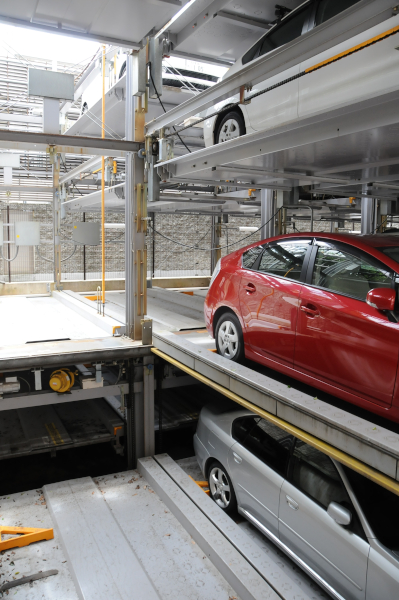
A Japanese parking rack for cars

In many Japanese garages, the parking lots are stacked on top of each other with no space for a person to move between the cars. The idea is as follows: All you need to build one is space for, say 10 parking lots in two rows plus access to the first row. Let’s also say you have space for 4 storeys, one underground and three above ground. The whole thing is one large metal “rack” (for lack of better words), where each parking lot can move individually left/right and up/down as needed. You rent your very own parking lot and only have access to this one.

Now, say you need your car, but it’s not in the first row on ground level – how do you get it out? You have a key that you insert into the control box. Your parking lot with your car will automatically move to one of the front row spots so you can get to your car. Other lots that are blocking the way automatically move. Of course, it may take a while until your car is in the right spot, so people need to factor that in if they are in a hurry.

Looking down a "parking rack" in Japan

On the other hand, this kind of parking racks saves a huge amount of space. In some areas, they are also used for temporary parking. Often, they are in very high but narrow buildings, and customers only have access to the ground floor. They leave their car there and an operator will take care of it – valet parking for everyone!

Here is a video on how parking works in one of these parking garages. It’s similar to the private ones in apartment blocks, but has an even more eerie feel (why are there announcements when there’s nobody down there??)

It is quite interesting to see such a system operating. I know that I was totally stunned the first time I saw one. In fact, a friend of mine whose building has one of these parking racks says that there are always tourists taking photos of it.

Japanese parking garages – the secret tourist attraction. Who would have thought!

Precautions

The latest Corona virus from China and its consequences have reached Japan, and 45 people have been infected in Japan to date. While the Japanese people are not prone to panic, you can see that something is wrong if you know where to look: More people than usual are wearing face masks in public. Even though production is at its limit, the masks are so much in demand that they are pretty much sold out. My very own Izumiya drug store has imposed a limit on the purchase of face masks: Only 2 packs per customer per purchase.

woman wearing  a surgical maskAs I said above, it’s not that the Japanese are prone to panic, but in this case, many Chinese living in Japan buy those masks to send them to their relatives in China. And that’s on top of the donations from the Japanese government and even sister cities, and the official purchases directly at the producers.

Personally, I still don’t wear these masks and I don’t see myself donning one any time soon. But then again, I don’t use public transport much and avoid the inner city of Kyoto whenever I can. So much so, that I only heard through a friend about the news report showing the “empty” streets of Kyoto. Hmm… maybe it’s time to visit my favourite places again, now that they are not overflowing with (Chinese) tourists?

Setsubun at Rozan-ji

Yesterday was setsubun, the last day of winter in the traditional calendar. It is said that between the seasons there is a gap through which evil demons enter the world. Obviously, this is not good, so they have to be repelled – by throwing roasted beans at them while shouting “oni wa soto, fuku wa uchi”. I wrote about setsubun and the ceremony at Kyoto’s Yoshida Shrine on this blog before (and also on What’s up in Kyoto by the way), if you are curious about details.

Yesterday I went to two setsubun rituals. In the morning, a friend of mine invited me to the temple were she usually goes to. First, there was a normal worship with lots of chanting done by the congregation, which was the first time I experienced this – usually, it’s only the monks chanting. Afterwards, there was a short sermon by the current head of the temple (broadcast from Tokyo, another first time for me) and then there was the mamemaki bean throwing. My friend’s mother was smart enough to bring a large shawl that she draped on our laps, so we got an extra amount of lucky beans without straining too much.

After lunch, we went to Rozan-ji temple, where Kyoto’s second largest setsubun ritual (after the one in Yoshida shrine) is taking place. Here, there is a Buddhist ceremony taking place inside the temple, and while only selected guests may enter, you can hear the chanting outside as well. Then, all of a sudden, three scary demons in red, green, and black appear on the scene, wielding a sword and a torch, an axe, and a mallet. They perform a kind of dance on stage and slowly and with lots of looking about, approach the temple and finally enter it.

Inside, the priests appear undeterred from their ritual and keep on chanting as if nothing has happened. Unfortunately, I could not see what was going on, but after a while, the three demons ran out of the temple, without their weapons and staggering from left to right. They disappeared somewhere at the back of the precinct, never to be seen again – setsubun mission accomplished!

Right afterwards, an archer came out and shot arrows into the four cardinal directions. This is meant to create a kind of blessed circle around the temple, which evil demons cannot cross. Catching one of these arrows is also considered lucky, and if you do, they should be displayed in the altar of the home or, lacking one, near the entrance door.

Finally, it was time for the setsubun highlight, the mamemaki bean throwing. Some of the priests and other invited people came onto the stage where just before the demons had danced, and started shouting “oni wa soto” while throwing beans to the spectators. Besides the lucky beans that were covered in white and pink sugar-coating (and were quite delicious), they also threw small mochi into the crowds. Some of them had a stamp on them saying “lucky”, and you could exchange these mochi for a sacred arrow.

There was quite some scrambling for the beans and the mochi. It’s surprisingly hard to catch them, but people were just as happy to pick them up from the ground (which meant more scrambling). I was not lucky enough to catch an arrow, nor did I catch one of the “lucky” mochi. I did catch one normal mochi though and picked up a second one, and one of the lucky beans caught in my collar.

All in all, with all the beans I got throughout the day and the two mochi, I think I will be decked in with luck for the time being. Which is always a good thing, I think we can agree on that!

I’ll add some pictures tomorrow!

Norwegian Wood

Norwegian Wood
Haruki Murakami

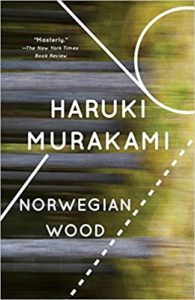
Cover of "Norwegian Wood"Taru Watanabe is a student at a private university in Tokyo in the 1960s and he lives the average life of an average student: some parties, some studies, some music, some girls… But then Naoko re-enters his life, a girl he knew from school. Taru had a crush on her then, but she was the girlfriend of his best friend Kizuki and thus off-limits. Now however, Naoko is free, and they rekindle their friendship that soon blossoms into a tender romance. But then Naoko disappears, and despite his efforts, Taru cannot find her.

At this time, he meets Midori, who is the total opposite of the quiet and introverted Naoko. Taru quickly falls in love with the outspoken and demanding Midori, but just as he is ready to commit, a letter from Naoko arrives…

On the surface, this sounds like a typical “man between two women” story, but it’s not quite that straightforward. Taru loves Naoko deeply, but her inner troubles don’t permit her a relationship. Midori on the other hand is open and available – which makes her scary in another way. Will Taru be able to choose in the end?

Haruki Murakami, born in 1949, is among the best known Japanese authors of today. He started writing with 29 and the above book, published in 1987, became his breakthrough with millions of copies sold in Japan alone. Haruki Murakami has been the recipient of a number of prestigious literature prizes, among them the Tanizaki Prize, the Yomiuri Prize, the Franz Kafka Prize, and the Hans Christian Andersen Literature Award.

To relive the times of young adult angst in and about love, get this book on amazon.com.

On Funerals

In the last weeks, two of my friends have lost pets. One of my friends took in a sick kitten from the Tamayuran and gave her a joyful final week. The other lost her beloved Pekinese dog of 12 years to cancer. It’s always painful when a pet dies, they are a part of the family and often best friends on top of that.

In my family, we have always had cats and it was hard to lose them, especially when I was a child. Since we then had a very large garden next to a big forest, our dead cats were buried somewhere on our property. Not that this is officially allowed in Austria, mind you, but I guess many people in the countryside do that nevertheless.

In Japan, customs are a bit different, obviously. What happens is that there are special crematoriums where you can bring your dead pet and you will receive an urn in the end. Then you can choose to keep the urn in your home or bury it in your garden if you have one, and there are even special pet cemeteries.

Mondrian painting of red amaryllisBoth of my friends made a point to explain that the funeral of a pet is very similar to the funeral of a human loved one. One of them showed me photos of her dead dog covered with fresh flowers before the cremation, and afterwards the urn wrapped in cloth next to a photo, some toys and dog food. This is exactly what happens in a Buddhist funeral, and once the urn is placed in the tomb, the descendants will place flowers, food, and water or alcohol on the tomb at special days like Obon.

What I found extremely interesting is that the urn for the dog did not seem much smaller than the urn was that contained the remains of my grandmother. In Japan, cremation for humans is not usually complete. There are bones left that are picked out by the relatives to be placed in the urn, one of the main parts of a funeral. Apparently, also for pets you receive bones and ashes, although you don’t pick them out, and you can choose which you prefer.

I’m sorry for the morbidity here, but I do find these things interesting. Probably part of my Austrian heritage?

Global Warming

Earth Day FlagI don’t know about you, but here in Kyoto we are having an extremely warm and dry winter so far. Temperatures are like in the middle of December, especially when it is sunny, and even when I am going home on my bicycle in the evenings, my extra thick gloves feel almost a bit too thick. And although I am getting cold easily, I am not using my space heater that often this year; yesterday I didn’t need it at all.

I am even wondering if I should already unconsolidate my home, that is, move my futon back to my proper bedroom instead of sleeping in the living room where it is warmer. But then again, winter is not over yet, and who knows when the winds from Siberia will turn and blow towards Japan.

This year, there is no snow at all in or around Kyoto, only a single time have I seen snowy caps on the mountains north of Kyoto. Note that I’m not complaining about the weather – it does save me a significant amount of money for heating – but it must slowly be obvious even to the biggest deniers that global warming is real and that we need to do something about it. And yes, I am using “global warming” because I find “climate change” misleading and not strong enough to describe the problem at hand. There.

Anyway, I am looking forward to setsubun next Monday. There are fun events at almost all shrines and temples, and I want to go to a new place this year. Setsubun in February is usually around the coldest time of the year, so I am looking forward to not freezing to death while I’m waiting for my lucky beans this year.

Humans, please!

In my newly renovated supermarket, a change has taken place: Semi-automated cashiers are now everywhere. I don’t mean self-checkouts (there are maybe 5 of these), but cashiers where there is a real human ringing up your purchases, and when done send you off to pay at a machine nearby. It does annoy me, a little at least. I always chat to the cashiers, and I have my favourite lady over at the roast chicken stand too. But now, there is barely any time to talk to the cashiers anymore. Not that they got much human interaction before anyway.

And in the uniqlo I go to in town, they have done the same. And it’s even worse, because there are only two manned cash registers (where they still don’t handle your money anymore, but at least they pack your things for you) and another 10 that are self-checkout. Fun fact is that there are tons and tons of staff everywhere, so it’s not as if they are trying to save money, really, not unless staff with permission to handle money are paid better.

I have to admit that the lines in my supermarket are moving much faster now, obviously. Not just because the cashier can ring up the next customer while you pay, but also because there are four or five machines where you can pay for each cashier. I don’t want to test it, but I guess not even during rush hour in the weekends would you ever have to wait to pay. Efficient, definitely. Humane, not so much.

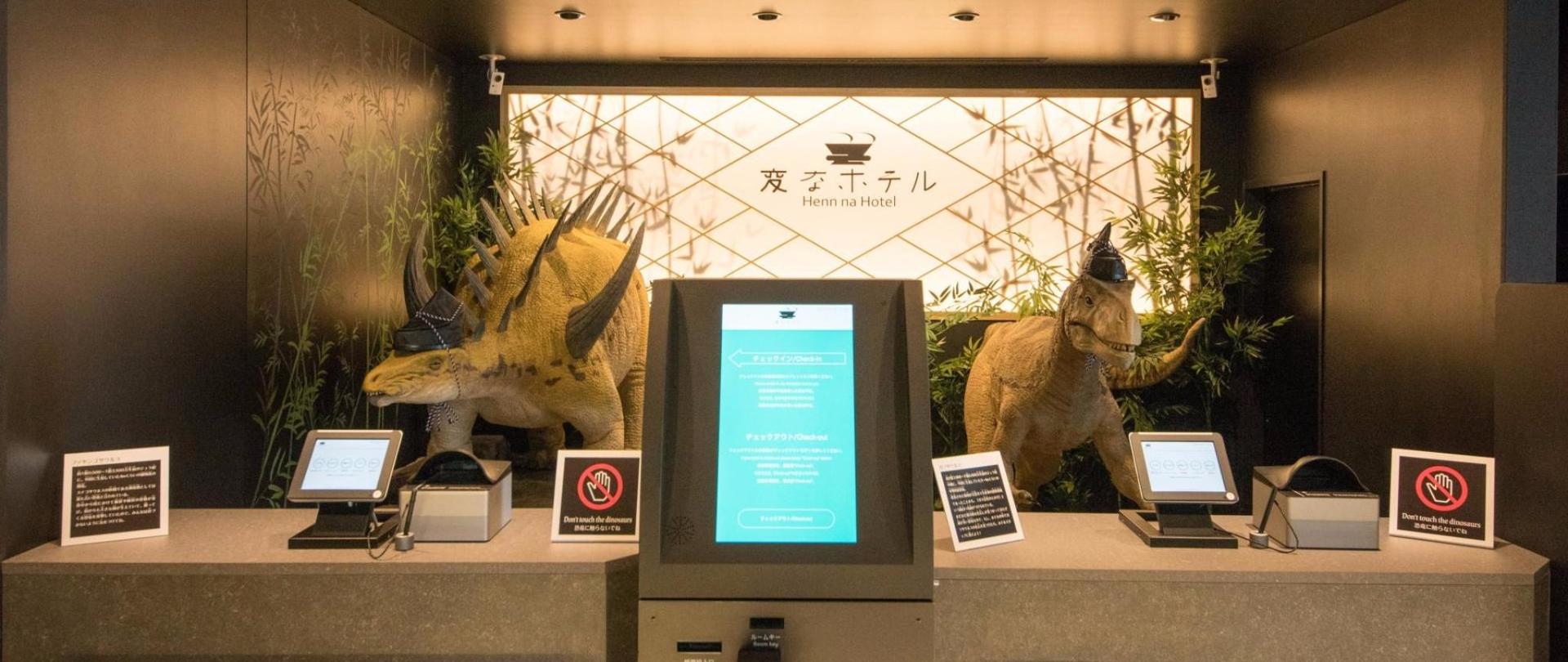
I wonder where this is going. I do understand that Japan is facing a severe labour shortage and they need to start early to do something against it. But going all the way robotic, I’m not sure… Is this hotel below just the prototype of where we’re heading? And do we really want that?

https://www.hennnahotelmaihamatokyobay.com/en-gb

Disappointment

What's up in Kyoto square logoFor my What’s up in Kyoto highlights this year, I have chosen event venues. There are a number of great places with live music as well as traditional theaters in Kyoto, and it’s a step away from the traditional events I usually do. As a bonus, I thought I would make a draw to win tickets for one of the events at the venue. I already had plans to do that last year with the museums, but the logistics isĀ  much easier this time around I think.

So, I set everything up on my end, and I got this month’s event venue on my side to sponsor two tickets for their signature dance event. I advertised my “win 2 free tickets” from the beginning of the month and had the lines open so to speak until yesterday morning. And how many entries did I get? Want to guess? Not a single one… Let’s call this disappointing, shall we?

I am not entirely sure what the reasons for this utter failure are. Perhaps I
– didn’t advertise enough or not to the right people
– don’t have enough visitors to begin with so there are not enough interested people
– didn’t choose the right event (contemporary dance is not for everyone)
– made it too difficult to enter (too many clicks to get to the entry form)
– …

Oh well. I will try again. After all, how else am I going to improve?

Half Way…

I still haven’t upgraded my computer… Before starting this, I thought, it might be a good idea to do some cleaning so maybe the whole thing will go faster. By now, I’m not so sure anymore. Yesterday, I spent more than 3 hours getting rid of about 50 GB of old data. And I haven’t touched the big issues yet – my photos…

I guess my updating journey will take a bit longer than planned. *sigh*