Eruption

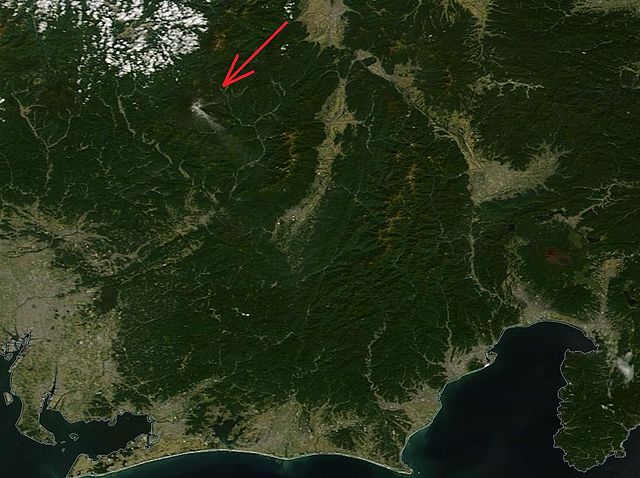
Last Saturday, September 27, just before noon, the volcano Ontake, around 250 kilometres northeast of Kyoto erupted in what is called a phreatic explosion. This is caused by water being almost instantly turned to steam (by the volcano’s magma) and then exploding through the surface. While this sounds rather harmless compared to a full-blown eruption with liquid magma, the images (you have seen them by now) tell another story. Ontake eruption from spaceSo far, 36 people are presumed to be dead, and at least 63 have been injured, some of them severely. Given that there were around 250 people near the peak of the volcano at the time of the eruption, it could have been much worse, but still… Here is a link to the latest news from Japantimes, complete with videos and photos: article from www.japantimes.co.jp

Mount Ontake, with 3067 metres, is the second highest volcano in Japan, the highest one is Fuji. Since olden times, it has been a sacred place complete with shrine and everything; apparently it is especially popular with artists and actors who go there to seek enlightenment and inspiration in trance and meditation. Even for those of less artistic bent, Mount Ontake is a popular hiking destination. It belongs to the list of 100 famous mountains in Japan, and Ni-no-ike, one of its five crater lakes, is the highest crater lake in the country. It seems to be relatively easy to climb the mountain, and thus, around this time, when the leaves begin to turn, many Japanese nature lovers visit the mountain and the area.

Demolition

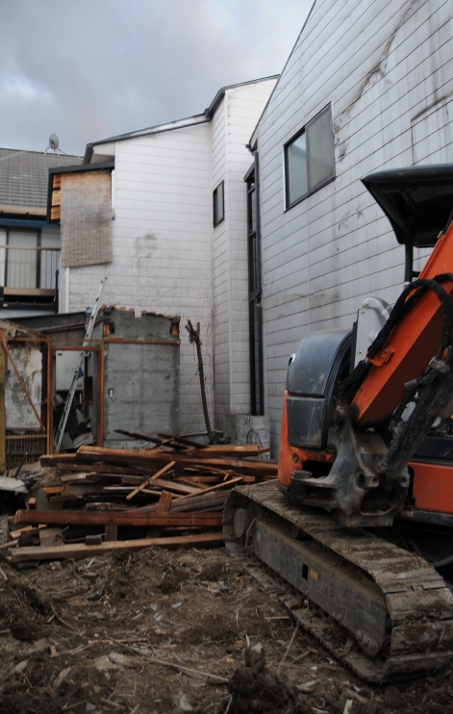
It always surprises me how quickly houses are torn down here. Yesterday morning I noticed how roof tiles were removed from a house in my neighborhood. Mid afternoon, the whole first floor was already gone, and this is what the house looked today after the builders (or should I say demolishers?) had left:demolished house with bulldozerI bet that the plot will be completely cleared by tomorrow evening. Only three days to demolish a house! Of course, most of the houses here are still made of wood, so it does not take much effort to pull them down. People seem to be rather brutal in their approach, they make tabula rasa in the true sense of the word. Near my soroban school, there was a nice family house in a large garden, complete with trees, a hedge and a big Japanese style gate. One evening, when I passed by there, half of the gate was gone, and a bulldozer stood in the middle of the house; and a week later, every single tree and bush and whatever else had constituted the garden was gone as well, the whole plot was a bare plane of gravel.

By now they are building one of those terrible modern Japanese houses there – a wooden structure covered with plastic inside and out. I positively hate them, they are so ugly! There is lots of building activity going on at the moment all over town. A friend told me that apparently this year is a very auspicious one when it comes to building new houses, and build they do.  At another open plot, I have seen a small tent with a number of chairs in it, apparently erected for some ceremony, most likely Shinto. I find it rather odd that in the 21st century people would still worry about auspicious times…

Anyway, I am quite sure we’ll get another one of those dreadful modern houses on the plot in my neighborhood, to be fair though, there is not much space to build anything else. We’ll see…

Studying

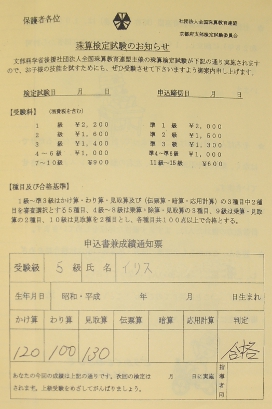
The other day, when I was returning from my favourite temple, an elderly man started talking to me. In good English, although using simple words and sentences, he asked me where I was from, how I liked Japan, the standard chat. When I said I lived in Kyoto, he warmed up a bit more, showed me a little booklet with a number of English phrases, and finally explained that he liked to talk to foreigners because he wanted to practise his English. The reason why he is studying English in the first place are the Olympic Games in Tokyo in 2020 – yes, that’s 6 years from now – and he said he was making an effort in anticipation of all the foreigners who would come to Japan during that time so he was able “to give good directions”. I can’t help chuckling a little about this reason, but hey, he has a goal to strive towards with his lessons! We said goodbye with mutual “gambatte!”

a page from my Japanese dictionaryToday I received a letter from the mother of my Nagoyan friend. It was a very interesting letter – written in English, German, and Japanese! She started out stating her purpose in English: She had translated a Japanese children’s song into German, hoping that I would understand what was going on despite her bad grammar – the song was cute and her translation very good. Her goal is to learn German because she wants to go and visit Germany a few years down the road, and she’d like to correspond with me to learn a bit more easily.  I will start answering her letters in German and Japanese – I hope we both can learn something this way…

Comb Festival

It was a great autumn day today, 30 degrees, sunny, with a clear blue sky… I celebrated by going to a quite unique festival in Yasui-konpiru-gu shrine: The comb festival or kushi matsuri. Similar to the needle festival I visited last year, here people bring their old combs and hair ornaments to the shrine where a ceremony is held for them. Detail of Japanese hairstyleApparently the idea behind these ceremonies is, that when an object has been used for a long time, they possess spirit – imbued by their owner’s or their own – and it is thus proper to send those spirits back to the gods instead of just tossing the item. Such ceremonies are held in various shrines and temples for a number of things: needles, combs, calligraphy brushes, dolls,… Unfortunately, I could not find out what would happen to the combs and hair ornaments that were brought to the shrine, but the thing in the back of the image below is called the kushi zuka, the comb mound, so maybe they are interred there, or at least, at some former time may have been. used combs before the comb moundJust like last year, there was first a ceremony and afterwards a short dance performance called “black hair dance” as an offering to the gods. The special thing about this ceremony at this shrine, however, is the attendance of about 50 young girls sporting the hairstyle of various periods in Japanese history. Of course, they wore beautiful kimono of the appropriate time as well, but the show piece were clearly the various coiffures. Japanese hairstylesI asked one of the girls in an elaborate Edo period hairstyle whether this was all her own hair. In case you consider me rude: Geisha very often have rather short hair and wear wigs for their performances, so I was curious.Japanese hairstyleShe said her hairstyle was about half-half, that some of the longer parts were hair pieces, made in the way they had been produced in the Edo period. It was very well done, and practically impossible to distinguish the pieces from her real hair, but, taking a closer look, especially from behind, you could see for example pieces of black paper that were used to style the hair.Japanese hairstylingShe also said that finishing her hairstyle would take about 3-4 hours – she must have gotten up very early this morning! After the ceremony and the dance, the girls formed a long procession through Gion, but I did not go with them, I had had plenty of photo-opportunities in the shrine already.Japanese hairstyle

Cooling

Today was a very cold day – barely 24 degrees. At least it was not raining, but even our new guest from Finland said she was surprised about the cool weather. According to the weather forecast, it will be warmer next week again though. I’m not ready for winter just yet! Actually, I am wondering – the summer was much cooler than usual; does that mean that the winter will be mild too? I am certainly hoping for it, still can’t tolerate cold…

I was not very motivated today, so I did some laundry, tried to vacuum my room just to find out that the vacuum cleaner is broken (to be honest, I’m not too sad about this – it was ancient anyway and made a noise like a Boeing at takeoff), and put away my fan for winter – won’t be needing that for a while now. Later in the afternoon I visited a friend’s cafe and then bought some sweets in my favourite bakery. The owner there always greets me very politely and talks to me in Japanese, one of the few opportunities I have to practise. Today he even commented on my perceived improvement speaking Japanese – but I think he was just being friendly…

Remnants

People are leaving Japan all around me.

When I woke up today and went downstairs, I noticed the open door opposite of my room. This was the room of the most long-term resident of Ebisu’s who had apparently left early in the morning without me noticing. Never before have I seen it open, it felt strange. Never before had I seen his room, so I went and had a peek. It was odd, seeing it so empty, so devoid of everything he had been. Just a pile of futons and sheets in one corner, a table in another, the tatami tattered at places. Curtains and windows were open just as the door, not much left that could be traced to him personally, only these hanging on a nail: keyrings on a nailHe had lived at Ebisu’s for more than five years, he was here all the time I had been here, and now he returned to Europe. He knew so much about Kyoto and Japan, showed me the ropes in my first weeks, told me where to get what,… Whenever I had a problem he would be there to solve it – except my personal problems with spiders and cockroaches, I needed to do that by myself. I am not sure whether I’d call him simply a housemate or a friend – I’m very picky with this title though – but I liked him a lot and we had nice and deep conversations about all sorts of stuff. This is why it is odd to say: I miss him already, but it is true, besides that, Ebisu’s feels different now with that one corner room empty… I’m sorry I was too late and could not say goodbye in person – have a great time back home, I’ll see you when you’re returning to Kyoto, soon, hopefully!

Other people are moving too. My friends from Kobe, whom I visited just two weekends ago, returned to Austria today. Thanks for all the books guys, take care!

Tomorrow another one of my housemates will leave. She was only here for three months, but she was really nice to be with. Today we went to a really nice sushi restaurant, her first and last time to have decent sushi in Japan. We both enjoyed it greatly and I hope she’ll be back some day for more. Thanks for your biscuit cake recipe!

Keiro no Hi

It’s national holiday in Japan! Today we celebrate Keiro no hi – the Respect for the Aged Day. Japan, more than any other industrialised nation is an ageing society with a birthrate of only 8.07 births per thousand people (in Austria, it’s 8.76). Walking around in Kyoto and seeing all the young mothers with small children, often two, sometimes even three, does not do much to prove those statistics, but maybe Kyoto is simply a good place to raise kids.

Anyway, back to the aged, who have statistics of their own. Just a few days ago, the government has published new numbers. Currently, there are 58.820 Japanese that are more than 100 years old (that’s 4423 more than last year). Why there are so many centenarians in Japan is open to speculation; personally I’m not sure whether I’d like to get that old. My grandmother often said that everything was fine until she turned 80 – and then it went downhill…

In any case, women do tend to get older than men. Of all the centenarians above, 87.1% are women, that’s more than 51.000. The oldest living Japanese – and also the oldest living person in the world – is also a women: Misao Okawa, born in 1898, is now 116 years old, imagine! She claims that sushi and lots of sleep are the reason for her longevity. I might just go and try that – good night!

Autumn

It is slowly turning autumn here. Already several weeks ago I noticed that it would get dark earlier in the evening, by now I ride to my soroban class when the sun has completely set. That means that I have given up cycling along the river, it’s simply too dark down there.

Now is the right time to come to Japan though, the weather is very pleasant with up to 30 degrees during the day and bright sunshine and no rain. This is perfect weather to do sightseeing, as it is not too humid either; I can understand why people would prefer to visit here now instead of summer. It does cool down in the evenings quite a bit though, so I will not be able to wear my shorts much longer then, and I will probably have to start looking for a jacket.

Besides that, you don’t notice autumn much just yet. Only here and there leaves are turning yellow and bright red, but it’s by far not cold enough. And the koyo, the autumn colours, will only be at their height in November anyway. Instead, we did have some spectacular sunsets in the last weeks, I have seen people flocking to the river and taking photos there (not everybody lives in a great place like I do with perfect view on it). orange sunset

Expectations

Last week Thursday, a friend of mine from Tokyo came down for a spontaneous visit. She wanted to see two things – and me – and came laden with great expectations with respect to both.

In the morning, we went to Daigo-ji, a large temple complex in the south-east of Kyoto. I had been in the area before, and didn’t like it much, so I was surprised to find one of the main temples of the Buddhist Shingon sect there. The compound is very large, we visited only the lower part on the foot of the mountain, there is an upper part on the top as well, but it would have taken us two more hours than we were willing to invest. In any case, my friend was mainly interested in the five-story pagoda located on the temple grounds, built in 952 and one of Japan’s National Treasures, which had been featured in a TV program just a few days prior to her visit. The pagoda was nice indeed, situated close to the mountain surrounded by many trees. Interestingly, there were many young monks walking around and praying in front of the numerous temple buildings; they have to do this each day for a whole year, probably as part of their training.

We also went to another part of the temple, called Sanboin. This compound comprises the old living quarters of the abbot, and the buildings indeed have a stately feel to them with their large rooms and delicately painted shoji. However, the most exciting part of Sanboin is the main garden. Although typically Japanese, meaning a lake, mossy stones, and pine trees, it is absolutely stunning, perfectly laid out, the most beautiful Japanese garden I have yet seen! And it is not even the high season for garden watching (hanami and koyo, remember). Unfortunately, it is not allowed to take photos in there (and there are even guards to watch your every move), so I cannot share my impressions, but if you are ever there, it is certainly worth the 600 YEN entrance fee.tickets for daigo-ji and Balthus exhibition

After lunch, we went to the Balthus exhibition in the Kyoto Municipal Museum of Art. My friend wanted to see it because she just recently read about him by chance, and as the book sang his praises, she wanted to check him out for herself. To be honest, we both were not overly thrilled by the exhibition. We found a few pictures nice, but there was only one painting we really liked. At the end of the exhibition was an extra room with large photographs of the artist in his Swiss home and atelier, and some of his personal belongings. Interestingly, there were photos of him wearing Kimono and Hakama – his second wife was Japanese…

In the end, my friend’s expectations were not met – or at least, not as she had expected. The things she came for had been nice, but it were the others, the unexpected ones, that she found more exciting. This has happened to me before as well, and probably to lots of other people. Conclusion: Maybe it’s better when looking for new experiences to leave all expectations behind…

Documentation

Yesterday I spent the afternoon in my favourite spot at Shinniyodo temple. There are lots of trees, often a cool breeze, and benches and tables where I can write and work. Unless they are working in the large area with attached cemetery with their leaf blowers and grass cutters, the place is very quiet and peaceful. As it is a bit off the beaten tracks, not many people are coming there, except during Hanami and Koyo season.

Every now and then, a hapless tourist stumbles onto the temple ground. Yesterday was such a day, and I watched a tourist – possibly a Japanese from outside of Kyoto – running around the temple taking photos. The man also took a picture of the front of the main hall, which struck me as particularly odd. Don’t get me wrong, the buildings are nice, there is a lovely three-storied pagoda, and for a special fee you can go and see the Japanese garden, but, right now, the main hall front view is this:temple with schaffolding

So, why on earth would you want to take a picture of scaffolding with a roof on top? Even if the man was a builder, this is very strange. It may have been simply for documentation purposes, something along the lines of Been here, Done that. I have seen many people taking odd snapshots. The most stunning experience, however, was a man in Heian shrine garden, who walked through it with his ipad raised to the side of his head, obviously making a movie. However, neither did he look at the screen, nor at the scenery at large, the only thing he saw was the path in front of him. To me, this type of tour documentation is useless. Even if you see the pictures half a year later – would you still remember actually having been there?