Karasu Sumo

Today was the ninth day of the ninth month, an auspicious day in Shinto religion (the last uneven month of the year – only single digits count I guess?) and once again, this called for a purification rite. Today, at Kamigamo shrine there was first a ceremonial offering of flowers – chrysanthemums – and, following that, entertainment for the gods: sumo wrestling.

The ceremony started at 10 am with the wrestlers – 18 boys – purifying themselves in one of the rivers of Kamigamo shrine. They all wore the traditional fundoshi loincloth and only a thin jacket, I’m sure they must have been cold even though the weather was nice. Then some more purification rites took place, with elaborate bowing to the river and waving of the white paper; but one of them involved a number of small arrows of maybe 30 cm length – that was certainly a new one for me. The offering of the chrysanthemums took place at the main hall of the shrine, but I did not dare to give up my front row spot for the sumo, so I cannot report any details on that.

Anyway, at some point the party returned and joined the spectators. A woman and two children, dressed in Heian style kimono (12 layers, remember) and some shinto priests seated themselves inside a wooden hall. Before it, a sumo ring had been installed, and the boys, divided into two groups, were seated to the left and right of it, or as it’s called in Japan to the East and West. Then the ring itself was purified by shinto priests, one from each side. Both drew a figure eight into the ring and walked along it. I am very curious what the reason for this is, but I could not find out. Then, after some offerings for the gods and each group stepping into the ring, bowing to the main guests in the hall and performing more rituals, the sumo bouts started.two boys sumo wrestlingThere were four rounds of bouts. The first one the boys from the East and West competed against each other according to their rank, from the lowest rank to the highest. The other three rounds were different, here the winner of the bout could stay in the ring to meet his next opponent. It was very exciting to watch, I did not expect that. The boys were so serious about winning, and still they had so much obvious fun, it was exhilarating. It was almost like watching adult sumo, albeit with slight modifications and minor lapses of protocol, but the bouts themselves were just as exciting as with the big boys. Some of the bouts were over pretty quickly, while others, especially with the boys of higher rank, took some time and you could see some quite nice techniques at work.

After the sumo wrestling was over, a small cup of chrysanthemum sake was offered to all spectators. It was considered to be free of charge, but most people made a small donation anyway. I did not notice anything particularly flowery about the sake, but  I am not an expert.pouring of chrysanthemum sakeAnd then, everything was over. I always find it interesting how quickly even the biggest crowds disperse in Japan. It seems that hanging around and staying for an extra chat is not something the Japanese are used to – well, not if even a restaurant visit is politely finished after two hours… This time it addionally surprised me that after the whole ceremonial beginnings and purifications and everything the whole thing ended rather unspectacularly – with a simple group photo…

Onigiri

Time to write about food again! One of the things I love about Japan is the great variety of cheap takeout. Many small restaurants provide takeout dishes if you don’t want to eat there, there are a number of sushi places that mostly cater to the takeout crowd – one in my neighbourhood has only a single table with two chairs so you can wait if you want anything extraordinary – and, of course, all the convenience stores have takeout dishes and a microwave for free use if you are extremely hurried.

My personal favourite takeout meal from the convenience store around the corner consists of various types of onigiri. They are nothing special, just rice balls with or without stuffing, about the size of a fist, mostly in triangular or oval shape, and often covered in seaweed. They are available in many flavours. The plain ones without stuffing can be only salted, or they are cooked with some red beans or other flavour and sprinkled with seaweed crumbs or black or white sesame. Sometimes they have a piece of fish on top, then they resemble an oversized piece of sushi (which is called nigiri sushi, by the way). Alternatively, onigiri can be stuffed with all sorts of things, from fish with or without mayonnaise, cooked beef or chicken, vegetables or different types of seaweed, to salty, pickled ume plums. The last type of filling is very interesting, for me it falls under “acquired taste”.

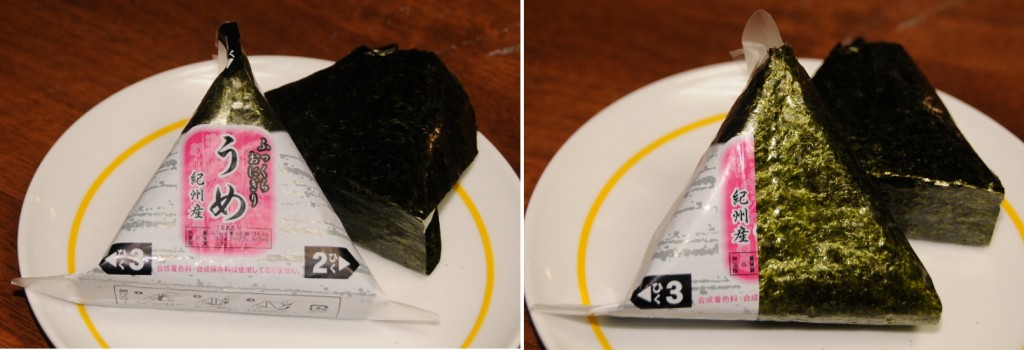
It is very easy to make onigiri at home, as they are only rice cooked with seasoning (different kinds are readily available) which is shaped and then cooled. Some people like to carefully fry the finished onigiri in oil, this is often done after a day or two when the rice has dried out too much to be tasty. ume onigiri

The convenience store bought onigiri are mostly triangular and wrapped in nori seaweed. They have a very ingenious packaging, because if the nori is in contact with the rice for too long, it becomes soggy and unpleasant to eat. So, the packaging consists of two layers of plastic, one on the outside and one that lies between the rice and the nori, separating the two until the onigiri is eaten, so that the nori always tastes fresh and crispy. Unfortunately this does not show in the picture above. There is of course a special way of unwrapping those onigiri: First you tear the package from the top corner, all the way from front to back, and then you gently pull on the left and right corner of the package to remove it from the outside and underneath the nori. How to do this is conveniently described on the package with 1 – 2 – 3 steps, I find this quite funny.

Whack!

Monday night, at around 3:45, I woke up. It felt as if something had kicked my bed (remember that I sleep on the floor) and I thought I had heard a noise as well. Nothing else happened, so I only took a look at my alarm clock and went to sleep again.

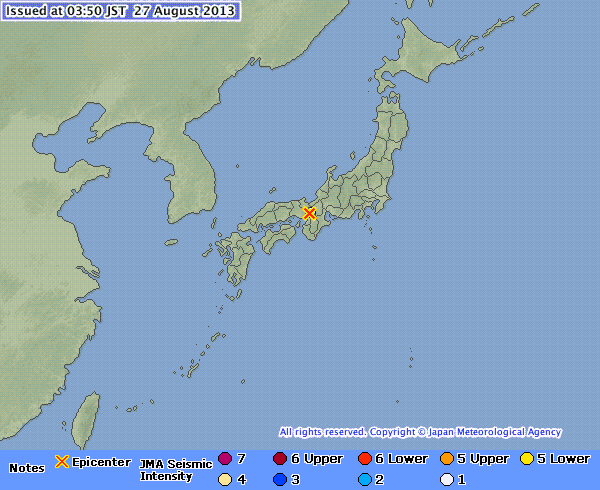
Tuesday morning however, I thought, well … actually … it could have been … So I checked the web page of the Japan Meteorological Agency, and indeed – the night before I had experienced my first earthquake during this stay in Japan! earthquake image from JMAThe details are as follows and can be found on this page: It was a small earthquake, of magnitude only 2.5 at its epicentre, which was around 10 km underground and about 22 km southwest of Ebisus’s.

Only one of my housemates felt it also. He said it was very subtle, and he heard the noise as well. He even said he expected something to happen because all the crickets suddenly went quiet…

It was a very interesting experience as it was so different from the other earthquakes I have witnessed. The bump and the noise were all – not even the lamp was shaking, but admittedly it was hard to see anything in the darkness. It was very short and only a singular occurrence, and as I said I went back to sleep immediately.

I am seriously considering to keep tally how many earthquakes I am experiencing – the ones I can feel at least. This one would be # 3 in total.

Volcano

Volcano
Shusaku Endo

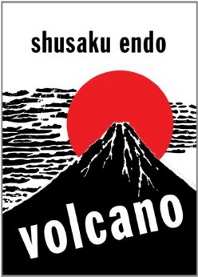
cover of VolcanoJinpei Suda has just retired as the director of the local meteorological institute. He is considered the expert on the Akadate volcano that lies just across the bay. For years the volcano has been inactive, and Suda has declared it extinct. But with the arrival of a new, eager young member in the institute who challenges his judgement, Suda becomes insecure and starts to climb the volcano again.

Father Sato is exhilarated. He finally received permission to build a new church on the foot of the Akadate. It will be larger and more beautiful than any of the churches in the vicinity. The land is bought and all but cleared and he impatiently awaits the start of the construction.

(Father) Durand, however, the former priest of the parish has his doubts. He has had them for a long time now, not just about god but about almost anything. Having turned a cynical, sick old man, he hopes that the Akadate will erupt to wash away the old and make place for the new.

An interesting but rather slow novel about people’s fears and hopes and about getting old and seeing the new replacing what you have built. The stories of the three main characters above are only loosely connected; they live more next to each other than with each other. I found Durand, the expelled priest the most interesting character. His cynical doubts and painful (self-) accusations make him the most memorable of the protagonists.

I think this book is fitting to the latest eruption of Sakurajima as mentioned in Monday’s post, as the story – with the volcano across the bay looming over the city – is quite clearly set there.

Check this book out on amazon – enjoy!

Trial

I met a number of friends during my vacation and we talked a lot – fun stuff, serious things… One of my friends was surprised that I didn’t have a Japanese bank account yet. He said: “I have a bank account in Japan – I just went there and opened one.” I know he never lived in Japan, and I was also quite sure opening an account is not that easy anymore, but I thought I’d go and try anyway…

With my last adventure involving banking in Japan still in my mind, I decided to take it easy. Instead of rushing all in and saying “I want” just to be told that “you can’t”, I planned to simply go there and politely ask for the necessary documents to open an account.

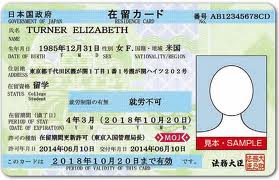
There was the same nice lady as the last time, who still apologised (quite unnecessarily) for her lack of speaking English, but she was trying to help me anyway. Her verdict was a very simple: “All you need is a zairyu card”, which is a registration cardSample of a Zairyu Card for foreigners residing in Japan. Residing being the key word here – people on a tourist visa cannot apply for one. In fact, if you have a work visa (or anything else that’s not a temporary one), your zairyu card is issued right at the airport – which is very practical! Besides that, a deposit of 1 YEN, and about two weeks of patience until all cards are issued, there is nothing more you need to open a bank account in Japan.

It was worth a try, but it seems times have changed and the Japanese are now much more strict who may open a bank account in their country. I’ll have to wait a bit more then…

Obon

As mentioned before, this week marked Obon, the Festival of the Dead in Japan. It is an ancient Buddhist ritual to worship the family ancestors who are said to return from the afterlife to visit their decendants. Traditionally, Obon was celebrated around the 15th day of the seventh month in the lunar calender (and is still in the southern parts of Japan like Okinawa for example) but with the switch from the lunar to the Gregorian calender, things became more complicated. Today, Obon is celebrated around 15th of August almost everywhere in Japan, but in the Kanto region around Tokyo and in Tohoku it happens one month before that. The three days of Obon are not national holidays, but many people are given leave anyway, especially small family run businesses are closed.

The rituals performed during Obon vary greatly depending on the local customs, but as I mentioned yesterday, many of them involve fire and light. I am sure there are special rituals performed at home as well, at each family’s ancestral shrine, but unfortunately I am not privy to any details here.

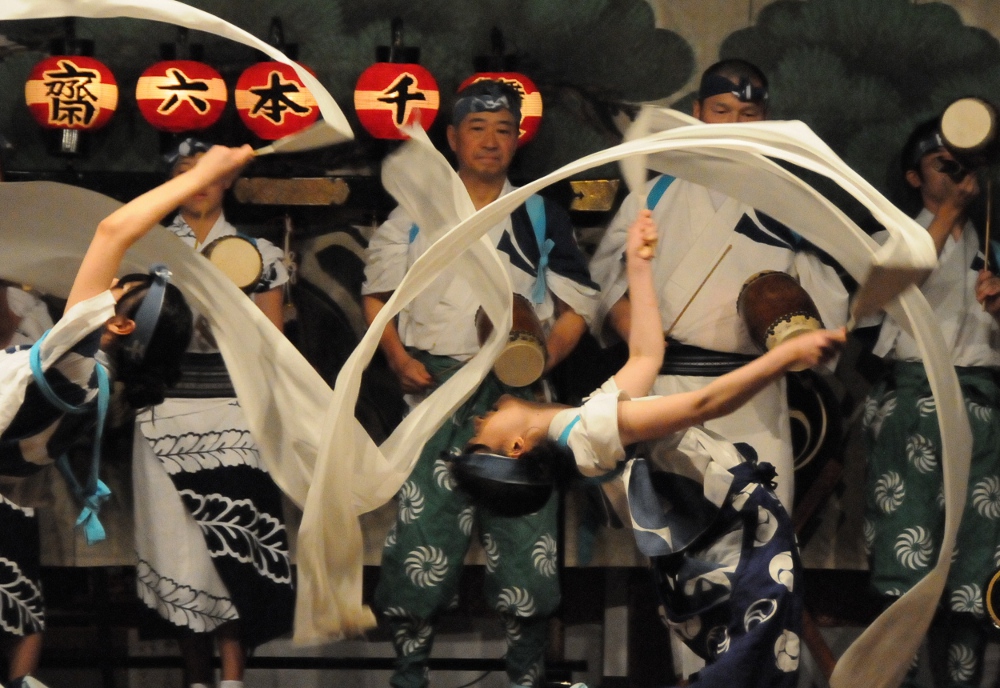
One thing that is done everywhere though are Bon Odori or Obon dance performances to entertain the dead – and the living as well. I went to the one at Enma-do temple in Kyoto last Wednesday night. There were about 20 performers, all dressed in same yukata and turquoise socks, and I was surprised to see both children and women among them (as women often have no place in religious ceremonies). In the beginning were musical pieces with flutes and small (taiko) drums.

Music performance with drums and flutesThen followed the dances, accompanied by music and sometimes a sung story. I am not entirely sure, but the two guys below dressed as women (do you notice their hair-ornaments?) performed a rather comical piece; and the two girls were meant to conjure images of the Maiko of Gion with their long sleeved kimono.

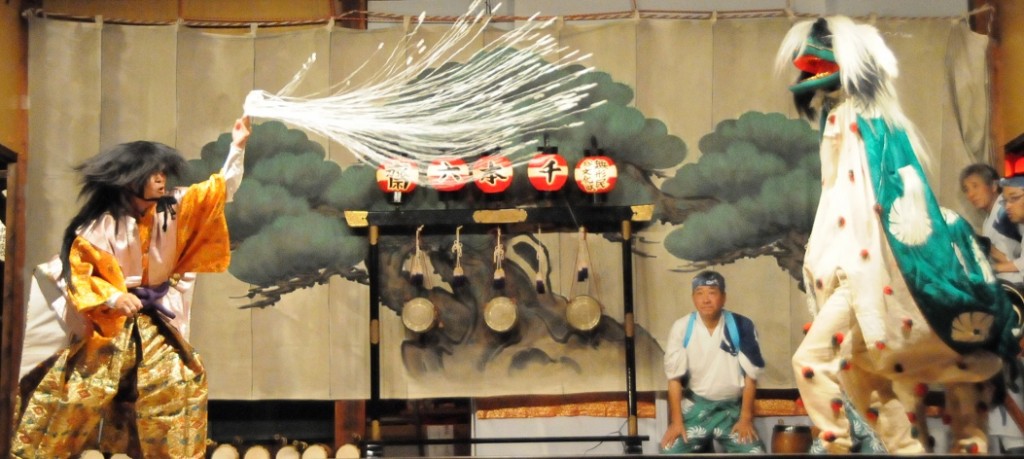
cross-dressed guys dancingwomen depicting maikoThe highlight however, was the lion’s dance: It told (all without words) the story of a lion, living peacefully in the forest – performing acrobatic feats so as to not get bored – until a “great” warrior came along and killed the poor beast. As you can see, I was rooting for the lion all the way! acrobatic lion on a small pedestalwarrior ensaring the lion in a net

Lights

As I have mentioned on Monday, from August 14th through 16th the Festival of the Dead, or Obon, is celebrated in the Kansai region of Japan. The idea is that the ancestors of each family come back from the realm of the Dead to visit their offspring, are worshipped and treated to some goodies, and then are sent off again.

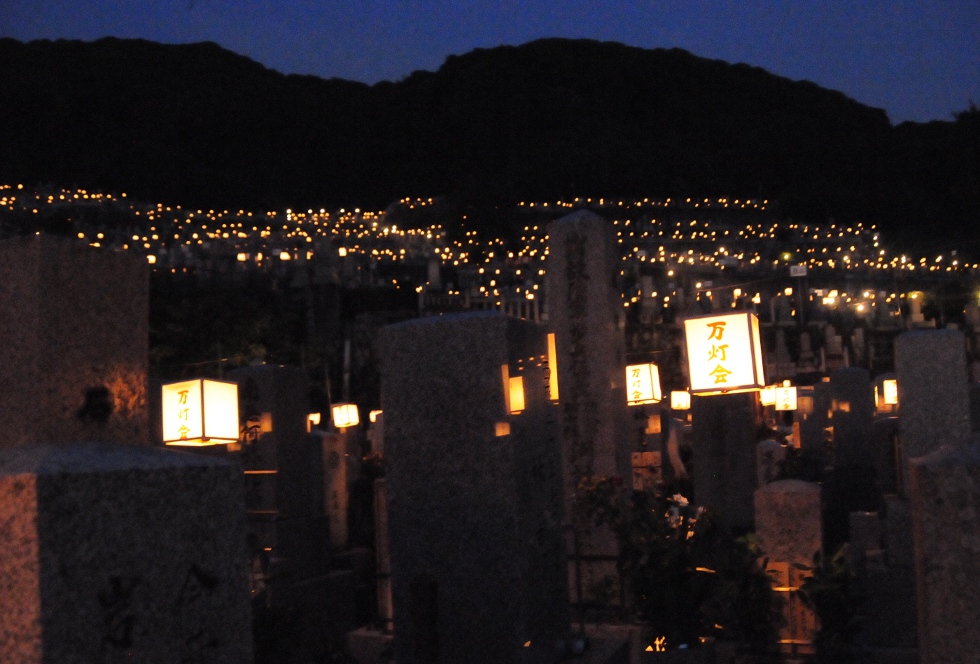
How this is celebrated depends on the region, but very often it has something to do with fire and light to guard the spirits. For example, I have seen in a comparatively small town in Nagano province, where many people own a house with garden, that during Obon small fires are lit at the entrance of each house so the spirits can find their way home easily. Here in Kyoto, at the Higashi Otani Cemetery for example, lamps with real candles are lit at the huge graveyard, and people can come and worship their ancestors during the early evening, bringing flowers and little offerings – I have even seen a cup of sake here and there.

higashi otani cemetery at obonThe important part of Obon however, is to make sure that the ghosts don’t linger for too long. They are sent off – once more with fire and lights – on August 16th. Again, the ceremony depends on the region. Where there is a prominent river or lake or maybe even the sea, little paper lanterns are inscribed with the name of the dead person and then set afloat on the water, so the spirit goes, accompanied by the light of the candle, home to the ocean.

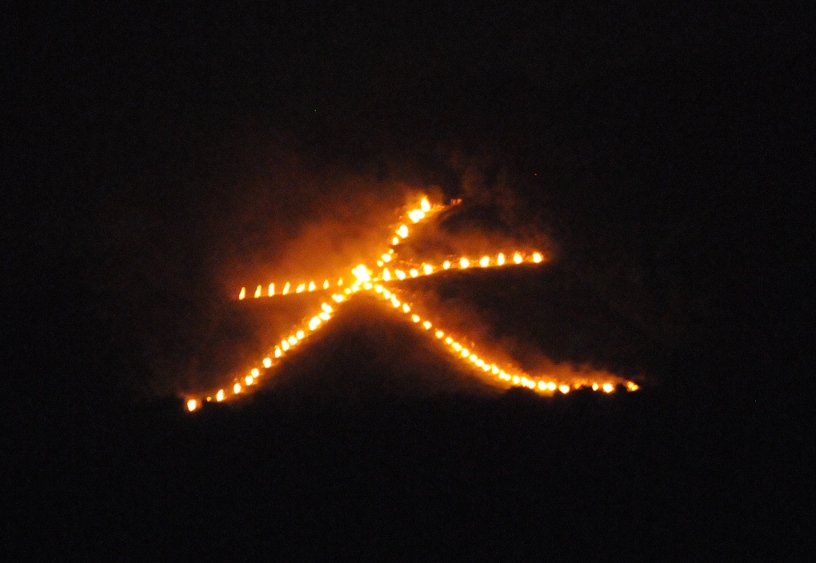
One of the most spectacular ways of sending off the spirits is happening in Kyoto (where else). It is called the Gosan-no-Okuribi (literally the Five Mountains Send Off Fire) or more simply the Daimonji. Kyoto has mountains on three of its sides, and on the flanks of the northern ones (counterclockwise from east to west) five huge bonfires are lit at 8 pm on August 16th. Each bonfire has a specific shape: The first one (the daimonji) is the kanji for “big”, the second one (myo and ho) the kanji for the Buddhist concept of “dharma”. The third one (funagata) has the shape of a boat the souls can ride in, the fourth one is another “big” kanji (called the left one to distinguish it from the first), and the last one is in the shape of a shrine gate or “torii”. The fires are lit at intervals of 5 to 10 minutes and only last for about 20 minutes, to keep it sweet and short.

daimonji character for "big"The worshipping of the ancestors at the cemetery, including light and fire rituals of one sort or the other, is done all over Japan, and of course it is necessary to travel home for that. Hence, although Obon is not a national holiday, many small and family run businesses close and allow their employees a few days to go home. This makes travelling during Obon very stressful, as there are so many people abroad, but interestingly, it is relatively easy to find a hotel (unless you insist on something small and family-owned) – clearly everybody stays with family.

I will write a bit more about Obon in my post tomorrow.

Biwa

Besides the large parades and processions that involve all the inner city and the Gion area in Kyoto, there are many small events taking place in July that are somehow connected to Gion matsuri. For example, last week there was a biwa recital at one of the stages of Yasaka shrine.

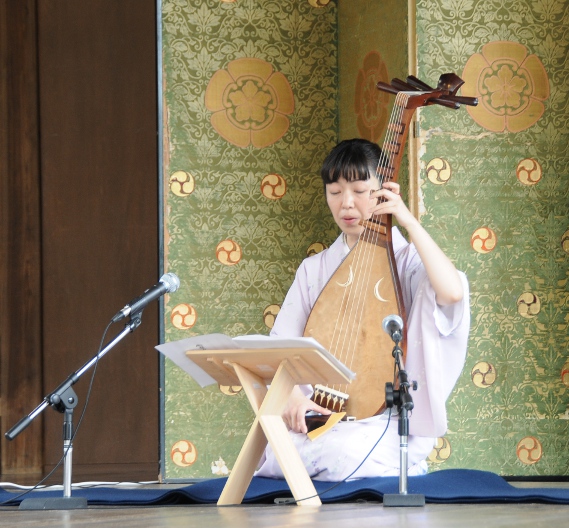
A biwa is a traditional Japanese instrument, a type of lute, originating in the 7th century. It is associated with Benten, the Shinto goddess of music, poetry, and education, and has seen a revival in recent years.The biwa is a lute with four strings which are struck with a large triangular plectrum, and it is held so that the neck is pointing upwards, with the body resting on the lap of the player, who has to sit in seiza, a kneeling position. a woman playing on a biwaSo I went to the recital last week and found it very interesting. I had not expected it to be such a drawn out affair though; there were 11 players, each of them playing a song of about 15 – 20 minutes. Interestingly, the order of the artists was according to increasing proficiency (or years of training), with the two masters at the very end. Just as with the Noh, I did not have that amount of time or patience, so I left long before their performance, but next time I’ll know what to expect.

Also, I did not know that the players had to sing as well – I expected a purely instrumental afternoon and was quite surprised when the first song started. Once again, it was highly formalized, but I cannot say for sure whether the songs were traditional or modern Japanese – I did not understand much of them in any case. I found the recital very interesting, but it is not one of those things for every day, just like the Noh. Nevertheless I will try to catch another performance at some point in the future – knowing that I’ll have to arrive towards the end to hear the really good players.

Gion Matsuri, Part III

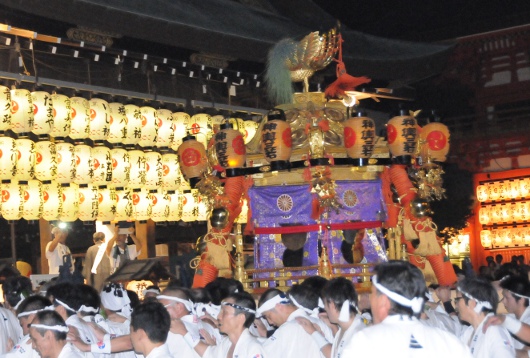
Last Wednesday the last main event of Gion matsuri took place – the Kanko Sai festival, where the three mikoshi were taken from their temporary display on the Otabisho, carried on different routes through the inner city, and then returned to Yasaka shrine.

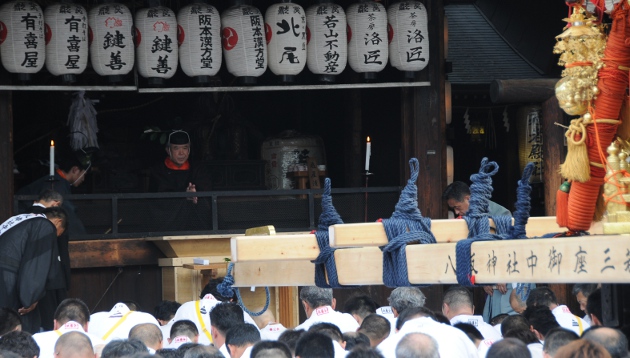
The parade started at 5 pm at the Otabisho. All of the things that can be seen in the picture of Wednesday’s post were removed and the mikoshi stood there for easy removal. The first one to be removed was the centre one. First there was a blessing of both the mikoshi and its bearers in front of the shrine to the right of the Otabisho. The mikoshi was then fixed to two long wooden beams and, amid shouts and clapping, was carried through the narrow streets of the inner city.

blessing the mikoshi
Blessing the mikoshi - note the knots!

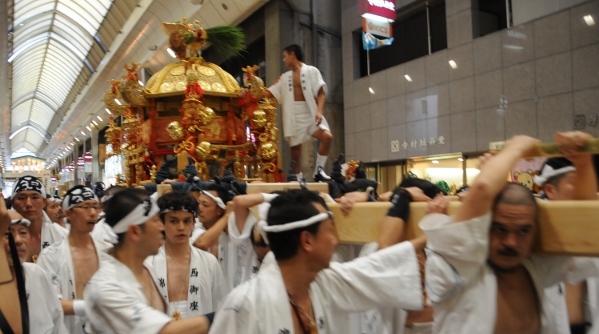
The same was done with the other mikoshi, first the “west” one, and finally the “east” one. One of them was carried through the narrow streets of Teramachi, and then through Nishiki food market, and I am still amazed how its bearers could manage to make the very narrow 90 degree turn between the two streets… Each mikoshi was accompanied by a person on a horse – the centre one by the chigo, by the way – and finally, around 9 pm, the individual parades turned towards Yasaka shrine, lead by a procession that carried all the things that were removed from the shrine to accompany the gods in the first place.

through teramachi street
mikoshi carried through teramachi

Once again, the bearers of the mikoshi showed off their strength by turning it around on its long wooden beams whenever possible, always accompanied by a rhythmic shouting of “hoi-tto”, “hoi-sso” or “ri-ssa”, and at Yasaka shrine itself each mikoshi was carried three times around the centre stage before it was placed in there again. The men carrying the mikoshi must have been exhausted at the end, but there was a certain excitement that went through them and the spectators, although I have seen a few with blood stains on their shoulders…

arrival at yasaka
Mikoshi arrives back at Yasaka shrine

All of this took a very long time, partly also because of the fastening and unfastening of the heavy ropes that were used to tie the mikoshi to several wooden beams. Finally, around 11:30, all mikoshi had been placed again on the stage at the centre of Yasaka shrine. Then, all the lights were turned off and only the moon lit the final, most important scene: the return of the gods to the main shrine. A path was made with sacred rope between the centre stage and the main shrine building. Accompanied by music and hidden from view by screens, two priests went from the main shrine to the centre stage and at each mikoshi in turn either perfomed a rite or actually removed something they then brought back to the main building to enshrine there again.

Except for the music, it was quiet, the hundreds of remaining spectators were completely still, many of them had folded their hands in prayer. A palpable relief went through the crowd when the gods were returned to their proper home and the lights were turned on again. Many people then went to the shrine and offered a quick prayer. The scene was strangely touching, even though I am not religious.

It was midnight by then and I had to walk home. About 5 minutes after the gods had returned home, it started to rain. Well, the main part of Gion matsuri was over anyway.


Rain

Today is the last major event of Gion matsuri. The three mikoshi which have been transferred from Yasaka shrine to their temporary abode in the Otabisho in the city centre will be moved back to the shrine today. otabisho with the three mikoshiThe ceremony starts with the procession of the mikoshi through the inner city at 17:00 and will end at Yasaka shrine around midnight. It was raining in the morning but hopefully it will clear up until the evening… I shall report on Saturday again.