Yesterday, I went to the National Treasures Exhibition in the Kyoto National Museum. The Japanese Government has designated a number of works of art from all over Japan and all centuries as “National Treasures”; they can be ink paintings, calligraphy, lacquerware, swords, clothing, ancient artifacts,… And in this exhibition, a large number of them were brought together from museums from all over Japan. And it seemed to me that people from all over Japan took the opportunity to visit the museum.
Even though I had been warned by a friend who went in the weekend and had to wait in line for three hours, and even though I came right when the museum opened, it was full already – I had not expected such masses of people. I have never experienced anything like this in a museum before! A ticket was quickly bought, but then I had to wait in line – 4 people per row – for half an hour, just to enter the museum. Inside, the people were standing in rows three deep before the exhibits, and it was really hard to get to the front where you could actually see anything at all. Interestingly, I saw quite a few people who had brought binoculars usually used in theatres to get close and personal with the exhibits. I found that quite funny, but then again, progress was so slow, there was plenty of time for detailed examination between two steps.
 Anyway, apart from the masses of people, I did enjoy myself. There were indeed stunning objects; remember that most Japanese art is applied and intended to be used. For example, there was a beautiful 14th century samurai armor; a bit rusty the helmet ornament, a bit faded the colors, but still imposing. Stunning pieces of lacquerware belonging to the trousseau of a Shogun’s daughter. A beautiful scroll with calligraphy, where one artist had written the same text in three different calligraphy scripts – I asked, even the Japanese could only read the most formal one. Another scroll with a chapter of the “Tale of Genji”, decorated with gold and silver flakes throughout and a lovely painting at the end from the 12th century.
Hard to say which were my favourite pieces, especially since I couldn’t see everything in detail (I should really buy one of those opera glasses). I guess I’ll go for two large scale 18th century screen paintings. The one above is by Ogata Korin, it depicts Irises on a golden ground and was painted around 1701/02 in Kyoto. It was announced with great pride, since it was exhibited in Kyoto for the first time in more than 100 years!
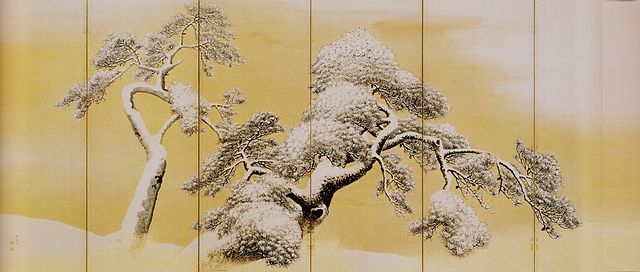
The painting below is by Maruyama Okyo, another golden screen painting depicting pines in the snow. Even though it is only in black and white, it is very realistic, and on first sight, I was stunned. It was painted around 1785 and looks still fresh and vibrant. I would have loved to buy a postcard or something with this motif, but there weren’t any, maybe the Irises above are more popular overall.
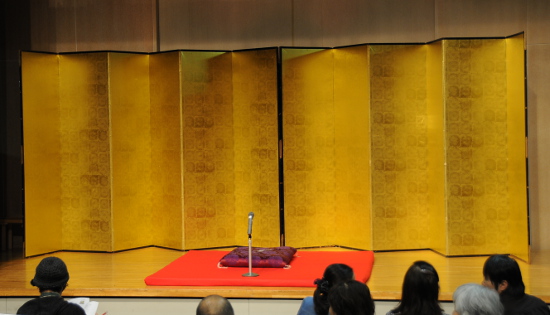 Rakugo goes back to Buddhist monks of the 10th century, who interjected little, often humorous stories to their sermons to make them better understandable for the lay people. The stories evolved to a kind of monologue that people told among themselves, and especially the daimyo of the Edo period were the patrons of this kind of storytelling. With the rise of the rich merchant class, however, rakugo as an art form finally spread to the common people, and by the end of the 18th century, professional rakugoka had emerged, who rented rooms – yose – for their performances. Finally, theaters especially for rakugo were set up as well.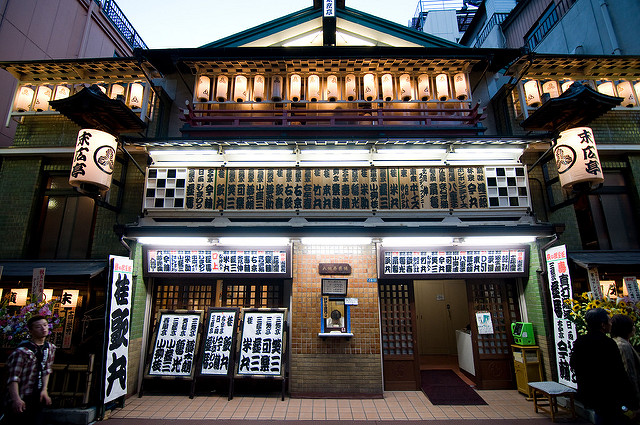



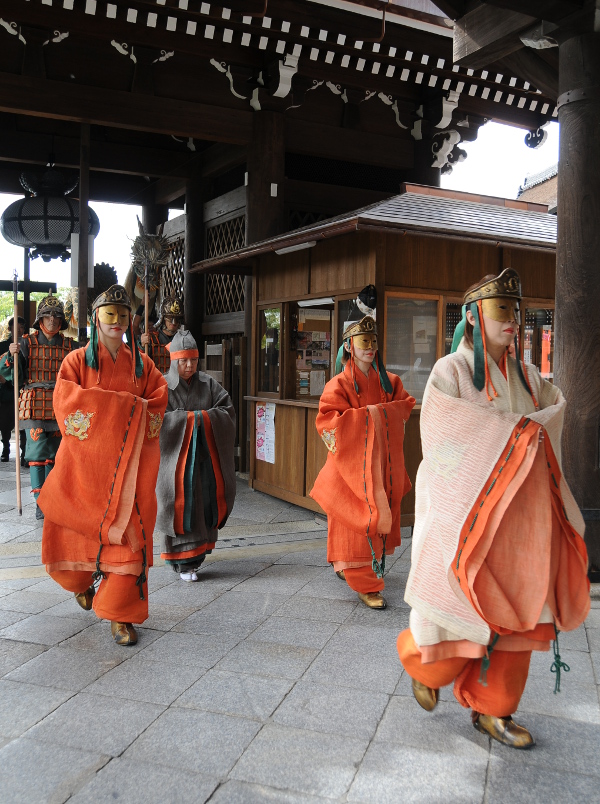 There is a very short ceremony in the main hall of the temple before the dragon moves on to the newly renovated stage where it performs an elaborate dance to the chanting of the monks that have followed it earlier. Afterwards, the dragon moves through the temple precincts and back to the pagoda, which it circles once before leaving the temple through the main gate and going down to the streets below to bestow its blessings onto the town.
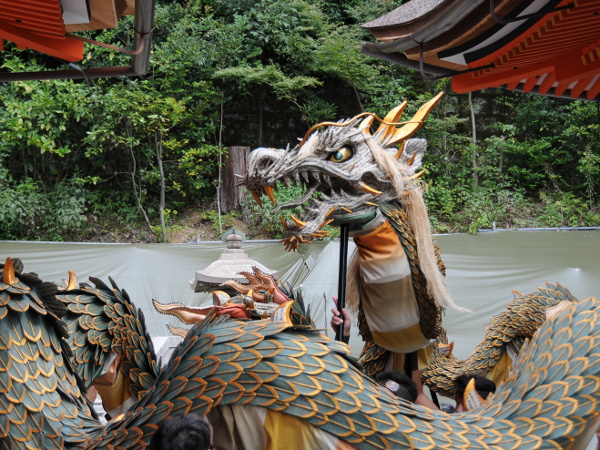 Interestingly, this is one of the newest additions to Kyoto’s festival calendar. The first Seiryu-e festival was held only in 2000, and although the dragon is quite spectacular, it appears as if not many people are aware of the performance. I had the impression that most people who were visiting Kiyomizu-dera – which is one of the most popular tourist spots in Kyoto – didn’t know about the festival and were taken by surprise.