Hina Matsuri

Today is Hina Matsuri, also called the Doll or Peach Festival. It’s an old celebration of the girls in a family, and it’s usually done by displaying hina dolls in the home. Traditionally, these dolls are dressed in Heian-style court attire, with costumes made from real silk, and they are not to be played with because they are so expensive.

As I have just learned when writing my latest newsletter for What’s up in Kyoto, the hina matsuri displays started only in the early Edo period. At this time, the merchants began to imitate the higher classes as a way to show off their newly gained wealth (which was otherwise prohibited). Before that, dolls in general were much simpler, often even just made from paper, and were often used in religious rituals and not just as toys.

Thankfully, nowadays there are equally simply hina dolls that don’t break any bank and fit into small homes too. Common materials are cloth, ceramics, wood, and of course, you can make origami hina dolls as well. I am personally not a big fan of decorating my home, but in a moment of weakness, I bought the pair of dairi bina you see here. They are just palm-sized and I like the modern style and the loving vibe the couple sends. While it would be great to get a “real” dairi bina pair, this one does the trick quite nicely too.
Six Four

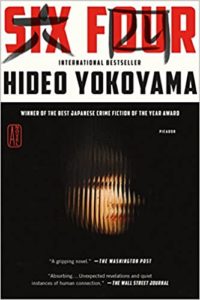
Six Four
Hideo Yokoyama

For eight months, Mikami has been the head of the Press Office in the Police Headquarters of Prefecture D. He still struggles with his own desire to open up communication with the local press and his superior’s demands to keep things as they are. The matter escalates just when the Director General from Tokyo has scheduled a visit to the victims of an as-yet unsolved kidnapping that happened 14 years earlier. While Mikami tries to prepare for the visit, he discovers not only the true reason behind it, but also a serious cover-up related to the old crime. With Criminal Investigations and Administrative Affairs locked in a power struggle, Mikami finds himself alone between the lines. All things come to a head when another kidnapping happens that has eerie similarities to the unsolved one. Will Mikami be able to find out the truth?

This mystery gives insights into the daily workings of Japan’s police apparatus. Mikami does not solve any crimes, but his investigation into the commissioner’s visit and why everybody suddenly refuses to talk to him is among the most gripping stories I have ever read. Although they are not taking a front seat (because the Japanese audience would be well aware of them) the descriptions of the intricate hierarchies and stifling rules of the police are a reminder of a culture most foreigners will never understand, lest experience.

Hideo Yokoyama was born in 1957 in Tokyo. For 12 years, he worked as an investigative reporter for a regional newspaper in Gunma Prefecture. His crime novels are meticulously researched; Six Four took him 10 years to write and caused a heart attack. This book – the most popular of the eight novels he wrote so far – was ranked Best Japanese mystery novel in 2013. He lives with his wife in Gunma Prefecture.

Try out this amazing thriller – it’s a long one, so be warned – and get it from amazon!

Botchan

Botchan
Soseki Natsume

Botchan is a young mathematics teacher, fresh out of college, and his first assignment takes him to a small school in the countryside. From the first day, he – the Tokyo metropolitan – looks down on everything in his new town, especially his country-bumpkin students. They, however, know how to pay him back in the same coin: by pulling all sorts of pranks in school and cheerfully commenting on his private life. Botchan does not fare much better with his colleagues, and the only one he feels somewhat closer to – Porcupine – is engaged in a silent but fierce battle with another teacher – Red Shirt.

Botchan soon sees himself trapped between the front lines of the battle, and while he begins to see Porcupine as a friend, an alliance with Red Shirt will have more long term benefits. At some point, Botchan will have to choose…

Botchan, sometimes translated as “Master Darling” has morality as its main theme, and is still widely read by pupils throughout Japan. It is a fun little book, and the quarrels of the teacher’s room bridge cultures as well as time…

Soseki Natsume, pen-name of Natsume Kinnosuke, was born in 1867 as the 6th child of a rather poor family. From the age of 15, he wanted to become an author, and because of his father’s disapproval, he entered university in 1884 where he studied architecture and English. He went to England in 1901 for two years, and did not like the experience. Upon return to Japan, he began publishing haiku and short stories. Today, he is one of the most famous writers of Japan. Botchan is based on his own experiences of teaching in a small school in Shikoku, and considered one of the most important works of Japanese literature. Natsume died in 1916, only 49 years old, from a stomach ulcer.

If you’re not afraid to go back to your own years in school, try out this book from amazon.

Silence

Silence
Shusaku Endo

Father Sebastian Rodrigues is a Catholic priest whose dream it is to go to Japan as a missionary. When news reaches Portugal that his old teacher, Father Ferreira, has apostatized, he finally receives permission to go to Japan, where Christianity has been outlawed, and all foreign priests are persecuted.
When Rodrigues enters Japan in a little boat in the dead of the night, a hidden Christian community welcomes his arrival and hides him from the authorities. However, he is soon betrayed and imprisoned, where he awaits his trial at the hand of the lord Inoue. While in prison, Rodrigues reflects on his life and faith, and can finally meet with Ferreira, who has an unexpected confession.

I greatly enjoyed this gripping story, and from the very beginning, you want to know what will happen next. Endo tells of the persecution of Christianity in the early Edo Period in great detail, but always through the eyes of the outsider Rodrigues. Once captured, he questions his determination and even faith, and the “silence” of the title refers to that of God, who is unmoved by the sufferings of the Japanese Christians and Rodrigues’ prayers. A great history lesson in a great story of human (and divine?) failure. Highly recommended!

Shusaku Endo was born in 1923 in Tokyo, but his family moved to Machuria when he was three. Already in elementary school, he published a newspaper with friends. He returned to Japan with his mother after her divorce in 1933, and one year later, he was baptized at a Catholic Church. He began studying in 1943 and started publishing stories in literary journals throughout the war. Endo received the Akutagawa Prize for “White Men” in 1954 and the Tanizaki Prize in 1966 for “Silence” which was turned into a film by Martin Scorsese. Most of Endo’s writings have a decidedly Christian, if not Catholic, bent. He died in 1996 in Tokyo.

This historical novel may not be the best read for the Christmas season, but if you want to give it a try, it’s available from amazon.

Sweet Apples

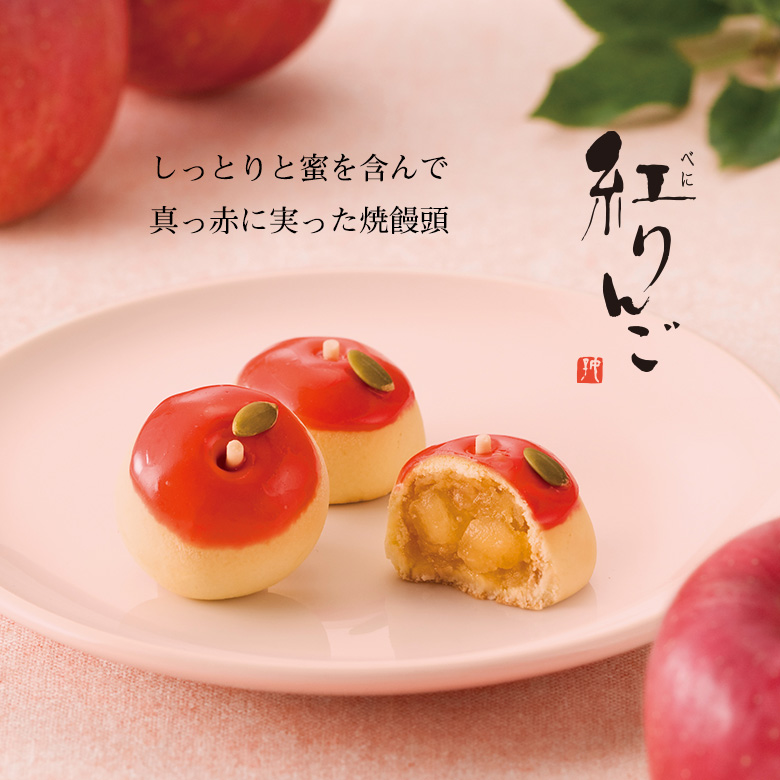
There are countless Japanese sweets. Some are made exclusively for tea ceremony, and others are eaten as desserts. Traditionally, many of these sweets are made with heavily sugared anko red bean paste or they involve matcha. Since I am not a big fan of red anko, I am happy whenever I find sweets that don’t have it. Like these palm-sized apples:

Crimson Apples dessertThese are called beniringo – crimson apples – for obvious reasons, and they are delicious. At first, I thought they would contain white anko (which I do like), but no, it gets better: they have an apple filling! They are a perfect afternoon snack, just two or three bites and very sweet. I have returned to the shop twice now and handed these sweets out to friends, and I’m actually tempted to buy another batch before they start the winter season with their sweets and I have to wait another year.

These wonderful apples are made by Kogetsu, a traditional Japanese sweets shop from Kyoto that opened back in 1945. Today, they have 16 stores in Kyoto and their sweets are sold in 69 shops (including department stores etc.) throughout Japan. If you’re coming to Kyoto and interested in Japanese sweets, both traditional and with a modern twist, I recommend you check them out.

The Woman in the Dunes

The Woman in the Dunes
Kobo Abe

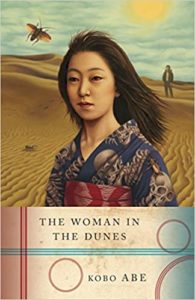
Niki Jumpei travels to a remote beach to catch sand beetles for his collection. On his search, he discovers a village with houses that are overcome by the sand, so much so, that some of them stand on the bottom of pits dug into the dunes. When he misses the last bus home, the village elders allow him to stay with a woman who lives in one of these sunken houses. The next morning, however, Jumpei finds himself trapped down there. Forced to help the woman excavate the sand so as not to be buried by it, he must choose whether to fight against the inevitable or to give in to it – and to the woman.

This is probably the best known book by Kobo Abe and a personal favourite of mine to which I return every so often. We follow Jumpei’s inner journey as he is trapped at the bottom of the pit, and the question “what would I do” is ever present. The ending of this novel is interesting, and depending on your own answer to the question above will either come as a shock or as a natural conclusion of Jumpei’s path.

Kobo Abe, born in Tokyo in 1924, was a Japanese writer, playwright, musician, photographer and inventor. Following his father’s footsteps, he studied medicine in Tokyo and graduated in 1948. In his last year in medical school, he started writing short stories, and already in 1951, he received the prestigious Akutagawa Prize. Woman in the Dunes, published in 1961, earned him the Yomiuri Prize and international acclaim and was turned into a film. Abe was famous for his surreal and modernist style. He died in 1993.

Somehow, I feel that this kafkaesque novel is the perfect ending for 2020. If you want to give it a try, you can get it from amazon.

Labour Thanksgiving Day

Today is the end of a long weekend in Japan, with Labour Thanksgiving Day – kinro kansha no hi – today. This national holiday was established in 1948 and is meant to “praise labour, celebrate production and give thanks to one another”. Especially the “celebrate production” was important after WWII when Japan and its economic miracle took the world (and the car industry in particular) by storm…

When it comes to Kyoto, the most celebrated type of production was going on in the textile industry. For centuries, it was a thriving industry with thousands of people working in it, and even today, it is one of the main industries in Kyoto (after tourism, of course). In Kyoto, the traditional textile industry has seen some of its most interesting innovations, like yuzen, shibori and other types of dyeing, and of course, nishijin-ori weaving for obi. Interestingly, when it comes to looms for weaving, Nagoya’s Toyota company was a large manufacturer, before they moved into the automotive business.

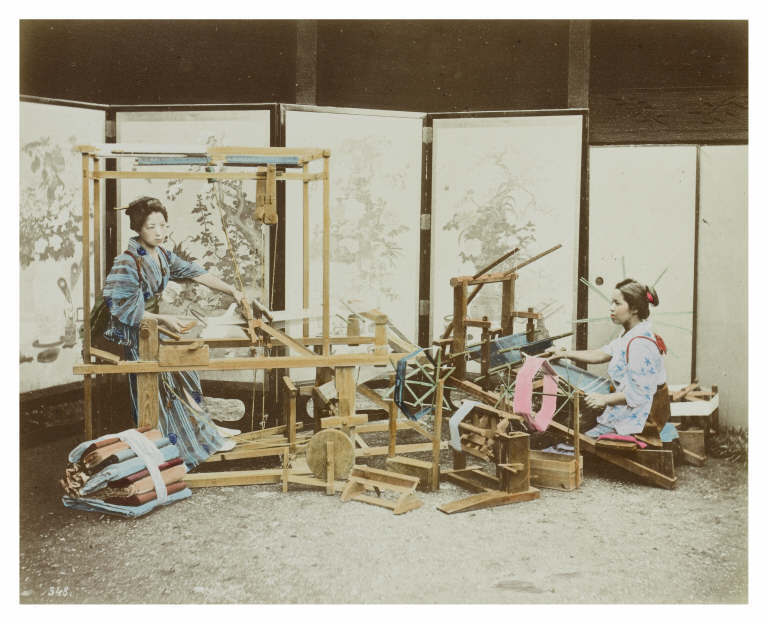
Although modern looms are used almost everywhere, obi are usually still woven by hand with traditional Jacquard machines – which have been modernised from punch cards to computer controls at least. Still, there is something special about seeing a craftsman working on a traditional loom. And even though the photo below was taken in a studio and does not depict the reality of an 1875 weaving workshop, it does come pretty close to how the work is done even today.

Pictures From Taisho

I’m very interested in Japanese history, in particular in the time of the Meiji and Taisho Emperors.

The Meiji Era (1868 – 1912) was when the Shogunate was abolished and Japan opened up to the Western world and had to speedily catch up with it. It was an era of extreme modernisation, in particular in the cities, while I would assume that most people in the countryside kept living their lives like they had for the last 250 years.

The Taisho Era (1912 – 1925) that followed saw a similar development, but at the same time, the West’s fascination with the newly discovered Japan lessened and whatever was left was drowned out by WWI.

In any case, below is a video of early film recordings taken in Tokyo in the very early years of Taisho, 1913 – 1915. You can see most of the people, in particular children, wearing traditional Japanese clothing and sporting traditional hairdos (I’m a fan of those!) The streets are crowded (as they are today) and I don’t recognise anything except the big lanterns at Asakusa temple in the very end.

The old film has been colored for this video, and there is an underlying soundtrack. The coloring is pretty good, but I’m not happy with the soundtrack – Japanese people are never so noisy! On the other hand, these are mostly children, and maybe things have changed in the last 100+ years. Anyway, enjoy!

Kabuki Dancer

Kabuki Dancer
Sawako Ariyoshi

When Izumo no Okuni comes to Osaka with some fellow villagers, all she wants to do is dance. Her rustic folk dances and songs quickly gain her a loyal following among the common folk, and she even gets invited to perform for high ranking samurai and court nobles. Her husband Sankuro, ever so interested in fame and fortune, would like her to dance only for wealthy patrons, but Okuni opts to move to Kyoto instead. There, at the banks of the Kamo river near Shijo street, her distinct and innovative style draws large crowds of spectators and, in time, competitors who imitate her. However, Okuni remains ahead of them all, and despite numerous setbacks, she remains “Best in the World” and single-handedly invents what is known today as Kabuki.

This book blends what is surely known about Izumo no Okuni with old tales and legends. The result is a gripping life story of a woman who did not always get her way, but nevertheless insisted on leading her own life amidst the turbulent last years of the Japanese warring period and the beginning of the Tokugawa Shogunate.

I greatly enjoyed this book about Izumo no Okuni that follows her life from the age of 17 until her death at 37. While much of her personality depicted here must be considered fiction, it is hard to conceive how a less strong-willed person would have been able to create an art form that is still practised (and innovated) today, 400 years after her death. Fans of Kyoto will recognise some of the places mentioned in this book.

Sawako Ariyoshi, born 1931 in Wakayama, developed an interest in the theater already as a student and her own plays are widely performed in Japan. She was a prolific writer of short stories and novels and became one of the country’s most famous female novelists who won the prestigious Akutagawa prize and a number of other Japanese literary awards. Her books deal with social issues like the depopulation of rural areas or the plight of the elderly that are as current now when they were written. She died in 1984.

If you’re ready for a fun historical novel that is set in Japan and does not feature any swordfighting – not real one, at least – get this book from amazon.