Rerouted

Two weeks ago on Saturday, I went to a sake tasting near Kyoto Station. Since I did not know how much I would get to drink, I decided to take the bus. It takes about 45 minutes from my place to Kyoto station, and just to be on the safe side, I took the bus at 16:45, so I could make it by 18:00 without problems.

Or so I thought. Traffic was moving as slowly as I had never experienced before, and by 17:20 we had only come half way. At that time we had arrived at Sanjo street and the bus driver made an announcement that it would take another 50 minutes to reach Kyoto station, and that anybody who had to go there should get off the bus. So, I paid my fare and left the bus. Outside, an employee of the Kyoto Bus company handed me another paper ticket and directed me and everyone else bound for Kyoto station to the subway, which also has a station at Sanjo street.

To make this clear, there are only two subway lines In Kyoto, one in North-South direction along Karasuma street, and the other one East-West along Sanjo street. Except for a few more railroad lines that also run underground in the city, and have most of their stops in the southern and eastern part of the city, Kyoto’s public transport relies heavily on the extensive bus network.

Anyway, with my paper ticked I could enter the subway through a back door and go to Kyoto station directly. I had to exit through the manned gate and return the ticked, and then I could finally go to my appointment – I was only a few minutes late.

What surprised me – once again – was how well organised everything was: The new tickets were all printed with detailed instructions (albeit in Japanese only), there were many staff with signs and megaphones guiding people to the correct entrances and exits, and everything ran really smoothly. Part of the praise here has to be lavished on the passengers: There were no complaints, no noisy arguing with the bus driver or other staff, only quiet compliance and doing what needed to be done.

Later I heard that the last weekend in November is the most popular one for momiji viewing in Kyoto, which must have been the reason for the deadlock on the streets. But this also means that obviously both bus- and subway company were prepared and just put a well thought-out plan into action. This actually gives me much hope in case I will ever be caught in a big earthquake – the Japanese will know exactly what to do. I love Japan!

Nengajo Intricacies

Yellow Bird and Chrysanthemum on the rock by KakuteiI am getting ready to writing this year’s nengajo, New Year’s cards. I was planning to write to 10 people only which is surely manageable even though I can write Kanji only very badly and slowly. However, I just received a mochu hagaki card, which means there is one less nengajo to write this year.

Mochu hagaki are mourning postcards sent at the beginning of December, and essentially they say “I had a death in the family, please do not send me nengajo this year.” The idea is first to pay respects to the deceased, and second, when your father just died, for example, how can the New Year be a “happy” one. This seems to apply to closest family only, however, and just for one year.

Another friend told me that many old people for whom writing dozens of New Year’s cards becomes too burdensome, will write something like “this is my last nengajo” onto the card. This not only means that you will not receive any more from them, but also that you are not allowed to send them any! Doing so anyway is considered rude! I have not received any such card yet – my friends are not that old – but isn’t it interesting how many rules there are for something so simple as a New Year’s card?

The Old Capital

The Old Capital (Koto)
Yasunari Kawabata

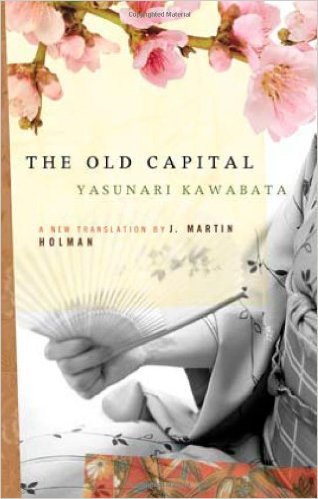
cover of The Old CapitalChieko is an adopted child, found one winter morning on the doorstep of Takichiro and Shige. Now Chieko is 20 and settled into the life and routines of a kimono wholesaler’s in Kyoto’s Nishijin area. But on a visit to a shrine during Gion festival, a young girl she has never seen before excitedly begins a conversation with her. It is Chieko’s twin sister Naeko who was raised by a poor family in Kitayama after the death of both their parents. Their unexpected meeting brings inner turmoil and outward complications to both sisters. But also the obi weaver Hideo, Chieko’s childhood friend, must choose between the two.

The book is set in Kyoto in the 1950s, and it provides interesting insights into the life of that time, where many people still wore traditional kimono when riding the modern tramway. What I found particularly interesting was the rigid class distinctions that existed between the girls, and which especially Naeko could not overcome – she keeps calling her sister “Miss” throughout the novel. In typical Japanese manner the ending is left open, but as Naeko departs from Chieko one still hopes for a happy ending for both sisters.

Yasunari Kawabata (1899 โ€“ 1972) was the first Japanese to win the Nobel prize in Literature, in 1968. This book, Koto, was one of only three cited by the Nobel committee for their decision – and that although the first (official?) translation into English was published only in 1987. Kawabata was orphaned at an early age and eventually lived with his mother’s extended family. When he graduated from university in 1924, he had already published some stories and quickly rose to fame; still he worked part-time as a newspaper reporter. He died under unclear circumstances, most people consider his death a suicide though.

Check out the book on amazon – have fun!

Advent Calender

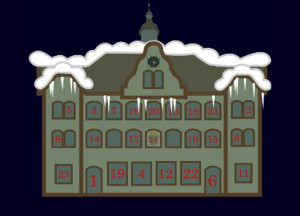
As today is the first of December, advent has begun, and it is time for an advent calender. I do the same thing as last year – I draw something to indulge myself every day – so that’s nothing new there.

Sebastian's advent calenderHowever, one of my students from Germany is visiting Japan right now. Apparently, he makes an online “Advent Calender of Curiosities” each year, and this year it’s all about those curious things he found en route in Japan. The doors open daily at midnight (European time) and he already started off with something … oh well, do have a look yourselves!

Unfortunately, the calender entries are in German, but there are pictures to go with the description and if all else fails, there’s always google translate. Enjoy!

(And big thanks to Sebastian for allowing me to link to the calender!)

Famous!

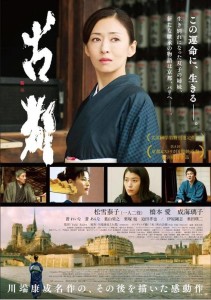
movie poster for kotoAround this time last year, I told you that a friend of mine and I had been engaged as extras for a Japanese movie. Well, I can now officially talk about it since I just found out that it was released last Saturday! The movie is called Koto in Japanese (in English: The Old Capital) and it is a sequel to the novel of the same name by Yasunari Kawabata. Now the two sisters of Kawabata’s novel are grown and have children of their own who have their own struggles with Japanese society. Part of the movie is set in France, while the novel takes place entirely in Kyoto and its northern outskirts.

I have not seen the result yet, but another friend went to the cinema on Saturday, and he said that both my friend and I are featuring very prominently in a scene that is set in an old house in Kyoto. If you take a look at the poster to the right, we were in a scene with the actor in the blue kimono to the far right. Apparently he is very famous in Japan – does that mean I’m now officially famous too? ๐Ÿ˜‰ We should be in at least two more scenes in the movie, somewhere in the background, but I cannot tell for sure until I have seen it – and this will take a while. My Japanese is not good enough to watch movies or TV yet (and fully understand what’s going on), so I will have to wait until there are English subtitles. The movie has already won a prize in the Kyoto Historical Film Festival (I think), and it may be sent to international Film Festivals as well – and that’s usually where the subtitles are made. I will see it eventually though, I’m sure.

Hakusasonso

Kyoto has lots of beautiful Japanese gardens, and there’s only so much time to visit them all. Last week, in the peak of the momiji season, I took time out to visit Hakusasonso, a private garden near Ginkakuji temple. I had passed by there many times before, but now I finally went in.

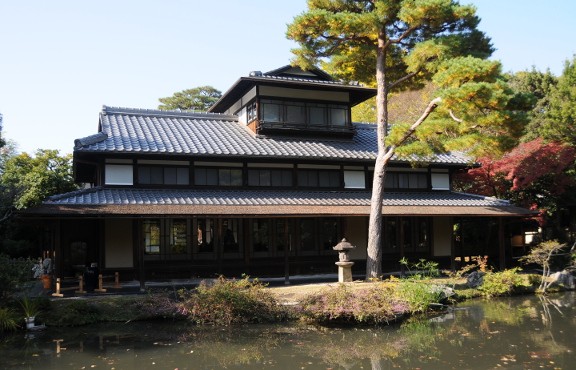
Teahouse in HakusasonsoThe Hakusasonso is the former residence of Kansetsu Hashimoto, a nihonga painter of the Taisho and early Showa period. He bought the site in 1913 when it was nothing more than rice paddies. Until his death in 1945, he worked on the 7400 square metres that make up the gardens now and most of it – including the buildings – are unchanged. Today, the garden is still in possession of the Hashimoto family.

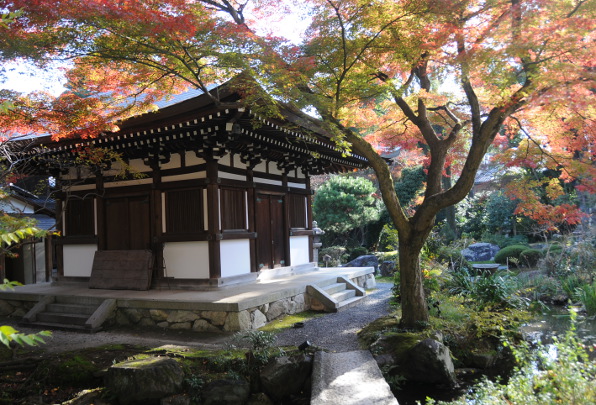
Buddhist temple in Hakusasonso.There are five old buildings in the garden, two small tea houses, one private Buddhist temple, and the old residence that is now used as an expensive kaiseki restaurant. The most interesting building is called zonkoro, it is essentially one very large hall that Hashimoto used as his studio. All four walls have large glass windows, and you can see almost all of the garden from the studio.

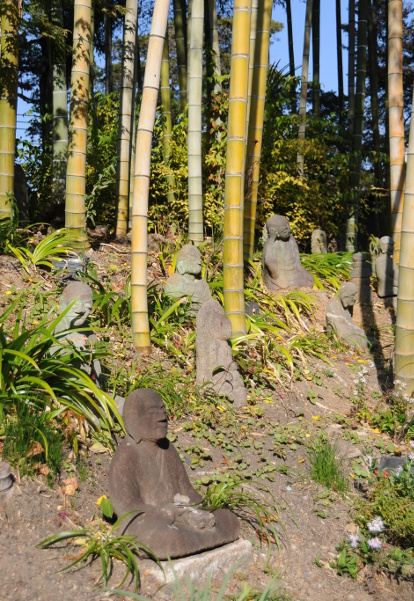
Zonkoro StudioNot only did he paint, Hashimoto also designed the buildings and the garden himself. He collected stone lanterns, pagodas, and Buddha statues (many from China) and placed them throughout the garden. Especially lovely is the little hill where Buddha statues meditate underneath large bamboos.

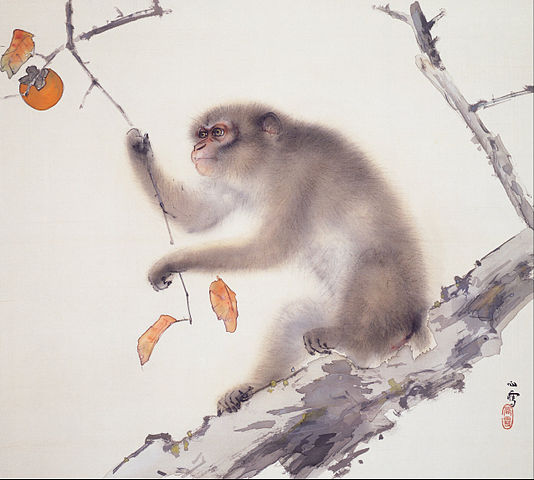
Meditating Buddhas in Hakusasonso.At one end of the garden there is the museum, a modern, two storey building where Hashimoto’s works are displayed. From the second floor of the museum, one can overlook the whole garden, and with the borrowed landscape of Mount Daimonji in the back, the scenery is made perfect. In the late 19th and early 20th century, Nihonga was a special style of painting that combined Western painting methods and ideas with Japanese materials and aesthetics. Nowadays, most Japanese painters work in truly Western style, and the distinction to Nihonga has all but disappeared.

Monkey by Hashimoto Kansetsu

Dedication

Japanese work ethic is legendary. And although I keep telling people that in many offices a “warm body” on a chair is more important than a “working body”, there is still this extra mile only the Japanese seem willing to go.

Point in case: At 9:00 pm today, I received a phone call. Okay, there have been spam calls before at such late an hour, and I usually deflect them by telling the caller that I can’t speak Japanese and he has to talk to me in English. I still have troubles with Japanese phone calls, so I’m not telling a huge lie, at least.

Anyway, the phone call today was from my local post office. The officer even spoke English (how come I never met him in person?) and he wanted to know my exact address. Apparently I have received a parcel – probably from abroad – and the last bit of the address was missing, so he wanted to make sure the parcel can be delivered tomorrow. (In case this sounds funny: On the form that comes with the parcel, there is a space for the recipient’s phone number. Today I finally understood what that’s good for ๐Ÿ˜‰ )

I am not expecting any parcels, so I am very curious as to what I’ll get – and from whom it is of course. It’s too early for Christmas presents as well, so…?

Meetings…

Today I was very busy, I just got home about an hour ago, after three meetings that took all day… I’m very tired now, but such days also leave you with the feeling of having at least accomplished something. Okay, that depends on the meetings, but they were good, all of them.

And in between the meetings, I even found time to buy Christmas cards and Nengajo for New Year’s. I should start writing them soon, especially the Nengajo with the addresses in Kanji will take a lot of time. At least I know now that I must bring them to the post office before December 25th (or so). Only then Japan Post guarantees that they will be delivered on January 1st. This year I can do it!

Gaps

Lately, I have been going to town more often than usual because of my new job. It has been raining several times now, so I need to take the bus instead of riding my bike through the back lanes and along the river.

And I noticed to my great dismay, that for some reason or other, lots of beautiful old buildings have been torn down lately. Where before there were lovely old wooden houses with high fences that allowed only a glimpse at the top of a pine tree, or even a kura store house standing at the back of the garden, there is now – nothing. Nothing but a gap in the rows of houses.

Since I have always loved old buildings, the lack of appreciation the Japanese seem to show to those old houses greatly upsets me. Even more so because those buildings are a big part of what “Japan” means to me, and why it is so nice to walk around Kyoto. I’m not interested in going from one temple to the next shrine when in between there is nothing but a random assembly of apartment buildings, parking lots, and convenience stores, with the occasional ugly private home in between.

Old private house in KyotoI want to walk along those little lanes with the old houses where you can see shoji through the wooden windows on the first floor. That’s what Kyoto means to me. I wish I were really, really rich – then I would buy all those old houses and renovate them and make people live in them again. But it seems to me that only foreigners value those houses, the Japanese don’t care. Until they are all gone, I guess?

Novelties

Last week, a friend visited Kyoto and we spent some time together. We went to Kurama and Kibune in the north of Kyoto and we went to Nara in the south. I had never been there before (and I will write a weekend post about it).

The nicest part about his visit was that I got to try a few things that I did not dare on my own. For example, we went to a Korean-style grill restaurant where we ate cow’s stomach, among other (less exotic) things. And we went to a pachinko parlour together… A pachinko place was something I always wanted to try, but the whole idea was rather daunting: The large halls with loud music, the flashy atmosphere, the unknown everything… But now I know that playing pachinko is not that big a deal, in any respect.

Pachinko machinesWhen you enter, you choose a machine and you feed it with money; bills from 1.000 – 10.000 YEN are accepted. For each yen you enter, you receive a small steel ball. You then shoot each ball into the machine where it should enter one (or more) openings at the bottom of the display. Every time you hit one of those openings, a game is played automatically, where 3 numbers should match – like at a one-armed bandit, but with the difference that you don’t have any way of influencing this part of the game. When the three numbers match, you have won a jackpot, meaning that you get more balls to play with.

Of course, this only scratches the surface of the whole pachinko idea, I am sure there is much more to it. Since we did not win any jackpot, I cannot tell you about the game in more depth; and since I don’t have the money to spend – or the need to be addicted to yet another silly game – you will need to find more information elsewhere.

What was interesting to me was the lack of control you have. Other than regulating the speed with which you shoot the little balls into the machine, there is nothing else you can do, it is indeed a game of luck. It was also interesting to see the people around us. We went on a Friday night, and there were lots of people, even those that looked very distinguished and well dressed. A friend of mine told me that many people play pachinko as a way of stress release.

We did not stay very long, only spending 1000 YEN each. But when we left, we were half deaf. The noise is incredible! Each machine has noisy programs and all of them run on full blast, regardless of whether somebody is playing or not. This is unlikely to become one of my preferred pastimes.