Saga Dainenbutsu Kyogen

Dainenbutsu Kyogen are short theatre performances that were originally meant to teach Buddhism to the general population of Japan. In Kyoto, there are three major such kyogen performances: Mibu Kyogen (in Mibudera Temple), Senbon Enmado Kyogen (in Injo-ji Temple) and Saga Dainenbutsu Kyogen.

The latter ones, shown in spring and autumn in Arashiyama’s Seiryo-ji Temple, originate in a ceremonial event called Dainenbutsu-e that was initiated by the monk Engaku in 1279. In modern times, their history was a bit rocky: In the 1960s, these plays went through a crisis when the number of actors declined and performances had to be cancelled. In 1975, volunteers founded the Saga Dainenbutsu Kyogen Hozonkai organisation to train new actors and keep the art alive through regular performances. In 1986, the Saga Dainenbutsu Kyogen were designated as a Japanese Important Intangible Folk Cultural Property, and today, the performances have become an integral part of Kyoto’s cultural calendar.

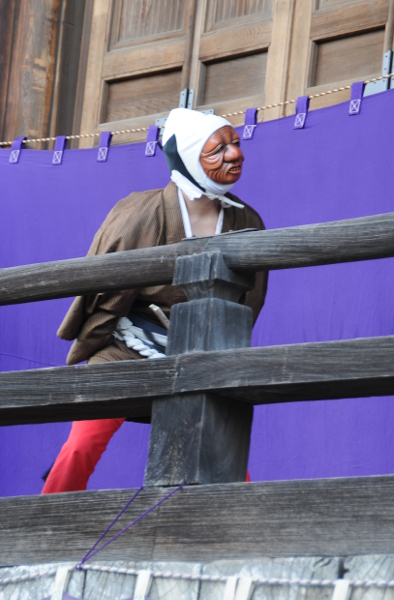
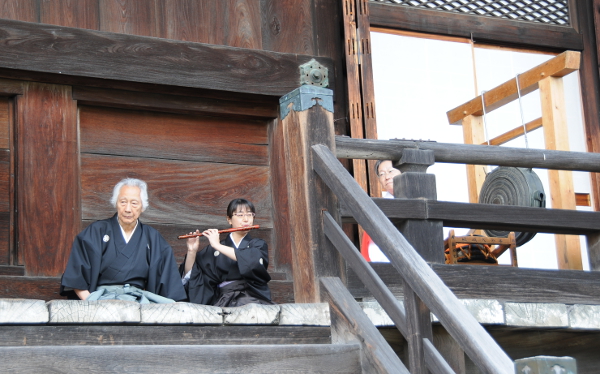
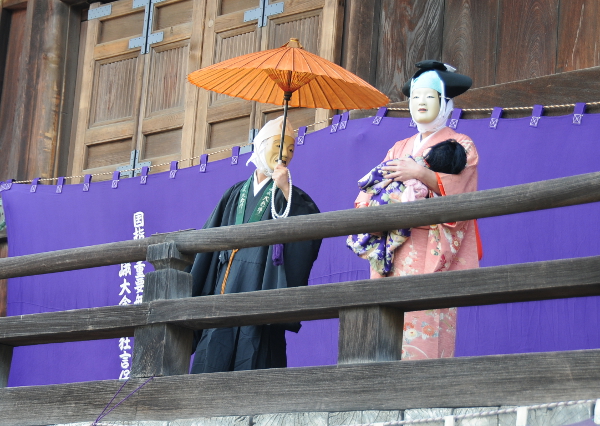
the servant stereotypeThe Saga Dainenbutsu Kyogen are pantomimes, where a set of (male) actors dressed as certain stereotypes (like the young woman or man, the monk, the servant, etc.) breathe life into the story that is performed on a simple stage with barely any stage design and only a few necessary props. The actors – called kyogen kata – share the stage with musicians – hayashi kata – who play a special, 9-hole yokobue flute, kane bell, and small taiko drum. There are only two basic patterns of alternating the bell and drum, it is more of a rhythm than a melody, and is played throughout the performance. Also on stage is a supervisor – koken – who may help the actors with props etc.

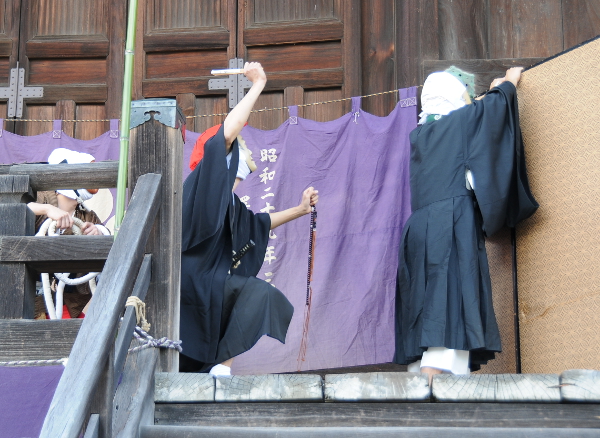
Musicians and supervisorThis is necessary, because in the Saga Dainenbutsu Kyogen, all actors wear full face masks in the style of Noh masks, a tradition going back to the Muromachi era (14th – 16th century). These wooden masks have only very small eye holes through which the actors can see, which makes finding small props or immediately reacting to another actor quite challenging. Thus, the actors sometimes clap their hands or stomp their feet as a sign for the others who may wait at the edge of the stage for their next action that the play has progressed to a certain point. It is possible that two unrelated scenes that are taking place at the same time but in different places, are acted out simultaneously on stage.

Monk and woman with childThe Saga Dainenbutsu Kyogen has a repertoire of about 20 plays. Not all kyogen are funny, or “soft” Yawarakamon plays, about half of them are more serious or “hard” Katamon that have their origin in Noh. Up to three plays may be grouped together and performed in one afternoon, usually the focus lies on the funny Yawakaramon though.

surprising the monkThe atmosphere around these plays – whether soft or hard – is very relaxed, it is an outdoor performance in spring or autumn, when the temperatures are pleasant. Because the plays were developed to teach laypeople about Buddhism and they work without any speech, the stories are very easy to understand and transcend time and culture. Universally funny, they are definitely worth watching!

Visitor

Sorry for missing the last two posts, but I was very busy: I had my first visitor from Austria! Of course she came with a whole suitcase of Austrian goodies just for me which are now filling my fridge and freezer – THANK YOU SO MUCH!

In return, we went out together on two days, it was her third time in Kyoto already, but even after living here for 5 years, we could still find things neither of us had done before. On Sunday afternoon, after a late lunch at a running sushi, we went to an exhibition, and in the evening, we visited the lightup at Kodai-ji and Entoku-in temples, both founded by Nene, the wife of Toyotomi Hideyoshi, and both considered national treasures for their gardens. The weather was a bit chilly after dark, so there were not many people, but from that one visit I prefer Entoku-in: more space to sit and contemplate.

Kodaiji in the nightEntokuin by night. On Monday I left my friend to explore the city, we just met up quickly for dinner when we had Okonomiyaki and made plans for Tuesday. We spent most of Tuesday walking a stretch along Lake Biwa: In the morning, we took a train to Omi Takashima, and from there walked to Shirahige Shrine, which has a nice torii located in the lake. It’s not as impressive as the one at Miyajima, but it’s still a nice place to visit. However, the enthusiasm is a bit dampened by the Nishi-Omi Highway that runs between the lake with the torii and the main shrine buildings and is a bit dangerous to cross.

Shirahige ShrineWe wanted to walk further south, but since the only way at this point is by walking along the highway, we went back to Omi Takashima and took a train two stations south to Omi Maiko. From there, there seems to be one beach resort after the other (with pine trees on the beach, very Japanese), so there are many little roads nearby the lake. Of course, it is way too cold for swimming still, so the beaches and restaurants and little pensions were all but deserted. However, in summer, it is clearly a hot spot teeming with families and youth.

48 Buddhist Statues near Omi Takashima Although we only walked a path the length of two train stations, this part of the trip took us almost two hours. Together with the two hours we walked to and from the shrine, this was the longest hiking trip I have done in a long time. When I finally came home, I was completely exhausted… I did enjoy the day though, and it may be worthwhile to take another trip along the lake on the bicycle one day.

My friend has since left me to my own devices again, and is now taking a serious hiking trip from Osaka all the way to Ise Shrine. I had a great time, it’s always nice to be pushed out of my comfort zone, and who knows, next time my friend comes to visit, I’m just as big a fan of hiking as my friend. 😉

Square One

In the last few days, I’ve suffered a couple of setbacks, unfortunately. One private, one business; they are not seriously serious, but still things I’ll need to take care of and find a workaround for.

A Man presses a "reject" buttionPersonal first: As you know, most of the people who rent an apartment (or even a company office) need a guarantor to do so. The guarantor is required to pay for costs the tenant may not be able (or willing) to pay. This can be missed rents, damages to the property on moving out, etc. When I moved in here, a friend of mine was so kind to be the guarantor for my apartment. He made clear that this is the only one apartment he would ever be guaranteeing for, but since I wasn’t planning on moving anywhere else for the time being, I thought I was settled.

Well, about a month ago, I received an email from him where he told me that he had suffered some hardships, and that he cannot be a guarantor for anybody at this point. So, he asked me to release him from the contract. Obviously, I’m not happy about that, but then again, he’s a friend doing me a favour, so I agreed. I did ask him to talk to my landlord though, and I was hoping the landlord would agree not to have a guarantor for the rest of my lease.

Unfortunately, that didn’t happen: I received an email today that he insists on my getting a new guarantor. Dang it. So, I’m back to square one: how to find a guarantor. Of course, after some three years more in Japan, I have a number of friends I might be able to ask for this favour. Still, a good guarantor is a person of “good standing” to which the landlord must agree, and somebody like this may be a bit more difficult to find. There are also companies who act as guarantors (chiefly for foreigners), but of course, they come with a fee attached. I have not yet spoken to anyone, but it’s something I need to start doing relatively quickly.

And then there is a business issue: I have tried to get a Japanese credit card associated with my business account. Usually, I don’t shop online, but there are always things you cannot pay for otherwise, for example web hosting for my What’s Up in Kyoto homepage. My accountant helped me filling out the application form, and last Friday I spent an hour at my bank to get the final kinks sorted out and my hanko at all the right places. I was promised a decision within a month.

They were much, much faster than that: Already yesterday I received a phone call (two, actually, the second girl did speak English) telling me that there’s no way I’m getting a credit card from them. Why? Because Japanese credit cards are reserved for Japanese and foreigners with permanent residency in Japan. Well, I’m not going to magically turn into the former, and the latter will take at least another 6 years, so it seems I’m out of luck for this one as well.

Not even the mention that the card was meant for the company and not for me did help because “the company is you, really”, which is true in a sense, but also bullshit in another sense. The infuriating part of the call was her tone of voice when she said “I’m so sorry” – if you are indeed that sorry, sweetheart, then try to find a way to make it happen after all. But it seems that the girl was too low in the hierarchy to make decisions like that, and unfortunately, my go-to guy in the bank who seemed to be a bit more flexible, must have a new job in another branch.

As you can see, I’m back to the starting point with two things. As I said above, neither of them is extremely bad (what would my landlord do if I cannot find a new guarantor – kick me out?) but both of them require efforts and possibly money that I wouldn’t have needed to spend. I hope life in general will go more smoothly again soon

Acquaintance

Last week, I was very busy. I always am towards the end of a month, but there were a few extra things that needed attention last week. For example, out of the blue, I received a ticket for a kyogen performance in Otsu, and I had to go the very next day, despite my already busy schedule.

Why did I HAVE to go? Well, nobody forced me, of course, but for some strange reason I like Noh, and kyogen are short and funny plays that are usually staged between the more serious and much longer Noh performances. And since I had never before seen a kyogen, I simply had to go and give it a try.

And this was a special kyogen to boot, because it was not a traditional Japanese one, but it had been written by W. B. Yeats in 1924, who was inspired by Noh and kyogen to write his own version of it. Kyogen are less stylised than Noh plays, and even though I only understood bits and pieces of the Japanese words, I could get the gist of the overall intentions of the play “The Cat and the Moon”. It is about an interesting symbiosis of a blind and a lame man, which is destroyed the moment the blind man is miraculously healed… Anyway, it was fun to watch, I am glad I took the time to go, and this has strengthened my resolve to learn a bit more about Noh and kyogen.

Fun fact on the side: It was my first time to go to the Biwako Hall, and I had to take trains I had never taken before, so I was a bit insecure. However, there was a nice elderly man in the train with me who happened to also go to the kyogen and so I trailed alongside him to the theatre. After the performance, when the audience was leaving, I saw him again, and he asked me if I wanted to meet the actors (who were lining up in the corridors outside the hall). I was a bit reluctant but he said “Don’t worry, they are my friends!” It turned out that this unassuming man in the train was a Noh actor himself, one who plays waki (supporting) roles. I was so thrilled! I do have his email address, so… who knows where this is going!

South of the Border, West of the Sun

South of the Border, West of the Sun
Haruki Murakami

Cover South of the Border, West of the Sun12-year-old Hajime lives in the typical middle class suburbs of a typical post-war Japanese town, in a typical family among other, typical Japanese families. However, in a world where everybody seems to have brothers and sisters, he is an only child. In elementary school, the only friend he has is Shimamoto, new in town, whose father’s job requires her family to move frequently. Soon, the two develop a special bond, based on the fact that both are only children; but despite their attachment they lose touch when Hajime’s family moves.

25 years later, Hajime is a successful businessman in Tokyo, who loves his wife and adores his two daughters. But then, on a rainy night, Shimamoto appears in his Jazz bar, strikingly beautiful, rich, and surrounded by a mysterious air. The two rekindle their friendship, almost as had there been no interruption, and finally, Shimamoto tells him “You take either all of me or nothing”, and Hajime has to choose between his soul mate and the life he got so used to.

The story follows Hajime – whose name means “beginning” – through many of the beginnings in his life, but his love for Shimamoto is ever-present. In the preface of the book, it was mentioned that Haruki Murakami owned a Jazz bar in Tokyo at some time before he became a famous writer, and I cannot help wondering how much of his own life we can read in this book.

Haruki Murakami is probably the best known contemporary Japanese author. His first novel appeared in 1979, and “Norwegian Wood”, published in 1987, lead to international recognition and fame. He has also written several non-fiction books, for example “Underground” on the Tokyo gas attacks or “What I talk about when I talk about running” about his experiences as a marathon runner.

A book about love and middle age, and the choices we need to make. Available from amazon.

Hanami 2018!

The cherries have arrived this year! All Kyoto is now full with cherry blossoms and people are all distracted and taking photos of each and every little blossom…

Of course, I have to go with the general flow as well. Yesterday, on my way home I got a takeout falafel and chai and had it down at the river. And today, I went there again for a proper hanami with two friends. Many people had the same idea, so most of the best spots for picnics were already taken. The weather was lovely, kids were playing in the river (which is particularly shallow up here) and of course, you could hear lots and lots of cameras clicking… Here are a few of my photos:

Kids playing in Takano RiverHanami 2018Very close closeup of cherry blossoms

Exciting!

In the beginning of this month, I have asked a friend of mine – a shin hanga woodblock printer – to help me design a new banner and logo for the What’s Up In Kyoto website. We spent about an hour chatting about my ideas, what ideas he has, what would look good and what wouldn’t, how many and what colors I’d like…

snippet of new whatsupinkyoto logoAnd just the other day I received a first draft, and: I love it! It’s quite different from what we thought we would try, but hey, he’s the artist here! There is one cute little detail which I didn’t even notice in the beginning, but it fits perfectly, and once you see it, it’s quite obvious why it is there.

I don’t want to reveal too much at this point, especially since it is not finished yet, but the above is a little snippet from the new logo. I’ll let you know once it is done and ready for the world at large.

Exasperation

As you know, I’m a staff writer over at Kyotogram,a facebook page showcasing the best of Kyoto. I enjoy the job, mostly because I do learn a lot about doing business in Japan, but it seems that there’s something driving me nuts every six months or so. No, it’s not the main job this time, nor is it the people. Work runs smoothly and rather predictably, I am happy with the atmosphere and the money is good still. But then there is the kyozutsumi… In the following “we” mostly refers to the main Kyotogram staff, I’m not involved in all the decisions.

It’s a new project that we’re trying to start, and the way it is run is just totally beyond me and drives me up the walls in the office (and at home too).Essentially it’s about selling things to the Kyotogram fans on facebook. So, we came up with the idea of the “kyozutsumi”, meaning a little package from Kyoto. It contains items that were made in or associated with Kyoto, and you buy the whole set that is only available (as this particular set) through us. So far the basic idea.

We started looking for a partner back in January, when the goodies for the first kyozutsumi were chosen: A set of three items made with the old Yuzen dyeing method by a small company hand-crafting them in Kyoto. They even agreed to do all the packing and shipping for us, which makes things much easier on our side.That was the easy part, things went downhill from there.

kyozutsumiFast forward to March, when we put out the first advertising on Facebook plus an article on the Kyotogram website (on a Friday). There was no easing into the idea: “That’s our kyozutsumi and here you can preorder”, that was all. If I see that on a site that has never done this before I go HUH? and move on. Of course, people were not eager to do anything, the post did not get much reach (meaning: views) either, and the preorders were in single digits.

On Tuesday the bombshell was dropped onto us writers: Somebody higher up we had never met before had finalised the contract with the craftsmen – and promised them 50 preorders until the end of March. Please believe me when I say: We started screaming! 50 preorders in such a short time are pretty much impossible and since then, all of us are in panic mode, trying to get more people to preorder. It’s not looking good – the main staff is trying to advertise to more people on facebook, going so far as to promise gifts for sharing our posts, trying to change the article on the Kyotogram website to make it more appealing…

Of course, with that bomb exploding just two weeks ago, the planned marketing campaign (whatever little plan there was) is now dead. First the slogan was “Show Your Love for Kyoto Culture”, and “Brand New Tradition”. Now it is “Preserve Yuzen Dyeing”. And of course, the copy that I’m writing for the article on the homepage is constantly being changed without my knowledge. I have lost count on how often I have already commented on it, and it still reads horribly. That’s the main thing that drives me nuts. A good marketing campaign doesn’t chase customers – the customers are made to chase you! Unfortunately, nobody in the group really knows how to write good copy and advertisements…

And then, I am also looking at this from a slightly detached position on the outside. There are so many things I don’t get: What’s with the preorder? Why not set up a shopping page immediately? It’s the internet, I want to shop now, not whenever the seller gets their ducks in a row, that’s not my problem. And what’s with the 50? It seems that the craftsman has only 50 in stock before he needs to start making new ones or something, but again: not our problem.

The worst part: It is very likely that, if this project is not taking off, this will be the end of Kyotogram, which means that I’ll need a new job. Which would be a pity, because I really enjoy what I’m doing.

So,if you’d like to keep me busy for the time being, have a look at the kyozutsumi page. The items are really nice – I held them in my hand – and especially the little wallet or pouch is of great quality. My favourite is the blue one with the rabbit. You may want to consider helping out with a preorder – all you need is your email address. And it’s okay if you don’t buy in the end, as far as I understand the system. I already preordered. Several times. Just sayin’… 😉

Important Cultural Property

You have no idea what I have met last Sunday… But let’s start at the beginning!

Last Sunday, I took a few hours off to take an introductory course on Noh in a very small Noh theater. Noh (or Nohgaku) is traditional Japanese theater with a history of some 600 years, and I have seen one play before. This time, however, there was an in-depth explanation of some aspects of Noh, given by three actors of both the Kanze and the Kongo theater – both major traditional Noh schools.

The course came in three parts: In the first, we got a brief historical overview, then talked about chants (Utai), masks (Omote), and movements (Kata). Two people could even try putting on one of the masks, which must have been very exciting for them. Anyway, in the second part, the movements were explored further, and the audience learnt a very short chant to which the actor then performed the moves on stage. Even though I can’t sing, this was the most fun part of them all.

Nohgaku TranslationIn the third part, we saw a short excerpt of the Noh play “Atsumori“. But first, the most senior actor played that part with all its movements and chanted in English what was happening. Noh movements are very complex and refined, without knowing what is going on it is pretty much impossible to discern it just from watching the play. So, this part was very useful, since we could compare the English version to the stylised real version we could watch just a few moments later. I liked this part a lot, and it gave me more incentive to go back and see more Noh plays. Yes, for some odd reason, I do like Noh, even though most of it is practically incomprehensible to the outsider.

Anyway, after the course, there was first a question and answer session, and afterwards, a few people – me included – went to have dinner in a nearby Japanese restaurant. There, the instructors of the course, the staff of the theater, and 12 people from the audience could sit together and eat, drink, and talk to the Noh actors. It turned out that the oldest one – who spoke English almost flawlessly – was the representative of a very small local Noh theatre. He was very knowledgeable, and talking to him gave me lots of things to think about.

Towards the end of the dinner, people exchanged business cards, and, you won’t believe it: That old sensei was a “Designated National Human Important Cultural Property” of Japan. These people are usually extremely knowledgeable in a traditional art of craft, and they are officially charged to maintain the art on the highest possible level and transmit their knowledge to future generations. Obviously, there are not many of them, and I am so thrilled that I could actually meet one of them – and even more: That he could speak English so well and that I was allowed to ask all sorts of questions.

Yes, I do indeed like Noh. I will be back for more!

Higashiyama Hanatouro

Every year in early spring, just before the cherry blossom season starts, there is the Kyoto Higashiyama Hanatouro. Between Shoren-in and Kiyomizudera temples, thousands of lanterns light the back streets of the Higashiyama mountains. Many of the temples en route hold special light-up events as well, and also, there are displays of large Ikebana works, most of them in Maruyama park.

This year was the first Hanatouro I visited, and it was lovely! The evening last Friday was cool, but not too cold, and as it was not raining, the atmosphere was very pleasant. There were other events and exhibitions on the way as well: You could write your wish to the world on a cherry blossom shaped sticker and put it on a lantern. There was a “fox wedding”, where a bride with a fox mask was drawn through the streets on a rikisha. There was an exhibition of designs for lanterns (and some of them were used on the streets). There was a stamp rally where you could win prizes. And there were many Ikebana displays, from the sombre and serious ones to the modern versions, one of which you can see below (it looked like the model of an atom, as my friend observed).

So, today just a few pictures of this year’s Higashiyama Hanatouro – enjoy!

Chion-in Temple during Hanatouro Modern style Ikebana. Huge Paper lantern warriorApproach to Sorenin during Hanatouro 18Ceramic lantern "cherry blossom"Kiyomizudera Temple during Hanatouro 18