
Break-up Stone

Yasui Konpira-gu is a rather small a shrine in Gion and large buildings encroach it on all sides. However small, it is very famous among people from Kyoto and elsewhere. Until recently, it had an ema museum, ema being wooden tablets on which worshippers write their wishes to the gods. Unfortunately, the building where the museum was located is very old and has been considered unsafe, so the museum is closed for the time being.

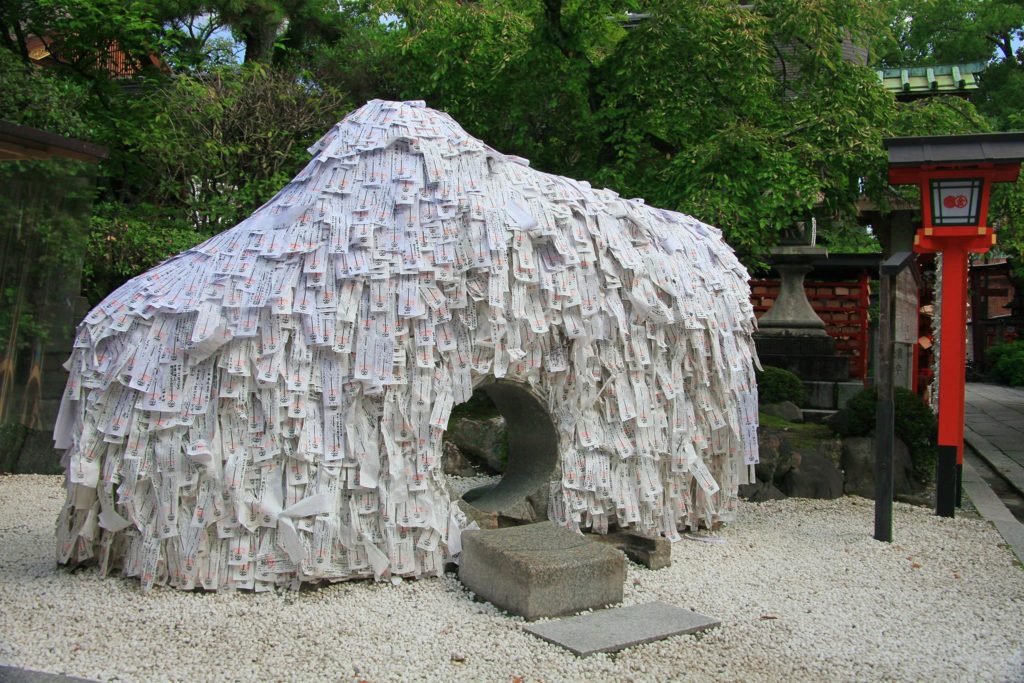
However nice the museum might have been, it was never the main attraction of Yasui Konpira-gu. That title goes to the enkiri / enmusubi ishi, a large stone (purportedly in the shape of an ema, but it’s hard to tell, really) with a round hole at its base. This stone is said to help break off bad, unhealthy relationships and form new, better ones instead.

break-up stoneThe procedure is simple: First you buy a slip of paper and write your wish on it. Then you position yourself at the stone and crawl through the hole. Going front to back means to break off a relationship. Going back to front expresses a wish for a new one. Many people do both; obviously you’ll have to end a relationship before you can start a new one (at least, that’s the clean way to go about it). Finally, you glue the paper to the stone and hope that your wishes will be granted.

By the way: this does not only work for romantic relationships, although most people probably visit the shrine for this reason. A friend of mine told me that some of the papers glued to the stone read like lines from a soap opera. “I want his wife to die” is probably one of the stronger requests. But many people come to break addictions to drugs or gambling, others want to find a more satisfying job, and cutting the “relationship” with an illness for oneself or a close person are very common wishes too… The possibilities are endless!

Finished!

Finally, I finished the revamp of the What’s Up in Kyoto website! There is now a new landing page instead of directly hitting the calendar, I have created two new pages on souvenirs and hotels, and I have fixed a few errors in the coding that I hadn’t noticed until now. Most obvious: the banner is new also, I showed it to you a few days ago already. I will use the logo with the phoenix on my business cards and letters as well, I’m glad I asked a professional for his input on this one. Your input on the new homepage is welcome too, of course!

what's up in Kyoto new logoStill, much left to do on the homepage itself: I need a privacy page (not that I really collect any of your data, but still), the archives need a new layout with pictures to make them more attractive for mobiles, and the calendar page needs space for advertisements (yes, the idea is to get some money out of this eventually). But essentially, these are minor things I can add piecemeal.

But for now, I’ll take today off. It’s the daimonji tonight after all (although it is raining again, just like last year…)

Kyo no Tanabata

I’m still busy with the website, sorry… So, this is just a very short post with a few pictures I took in the weekend at Kitano Tenmangu Shrine.

Kitano Tenmangu @Kyo no TanabataTogether with a friend I went there, because it is one of the places where there is an evening light-up for the current Kyo-no-Tanabata festival. The shrine was open and lit up until 21:00, and there were quite a number of people visiting. They also had a mitarashi purification – that’s the one where you wade through a cold stream – but my friend said that the mitarashi purification you do at Shimogamo Shrine and nowhere else. Indeed, this is the first year I hear of it taking place at Kitano Tenmangu. I guess it must be a really popular festival if it is being copied by other shrines… Kitano Tenmangu @ Kyo no TanabataAnyway, the shrine was beautifully lit up and everywhere were little bamboos where you could tie your wishes to. To be honest, I was a bit disappointed, because it looked a bit empty and haphazard. But then we went down to the momiji garden… This is a very quiet place that is indeed a bit lower than the rest of the shrine, the Tenjin river flows through and there are dozens of momiji maples. Of course, now is not the time to see momiji, but there were lights in different colors making the trees resemble the autumn colors. It was rather quiet down there, maybe people didn’t know about this place, so it was a nice stroll along the river.

Kitano Tenmangu @Kyo no Tanabata

Pin – Badge – Wappen – Mon

To me, the Japanese language is fantastically frustrating and frustratingly fantastic. Especially their loan words, which are almost always written in Katakana, can be a challenge. This is mostly because the Katakana give no indication as to the origin of the word. It could be an English word spelled correctly (as far as this is possible in a syllabary) or a French word written phonetically. The fact that many of these words are abbreviated doesn’t really help either. And on top of that: false friends – words imported from some other language that took on a completely new meaning in the process.

Doppeladler of AustriaThe following is an interesting example of this. My Japanese teacher, whom I meet once a week likes to wear hats. His summer attire is a real Panama hat made from straw; he got it from his brother-in-law who once went on a trip to South America. Anyway, this week he pointed to a pin at his hat, and this is the conversation that followed:

“What is this called in English?
“A pin”, I said.
“Not a badge? That’s what we say in Japanese.”
“No, a badge is made from cloth and is sewn onto clothing.”
“Oh, in Japan, that’s called a Wappen.”
I laughed: “Wappen is actually German, and it means the crest of a noble family.”
“In Japanese, that would be called a mon.”

I rest my case.

Revamp

Sorry for not writing in the weekend – I’m quite busy these days… I am planning a revamp for my What’s up in Kyoto page, but I’m running into more issues than I had thought possible, unfortunately. Part of it is also my hang towards perfectionism, I want it all and I want it now – even though I know deep down that that’s not possible… Hopefully, I can still roll out the new design (including a few new pages 😉 ) some time this week. For now, here’s the new logo a friend of mine made for me. What do you think?

what's up in Kyoto new logo


Stress

I have been working on an update for my What’s up in Kyoto website: A brand-new logo, special landing page, updated calendar page with a new gimmick or two… I had planned to roll it out by August first, at the same time with the new highlight, but there are a few other deadlines in my way that need to be taken care of as well.

And of course, nothing will happen if I have to spend half days at the hospital. Unfortunately, I have developed shingles (herpes zoster) on my back. At first I thought I had scratched myself somewhere, but when I noticed the blisters yesterday, I decided to see a doctor as quickly as possible. He confirmed my Wikipedia self-diagnosis and put me on medication for one week. I hope this will do the trick, apparently shingles can be very painful (in some cases even requiring opiates for pain management) and this is nothing I need to experience myself! For now, the affected area is about as big as my thumb and feels more itchy and irritated than truly painful.

I’m not entirely sure what caused this outbreak, it may be stress related, even though personally I wouldn’t say I feel overly stressed, and I had worse stress during the final days of my PhD, for example. Currently, I do have problems sleeping in this heat though, and in the afternoon, when I usually take a nap because it is too hot to work anyway, there is the noise from the nearby construction that doesn’t let me get much rest. I hope that the weather will cool down soon, so at least I can get enough sleep again.

Summer Festival

Last Sunday a friend of mine took me to a local shrine’s summer festival, a new opportunity to meet the neighborhood! It was a small festival, where the neighborhood association prepares food and drinks for cheap prices, and there was some entertainment as well: First a taiko band (Japanese War Drums), then Hawaiian Dance (yes, I found this a bit odd too, but it was nice), and finally, when the evening got a bit later, the perennial Japanese pastime: Karaoke. We left at this point, but it was fun, mostly because my friend knew a lot of people there.

Taiko Drums at Awata JinjaI always enjoy going to the things that are not geared towards tourists. People are friendly and forthcoming as ever, but it’s just this little private charm that makes all the difference.

Looking for the Lost

Looking for the Lost – Journeys through a Vanishing Japan
Alan Booth

Cover: Looking for the LostThe perennial classic “Looking for the Lost” tells about rural Japan as the author retraces the steps of famous people before him on three different journeys.

The first journey “Tsugaru” describes Booth walking in the steps of Dazai Osamu, in a journey back to the writer’s home in Aomori prefecture in Northern Honshu. Dasai had walked there for three weeks and described his impressions in a book with the same name. The second journey follows “Saigo’s last march”, as Japanese hero and commander in the Satsuma rebellion, Saigo Takamori fled from surrender and returned to Kagoshima at the southern tip of Kyushu to make a final stand there. The third journey “Looking for the Lost” starts out from Nagoya and moves northwards through Gifu prefecture in an attempt to trace possible descendants of the clan of the Heike who were all but wiped out in the middle of the 12th century.

Throughout the book, Booth mixes historical facts with his observations about contemporary Japan and muses about various subjects. On all his journeys he is walking through the countryside, obstinately refusing any other means of transport. He mostly stays on small roads and often stops for a beer or two at local liquor stores. Talking to the locals and staying at traditional ryokan provides him with new friends as well as unique opportunities to broaden his knowledge of Japanese life outside the big cities.

Alan Booth (1946 – 1993) was born in London. Throughout his life, he was interested in theatre, and moved to Japan in 1970 to study Noh. There, however, he soon began writing and worked for Macmillan Press. He wrote numerous articles and two books about his hikes through Japan, “Looking for the Lost” being his second book. He died from colon cancer in 1993.

Although more than 20 years old, this book is a classic and a must-read for everybody interested in the “real” Japan. You can get it from amazon!

Genkan

I’ve been living in this apartment for about three and a half years now, which, now that I think of it, is the longest time I have lived anywhere since I left the students dormitory to move abroad.

Anyway, finally after all these years, I have gotten tired of the state of my genkan. The genkan is the entrance to a Japanese home, it is usually very small and a little bit lower than the rest of the house or apartment. It is considered somewhere between the inside and the outside, and the place for people to take off their shoes.

Talking about shoes… I’m a woman. I love shoes. And even though I only have 30 pairs of shoes altogether (which means I’m practically walking barefoot), they do take up a lot of space. So far, I have put the ones in season in the genkan for easy access, the others were stored away out of sight. Well, easy access… with 15 pairs of shoes, things do get a bit tight and messy in a small entrance. But last week, I’ve finally had enough: I went to the Nitori and bought a shoe rack!

And it was delivered yesterday. At first I thought Nitori was just a Japanese version of IKEA, and in a way it is, with a subtle difference: The furniture comes almost assembled, and if you pay for delivery (only 1000 yen), it will be put up for you. So, when the two delivery men came yesterday around noon, they unpacked the shoe rack and put it right where I wanted it. All I had to do was to put in the shelves at the right position – and to apologise profusely for not having an elevator to get into my 5th floor…

my genkanAnyway, this is my genkan, before and after shoe rack: I am very pleased with the result, my entrance is now less cluttered and much easier to clean, and: I could fit almost all of my shoes into it! So: another room finished after office, kitchen, and bedroom. The biggest room is still a “work in progress” though: my livingroom. I’m getting somewhere with it though: A couple of months or so back I finally installed curtains. You see, I am indeed settling down!

Ofunehoko

Yesterday was the second yoiyama, the day (and night) before the second grand parade of Gion Matsuri. As I have mentioned last week, it was a very special yoiyama for me: I was invited to volunteer at the Ofunehoko, the large boat-shaped float that always ends the Ato Matsuri parade.

The boat shaped O-fune hoko ending the processionNow you’re probably wondering how I, as a foreigner (with very bad Japanese to boot) can help out at one of the most important Japanese festivals! Well… it was all really by accident… I am a member of the Miyakogusa, a volunteer organisation of Kyoto where people of all ages (mostly women of a certain age though) do a variety of activities: From visiting shrines and temples, to cleaning up the Imperial gardens, to presentations on Kyoto’s history, this is all volunteer driven and organised. How I got to be a member of this is an even more unbelievable story, I’ll tell it some other time.

Anyway, the leader of the Miyakogusa is a very energetic woman (!) and she seems to have many sundry connections and know everybody, including the people from the Ofunehoko, which has been restored only a few years ago. About a month ago or so I received a phone call from her where she invited me to take part this year. Of course, when Gion Matsuri calls, you don’t say no. And thus I ended up working yesterday, selling chimaki charms and books and little tenugui hand towels…

It was a very interesting experience. Two weeks ago there was an introductory meeting where we were explained the history of the Ofunehoko, little details to its size, weight, number of men to pull it… Then there were the practical things: How much was each item, where would we get lunch, where is a toilet for us volunteers… Everything was planned to the last dotted i – including what to say when selling something and asking for the money – actually, we were “giving” things to people, since “selling” is a dirty word when it comes to items blessed by the gods…

The level of detail that went into the planning made the whole thing yesterday run very smoothly. When I arrived at the spot, I was set up with two Japanese into one team – we were to do everything together and change stations regularly. There were three stations for us: The small northern and big southern tent, where we sold the chimaki and other things as well as entrance tickets; plus the entrance to the house, from where you could enter the Ofunehoko and take a look at the street from above.

Mostly the work was easy, there were hardly any foreigners requiring assistance, and the Japanese I talked to were easy to satisfy. Part of the smooth ride was surely that I took the morning shift from 10:00 to 16:00, I could see a sharp increase of visitors towards the end of my shift. Then especially the entrance to the house got busy: We were to take the shoes of each visitor, clip a number onto them and hand an identical number to them, so we could find their shoes on returning and give them back. The later the afternoon, the more people wanted to go upstairs, and even though they were only admitted in groups of 10, it sometimes became quite overwhelming when just as many came down the stairs also.

Anyway, I had great fun and I made a couple of new friends. Some of my old friends visited me at work as well, even though it was very hot. Unfortunately, we were not allowed to take pictures from the inside of the stalls, it would have been an interesting and rather unique view on Gion Matsuri! After 6 hours of standing only (there were seats but not enough for everybody) I was exhausted! Not so much from the heat – we had enough free drinks and cold patches to stick underneath your clothing – but because my feet hurt so much…

Fun incident: All of us volunteers had to wear yukata. It took me about 45 minutes to get dressed; first the spanx and the towels (long story), then the yukata itself, and then I needed 20 minutes just to put on the obi! By the time I was done, I was soaked in sweat – definitely a good start for the day! After all that work, I was mightily proud of myself, but obviously it was not good enough still. At some point, one of our yukata-wearing customers looked at me disapprovingly and said: Turn around! She then proceeded to pull hard on the back of my yukata – the part that reaches down below the obi, and after a few minutes, she was satisfied: the pulling had produced a better neckline in front – and in fact, other women passing by later did comment on this! Only in Japan…