Catching up

I’m back from spending a week with an old friend of mine and her family, and I’ve enjoyed myself greatly.

Tuesday I went up to Nagoya, and after saying a short hello to her mother, we went to see Atsuta shrine, the biggest shrine in Nagoya. The area the shrine covers is very large, and it struck me immediately that the precincts were well kept and had many new buildings. It turned out that this shrine houses one of the three sacred treasures of the emperor: the sword. Thus, it is a shrine dedicated to the sun goddess, and is considered very important. In the evening we had dinner at my friend’s brother’s place. I had met him before, but he has only recently moved back to Nagoya. Once again, he was cooking lovely food, and we had a great evening.

Wednesday we spent in Arimatsu, one of the neighborhoods in Nagoya. Although only a small place, it is known as a part of the historical Tokaido – the road between Edo (now Tokyo) and Kyoto. A small part of it has been restored, there are lots of beautiful old houses to be seen there. Arimatsu is also famous for shibori, a beautiful tie-dying craft that apparently goes back to the 8th century.

Takayama was our next station, and we spent Wednesday night and Thursday there. It is a rather small town in the middle of the mountains, and its surroundings remind me a lot of the place I come from in Austria. There is the Hida Folk Village a bit outside of the town, an open air museum that has a number of traditional farmhouses from all over Gifu prefecture. All the houses can be visited, and as it was comparatively cool on Thursday, there was a fire in each one of them. There are many other sights in Takayama, and we spent a lot of time walking through the inner city with its old wooden houses and breweries.

Friday and Saturday we spent in Kyoto. My friend wanted to see a few specific things, and so we went to the Western part of town, which I have grossly neglected so far, I have to confess. We went to Ryoanji temple with the famous zen garden, and to Ninnaji, which is less than a temple and more of an old emperor’s residence. We also saw the Myoshin temple complex, a huge accumulation of temples next to each other; Ryoanji is considered one of the outlying temples of Myoshin. Saturday we spent on my side of town, starting out on the philosopher’s path and then moving on to the city to do some shopping.

I had a great week and thanks to my friend I could revisit parts of Japan I loved very much, like Takayama, but could also see new things in Nagoya and Kyoto. It’s so much more fun to go with somebody else than to do everything on your own all the time. I hope her brother will visit me soon, as promised…
Jizo-Bon

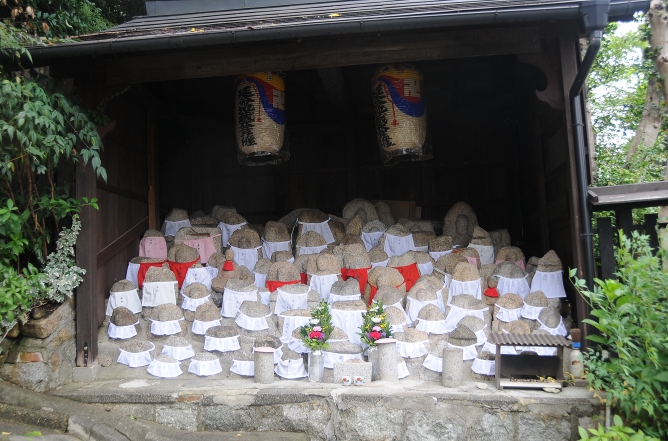
Yesterday, I was woken up by the neighbours just before 8 am. They were already up and about on the little street down the steps from our house and chatting and laughing and doing something. Children were also already up and running about – what ever happened to sleeping in in the weekends? There was something going on all day, and in the early afternoon, the party culminated in a little ceremony at the Jizo shrine at the bottom of the steps… This I found worthy of investigation, and, lo and behold, last weekend was Jizo-Bon, the Jizo festival.

These are the Jizo statues in our Jizo shrine at the bottom of the steps:Jizo Shrine

Jizo is a Buddhist saint, a Bodhisattva (Japanese: Bosatsu), that means, he has attained enlightenment, but will stay on Earth to save other souls. O-Jizo sama is chiefly the guardian of children, dead or alive, but he also takes care of travellers and firefighters. Thus, he is probably the most popular saint in Japan and his statues can be found everywhere. Often he is depicted as a simple Buddhist monk walking with a staff, and the statues are clothed in little red or white hats or bibs. The idea behind that is that, as Jizo will take care of dead children, he will protect them from harm and cold – and pass on the clothing.

Jizo-Bon is the yearly festival for this saint, and it happens on August 24th (and sometimes also on August 23rd). Traditionally, it has been a day to confess bad deeds to the Jizo and asking for their forgiveness, and probably many people still do that. Nowadays, it is often combined with a children’s festival, Jizo-sai, where the neighborhood children are allowed to do little things like changing the clothing of the Jizo statues or painting their faces, and eat red-coloured food. From the sound of it, it seems that the kids had lots of fun last Sunday!

Note: I will visit a friend in Nagoya for the rest of the week, so my next post will be in September!

Average

There have been heavy rains in several Japanese provinces, causing floodings and landslides. I have just read that in a large landslide in Hiroshima, at least 40 people were killed, and more than 50 are still unaccounted for.

In case you were reading these accounts: Kyoto has been fine so far. As I said last week, just up until the Daimonji, there were heavy rains. Apparently during the ceremony, people were not allowed to go down to the riverbank (which is a favourite spot for watching the big dai) because the river had partially overflown the banks of the Kamogawa and the current was indeed very strong. Besides that, I did not notice much effects of the bad weather in Kyoto. Here, it has been dry the whole week, and although there are still weather warnings in place, they are now in the North of Honshu and the South of Hokkaido, far from Kyoto.

So, don’t worry about me here in Kyoto – the summer has average temperatures and average precipitation here. Must be all the mountains that surround the city…

Ears and Noses

The other day, when browsing Wikipedia, I came across a description of a place in Kyoto that I found most intriguing. It sounded so odd and interesting that I decided I needed to see it myself. This is it:Mimizuka in Kyoto

It is called the mimizuka, the Ear Mound – although at the time it was erected in 1597 it was called the hanazuka, the Mound of Noses. It is what the original name suggests: a tomb for noses, and the story behind it is rather… gruesome.

From 1592 through 1597, Hideyoshi TOYOTOMI – who, by the way, is enshrined in the Toyokuni shrine literally across the street – led an invasion of the Korean peninsula, with the intent to conquer first Korea, and ultimately, China. Wars in the 16th century were obviously not the clean “push-button-here” affairs that we can watch on TV now, and there were thousands of casualties, both on the battlefields and among civilians. At this time, soldiers were paid per kill, and one way to prove that was by taking the heads of the dead. By the second Japanese invasion in 1597, the custom had changed to take the more easily transportable noses of the victims instead, which were properly collected, counted, and then shipped to Japan as proof of the army’s efficiency. More than 200.000 heads and noses were taken during this time.

Interestingly, by the end of the invasion (which was unsuccessful, by the way), the noses were interred with proper ceremony in the hanazuka, and Buddhist priests were set to pray for the souls of the victims of the war. Only several decades later it was decided that the name hanazuka was too offensive and changed to mimizuka, but personally I don’t quite see the difference here, as the kanji for “ear” is still used.

Nowadays, it seems that many Japanese do not know about the significance of the mimizuka (there are a few others in other parts of Japan) and what the monument contains. Koreans do come to visit it, however, and there are even efforts being made to get the remains returned to Korea. Once again something I find rather odd – it’s 400 years ago after all, it is a nice and well-cared for monument, and there still seem to be regular ceremonies held there. But then again, what do I know…

Daimonji 2014

Indeed, the Daimonji festival took place on Saturday evening, despite all the rain. A friend of mine told me that it was a religious ceremony, nothing geared towards tourists, so they would try to do it at the designated day no matter what.

It rained heavily on Saturday, with brief stops in between, and all day I was unsure whether the daimonji would take place. However, the rain stopped at around 6 pm, and when it got dark about an hour later, you could make out people – or rather, their flashlights – on Mt. Daimonji, where the largest and the first of the five fires is lit.

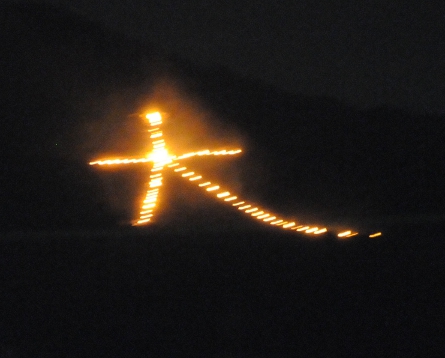
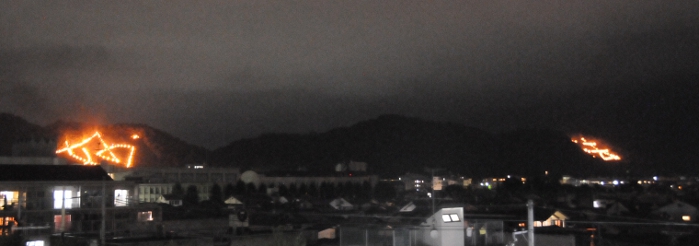
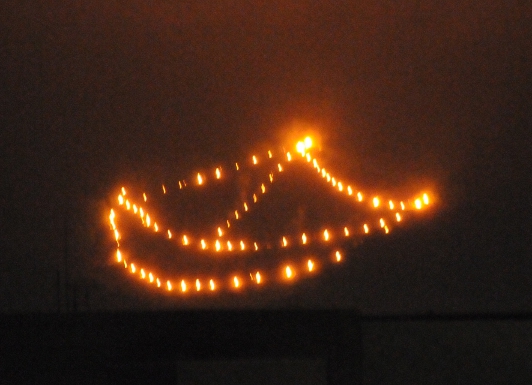
I went to a friend of mine who lives farther North in Kyoto and who had arranged to go to the roof of a three storey building in his neighborhood. From there, four of the five fires could be seen, although not all picture perfect: the hidari-dai or “left dai” fire could not be seen in its full glory, but only as a single thin strip of fires. Here are photos of the three fires – from right to left on the mountains, in order of their being lit – that are more or less recognisable: The dai on Mt. Daimonji, which simply means “big”; the two signs myo-ho, part of a Buddhist sutra; and my favourite one, the fune, the boat-shaped fire.Daimonji "dai"Daimonji fire spelling "myo-ho"Daimonji fire in the shape of a boatWatching the fires being lit one after the other to guide home the ancestral spirits was once again a wonderful, touching experience. The whole display only took about half an hour, and then I walked home, meandering through town in the dry, cool evening.

There is only one of the daimonji fires I have not seen yet: the big torii gate on Arashiyama. Maybe I will try to go there next year.

Anticipation

Tomorrow is the day of the daimonji, the end of the Obon-festival, where on the mountains surrounding Kyoto five huge bonfires will be lit to guide home the spirits that were visiting the Earth during Obon.

A friend of mine has secured a place on the roof of a building from where you are able to see at least four of the bonfires, if not all five of them, and I was planning to go there tomorrow evening and write a post with pictures.

Unfortunately, it has started to rain, and tomorrow’s weather forecast talks about “rain that periodically stops”… Usually, the festivals in Kyoto take place regardless of the weather, but I am not very confident that there will be the daimonji tomorrow. If it rains too much it will be impossible to see the fires – provided they can be lit at all. As far as I could find out, only once the daimonji had to be postponed by one day, let’s hope the second time won’t be tomorrow.

I’ll post an update and pictures when the daimonji has taken place.

Dorm

When I came to Japan last year and needed a place to stay, I decided to look for a gaijin house, a shared accommodation for foreigners who stay in Japan on a short-term basis only and cannot or don’t want to rent an apartment. I did it mostly because I was not allowed to rent an apartment (no zairyu card, remember?), because I did not really know which parts of town are the “good” ones (I still don’t, but I have a better idea of where I’d like to live), and finally, because I thought it would be a temporary thing anyway.

The first year was very pleasant, we were only three people who stayed for longer, and occasionally there were short-term guests. But every one was nice and thoughtful and respectful in dealing with the other tenants and with the house.

This year, the house has become much more busy. Three weeks ago or so was the first time all the rooms were rented out since I moved in. A lot of the people were in their mid-20s, students having fun on their vacation; and unfortunately, the atmosphere in the house turned to that of a student’s dorm…

I had lived in a dorm for long enough to have known the moment I moved out of it, that I never wanted to experience that again. Ever. So I found it especially grating to go through the same old stuff again: dirty remnants of food in the kitchen (well, the cockroaches loved it), a filthy bathroom; a general inability to turn off lights and close the fridge (great stuff in summer, that), noisy homecomings at 1:30 in the morning (banging sliding doors is an art). No amount of requests or explanations of the senior members of the household changed anything, so I was incredibly relieved when the more obnoxious tenants moved out a bit over a week ago – at least I can sleep through the night again.

But today, I had another dorm flash back, and as I was not directly involved I found it rather funny. When I woke up and groped my way downstairs to the toilet and from there to the bathroom, I found, stuck to one of the mirrors, a letter headed with “To whomever is throwing up every night”… In a surprisingly blunt tone verging on the passive-aggressive (the letter was not signed), the puking person was strongly urged, if not to change their lifestyle, then to at least clean up afterwards.

I have since ascertained who has written the letter and that said writer was indeed extremely pissed off about the state of the bathroom sink (!) last night, hence the writer resorted to such methods. I would have never thought this otherwise so gentle person being capable of this!

Anyway, I had my laugh in the morning, and the letter was gone when I went down the next time. Hopefully the addressee has received the letter and the message – and we’ll have a sufficiently clean bathroom around the clock from now on. I also hope that in the future we will get more adults who can look after themselves (and the house) and don’t need to be on the receiving end of anonymous letters…

Kyo-no-Tanabata

Tonight was the last night of the Kyo-no-Tanabata night displays along the Kamogawa and the Horikawa. I rather not call it a festival, because it was more about art and there were no food stalls anywhere in sight, although you could put up wishes on bamboo trees as it is traditionally done during tanabata. Kyo-no-Tanabata lamps at the entranceThere are two venues with light installations and art displays, one along Kamogawa between Nijo and Shijo dori and the other along Horikawa north of Nijo Castle up to Imadegawa. I went to the second location and had a couple of hours of fun – although there were lots and lots of people crowding the small walk along Horikawa and taking pictures instead of walking along… I took a number of pictures too, but as I was trying something new with respect to taking pictures at night, very few of them are presentable, unfortunately.

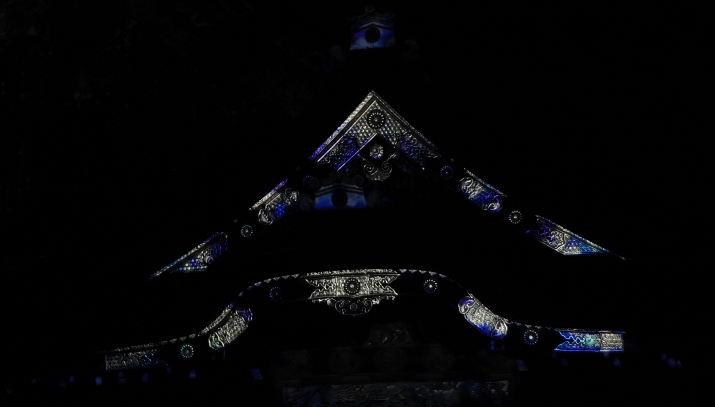
The evening started at Nijo Castle, where there was free entrance to part of the grounds, and a projection of light onto the main castle walls, accompanied by music. It only took ten minutes, probably so that as many people as possible could see it, and I think it was very well done indeed. Light display on the main hall of Nijo CastleFrom there, I went down to Horikawa, a small stream running through town. There is a walkway beside it, but it is relatively narrow, so there was one-way traffic up to the north only, with the single entry point near Nijo castle. You could get out on the way if you wanted to, but not enter. At the entrance there were a number of Tanabata trees and you could buy tanzaku, paper slips, to write your wishes on.

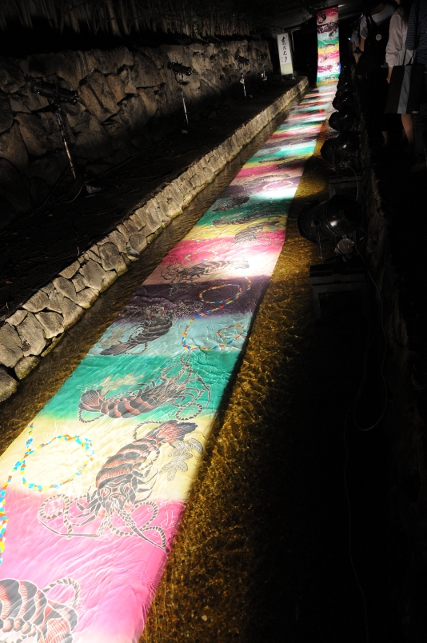
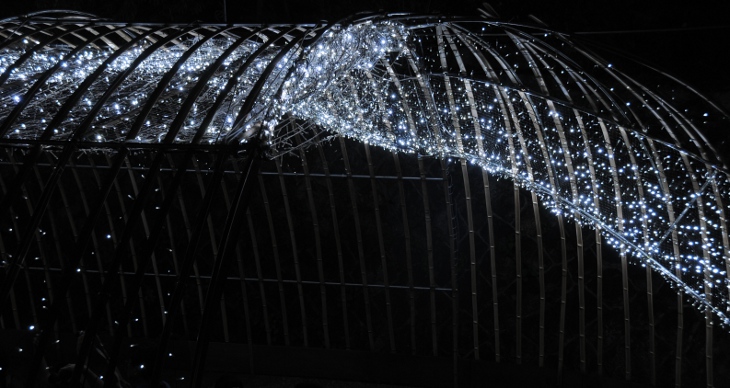
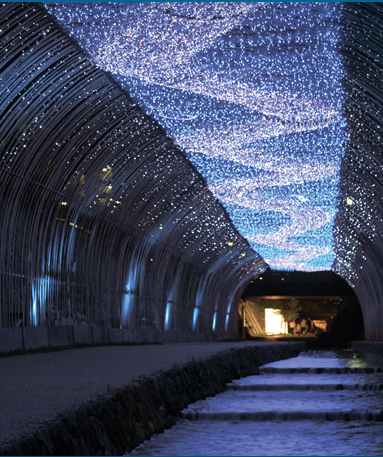
The art displays started with long rows of paper lanterns with calligraphy and paintings. large lanterns with calligraphy and paitings along Horikawa riverA long band of silk, maybe 80 cm wide, dyed in the famous Yuzen style, flowed through the stream. Horikawa lies close to the Nishiki silk weaving district, and apparently has been used in former times to provide the water for dying and washing the silk. A dyed band of silk, decorated with shrimp flowing through the riverA large tunnel with white, blue, and yellow LED’s resembling the milky way was the main attraction, I think.

start of the milky wayofficial photo of the milky way tunnelThe last photo above is the official photo of the milky way, I stole it from the Kyo-no-Tanabata website because it is so much better than any of mine (and there are no people in it…) On the website there are plenty of other pictures, also from the venue at Kamogawa, but some of them appear to be from last year. Anyway, enjoy!

Acquaintance

It has 23 degrees right now – and I’m cold. Yes, I know how that sounds, but only this morning we still had 10 degrees more… It started to rain in the afternoon, and thus cooled down considerably. Apparently there are two typhoons on their way to Japan, one of them (No. 11) is coming from the South and is probably the reason for the rain.

I don’t like going out when it’s raining. Especially now as I don’t really know what to wear – shorts and sandals are not warm enough, and long pants and sneakers get soaked within five minutes. Today I chose the latter, and ran around with squishy feet all evening, which was not really nice, so I might try the long pants with sandals idea next time, as my feet will be equally wet and cold, but there is at least the chance of them drying in the restaurant…

Yes, this is what I was doing – I went to a restaurant with my language exchange partner and a friend of his, and it was really fun! He did not tell me much about his friend beforehand, only that she had spent the last year in Austria, so I was very excited to find out that she lived in Graz, where I myself had studied so long ago! We talked about Graz and where she lived and where I lived and how much Austrian she actually spoke… We talked about her favourite Austrian dishes (Bauerng’röstl, closely followed by Käsespätzle), and when she mentioned that a friend had given her a bottle of real Styrian Kernöl, I recommended her one of my favourites: Vanilla icecream with said Kernöl. She was very surprised, apparently she hadn’t heard of it, but she promised to give it a try. The evening was a short one, we were literally kicked out of the restaurant a bit after 9 pm, and I think because of the rain, nobody wanted to go elsewhere and keep chatting.

I gave her my email address and she promised that if she had time, we could meet again – and talk about Austria. She claimed that she could understand Austrian dialect but not speak it, and I’m curious to try it out… What a great evening, despite the rain!

Certificate

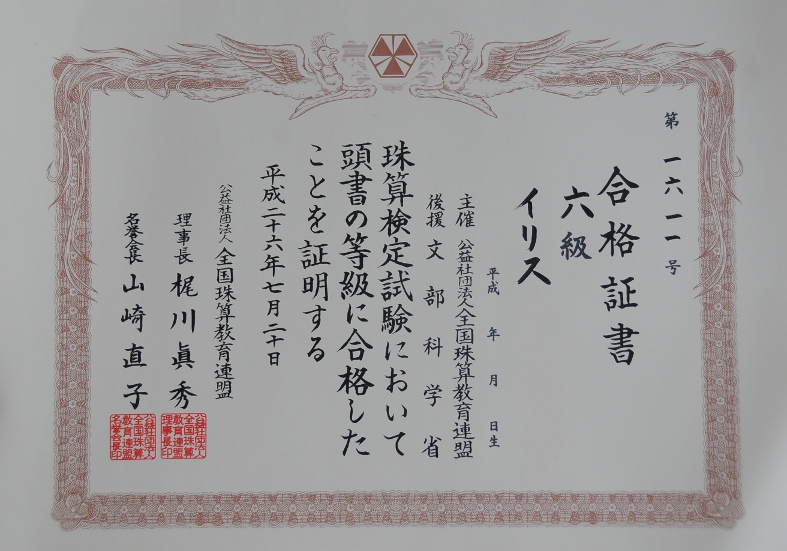
Yesterday I received my first soroban certificate! Here it is:Official certificate for soroban 6th kyu levelIt says that Iris is now a sorobanista of 6th kyu rank, which is not really much but, it’s a start. Everything has to have its proper order in Japan, so this certificate is signed (see the two red seals on the far left) with the names of two famous people who are somehow affiliated with this soroban association. The leftmost of them is Yamazaki Naoko, who, in 2010, became the second Japanese woman in space… I feel honored, actually!

The interesting thing about this certificate is that is does not contain my birthdate, although it should. No, it’s not because I deleted it… It’s because this is a pre-printed certificate, where only name, birthdate, and current kyu-rank are filled in by hand. Apparently, only children take these sort of exams, so the birth year is pre-printed as “Heisei”, the current Japanese era (we are in Heisei 26 right now). However, my birthdate falls into the last Japanese era called “Showa”, hence they left this part of the certificate blank. Sensei promised me to ask next time to have a “Showa” certificate issued, I said it was not important until I’ll get the first dan grade – the equivalent to a black belt in martial arts. Anyway, it’s a nice certificate (noticed the phoenixes?) and I am sufficiently proud of it!