Showering

When I returned from my Christmas trip on December 28th, I came home to an empty house with the doors wide open. While petty theft and burglary are not a huge issue in Japan, and the house is on a spot that is unreachable by car and hardly has anyone but neighbours passing by, I still think it’s not a good idea to have everything invitingly open like that.

constructionWell, my landlady was upstairs telling me the news: In the morning, something in the gas geyser supplying the showers with hot water broke, there was a gas leak and even smoke in the house. It took more than an hour until somebody from the gas company arrived to turn off the gas and to find out what’s wrong – an hour of waiting outside in the cold for everybody, just to be on the safe side and as far away as possible from the gas leak, you never know.

The person who came already determined what replacement part would be needed to fix the problem, but of course, he didn’t have it with him on a Sunday morning. So the landlady tried to plead to fix this as quickly as possible. Even our neighbour got involved and tried to pull the foreigner card: “Look, those are all gaijin, you cannot let them go without hot showers for so long, that’s not possible, I mean, you don’t want to give them the impression of Japan as a backward country…” and some such. It didn’t help though, and the plan was for somebody to come by on Monday morning (December 29th) to fix the problem.

Of course, the person who came by on Monday morning did not get the memo and did not bring the necessary replacement part. Furthermore, it seemed not to have been available for purchase anywhere in Kyoto, despite the frantic phone calls of our landlady. After all, it was the New Year’s week, where many factories are closed, lots of people are on vacation, and Japan as a whole is on standby and runs on emergency procedures. And now that the gas was shut off, the emergency was dealt with, and a number of slightly smelly foreigners were nobody’s problem, really.

It didn’t help that New Year’s was on a Thursday, and there was yet another weekend during which nobody would do anything. Even the sento around the corner had special opening hours when it was not closed outright, and of course I managed to stand before closed doors one night when I desperately wanted a shower. (No, I don’t take cold showers. End of discussion.) At least we still had gas available in the kitchen, so we could wash our hair in the kitchen sink – not overly nice, but doable.

Finally, yesterday morning, on January 6th, I got an email from our landlady informing me that the replacement part had arrived and that some time during the day the repair would be done. It took about two hours in the afternoon to get our gas geyser repaired. We now have a new control unit that talks back to you when you turn on the hot water. And I can attest – after being the first one to literally test the waters, that after 10 days of waiting everything works fine and is back to normal.

For now. Let’s hope that whatever it is that breaks next, it has the decency to do so on a Monday morning, 9 am with no holidays in sight…

Japanese New Year’s Traditions

I have written a little about Japanese New Year’s Traditions last year, and I bet I will be writing on this subject more often 😉 Again, I will focus on the things I have done myself this year.

Just like last year, but this time alone, I went to the other side of Yoshida hill to the joyo-no-kane, the ringing of the bells. I went to Kurodani temple and listened to the bell being rung over and over again. Instead of waiting in line to do my own ringing, I went inside the temple, where monks where holding a ceremony. It was a Buddhist ceremony, and while the bell was ringing outside, four or five monks were banging sticks, sounded a sounding bowl, and recited the name of the Buddha over and over again: Namu Amida Butsu, Namu Amida Butsu

There are many Buddhist sects, but there is that one tradition for everybody, which teaches that anyone can be saved and go to heaven after death who is sincerely calling upon the name of the Buddha. Namu Amida Butsu literally means Homage to Infinite Light, but it can have other ideas behind it depending on the sect. In Japan, Butsu is the Japanese version of Buddha and Amida means as much as merciful.

While they were having the ceremony, people wandered in and out, praying together with the monks or alone, while all through the bell kept ringing outside. As I had no idea how long the ceremony would take, and it was cold in the temple (although it was a bit warmer than last year), I left after a while and went down to Okazaki shrine for my Hatsumode.

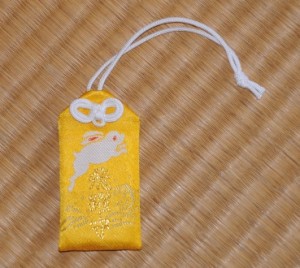
Japanese Lucky CharmHatsumode is the very first shrine visit in the year, and people pray there and buy Omikuji fortune-telling slips or Omamori charms. There are many different charms for all sort of things available, and this year I bought one myself: a general happiness-increasing charm in bright yellow.

It already made me very happy: Yesterday evening and all through the night fell Hatsuyuki, the first snow of the year. In fact, Japanese people are very aware of everything that happens or they do for the first time in a new year. I guess many people stay up to see the Hatsuhinode – the first sunrise of the new year. New snow of course invites Hatsusuberi, the first skiing (not for this odd Austrian though), and there is Hatsubasho – the first sumo event – some time in mid January. Hatsuyume – the first dream – is of course very important, and if you can’t sleep, there is always the Hatsuuri or first sale of the year, often with lucky bags that contain surprise items at very decreased prices and may require people to line up in front of the shops. By the way, I have invented my own New Year’s tradition, which I intend to keep up for a long time to come: Hatsuchoco, the first chocolate of the year…

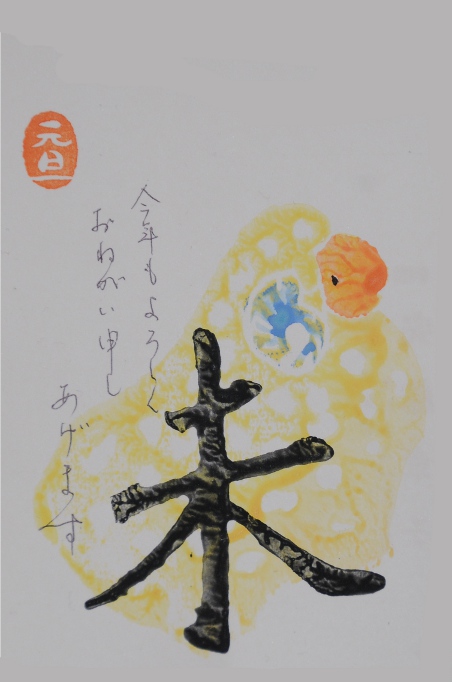
It does not really count towards Hatsudayori – the first exchange of letters – because those cards are prepared well in advance in December; but quite early in the morning on January 1st you will receive New Year’s cards, nengajo. Many people of an artistic bent spend lots of time in making their own, just as my friend has: Hand made New Year's Card 2015

Weekend

I have returned from my Christmas weekend trip in Nagoya safe and sound – and very pampered and, it seems, a few kilos heavier…

As I was seeing Japanese friends, and all of Asia has this obsession with food, we were eating a lot this weekend, both home cooked Japanese (fish and veggies and soup and rice with ginkgo nuts…) and Italian snacks in a small restaurant that is open only on weekend nights and serves as a wine shop during the weekdays. I was totally surprised that this tiny little shop not even in the middle of Nagoya had a selection of Austrian wines! Not many people abroad know that Austria is a wine-producing country to begin with, and as our grapes are rather special and mostly grown only in Austria, it does not help with the people knowing about them. I was surprised enough to buy two bottles, one of which I have already shared with my friends that night, but the other awaits another nice evening…

Besides that, we also went to a special Japanese spa taking a rice bran … umm … bath? There were big tubs with heated rice bran where you lay down and are covered with it from head to toe. You stay there for 15 minutes while your body heats up and – allegedly – absorbs the nutrients of the bran through the skin. It was an interesting experience, and a bit scary at the beginning, as the material is rather heavy and you are buried at least 10 cm deep in it. However, when you can relax, it is very enjoyable – and very hot. I was happy that about half way through the treatment somebody came to put a cool washcloth on my forehead.

Afterwards you have shower – in your private changing room – to wash off all the bran that sticks to your body, and which looks and feels like dark brown sand. Everything is provided, of course, but when I was finished, I encountered a small problem: I was in the shower all wet and clean now, but I had come from the bran tub with bare feet, my body all covered with the brown dust. Clearly all the floor outside would still be covered with it, and I prepared to take an awkward jump trying to avoid getting my feet dirty again. So, when I opened the shower door, I carefully checked the floor and – instead of the leftover bran, I saw a nice fluffy bath mat. Somebody had come while I cleaned myself to do the same to the floor and put the mat down. Well, that’s Japan, everything perfectly thought out to the last detail.

Before I went home yesterday afternoon I went to the large bookstore on the 11th floor of the Takashimaya at Nagoya station, which has a surprisingly large selection of English books (large compared to the selection in any one of Kyoto’s bookstores, not quite as large as the one in Kinokunya in Shinjuku where there is a whole floor for English books… Okay, I’ll stop dreaming) and I bought a few books there. I did not stay as long as I had wanted because it was very busy as usual on Sunday afternoons anywhere in Japan, and I don’t like to have that many people shuffling around me.

That was my weekend, nice and relaxing, and I enjoyed it very much indeed. Next time, however, my friends have promised to come and visit me in Kyoto…

Yuzuyu

It’s winter solstice! Depending on your point of view, this is either the middle of winter or the start of it. In any case, today (actually, late last night), the sun has reached her southernmost point of voyage and will now move northward again, eventually bringing with it: spring… However, this will still take quite a while, before that it will get really seriously cold in the northern hemisphere; not something to look forward to for a heat loving person like me living in central heating deprived Japan…

Anyway, that’s exactly why the Japanese have invented heated toilet seats and hot spring baths. I have written about onsen and sento before, but winter solstice is a very special day there: it’s the day of the yuzuyu, literally the hot yuzu water.

Picture of a yuzuThe what? The yuzu is a citrus fruit with yellow skin, about the size of an orange, but with a taste similar to grapefruit. They have a very aromatic smell, and although rarely eaten raw, they are used to make tea or jelly for example.

On winter solstice, the usually pristine bath tubs of onsen contain yuzu, either floating about freely, or, more often, cut in half and put into the bath water within a net, so that the full aroma is released. Japanese people belive that such a yuzuyu will help keeping colds away and prevent sickness all through the winter.

Well, it worked for me last year, so I’ll go again a bit later tonight…

Waiting

It was indeed snowing yesterday morning, and it did so until the early afternoon, just as predicted, although not quite as much as I hoped for. Apparently, it was snowing much more in the North of Kyoto (about 30 cm) and there were 2 m of snow in Hokkaido – well, that’s what I call a decent amount! Anyway, here’s a photo, shot straight out of my window:

Snowy view from my windowBy now, it’s not as cold anymore, so instead of snow we are getting rain, which I find rather more depressing, although it’s the same water…

Today, I decided to check out the market for rental apartments and houses. I had already made out a small rental agency not far from my place, and I had made an appointment to come this afternoon and visit a few places. I have always lived in a house as a child, and still, this is what I’m leaning towards. Here in Kyoto, you can either rent an old house or a new apartment for essentially the same price, and as I always loved old houses anyway… They had this lovely old house on their webpage, although not in this area; it was a fairly big, traditional Japanese house with a small garden in front and a larger garden in the back, with a gorgeous old-fashioned entrance gate… It was a bit expensive, but I had set my mind on it and at least wanted to see it.

Unfortunately, somebody had snapped it up just the day before… So, no new old house for me just yet. The agent said that right now it’s not a good month to move, as there are not that many properties around. He asked me if I could wait until January and he promised that there would be more rentals – especially traditional houses – available.

Well, the kids downstairs are behaving a bit better right now – they don’t seem to leave their own rooms much anymore, I guess it’s too cold for them – so I can probably survive another month in the house. I really want to have my own place by the beginning of February though, I hope everything will work out.

Majority

Yesterday the latest elections for the Japanese Lower House took place, after barely one month of election campaigns. As I cannot read Japanese newspapers, I cannot tell in detail what a Japanese election campaign entails. Part of it are posters of the people campaigning for any given party, either posted singly at will in windows of shops or even normal houses, or in groups on large signs, strictly ordered by … well, I guess by their rank on the ballot:

Local posters of people running in the election.Another part of campaigning in Japan is the dressing up in the party’s colours and standing at crossings and waving at the people driving by. Sometimes, the candidate himself will stand there, brandishing a microphone and asking people for support. Often, they are driving through the small neighborhoods in a van equipped with loudspeakers and do the same, the car is full with people waving and shouting at people.

Last week I was waiting at a pedestrian crossing, and such a van arrived. Inside, everybody was dressed in blue and they were waving and shouting – at me, the obvious foreigner who is not (and will never) be allowed to vote in Japan. The loudspeakers were droning an endless row of Please and Thank you!, making you wonder if there is any sort of political program at all. It was hilarious.

The outcome? Same old, same old: More Shinzo Abe for the next four years. The people are not happy with his politics – he wants to turn the nuclear plants back on, has plans to abolish the non-attack parts of the constitution, and is generally considered a political hawk – and the turnout showed that, with only 52.66% of all voters taking part in the elections, a record low.

Sometimes I think it would be better if voting were mandatory, but then there should be an option “NO – I don’t want any of those parties”, and the seats should be divided according to the outcome, with the NO votes represented by empty seats in the parliament. I wonder if this would change politics? Looking around at various countries, it seems that the only option you have these days, no matter where you live, is the choice between pestilence, cholera, and a bit of Aids…

Kicks

Languaga page from my Japanese dictionarye is a minefield, even if you’re working with people who you think are great foreign-language speakers…

Last Thursday, at the end of my soroban class – we were running a little late – I wanted to finish the last of my addition exercises. No, sensei said, we’re past 8 already, please go and check your results. Oh, you’re kicking me out?! I replied and started to wrap up.

I should not have said that. Sensei’s reaction was straightforward: Within an instant he got really, really pissed. This simple sentence, jokingly used in English (we say something similar in German even) triggered an angry response as I have not thought a Japanese being capable of. At first he didn’t want to talk to me at all, then he was accusing me of thinking him rude (How can you think that, I never kicked you out) and then he said that he would not help me again.

It took me almost half an hour to smooth the waves, and I am still not sure whether I really understood why he became so angry, other than: well, it’s a language problem. The English phrase “You’re kicking me out?” can be used for example in a bar, when the bartender starts to clean the place, putting up chairs and such, without really asking you to leave. It’s used in a joking way, neither meant to express nor to cause offense, and as such it is understood in the situation at hand.

However, yet again, Japan is different. Apparently, just using the word “kick” in Japanese would be a rather rude thing to do. Add the implication that you as the host are kicking a guest out of your house… And finally, consider the fact that Kyoto is the last enclave of court-derived, serious politeness in all Japan, and there we are…

In the end, I think we’re okay again. I had to explain that we’re essentially navigating three languages, my German, his Japanese, and the English where we meet in the middle, and that of all of those the German is the most straightforward and the Japanese the most turning in circles. I hope I will not make such a mistake again – although, how could I possibly avoid that?

Thai Rice

We have a new housemate since last weekend. He will be here for one month and will work in that time as an intern at the University Hospital, which is just 10 minutes away from the house. I happened to be there when he came to Ebisu’s, and when he climbed the steps, I noticed his luggage: He carried – or rather, hardly carried – a large suitcase and a huge backpack, and I already wondered how much stuff a guy can possibly need in a single month.

Well, I watched him prepare dinner one evening, and now I know what he’s been lugging around: It’s food. Don’t get me wrong, we all have our special needs when it comes to food, and we all like to have familiar stuff, even on vacation. A Finnish houseguest filled half the freezer with dark bread, Koreans take their kimchi everywhere (it’s even available at every Korean airport in the duty-free section), Australians are rumoured to bring their Vegemite wherever they go, and I have to admit that when I was in Europe the last time, I stuffed my suitcase with bread and special Austrian sweets (Punschkrapferl, Mohnstrudel, Nusskipferl,…) as well. And with Nutella, of course.

A bowl of white riceBut I think that our new guest lifted the whole thing to a totally new level. When he made a curry dish the other evening, he used a special kind of spicy Thai-sauce, a bag of curry made with some meat, and: two cans of pre-cooked rice, everything brought over from Thailand…

I can understand the sauce, and even the curry – but the rice? Seriously? Japan produces about 120% of their national rice-consumption, and even so, I am sure there is Thai rice to be found somewhere. Bringing staples like this with you is just odd… At least, there will be lots of empty space in his bags that he can fill up with souvenirs when he’s leaving.

Mints

bonbon wrappingI went to see Katsura Imperial Villa today, I will write a detailed post once I have sorted through all my photos… It is quite far from my house, it took me about one hour to get there, taking two buses. The first one got quite crowded and at some bus stop, I offered my seat to an elderly lady. She was not really ancient, but still obviously happy to be able to sit down. Then, she started rummaging in her bag and after a while she touched my hand – and offered me a mint bonbon… She did not eat any, so I guess it was her way of saying “Thanks”. What a nice thing to do!

Kyodai-matsuri

For the last few days it has been rather noisy in my neighborhood. The main campus of Kyoto university is nearby and currently, the yearly university festival is taking place. Throughout the day, especially in early afternoon, you can hear bands playing and announcements of stuff I cannot quite make out…

This seems to be a time when all the university clubs put on a great show. For example, there are groups devoting themselves to learning traditional dances – Western traditional dances, mind you, and they are even taking the time to make their own costumes. According to a friend of mine who is Bulgarian, they do Bulgarian dances as well, and the costumes they make look even better than the real thing.

Foodstalls are present as well of course, and there are people – mostly girls, dressed in surprisingly scanty clothing for November – who hand out little flyers to draw people to other places and performances that do not take place outdoors. Yesterday evening there was apparently even a fire-performance, but I did not go there after all.

Besides all the students on and around campus, this weekend there are many tourists walking through the neighborhood chasing the momiji equipped with little maps. I hope there will be something left to see when I go to the imperial villa next Friday…