Kitano Tenmangu Shrine

Kitano Tenmangu is one of the most popular shrines in Kyoto, among locals and visitors alike. Not only does it have a huge flea market (Tenjin-san) each month on the 25th, but many students of all ages visit before an important exam to pray to the God of Wisdom that is enshrined there. The year 2021 is an especially good year to visit Kitano Tenmangu because of its connection with the ox, this year’s zodiac animal.
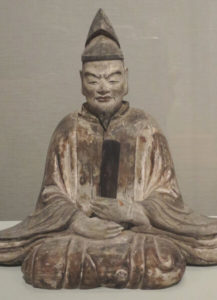
Wooden Statue of Sugawara-no-Michizane.Kitano Tenmangu enshrines a real historical person, Sugawara-no-Michizane as its main deity. Born in 845, he was a precocious child, writing poetry from a very young age. He became a renowned poet and scholar and eventually a courtier, where he was supported by Emperor Uda. However, after Uda’s retirement, rivals from the Fujiwara family slandered Sugawara-no-Michizane, and he was forced into exile in Kyushu in 901. He died there two years later without returning to the capital, and was buried in Kyushu. Now, the story goes that after his death, Kyoto was hit by natural disasters and a number of Fujiwara courtiers and even the emperor’s family met with illness and personal tragedies. In search for the reason, Shinto priests reported that Sugawara-no-Michizane had appeared in their dreams. Thus, in 947, Kitano Tenmangu was built to appease the angry spirit of Sugawara-no-Michizane, and he was deified and enshrined as Karai Tenjin, the God of Fire and Thunder. In 987, he was elevated to Tenman Tenjin, the God of Scholarship, and today, Kitano Tenmangu is the head shrine of around 12,000 other Tenjin shrines all over Japan. 

The approach to Kitano Tenmangu from the south starts at a large stone torii and follows a path lined with stone lanterns. At the end lies the shrine’s impressive romon gate, a bit elevated from the outer grounds and the main entrance. It is flanked by the common statues of komainu lion-dogs and zuishin warriors and is known for its beautiful carvings and the large lantern right above the path.

On the other side of the gate the precincts open wide. To the left lies the emasha exhibiting large wooden tablets, typical presents to shrines. During the New Year’s period people come here to write their very first calligraphy of the year, and the best ones are exhibited afterwards. Further down this path lies the plum garden of Kitano Tenmangu. These were the favourite trees of Sugawara-no-Michizane, and more than 1500 trees can be found in the precincts. The fruits are pickled and sold in December, to be put into tea on New Year’s day as a good luck charm.

To the right lies the shrine’s treasure house, where many valuable gifts that were presented to the shrine over the centuries are stored and exhibited. The most important treasure is the Kitano Tenjin Engi Emaki scroll below which depicts the origin story of Kitano Tenmangu.
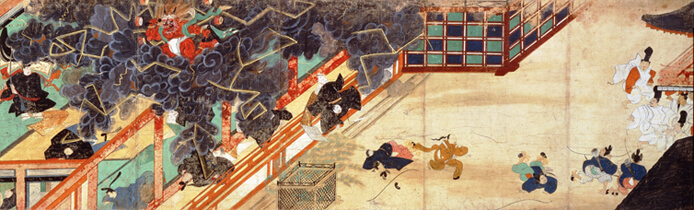
Painted Scroll showing the founding of Kitano Tenmangu in Kyoto.

However, the main buildings of the shrine lie straight ahead from the romon gate. You must pass through the sankomon gate, the “Gate of Three Lights”, behind which lies a lovely courtyard with the outer and main prayer halls straight ahead. At Kitano Tenmangu Shrine, these two prayer halls lie under a single, wood-shingled roof, which is very unusual and called the yatsumune zukuri style. The two main gates and the main hall show the typical architecture of the Momoyama period with intricately painted carvings, golden ornaments and pretty lanterns. They were donated to the shrine by Toyotomi Hideyori in 1607, and the main reason why Kitano Tenmangu is designated as a National Treasure.

Another historically important feature of Kitano Tenmangu is often overlooked by the casual visitor. It’s the so-called Odoi, a slightly elevated hill at the western end of the precincts that was once part of the city’s fortification wall. From there, you have a nice overview of the shrine to one side, and the lovely momiji valley on the other through which a little stream flows. As can be expected, this part is especially beautiful during the the koyo in autumn and the aomomiji fresh leaves in spring.

Okay, enough teasing: What’s the connection with the ox? Well, Sugawara-no-Michizane was born in the year of the ox, and thus, oxen or cows are seen as his messengers. Another story goes that when he was supposed to return to Kyoto, he died on the way, and the ox that was pulling his cart lay down on the street and would not get up anymore. In any case, throughout Kitano Tenmangu, you will find many statues of cows. These are called nade ushi, stroking cows, and the idea is that you first rub your ailing body part and then its counterpart on the cow to transfer your malaise to the statue and get rid of it for good. Definitely worth a try!
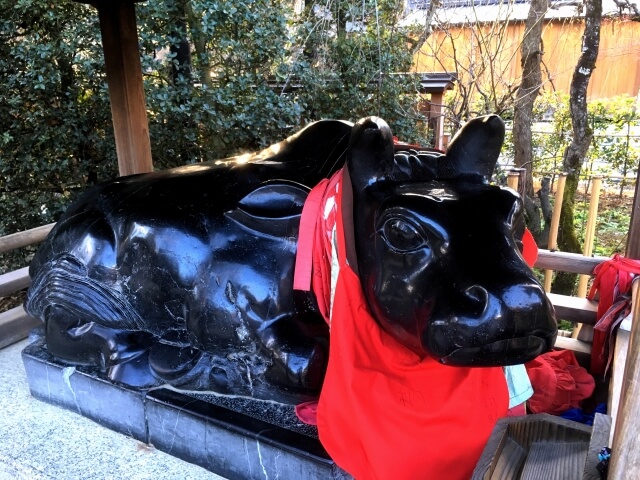
Statue of a black cow with red bib in Kitano Tenmangu.

Because it is visited by so many high school kids preparing for their university entrance exams, Kitano Tenmangu is very busy throughout the year. Like at all other shrines, you can buy goshuin stamps and omamori charms, mostly related to scholarship. Since I like useful stuff, I bought a lovely wooden box of pencils with the shrine emblem and wise sayings on them. Not sure it helps with the wisdom though…
I’m back!

My first post in 2 weeks! I had a great “holiday” at home. The three national holidays in a row provided some much needed peace and quiet, and I’m very happy to say that so far, it’s still pretty quiet since the construction next door is on a break. I’m feeling perfectly relaxed, which is wonderful.

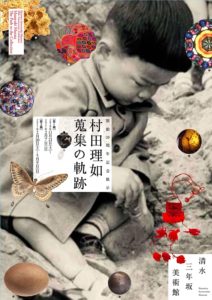
flyer for 20 years of Sannenzaka Museum exhibition.In the last 2 weeks, I did some smaller things around my place, but mostly I spent my time reading. Not the weather was that good anyway. Unfortunately, it was also raining on Children’s Day (May 5), so I skipped the ceremony at Kifune Shrine, which I wanted to see. Oh well, there’s always next year (a dangerous thought, I know). However, I did visit my favourite museum, the Sannenzaka Museum. They specialise in Japanese arts and crafts from the Meiji and Taisho period, and I made it there just before the end of the last exhibition period. Since it is a rather small museum, they have chosen to remain open during the state of emergency, giving me some place to go.

Speaking of our state of emergency… Well, it was supposed to end yesterday, but it was not only extended until May 31, but now includes Aichi prefecture (Nagoya) as well. This is exactly what happened last year! Looking back, it’s quite hilarious how in June last year I thought that everything was over and “back to normal” already.

Even though some things are indeed more relaxed (definitely compared to last year), we should remain careful. Vaccinations go very slowly here, and Japan plans to have most elderly people vaccinated by July, which probably means that we young ones can get our shots then, finally.

Anyway, I’m back and I’m trying to stay positive and focused on what little work there is at the moment. There will be a “normal” soon. I hope I’m right this time around…

Wish Fulfilment…

Last week, on this very blog, in a comment to one of you dear readers, I vented my frustration about our Corona measures. Essentially, I said: Oh, just shut everything down already! Well, what can I say.

In the latest episode of the perennial hit series “Careful What U Wish 4”, the government has done exactly that: Kyoto, together with the neighbouring prefectures Osaka and Hyogo, is under a new lockdown, pardon me: state of emergency. Beginning last Sunday and ending, hopefully, on May 11, restaurants, bars, shopping centers, museums… are closed. And Kyoto Zoo. With more people sick in Osaka than in Tokyo (which is under lockdown too), the measure is understandable. Besides, I dare not complain again…

Well, here goes my holiday. For the last couple of weeks I was thinking of going out of town for a couple of days around Golden Week (which starts tomorrow). I didn’t want to go too far anyway, down to Nara again perhaps, or over to Otsu, more a change of scenery than a holiday, really. It’s not going to happen now. But, I have all intentions to take time off from tomorrow through next week, so that’s at least something.

There are other good news too: Just yesterday, they finished the demolition next door. The ground is level, the machines are gone, and it’s quiet again, for the first time in months! I very much hope that they will take their sweet time with the surveying before they tear everything up again and start constructions. I am pretty confident though that nothing much will happen until the end of my “home holiday”.

Yeah, I’m good, for now. Let’s hope it lasts.

The Tale of the Heike

When I wrote the story of Gio last Sunday, I was quite surprised to find that I haven’t talked about “The Tale of the Heike” yet. Here’s to remedy that oversight!

Heike Monogatari

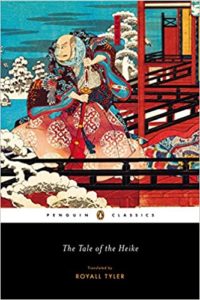
cover image of "The Tale of the Heike".

The Heike Monogatari is an epic tale that essentially tells the story of the Japanese Genpei War. This war from 1180 to 1185 was a power struggle between the Heike/Taira clan and the Minamoto/Genji clan that had been going on for a while already.

At first, Taira-no-Kiyomori is one of the most powerful men in the country, even having married his daughter to the emperor. However, when he tries to put his grandson, 2-year-old Antoku, on the throne, the rival Minamoto conspire with the deposed emperor to overthrow him. Both sides gain allies and prepare from war that starts with the Battle of Uji. From there, a series of battles between the two clans ensues in which the Minamoto eventually gain the upper hand and Emperor Antoku is killed. At the end of the war, the Taira clan is defeated and all but wiped out, while the victorious Minamoto establish the Kamakura shogunate.

The monumental Tale of the Heike comprises numerous stories and legends that were at first passed on orally by so-called biwa-hoshi bards. It was complete by 1330. A number of individual stories have been transformed to Noh plays that are still performed to this day, as well as movies, manga etc.

Personally, I found the first part that deals with Kiyomori and the scheming by and against him the most interesting. Once Kiyomori dies of old age and his son takes over, the war soon begins, and the story turns to detailed accounts of who-killed-whom-and-how. This part I found a bit tedious because there were so many people involved that they were hard to keep track of, and most were killed on the very page they entered the scene anyway. Yet, having read the Heike Monogatari gave me an insight both into Japanese history and beloved heroes like the unbeatable Benkei and Yoshitsune, whose stories are an important part of Japanese culture.

If you’d like to try one of the famous Japanese books on war, you can get the Heike Monogatari on amazon.

New Trend: Mokushoku

Today was one of the days when I fled my apartment mid-morning because of all the noise next door. (No more complaints, promised!) I went to my favourite cafe nearby to get some writing done, as usual. But I arrived to a rather unusual setting.

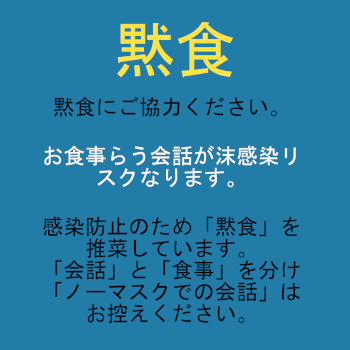
I did mention that we’re in another “lockdown” until May 5, right? For my dear beloved that means that there are now two more tables for two (my favourites) that you can’t sit at because of social distancing. And the huge table that dominates the room and usually sits 12 people at least, if not more (never counted pre-Corona, honestly), has now only 6 chairs left, three on each side. No wonder they had to raise the prices (2 yen per cup of “Royal Milk Tea”, but it’s ’bout the principle.) Thankfully, I did find an empty spot, but on the table was a notice like this one:

(I recreated this at home because no smartphone to take pictures… but I carefully took down all the kanji and even tried to match the colors.) It says:

Silent Meal

Please cooperate with the silent meal. Conversations with meals pose a risk of infection. We recommend “silent meals” to prevent infection. Separate “conversation” and “meal” and refrain from “conversation without mask”.

Well, that’s definitely a new one! And it’s hilarious. Just think about it: How is it possible that speaking while having a meal is a bigger infection risk than a conversation without food? How much open mouthed do you need to eat to make this possible? And how come that if you’re such a sloppy eater you still have people who’d want to go out for lunch with you?

I can see this with babies, toddlers even, but this is not a daycare for kids. It’s a cafe for adults who like to step out every now and then and have a coffee and catch up with the papers. And most people who are coming are doing so alone because they study or read – I mean, that’s the whole point of a quiet book cafe… The mind boggles. I’m seriously wondering what else they’re coming up with next.

The Tragic Loves of Gio-ji

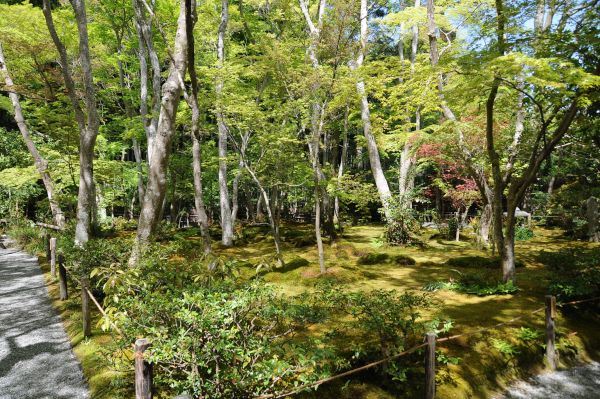
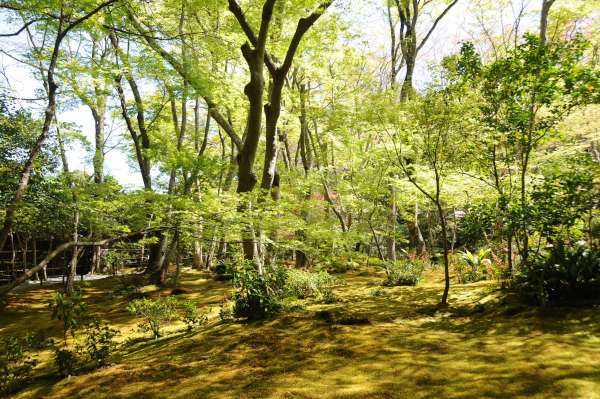
While I was out and about in Saga for the Dainenbutsu Kyogen last weekend, I also veered a bit off the beaten tracks to a tiny temple called Gio-ji (emphasis on the o). Well, it’s not really a temple, more of an hermitage, with a single building. There is one Buddha statue in a room that is not bigger than most modern living rooms. In fact, the temple is mostly garden; huge maples and other trees in a bed of moss with the occasional lantern or memorial stone. Right now is not the best time to visit, as you can see below. The moss is at its prime during the rainy season and the temple shows off its beauty when the maples are blazing in autumn, of course (as in the last two photos).

Gio-ji was not alwasy that small though. Once it was part of a larger temple complex called Ojo-in which is said to have reached all the way up the mountain. This temple was allegedly founded in the late 12th/early 13th century by a disciple of Honen, he himself founder of Jodo-shu Buddhism. Be that as it may, this large temple fell into disrepair, and all that’s left today is the little hermitage and the moss garden.

However, Gio-ji is more than just a remnant of another temple, and it is more than just another pretty spot for moss and maples in the Arashiyama mountains. What makes Gio-ji famous is the story behind its name, the story of a woman. The following is a story as related in the Heike Monogatari:

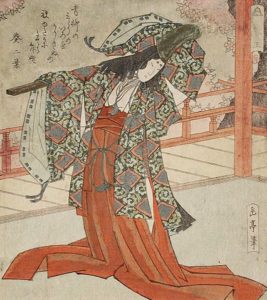
Gio was one of the most beautiful women of the 12th century. She was a shirabyoshi, a dancer, and, as beautiful women often do, she had numerous admirers. One of them was Taira-no-Kiyomori, the military leader of Japan in the late Heian period. This powerful man took a liking to Gio and, as powerful men often do, wanted to have her all for himself.

Gio fought hard. She resisted with everything she had, brought up a younger sister and an ailing mother she had to take care of. But Kiyomori insisted, sent poems, beautiful robes, and other gifts. Eventually, Gio’s defenses broke down. Besides, what could go wrong as the mistress of the country’s de-facto leader? So, Kiyomori installed Gio in the palace. She had traded her freedom for the easy life plus all the attention a dancer could crave. But of course, it couldn’t last forever.

Gio’s luck ran out when that of another woman started: Kiyomori had cast his eye on a new, younger dancer called Hotoke. And the story repeated itself: Kiyomori courted Hotoke with all he had and eventually installed her in his palace. And Gio had to leave.

Stone lantern at Gio-ji temple surrounded by moss.

Even though Gio was only in her 20s at the time, she decided to become a nun. And it is said that she together with her sisiter and mother, took up residence in the little hermitage that today is Gio-ji. This is why you will find not only Buddha, but also statues of several nuns in the little room at Gio-ji. And among the temple’s graves are that of Gio and her family.

Is the story true? Probably. It is told to us in the Heike Monogatari, one of the epic tales of Japan, that dates back to at least 1330. We can expect that the story was embellished over time, of course; a Noh play, and many other retellings of the story did help with that. No wonder, it’s a timeless story that we have all heard one way or the other…

Frustration x 2

How are you all doing? I’m just clawing myself out of another hole, and it’s not going very fast… I don’t like whining in general and certainly not on here. First of all, everybody’s got their frustrations (especially now) and second, it’s boring to read or listen to if it’s getting too much. And it is getting too much for everybody lately. But I do need to vent a little, so just bear with me this time, okay?

First of all, Kyoto is in another COVID-19-induced lockdown with the same old spiel of “avoid going out”, “keep your distance”, “restaurants and bars close at 8”. It started on Monday and will end on May 5th, on the last day of the Golden Week holidays. I’m getting so tired of this. And what’s really annoying is that Kyoto is actually doing rather well. The problem is Osaka, where only yesterday they had 1000 new infections (with 2.6 million inhabitants, but still), and with people from Kyoto commuting for work every day…

So yes, more “stay at home please” orders for 3 weeks. I’m thrilled. Just thrilled. It wouldn’t be that bad if staying at home all the time were pleasant. But the construction works in front of my office window, which have been ongoing for months already, have reached new noise levels.

Of the six buildings that were there before, nothing is left. To be honest, it was actually quite interesting to watch the apartment building being torn down. They used huge claws to bite into the gutted building where only the concrete walls with the windows in them were left, and bit by bit they demolished it and carried it away on large trucks. It’s amazing how dexterously a skillful person can operate these enormous pieces of equipment.

I was happy when the building was gone and I thought I could look forward to a bit more quiet. But no, they are now digging up the foundations which is a completely different game. The walls on the outside are much more massive, and huge chunks are “bitten” of in one piece and then crushed individually. As I said, it’s a completely new level of noise. And it’s going on from 9 – 5 with a one hour lunchbreak from 12 – 1 and two shorter breaks in the morning in the afternoon. Unfortunately, it’s not the kind of continuous background noise that the brain filters out after a while either.

This constant noise is very stressful.. When I have work where I need to focus, the noise recedes into the background and it’s fine. But most of my work is rather creative, where I need time to think about how to do something. And there the noise is very disruptive. Not all my work can be done in my favourite coffee shop, so I am doing some after the workers quit for the day. Sadly, I can’t sleep in and even when I’m not working, it’s hard to relax during the day.

Oh well. Right now, I can at least keep my windows closed, not that the single-glazing is doing much good. But with the cherry blossoms being long gone, it will get hot soon, something I usually combat by opening up all windows. I have no idea what I’m going to do this summer. Let’s just hope it won’t get too hot this year…

Thanks for listening! I’ll try not to whine too often. It’s really not fun to read…

Saga Dainenbutsu Kyogen

I had a great day yesterday, spending some time in Arashiyama. It was not as busy as it used to be, no wonder, all the foreigners are yet to return… The reason I went yesterday were the performances of Saga Dainenbutsu Kyogen at Seiryo-ji Temple. I wrote about them in detail before, but this time, probably thanks to COVID-19, somebody had recorded the plays and put them online. These are the two kyogen that were shown yesterday:

The first play was called Shaka Nyorai and it’s a funny or “soft” Yawarakamon play. The title refers to a Buddha statue that is set up in a temple by a priest. When a beautiful woman comes to worship, the statue turns his back. The priest and a samurai (or worker?) at the temple ask her to worship again so that the Buddha will turn his back and face the proper side once more. Instead, the Buddha lays his arm around the woman and leaves with her. The priest takes the Buddha’s place and the same thing happens with the woman’s beautiful daughter. Finally, the worker at the temple tries the same – will he succeed in finding a wife too?

https://www.youtube.com/watch?v=pTUjgGQpeLs

The second play was the famous Funa Benkei (Benkei on a Boat) and it’s a serious or “hard” Katamon with an origin in Noh, or rather, in the Heike Monogatari. The story tells how famous warrior Yoshitsune is urged by his friend Benkei to leave the city to save his life. He first takes leave of his lover, Shizuka Gozen before he reluctantly boards a boat together with Benkei. When they have sailed for a short while, the ghost of Taira no Tomomori appears and tries to kill Yoshitsune in revenge for his own death. The two fight but almost draw until Benkei recites prayers that send Tomomori back to the underworld.

https://www.youtube.com/watch?v=Iw-V_5zx5D0

All Dainenbutsu Kyogen are pantomimes that need no words, but it does help if you know the story. They are rather slow moving with stereotypical costumes and accessories and the players – all male – wear beautiful masks. In the background, music is played, a simple beat that speeds up at the most exciting parts like fight scenes. Enjoy! (I have no idea why the embed is not working, but the links should).

Cute Food

Remember the Tamayuran cat cafe? It’s been a while since I last visited, but I just found this photo that I wanted to share. Aren’t these sweets cute?

These little kittie paws are actually cup cakes, and I got them as a present to take home last time. I decided to heat them on my toaster for a bit, but unfortunately, the left one slipped inside and got a bit darker than I wanted. They were still tasty, a great breakfast!

Anyway, the owner of the Tamayuran is still going strong. As she had to limit the number of visitors to her small cafe because of Corona, she has now started an online side-business where people can buy her handmade cakes. Her sweets are absolutely delicious (her lunches, not so much) and are always a special bonus on top of all the cats roaming the cafe. Unfortunately, she will also have to move the cafe since the lovely old buildings in the area have been bought by a developer who will doubtlessly build a mansion there instead… I don’t approve, but that’s the way of the world.

As for Corona, things are by far not back to normal and who knows if they ever will be again. But it’s the little things that make me happy in between all the dread. They always did and I hope they always will!

Japan’s Most Beloved Loser

It may seem weird, but in Japan, it’s not all about winning. It’s more about having the right fighting spirit. The ubiquitous cry “ganbatte” does not so much spur you on to win, but merely prompts you to do your best. And as long as you do that, and don’t give up, you can even make the headlines of national media. It helps if you’re a horse though.

Japan’s best-known loser is Haru Urara, “Glorious Spring”, a horse born on a farm in Hokkaido in 1996. Although she had famous racehorses in her pedigree, she didn’t sell, so the owner decided to keep and train her himself. Her first race was in 1998 in Kochi, Shikoku, where she came in 5th place. That’s no unusual for a beginner, and somebody has to be last after all, so, Haru Urara went on racing.

And she lost in the next race too. And in the race afterwards. And then again. In the next 4.5 years, where she steadily ran races about twice a week, Haru Urara collected loss after loss. She wasn’t always last, mind you, but she never made it to the top of the field at the finish line.

In 2003, a local news reporter picked up the story and Haru Urara, the constant loser in the pink Hello Kitty facemask became an instant media sensation. After Japan’s “lost decade” with record unemployment and the economy in a deep hole, people were immediately drawn to the horse that never gave up.

More and more people came to see her races, and Haru Urara was soon called “the shining star of losers everywhere”. Her losing tickets were stamped with “ataranai” and placed behind car windshields as a lucky charm, the term not only meaning “to lose a bet”, but also “to avoid being struck”. Fans could buy t-shirts, toys and other merchandise, and her fame even reached the prime minister, Junichiro Koizumi, who said “I’d like to see Haru Urara win, even just once. The horse is a good example of not giving up in the face of defeat.”

But her biggest race was yet to come. On March 22, 2004, she was set to run on her home racetrack in Kochi. At the height of her fame, Japan’s #1 jockey Yutaka Take had agreed to ride her on that day, and with 3000 won races, it was certainly possible that with him, Haru Urara could achieve her very first win.

On the day, Kochi racetrack was packed with 13,000 spectators, many of whom lined up hours before the track opened. A special booth was set up, selling “Haru Urara Commemorative Tickets, and people placed bets of 121,751,200 yen (more than 1 million US$). Even international media were present to cover the race, and the sun came out just before Haru Urara was going onto the track for her 106th race.

It would be wonderful if I could tell you that Haru Urara beat all the odds and won that race. But she didn’t. She came in 10th place. The crowd was pleased nevertheless, again, it was more important that the horse hadn’t given up.

Haru Urara ran another seven races before she retired in August 2004 with a record of 0 wins to 113 losses. Her whereabouts were unknown for a while, but she was eventually found enjoying her retirement on a horsefarm in Chiba, where she is still visited and supported by fans. In 2019, a short film about her life was made, and I can heartily recommend it: (18:38)

So as you can see, it’s not necessarily about winning, as long as you don’t give up. Ganbatte!