Going Down, Down…

You’ve probably noticed my rather erratic posting schedule lately. Well, I’m not at all feeling well. For the last month at least, I’ve been in the depths of a serious bout of depression and things are not going well.

This is nothing new. I’ve had depressive episodes since I was a teenager. At several points in my life, things got so bad that all I wanted to do was stay in bed and read all day. A stack of books and a large jar of Nutella, and I was set. (To be honest, I still believe this is the setup for a perfect weekend at the best of times.)

But this time, it’s different. I don’t want to do anything. I don’t want to read, and eating – even chocolates – is optional. I’ve saved almost a quarter of my food budget last month because I didn’t feel like eating much beyond a sandwich or two a day. I don’t feel anything right now, there are no highs, no lows, there’s just apathy. I lie in bed, stare at the ceiling and that’s all.

It’s the first time I’m down quite so low and I wonder why. Maybe, because the other times, I still had a 9-5 job that forced me out of the house and among people five days a week. Many people do perk up with daily routines; not so much because it makes them happy to be among people, but because it keeps them from brooding too much. However, if you’re working from home most of the time – and there’s not much work to do right now, still thanks to Corona – it’s easy to fall into holes.

I’ve been thinking about what to do. At least, I’m keeping the handful of appointments I have every week. Even though I often just want to cancel, I make an effort to show up, and I usually am glad that I did, afterwards. I also try to do things I usually enjoy, on days I can muster the energy. I mentioned the Dainenbutsu Kyogen plays I say two weeks ago (final report is forthcoming, promise), and last Sunday, I went to the big “Ancient Egypt” exhibition with items from the Berlin State Museum. Tomorrow I’m planning a shopping spree – well, I am going to order shoes and a book. It’s nice to focus on something else every now and then.

But overall, those are just tiny islands sticking out of a vast ocean, and I’m mostly struggling to stay afloat in between them. So, forgive me if my posts remain a bit unpredictable for the time being. I am thinking of not forcing myself to write on Wednesdays and Sundays, but just when I’m feeling up to the task, and then scheduling the posts accordingly. But to be perfectly honest, I’m not even sure I want to commit to even that much right now.

Don’t worry. I’ll be fine. This too shall pass. Like all the times before…
Journey under the Midnight Sun

Journey Under the Midnight Sun
Keigo Higashino

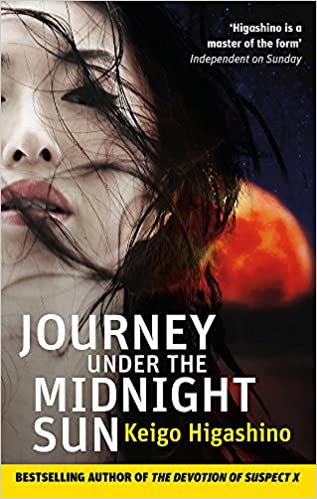
Cover for "Journey under the Midnight Sun" by Keigo Higashino.

Osaka, 1973. In an abandoned building in a poor part of town, a local pawnbroker is found stabbed to death. Although the investigation is able to zero in onto a prime suspect – the man’s lover – the case cannot be solved and is put on ice. But inspector Sasagaki is not deterred and keeps a watchful eye on Ryo, the son of the pawnbroker and on Yukiho, the daughter of his suspected mistress.

Over the years, Yukiho turns into a mesmerizing and independent woman, and Ryo becomes a small gangster involved in computer crime before he disappears without a trace. Only 20 years after the murder, inspector Sasagaki is finally able to tear apart the web of deceit that surrounds Yukiho and Ryo and finally finds out who and what was behind the murder.

Another fascinating novel by Keigo Higashino with a startling twist near the end. We follow the two children at the periphery of the murder from their teens to their early adulthood, and although they never seem to meet openly, there are too many coincidences in both their lives not to believe in an ongoing connection. What starts out as a strong bond of friendship between them is soon brimming with criminal energy, both out in the open and hidden in the dark.

Keigo Higashino was born in Osaka in 1958 and received a Bachelor of Engineering from Osaka Prefecture University. He started working in the automotive industry, but left the company in 1986 after receiving the Rampo Prize for best unpublished mystery. Has written more than 85 novels and short story collections, and is one of Asia’s most popular authors. From 2009 to 2013 he served as the president of Mystery Writers in Japan.

Get this great summer read on amazon before heading to the beach.

Kyoto’s Three Dainenbutsu Kyogen

Super short weekend post today. I was out all afternoon and came home later than I expected. I was watching Dainenbutsu Kyogen – short pantomimes that often have a religious theme but are mostly meant to be funny – by the three most famous groups in Kyoto, all in one afternoon and all in one venue and for (almost) free to boot!

I will give you a more detailed report next week.

Hip Issues Resolved, Kinda

I guess it’s time to give you an update on my hip issues… Over the last 18 months, my condition has improved greatly, and although I will probably never be completely pain free again, I can now walk longer stretches without too much discomfort on most days. Therefore, my doctor and I have decided to end the physiotherapy and I only need to see him again if and when the pain increases again. Yay!

Somehow, I have the impression he’s not completely happy with that though. He started seriously talking about getting me a hip replacement, which greatly surprised me. First of all, shouldn’t we have talked about that before all the therapy sessions? Second, I feel way too young for this, we can revisit that one in 40 years or so. Hence, I declined.

Then he suggested monthly drug injections directly into the joint to more or less lubricate the joint and thus increase mobility. The thought alone makes me shiver with pain, so I declined again. While I do have some problems putting on my socks on my left foot (at my age, how embarrasing!), I’m pretty sure this can be fixed with regular stretching and exercise. So, he’s out of luck overall – for now. Let’s hope things don’t go downhill again any time soon…

Anyway, the day after my doctor’s appointment, I bought a little gift for my physiotherapist. She’s very young still, just out of school, and mentioned that she goes to Starbucks regularly in the weekends to study. Well, she won’t have to spend her own money for a while. Sadly, even if I do have to return for more therapy, I will probably not work with her again. She’s moving to a different part of the clinic and will work with inpatients only. I hope things will work out well for her – and for me too!

Blood Donations in Japan

I donated my first 400 ml of blood when I was 18. Not that it was my own idea, a classmate of mine was determined and in the end we were five, six girls who went. Everything went fine and I kept it up for years to come. Since I moved to different countries so often, I lost count of my donations, but I must have given blood at least 50 times, which amounts to roughly 20 liters.

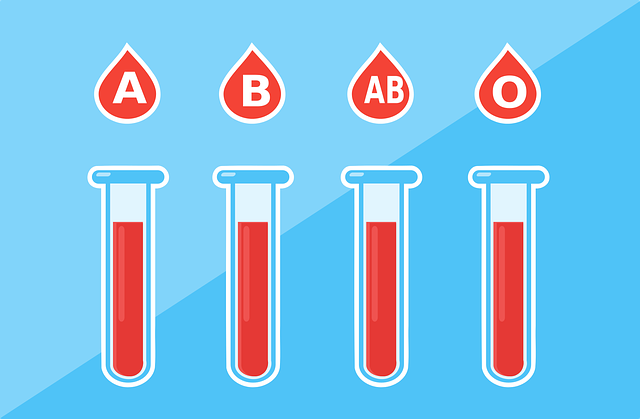
blood types by 200 degrees on pixabay

Even though I’ve been living in Japan for years now, I never tried to find out whether I was allowed to donate blood here as well. I asked my doctor the other day to help me with that, and, to cut a long story short: No, I am not eligible.

Besides the usual criteria for disqualification like having had blood transfusions or organ transplants, having travelled abroad recently, or receiving dental surgery or a tattoo within a certain time span, there’s also one pertaining to BSE. Also known as Mad Cow Disease, it had a large-scale outbreak in the 1990s in Great Britain, and eating meat from an infected animal may cause Creutzfeldt-Jakob disease in humans even decades after.

Since this disease can be transmitted via (donated) blood as well, in many European countries you will be excluded from blood donations if you lived in Great Britian between 1980 and the early 2000s. Asian countries go a bit further: In Hongkong they effectively exclude everybody who grew up in Europe in the 1980/1990s. In Japan, they ask you whether you lived in certain countries besides Great Britain, among them Spain, Germany and the Netherlands.

Well, that one does it for me… It seems that my blood donor career is over – unless of course I’ll move again to another (European) country, which I have no intentions of doing. Oh well, it was fun as long as it lasted.

PS: I hope you’re inspired to go out and give this blood donating a try. Just one thing: Please don’t lie on your pre-donation questionnaire, no matter how eager you are to “help”. You have no control over who’s getting your blood. It may be a burly truck driver after an accident or a 2-week old baby. Don’t play with their lives!

Teru Teru Bozu

Japan is very much a kawaii culture. Think of Hello Kitty, Doraemon and yuru-chara like Kumamon. Even official letters from the government, tax office or health center cannot do without specially designed characters, the cuter, the better. More traditional ones that originate centuries ago are the maneki neko in stores, the ubiquitous tanuki and the teru teru bozu.

This little doll resembles our kids’ idea of spooky disguise: put a bedsheet over your head, paint on black eyes and turn into a ghost! The resemblance is purely superficial though. In Japan, a teru teru bozu is believed to be a good spirit that influences the weather!

These dolls were originally made by farmers as a prayer for good weather. They became very popular in cities during the Edo period when they were made by children and hung outside their windows just before a school outing. Sadly, they don’t seem to be very common anymore, probably because of vastly improved weather forecasts. In all my time in Japan I have only seen the one above – and at a temple to boot (which is funny because the name means literally shine shine monk.) However, if you do see one, you can find out easily how enticing the upcoming school outing is to the child: If the teru teru bozu hangs heads up, the prayer is for good weather the next day, heads down, and the prayer is for rain. I wish I had known a trick like that when I was in school…

Studying Cute

Wouldn’t you have guessed – our state of emergency has been extended once more, this time until June 20. I hope this is the last time for the forseeable future. The number of active cases are decreasing, Osaka has the highest in all Japan with currently some 9500, Kyoto has 10% of that. The government is stil stubbornly holding on to the Olympics, even though many people are against it. It’s nice that the IOC is planning to get all the athletes vaccinated, but what about their whole entourage – the trainers, managers, masseurs, staff, all the journalists? If we’re getting a fifth wave in September, I hope the IOC will be kind enough to provide Japan with vaccines too…

Anyway, I don’t want to bitch too much. The weather is picking up, and it is pleasantly warm without being humid. It’s nice to take a short bicycle trip right now, and there are a few places I’d like to go and see soon. Also, despite the extended lockdown, many museums are opening up again this week, so there’s something else to do if I feel the need to get out of the house.

Speaking of something to do: I have decided to put more energy into my Kanji studying. This takes a lot of time and effort, and although I’m pretty good at pattern matching, the more difficult Chinese characters bring me to my limits… Enter the Kanji Drill workbooks. Isn’t this cute:

These are for kids in elementary school, and each workbook covers the Kanji of one grade. The above is for first grade with the 80 most basic Kanji. I know most of them already, but I still have troubles writing some of them, which is an interesting problem that plagues many Japanese as well, thanks to computers and smartphones.

These books are super cute with their characters and drawings, and they even come with stickers that your parents can award you on the bottom right hand side if you did the exercises well. I have only seen these books for elementary grades (6 years, covering 1026 Kanji). There should be similar books for secondary grade (another 6 years, 1110 Kanji), but let’s cross that bridge when I find it! It’s good to know that Japanese children get 12 years to learn the basic 2136 “Joyo Kanji”, so there’s no reason to feel bad that I’m not perfect yet.

The 10 Loves of Mr. Nishino

The 10 Loves of Mr. Nishino
Hiromi Kawakami

The first time we hear about Mr. Nishino is when he suddenly appears in the garden of one of his ex-lovers, and claims that he’s dying. She and her daughter, who knows him as the man who bought her parfait as a child, sit with him and reminisce, until he disappears again as unexpectedly as he has come. This pattern (minus the dying) repeats itself with nine other women of Mr. Nishino’s life who share their own memories of their often brief relationship with this fascinating man, who nevertheless remains elusive to each one of them.

This is not so much a novel than a set of 10 vignettes centred around the main character, Mr. Nishino. From early childhood on, he is irresistible to girls and women, who fall over each other to land in his arms. Yet, even though some of them know he’s double-dating, they still describe him positively, almost as if he couldn’t help it.

Unfortunately, each chapter is written from the viewpoint of the woman du jour, so that the “real” Mr. Nishino never has to reveal himself. And the women themselves function merely as chroniclers of, rather than as participants in, the stories. This left me unsatisfied and none the wiser about any of the characters, and there is no plot either to provide a cohesive whole. I like Kawakami’s books in general, but this was not one of her stronger ones.

Hiromi Kawakami was born in Tokyo in 1958 and started out as a writer and editor of science fiction stories after graduating from college. She has since received numerous Japanese literary awards, including the Akutagawa Prize, the Tanizaki Prize, and the Yomiuri Prize.

I’d recommend getting this from the library, but if you prefer to own your books, here’s a link to amazon.

Early Onset Rainy Season

raindrops on a windowOh my, is it really tsuyu already? It’s been raining daily for a week now and people start calling this the rainy season. This would make it three weeks earlier than usual, and the earliest start of the rainy season ever recorded. It was the same with the cherry blossoms this year – everything seems to have shifted forward significantly. Well, as long as the trend doesn’t spontaneously reverse and provides us with three extra weeks of rain…

But in a way, it’s not too bad that the rainy season is that early. At this time of the year, it’s not yet very hot, so the additional humidity from the rain doesn’t make you feel uncomfortably sticky. Also, Kyoto is still under a state of emergency, which has been extended to much of the country a few days ago. The rain usually keeps people from going out, so it may also prevent a further increase of Covid infections, to date around 80,000.

So yeah, there is a silver lining even to these rain clouds…