Gion Matsuri – Building Phase

In Kyoto, all through July, there is Gion Matsuri, what I like to call “the biggest party in Japan”. While the main party night is on July 16th, i.e., next Monday, people are getting ready: The yamaboko floats for the saki matsuri parade on July 17th are being built right now.

Today, I went with two of my friends to get a glimpse at the new floats. Building of the biggest ones has already started, but the smaller ones are not out yet. We first had lunch in a tiny restaurant serving excellent sashimi, then we walked around the inner city and watched five of the big floats being built. Although they weigh more than 10 tons, there is not a single nail used anywhere, they are held together by elaborately tied, nay: woven ropes of rice straw. The whole frame is then covered with beautiful tapestries, the originals of which are hundreds of years old and are on display during the three days of yoiyama, starting on July 14th. Below is the building of the Kikusui Hoko, one of the large and popular ones.
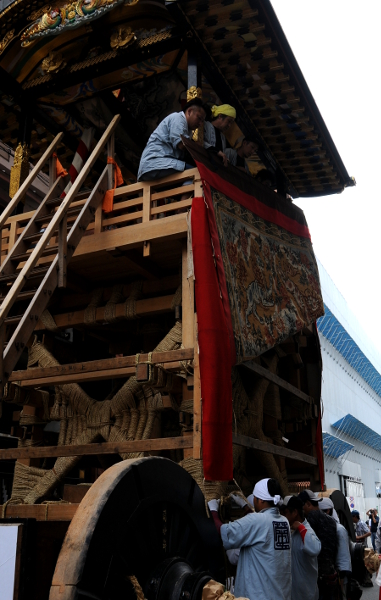
Building Kikusui HokoOne of the favourite things for Kyotoites to do during Gion Matsuri is shopping. For yukata and obi, but also towels and new handbags… anything cloth-related, really. So, we went to one of the Yukata shops nearby the Kikusui Hoko to have a look around. Gion Matsuri is the one and only occasion where I am wearing a yukata – a summer kimono – myself, and while I am interested in the patterns, I didn’t really want to buy one: I already have two, and I’m not a big fan of pink flowery clothes.
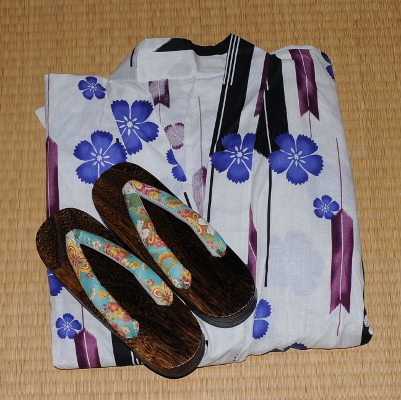
My brand new Yukata! However, my friends decided on the spot to buy a new yukata for me! Isn’t it lovely? (I know that this is not the correct way to fold it!) I think these are bell flowers and some sort of feathers, a rather common pattern. I got dressed in my new yukata on the spot (and I hope I can remember the correct way of doing so) and could spend the rest of the afternoon looking really nice and mature (according to my friends), and I did get a number of approving looks as well. I also bought a new pair of geta – summer sandals – mostly because the straps on my old ones are broken and cannot be repaired. I am not a huge fan of the new pattern on the geta, but now that they are proper Japanese ones and not “made in China”, I can have them replaced at any time.

So, I had a fantastic afternoon at Gion Matsuri! To my friends (who are reading this): Thank you for spending today with me, thanks for the lunch and the tea, and, of course: Thank you so much for the beautiful yukata!
Dry

rainbow over Kyoto, taken from my windowSince so many of you have asked: I’m fine, don’t worry!

Even though it rained for two weeks straight here in Kyoto city, the only thing affected here were the walking paths on the river banks, which had to be closed throughout. In the western part of Kyoto city, Arashiyama, there were a few mudslides, but nothing serious. Four people did die in more rural areas of Kyoto province, though.

The most affected areas were in Kyushu and around Hiroshima. Even today, there are places nobody could get to so far, so there is serious concern that the death toll will rise beyond the current 150 people or so. Apparently this was the worst rainfall in decades throughout the country, and efforts to clean up will take a long time, even though there are 75.000 people helping right now.

In Kyoto city, the rain has stopped on Sunday already; literally over night, just like somebody closed a faucet. It is now time to get hot and humid all over Japan, but I hope that people in southern Honshu, Kyushu and Shikoku will be safe.

Similarities

It is always interesting to me how cultures so different as the Japanese and European ones can be so similar sometimes. Two of my friends, whom I have told about the death of my grandmother gave me little gifts to aid in remembering: A set of candles and some incense. 2 candles and 2 packs of incense. We do use candles in Europe as well to remember the deceased, but the Japanese ones that are burnt in Buddhist temples are much, much smaller, barely 10 cm long, and more delicate. The ones I received are hand painted with lotus flowers – a popular Buddhist theme where people are believed to be born again on the other side on a lotus flower (and may even share it with their loved ones for all eternity).

Outside of church and some very special occasions, using incense is not common in Europe. Here, however, people burn it in temples and in front of the family tomb at certain holidays. Also, even in the cities, many Japanese people still have a butsudan in their homes, a small shrine where they keep a Buddha statue or image and tablets bearing the names of their dead family members. When praying in front of the butsudan, both candles and incense are used.

It’s always nice to see different ways of dealing with the same problems. And it’s nice that my friends think of me – and teach me the Japanese ways.

Extension

We have a new construction site in the neighbourhood. Once upon a time, way before I moved here, there was a hotel just north of my apartment block. Since it had been demolished, there were discussions on what to build on that empty space instead. For many years, the neighbourhood associations have fought against a pachinko parlour, apparently one of the main contestants for a building permit.

The fight is over, and, glad to say, the neighbourhood associations have won it: Instead of the gambling hall, there will be an extension of the shopping centre, situated right next to the spot. The extension will add about 50% of floor space to the shopping centre, which is already enormous now. I am wondering what kind of shops will come there, and if there will be new ones or just the current ones enlarged. Probably a bit of both. Also, there is another shopping centre two blocks away, which belongs to the same chain – maybe they are planning to get rid of that one, since it is very old already.

Anyway, construction has already started last month, and according to the schedule I have received (since I live in an area affected by the noise, this seems to be mandatory), they want to be done with construction by the end of July. I am curious if this will work out, but if they say so…

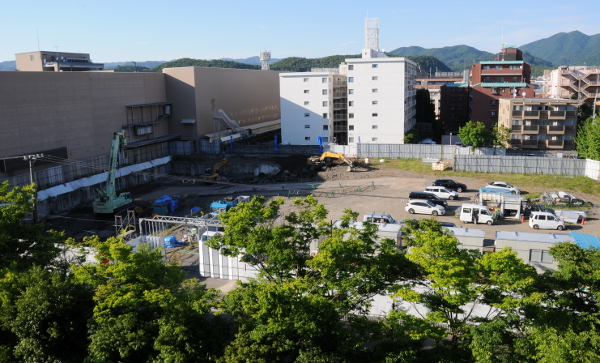
Neighborhood construction siteIn the picture above you see the current state of the construction. There will be a one floor deep basement, and they are now getting rid of the concrete remains of the hotel’s basement, and drill a few holes of their own. What I noticed when going shopping in the evenings (the big brown building on the left is the current shopping centre), is that the frogs are gone. A few weeks ago still, there were frogs in the ponds built inside the old basement to the left, and they were happily croaking away. Now, everything is quiet, and looking at the picture, you can see no more water anywhere on the grounds. It seems the Japanese don’t care much about things like this, they probably just filled in the old basement and let the frogs fend for themselves. This would be unimaginable in modern Europe. I hope some of the frogs survived…

Growth Spurt

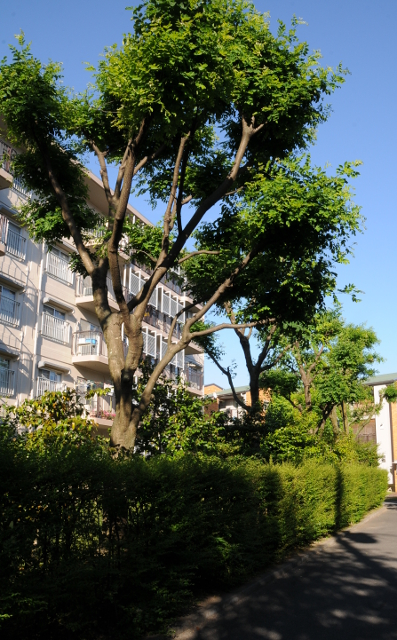
Just a quick update on the sad trees I posted a month ago: Even though I did not think they would make it after the extreme cut they received, they absolutely did! They don’t look as good as the trees on the other side of my house, but still, it is nothing short of a miracle: The same trees as a month ago

Passing On

One of mz elderly friends is still full of energy, but she says she wants to prepare for old age, and tries to make things more easy for her. For example, she moved her bedroom to the ground floor of her house and had a very small kitchen installed there. She says, in case she’s sick, bed, bath, and kitchen are now all within 20 steps of each other, so she can stay at home. Another way to prepare for her is to get rid of stuff. She is not quite as sentimental as I am, but still, she prefers to give her things away to people who would use them further, rather than just throwing them away.

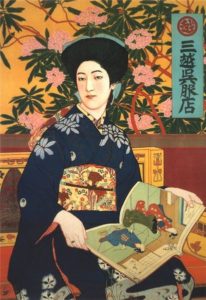
Poster for MitsukoshiAnd this is how I came into the possession of 12 of her old kimono. Not expensive, formal silk kimono, of course, but rather casual ones from cotton and similar light fabrics, mostly intended for summer. I have made it clear that I cannot wear them –  besides having the wrong body shape, she is much smaller than me – but she says it’s fine if I cut them up and use the fabrics to make something else. So, I have made rough plans for one jinbei, one pair of summer pants, three dresses, and two jackets. And one lovely summer yukata I will keep for myself, even though it is a bit on the small side. The rest I am not sure about, there is one with a really strong pattern that should be kept intact if possible.

So far my plans. I have talked about my unexpected gifts to my English students, and they were quite excited about it. So, I invited one of them over last week to have a look at the kimono and maybe give advice on what to do with them. And when I was unpacking them one by one and put them in front of here, there was one she went all crazy about: “Oh, how beautiful!” She was so excited about it, that I asked her to try it on – and when it fit, I gave it to her. That’s the nice thing about kimono: As long as the fabric is holding up, age does not matter at all. In fact, many expensive kimono are passed on through generations of women! Size does not matter much either, so it really boils down to whether you like the pattern and color or not.

And with one simple act, I have made two of my friends happy: By taking from the one, and by giving to the other. If life were so simple all the time!

Efficient

Last Saturday I went out with my friend to see this year’s Kyotographie Photo Exhibition. It was spread out over the inner city, so we had a lot of walking to do all day and in the evening we were both exhausted…

Anyway, on our way to one of the venues, there were lots of fire engines going in the same direction, and we noticed all of a sudden six or seven helicopters hovering over the part of the city we were heading towards. And then, we saw the smoke.

A huge sand-colored cloud of smoke blew through the streets and hung over the low buildings of Gion. Nearby Shijo street – one of the main thoroughfares – was closed for all traffic, there were at least 15 fire engines, two firemen were perched on a long ladder to get an overview, and a few others were sitting on a nearby roof as well. However, the main action happened somewhere deep inside the narrow side streets of Gion. At first we thought that one of the temples was burning, but we asked a policeman and he said that it was just a normal house.

In Japan, fires are extremely dangerous. Even nowadays, many private homes are still made of wood, and in a typical modern residential area, the houses sit next to each other almost touching wall-to-wall. One of the first new words I learnt when moving into the old guest house was “kaji”, the Japanese word for blazing fire. Especially old houses burn very quickly, often, there is no time to attempt putting it out yourself. It’s best and safest for everyone just to get out of the building, alert the neighbours and call the firefighters.

The ones of Kyoto must be especially well-trained and efficient, because when we passed by the spot on our way back less than an hour later, everything was over already. When I checked the paper later that night, it said that in total six houses were damaged, but nobody got hurt. The fire had started in a restaurant – a quite famous one to boot with three Michelin stars – when they had closed after lunch service.

Equally efficient were the media (immediately present with camera teams on nearby buildings and in the helicopters I mentioned), as well as google. When I looked for the restaurant later that night on google maps it said already “Permanently Closed”.

Philosophy

A friend of mine has come back to Kyoto for two weeks or so, and we spent yesterday afternoon strolling around the Arashiyama and Higashiyama mountains of Kyoto. It is always nice talking to him, mostly because we learn from and challenge each other. He, as another mathematician, is also very observant, something I’m not used to anymore in my other friends.

For example, he said that when we were walking around at Higashiyama, that he could feel that this was “my” part of town; he said that I was “walking differently”. I thought about this and indeed, I felt more relaxed there than in Arashiyama where we had gone before. Altogether, I have been to Arashiyama only three or four times. It is quite far from my place (about an hour away, no matter how I’d go there) and it is always very crowded, which I don’t like at any time – it stresses me. This is probably because the interesting area of Arashiyama (especially to the east of Togetsukyo bridge) is rather small, and there are not many other routes where you could avoid all the people. And then I also wanted to see the bamboo forest, which is essentially only a single long path winding beneath huge bamboo trees (?), so again, no place to avoid all the selfie-shooting people. At least we went during the week…

We had matcha and chocolate at my friend’s cafe, and dinner at a tiny little fish restaurant. And for some reason, we started talking about the purpose of life. I am against the motion that everybody has a specific, earth-moving purpose in life, like so many people seem to think. What if not – that doesn’t mean life is wasted. Maybe somebody’s purpose is simply to drive a bus in a tiny town for 25 years. What’s wrong with that? Besides, if there’s that huge purpose you’ve made out for yourself – what happens if you can’t achieve it for whatever reason? Can you change your purpose? I prefer John Lennon’s take on this:

“Life is what happens to you while you’re busy making other plans.”

We also talked about the funny ways life takes sometimes. He says he goes with the flow, and that he thinks I’m trying to fight it. I’m not sure he is right. I do like to be in control, and I always liked to do my own thing, but at the same time, the first truly independent and conscious decision I made was to give up academia and settle in Japan. Before that, I did the things as they showed up, sometimes put in front of me by other people. Maybe I’m now trying to compensate for that former lack of control? I’m not sure. Japan has changed me, I am much more self-confident now than I was ever before. I cannot change all the circumstances, but I still try to do my own thing.

And he said: “I’m not sure that you are where you should be and that you’re doing what you should be doing.” Actually, I’m not sure about the latter either. I could pour much more effort into things, but something is indeed holding me back, and I don’t know what it is. However, I do believe that at least right now, Japan indeed is the place to be for me. I feel safe here, a very peaceful feeling. Probably my personal growth spurt has something to do with that.

Missed…

Today, I’m very tired again, I’ll go to bed soon! After my usual three appointments today, I had a fourth one: A Japanese friend’s Polish friend has an exhibition starting tomorrow, which means that the opening party was tonight. My Japanese friend wanted to introduce me to her Polish friend, so I got invited (the event seemed very low-key and laid back). Even though I didn’t really want to go, because I’m usually exhausted on Tuesday nights, I did visit the gallery anyway, business networking and so.

seiko alarm clockUnfortunately, I must have been too late, because my friend wasn’t there (anymore). And because I can’t really walk up to people and say “Hey are you the Polish friend of…”, I didn’t stay long after I took a look at the exhibits. I’m not a big fan of modern art but some of the pieces were quite interesting! Maybe I should give modern art a try after all?