Cat Cafe

I am sure you have heard about the Japanese speciality of cat cafes. They are normal cafes housing a number of cats that are allowed to roam freely and interact with the guests. The idea is to provide people who are not allowed to keep pets, with some sort of outlet and the possibility to feel like a cat owner for a short time.

Well, since I am a wannabe cat owner, and since I am not allowed to keep a cat in this apartment, and since I am thus feeling rather cat deprived, I went to one of Kyoto’s cat cafes this afternoon.
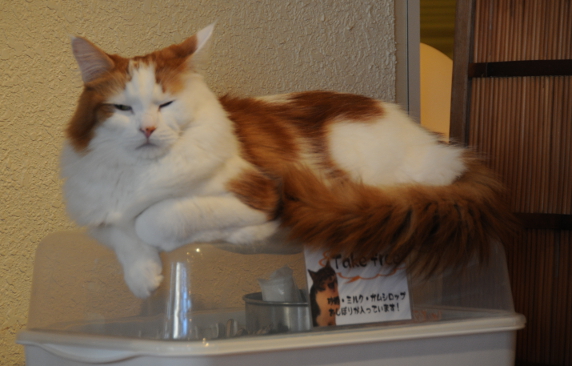
Red-White Norwegian catThe first thing I noticed when I entered was the warmth – this must have been the most overheated place in Japan – and the rather distinctive smell of kitty litter. There was an extra door at the entrance to prevent the cats escaping through the main entrance. I had to take off my shoes, wash my hands, and indicate how long I was planning to stay before I could get further inside. When seated, I was shown a “how to behave” list: No flash photography allowed, no harassing of the cats (or other guests), and a warning that the cats may scratch and that there may be cat hair in my tea. And then, finally, I was left to roam around freely and to interact with the cats. The place was well adapted to the cats’ needs: fluffy cushions and blankets, boxes of all sizes, high shelves to hide upon, plenty of cat toys, and sufficient litter boxes. The only weird thing was the aquarium with the single goldfish inside. Cat TV, I presume?
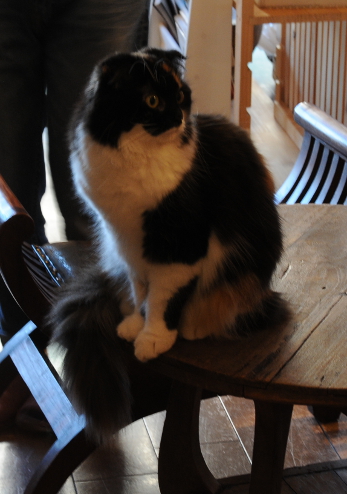
Cat on tableThe cats were gorgeous. There were three young kittens in a little extra stall with extra charge and 15 adult cats in the main part of the cafe. The animals were of all colours and races – Russian Blue, Scottish Fold, Persian, and an amazing Norwegian Forest cat, among others. Unfortunately, I arrived at nap time, and all the cats were asleep. They were friendly and could be petted still, but I prefered to let them rest. Only when my hour was over, did they come to life again – and I felt a bit cheated, to be honest.

It seemed that the cats were well taken careCat on shelf of. Their coats were shiny and well-groomed in case of the long-haired cats, and although one was allowed to feed them, this was only possible with the food provided by the shop, a wise decision. Behind the counter there were some crates into which the cats would be placed at times to avoid overstimulation by the patrons. As for those, I expected the guests to be a bunch of elderly cat ladies like myself, but there were mostly young couples, which surprised me.
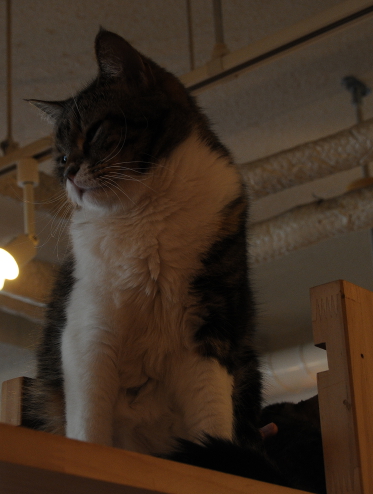
I spent a pleasant hour there, but next time I will go a bit later, after nap time. It is rather expensive – 1 hour there costs 1500 YEN, including one set of drinks and sweets – but if you’re really into cats, this is the place to go:
http://animalcafes.com/v/25475.html

Kenkoku Kinen No Hi

Today is a national holiday, the National Foundation Day. I have written about this last year, so instead of repeating the details, I give you a beautiful image instead, made by Eitaku Kobayashi (1843 – 1890). It shows how the gods Izanami and Izanagi churn the waters of the ocean with a spear to make the very first island of Japan. Those two are among Japanese earliest deities, and their union eventually produced the whole Japanese archipelago as well as most of the other Japanese gods. Izanami and Izanagi

Storm

I have read that the weather is very bad on the Atlantic coast of Europe. 19.000 Brits without electricity, waves that are phenomenal (up to 14 metres) and higher (no meteorological name for this apparently), and cancelled carnival parades in Germany… Hopefully it’s over soon. We also had a very cold and stormy day today here, but even so, it was not raining and the sky was bright blue, so I took a walk along the river.

People did not seem to bother, and even the construction work on our apartment block commenced without problems. Right now, they are building the scaffolding for the first house, and although I noticed that they were going quite slowly, they did not cease working all day.

Inside my apartment, again, the curtains were moving and even the sliding fusuma doors rattled. I guess I will never get used to that. On the positive side, this also means that I can paint in my living room without suffocating. I bought some cheap book shelves that need a coat of paint to fit the little bit… well, okay, to fit the one single piece of furniture that I currently have in my livingroom. I am planning to get this room finished and fully furnished, preferably before my anniversary of living here.

Nioi Bukuro

I recently received a Japanese nioi bukuro scent bag as a gift. The name, literally “bag of odors”, says it all: it’s a little bag made from cloth containing a variety of herbs.

Nioi bukuro were introduced to Japan – like so many other things – by Buddhist priests some time in the 8th century. At this time, Buddhist rituals began to spread, and the use of incense and other fragrances became popular in the nobility. Soon enough, cloth bags were filled with mixtures of incense and herbs that would emit a pleasant fragrance even at room temperature.

Depending on the herbal mixture, the nioi bukuro were used for different purposes: Small ones were worn around the neck or tucked into a kimono sleeve as sort of personal perfume. Larger ones containing sandalwood and cloves were put into clothing storage to scent the clothing and repel insects. Yet others, called kakeko (literally “hanging aroma”) were hung on walls in rooms, also with the intention of eliminating mosquitos and, according to an old belief, to protect that room from ill fortune.

Nioi bukuro are very easy to make. All you need is a small bag, preferably of silk, and the right number and type of herbs. A typical mix is the following:

  • sandalwood (3-4 tablespoons)
  • cloves (1 tablespoon)
  • star anise (1 tablespoon)
  • cinnamon (1 tablespoon)
  • camphor (1/2 – 1 tablespoon)
  • spikenard (a type of valerian from the Himalayas, 1/3 tablespoon)
  • galangal (a ginger-like plant, 1/3 tablespoon)
  • mint (Japanese perilla, 1/3 tablespoon)

Nioi bukuro made from sea shellsMix the herbs together and fill the bag with the mixture. Tie the bag with a string, and your nioi bukuro is ready for use. The smell will last for about a year.

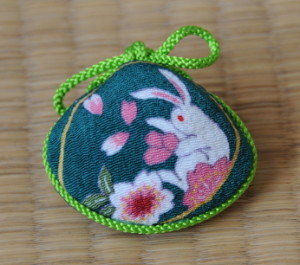
Most nioi bukuro are simple bags, but they also come shaped like little kimono. To the right is the one I got as a present. It is special, since it consists of cloth-covered sea shells, with the bag of incense inside.

Interestingly, nioi bukuro are still popular today. For example, kabuki actors are wearing the little bags in their kimono, but in a more modern twist, school girls like to put them in their gym bags.

Lottery

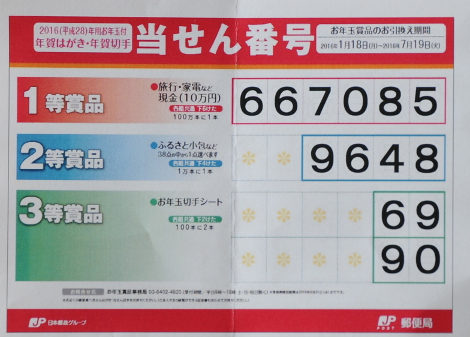
I am not sure if I mentioned it, but when you send nengajo New Year’s cards, most of the standard cards you can buy have a lottery number printed on the back. You then hold on to all the cards you received until mid January, when the winning numbers are drawn, and then you have half a year’s time to go a post office and claim any prizes you have won.

Prizes start from sheets with stamps (it is a post office lottery after all) for correct two-digit numbers, local specialities for the correct 4 digit number (this year you could choose among specialities from 38 of Japan’s provinces) and the first prize for 6 correct digits are a holiday trip, household appliances (TV, washing machines, etc), or 100.000 YEN.

nengajo lottery winning numbersThese are the lucky numbers for this year. Unfortunately, I was only 75% lucky: I had the 648 of the middle prize, but no 9 in front of it… Of course, since I only received seven cards, this was to be expected. Friends told me that they send around 100 nengajo each year, which means they should receive just as many in return. In that case, it is easier to be lucky, no?

Finances

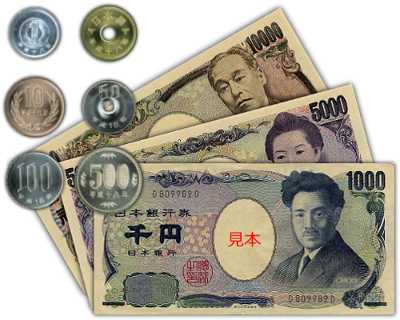
Japanese currencyAs a business owner, one of the things you have to keep on top of at all times is your finances. It’s always good to know how much is coming in, and even more so, how much is going out. Thankfully I have always been financially conservative, meaning that I prefer to earn more than I spend, so at least this is not an issue. Last month has proven especially fruitful.

For the first time, my company’s earnings have exceeded my personal spending. Not that those two numbers have anything to do with each other directly, since I have to pay myself a salary in any case, but it still nice to know that I can support myself with my earnings. The next step will be to earn more than my salary, but this is not that easy.

Unfortunately I must confess that business is very slow, and that I am far from making enough money to make this viable. I am now applying left and right as freelancer for all sorts of jobs that are within my expertise, but even though I now have a visa that allows me to work in Japan, my other major deficiencies have not gone away: Not being a native English person who knows perfect Japanese. That makes things just as difficult as they were before. I am trying to get some online freelance jobs from abroad now, and I am making some money there, but by far not enough. I still have a few more months to go before I need to start panicking though. And as we all know: Hope springs eternal.

And hope is not always betrayed: I told you about working on my German tax return just before Christmas, right? Well, I have already heard back from them, in fact I have received money back, a total of almost 3000 EUR. Well, bothering some of my old friends in Germany about this has certainly borne fruit. I am very happy about this windfall!

Sick

I have an upset stomach. It doesn’t happen very often here in Japan, but still I must have caught some bug. I stayed in bed all day (except for some rather hurried trips to the toilet), but it feels like I am getting better now. It’s really no fun being sick, especially when your apartment is freezing… At least, there is only one more month of winter ahead.

Happy Isle

Last week, especially in the weekend, large parts of Japan got covered in snow. Finally, it’s winter after all! Especially the northern and western parts of Japan bore the brunt of the snow and cold, but even on tropical Kagoshima island there was snowfall – the first in 115 years! Even the temperatures in Okinawa dropped perceptively, a friend of mine was there last week and said he expected something else.

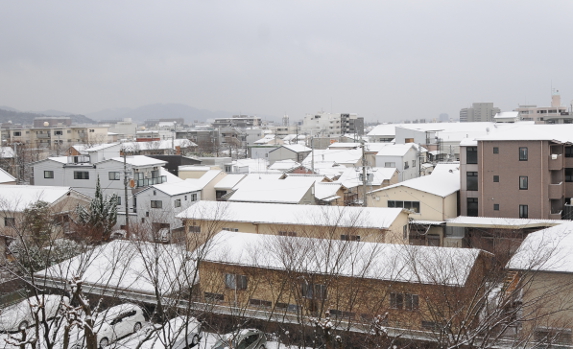
Anyway, Kyoto seems to be a Happy Isle in all this snow. It snowed heavily last Wednesday morning, and I only took this quick picture from my balcony before I went along the river to one of my favourite cafes. I arrived there very happy indeed – and totally soaked by the fluffy snowflakes the Japanese call “peony flakes”. In the afternoon, everything was over, and most of the snow had melted already.

Snowy view from my windowLast weekend was very cold, and there was a heavy storm over Kyoto on Sunday. I noticed to my alarm that even here my windows are not entirely tight after all; it’s not nice watching the curtains move with the wind when the windows are closed and securely fastened. Anyway, to my chagrin, there was no more snow, and it seems that, as the temperatures will go up again tomorrow, that there will be no further opportunity this year. This really doesn’t do – one or two days of snow per winter are simply not good enough for this mountain girl! Maybe I should consider moving to Hokkaido?

Genji Monogatari

The Tale of Genji
Murasaki Shikibu

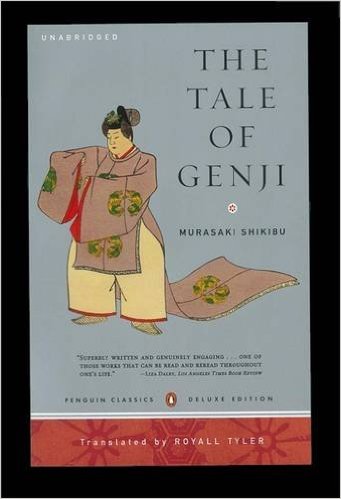
cover of "The Tale of Genji"He is the son of the emperor’s favourite concubine. As such, he is too far down in the line of succession to every ascend to the throne, so his father removes him completely by making him a commoner and bestowing the name “Genji” onto him. Genji is nevertheless raised in the palace and is almost unanimously loved at court. Growing up, he shows many talents in writing poetry, calligraphy, music, and in charming women of all ranks. His numerous conquests get him banned from court twice. Twice does he have to settle in a remote area, twice even there women fall for his charms, and twice is he reinstated at court after a while. Genji is a lovable character, and although a womanizer, he always takes care of his lovers in one way or the other, even after the end of their relationship. Only the lady Murasaki (meaning purple) can capture his affections throughout her life, and Genji is heartbroken at her death and dies soon afterwards.

Genji Monogatari can be called a biography of a Japanese courtier of the 10th century. Although fictional, it depicts court life in great detail: its intricate politeness (never use personal names), its unbelievable etiquette (unrelated men and women are always separated by screens), and its numerous festivals and ceremonies. The Tale of Genji is considered the earliest and finest example of Japanese literature.

The book was written by a lady-in-waiting of the Heian court in Kyoto. Not much is certain about her, not even her real name, so she is named after the main female character in the book, Murasaki Shikibu.

I found Genji Monogatari a worthwhile book, but rather difficult to read, it took me about three months. There is not much going on, it is a biography after all, but the immense number of characters, most of which are never referred to by name, but rather by their ever changing ranks at court, makes the story difficult to follow at times. I have read the unabridged translation by Royall Tyler from 2001 containing lots of footnotes that help understanding the implicit intricacies of the time, but sometimes you still have to remind yourself that the conversation recorded could not have taken place like this, but was conducted either in written letters or with servants as go-betweens.

Check this book out on amazon.

Renovations

Last week I received a large, thick booklet informing me about the pending renovations in our block of apartments that will be carried out this spring. As far as I understand, this concerns only the buildings’ outside: the balconies will be renovated (how exactly, I am not sure), and the whole building will receive a new coat of paint. The booklet describes other types of work, but I am not sure whether they really will replace any of the wires and pipes. I would not mind getting new water pipes though – the old ones are very rusty and would really need to be replaced.

constructionAnyway, since the work is scheduled from February to June, and from 8:00 until 18:00 on weekdays, I hope it will not be too noisy for too long. Work on my building will start only in Mid March, when the scaffolding will be erected, and I’ll have to remove all personal belongings from the balconies by then.

The whole renovation appears to be planned down to the smallest detail. The document I received has 28 pages in total, and besides a detailed schedule for each of the four buildings in the block, it is also stated for example who is in charge of the work (photo included), what types of clothes and badges the workers will wear, which parking lots cannot be used in that time, and which type of further information will be sent in leaflets of which colour. Since the building will be painted, there will also be days when we are not allowed to hang out laundry to dry, and these days will be announced one day in advance, at 3 pm.

And if there are still questions unaddressed, there is a meeting this Saturday to clarify all the details. Since the meeting will be in Japanese, it is probably a bit pointless for me to show up, but still, I am deeply impressed about the care that is being taken here! We’ll see how impressed I will remain once the work has started. I am sure you will hear about this more often in the future.