Preparations

One of my English students is taking a break for a while, since she will have to do a great amount of preparations in the near future: Her daughter is getting married! It’s a pity somehow, because this would be my first close-up of a Japanese wedding, but I hope she will send an email every now and then to let me know how things are going.

Photo by Ben Rosett on UnsplashWhat I know so far: It’s an omiai wedding, meaning that when the couple had met for the very first time, they had done so for the express purpose of meeting a partner for marriage. In these kinds of arranged marriages (although the couple nowadays has full veto powers), things tend to go very quickly. These two met in the beginning of February, and the groom already wanted to get married on May 1st…

The groom was introduced to the bride’s parents only last week, and this weekend, the parents will meet. That the marriage will take place is already decided upon, now it’s just about the date and the type of wedding – traditional shinto or modern Japanese – that needs to be fixed.

To me, this seems a bit strange and very exciting at the same time. Not necessarily the way the couple met – I guess every single person ever has had friends play matchmaking on occasion – but the fact that it’s already clear that they will marry, after not even three months. I realize that there is something like “love on first sight”, but even so, this is a speed that I’m not used to. Western bias, I’m sure.
Hanami!

Sorry for being quite so whiny last week… We all have our ups and downs, and I’m feeling nicely up again, thanks to the last weekend! There were lots of things to do, and I feel perfectly energised.

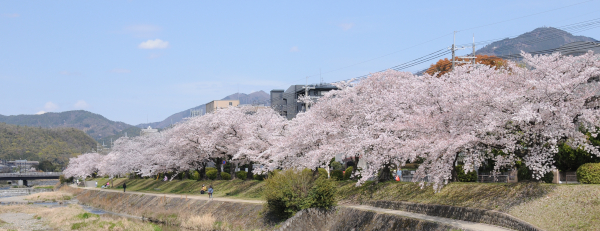
On Friday, the weather was nice and the skies were blue, and the sakura were blooming… I did not go far, just around the corner to the river, but here’s a photo of this year’s sakura at Takanogawa:Hanami along the Takanogawa, 2019

Saturday was even more busy: First, I went to an exhibition about the faith of Kitano Tenmangu. A friend had leftover tickets, and I learnt about Sugawara no Michizane, a renowned Japanese scholar who lived in the Heian era and who is today revered as the God of learning (and enshrined in Kitano Tenmangu). A great number of treasures of the shrine were on display and even though I couldn’t read any of the descriptions, lest the centuries old documents, it was very interesting.

Then, I went to the Art Dive Festival, where a great number of young artists, artisans, and craftswomen were exhibiting their arts and crafts. There were lots of manga-style drawings, which are not really my thing, but also lovely other things like jewellery, crafts from paper and textiles… I ended up buying lovely earrings after going back and forth on them for three times or so… I’m happy about them, so that’s a plus.

And today, I received word from another friend that she will come over to Japan at the end of May, that makes three people already I haven’t seen in a while and will have great fun catching up with. And they will all come within a single month – it’s wonderful!

Not My Day…

raindrops on a windowYesterday was so NOT my day…

I had forgotten to make a facebook post for What’s Up in Kyoto, so I had to get up early to do it, and: facebook didn’t like me, or my browser didn’t like facebook and it shut down 5 times before I could finally publish the post. I don’t like facebook and this is not the first time that happened, but it was definitely a new record!

Then, I had to go to the bank to pay my taxes – and I needed three attempts to do so, all because of my own stupidity. I brought the forms along alright, but then I noticed that I had forgotten my hanko which I need to “sign” the transaction. Back home I went to fetch the hanko, just to realise the second time I was at the bank that I had forgotten my passbook, which is also needed for the transaction… On the third try, I finally made it, and when I was home at around noon will all the forms and stamps and passbook prints in place, I was already exhausted.

It was raining too, and I soaked through my sneakers in the morning already. On a normal day, this would have been a reason to go straight back to bed, but I had an appointment in the afternoon and couldn’t do that. Because it was raining, I had to take the bus to get to the appointment. This is a bus that only runs three times an hour, so I need to check the timetable every time I take it. And, for some reason or other, the online timetable was offline… I was lucky that I came at the right time for this one.

After the appointment, I had to go to several places in town for shopping, and I dropped by the Lindt Chocolate store to buy something for Easter. And of course, they offered me a free piece of chocolate – and matcha to boot. It was really difficult to decline (but I promised that I would be back in two weeks).

After that, I decided to have dinner at a restaurant nearby my home, and when it came to paying, I had prepared the wrong amount for the cashier. Not a big deal, really, but it was the last straw. I then went home, did not turn on the laptop but went straight to bed – at about eight. At least I had a stash of books at hand, but this was so far the one and only time I had a terrible craving for chocolate, just to soothe me for the terrible day I had…

Raise

A new fiscal year has just started and: I’m getting a raise! YAY.

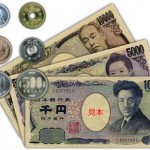
Japanese currencyNo, that’s not a joyful yay, actually, because once you’re self-employed, giving yourself a raise is a bit more complicated than just being happy about more money. That’s because I’ll have to earn the money before I can spend it – have I ever mentioned that I am financially conservative? – and it is quite a large amount, as you will see in a moment.

So, why on earth am I giving myself a raise if I’d rather not? Excellent question! Answer: Because I have to.

Recently, the Japanese government has decided that everybody who is living in Japan must pay into the national pension fund. So far, it was optional (even for Japanese as far as I know) and especially if you were self-employed, you didn’t really need to. But now, since April 1st, paying for your pension is mandatory, and because I have been living on the financial edge already for the last few years, I need that raise to pay my pension.

Even worse, it turned out that I cannot pay pension privately (as I had done with health insurance), but I need to run this through the company, which makes everything significantly more expensive. I have now enrolled in the national social security which means I will pay health and pension insurance in one lump sum – of about 60.000 yen per month. Like in many other countries, this is split into 50% for the employee and 50% for the employer, so 30.000 yen is my salary raise, and 30.000 yen is additional company expenses.

In the end, what I get onto my account by the end of the month is the same as before, but since I now pay health insurance through the company, I am saving 20.000 yen of my personal money, which will give me a bit of breathing room every month. Still, it does hurt: for 20.000 yen more in my pocket I’ll need to earn 60.000 yen more each month.

As I said above: yay.

A Quiet Place

A Quiet Place
Seicho Matsumoto

Cover of A Quiet Place

Tsuneo Asai is on a business trip in Kobe when he receives the news that his wife had died. Eiko had had a weak heart, so, while her death was sudden, the heart attack causing it was not exactly a surprise. The circumstances of her death, however, are puzzling: What did she do in that neighbourhood in a part of Tokyo they had never visited before?

When Tsuneo visits that neighbourhood to apologize for the trouble caused by his wife’s death, he notices a number of love hotels on top of the hill. Immediately, the idea that his wife must have had an affair takes hold, and Tsuneo is determined to find out the truth.

This is not your typical “whodunit” crime novel, since the death of Eiko was from natural causes. Still, Tsuneo acts like a sleuth on his quest to unravel his wife’s apparent double life, which makes this a compelling read. Once the truth is found, Tsuneo must make a decision, which turns the story into the direction of obsession and what can happen when you don’t let sleeping dogs lie…

Seicho Matsumoto (1909 – 1992) was born as Kiyoharu Matsumoto, an only child, in Kyushu. He never finished secondary school, and worked as an adult making layouts for Asahi Shimbun. His first short story was entered in a 1950 competition and won him third prize. Six years later, he had quit the newspaper and worked full-time as a writer and until his death in 1992, he wrote more than 450 works, only a handful of which were translated into English. His detective and crime fiction, where he not only depicts the crime but also Japanese society and its ills, was very popular in Japan. He won the prestigious Akutagawa Prize in 1952, the Kikuchi Kan Prize in 1970, and the Mystery Writers of Japan Award in 1957. He served as the president of Mystery Writers of Japan from 1963 to 1971.

I discovered Seicho Matsumoto through a friend of mine, and these crime novels are well crafted and fun to read. Try for yourself and get the novel from amazonhttps://www.amazon.com/Quiet-Place-Seicho-Matsumoto/dp/1908524634.

Weekend Trip

Last Sunday I took the day off and, together with my soroban class mates and our teacher, of course, we went to Himeji, about 1.5 hours south of Kyoto. There lies Himeji castle which was built in the 14th century, and it is lauded as the most beautiful castle in all Japan.  Its wooden construction is still intact, and the white exterior and the great position on top of a hill – and directly visible from the station – makes it one of the most popular places to visit in Japan.Himeji Castle as seen from the West Bailey.

It was rather busy, not only because of the weekend, but because people went there for their hanami. Himeji is very famous for the cherry trees on its grounds, but it was still quite cool, so not many of the trees were in bloom. There were still enough people that it took us more than an hour from the ticket gate to the inner keep, and inside the castle, we had to wait for one floor to empty before being allowed to climb to the next one.

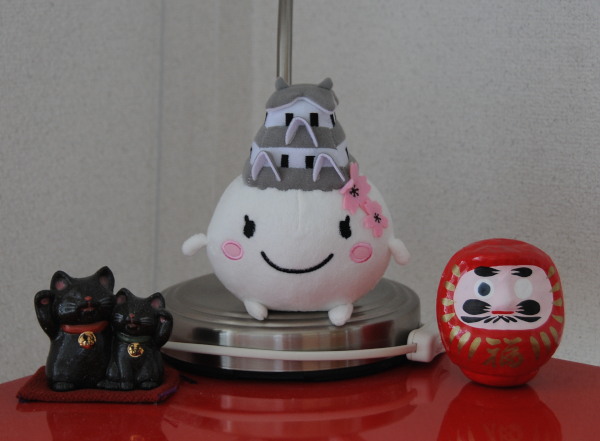
We spent several hours in the castle and had great fun even though the weather was cool with lots of wind. My personal highlight was meeting Shiromaruhime, the mascot of Himeji. The word means literally “White Circle Princess” and many people were lining up to take pictures with her, and so did our group. I usually don’t buy souvenirs, maybe a postcard or two, but I caught a severe case of cute overload and could not resist buying a small plush toy that is now adorning my desk. She’s really cute, don’t you think?

Shiromaruhime, the mascot of Himeji.


Reiwa

Japan is moving into a new era – quite literally – with the abdication of the current emperor on April 30th and the ascension to the throne of his son on May 1st. The preparations for this enormous event must have started a long time ago, but most of them are done in private, so that the average Japanese is not aware of all that’s going on behind the scenes.

Yesterday, however, the first big official event took place: The reveal of the new era (gengo) name. Each reign of a Japanese emperor is associated with an era name, and while an emperor is never called by his given name during his lifetime, his era name will be used to refer to him when he is dead. Since the Meiji Restoration in 1868, there were four eras: Meiji (1868 – 1912), Taisho (1912 – 1925), Showa (1925 – 1989) and Heisei, the current one. Before the Meiji Restoration, the era name could change more frequently. Often, a new era was begun to give the nation a symbolic fresh start, after a natural disaster, or a number of deaths in the imperial family, for example.

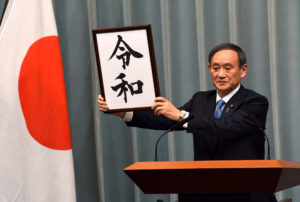
Yoshihide Suga , Chief Cabinet Secretary announces the name of Japan’s forthcoming new eraAnyway, the new era that we in Japan will live in from May 1st will be called Reiwa. The two kanji were taken from the Manyoshu, one of the oldest collections of Japanese poetry, compiled in the second half of the eight century. Like many characters, these kanji have different meaning. The first one – rei – has a meaning of to rule, to order, but can also mean elegant, fine, beautiful, or auspicious. The second character can mean peace, calmness, harmony.

There are two interesting articles on how Japanese era names are chosen in the modern era.
This one is about the forthcoming one, Reiwa:
http://www.asahi.com/ajw/articles/AJ201904020020.html
And this is an interview with one of the people sitting on the committee for the current one, Heisei:
https://www3.nhk.or.jp/nhkworld/nhknewsline/backstories/insiderexplains/

It is interesting to note that the term Reiwa itself has no meaning as a word, it is more a concept that is open to some interpretation (just like Heisei, by the way). Prime Minister Abe explained that Reiwa signifies “a culture being born and nurtured by people coming together beautifully.” We will see how this will work out. For now, however, the Japanese seem to be pleased with the new era name. Friends have told me that they sound is good. Let’s hope the era itself will live up to the “good sound”.

Efficiency

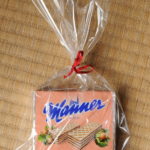
MannerschnittenJapanese efficiency is amazing! Yesterday, I ordered a new pack of “Manner Schnitten” from THE Japanese online retailer Rakuten. They said that delivery would take a day or two, and I thought, okay, Wednesday morning I’m home, so let’s have them delivered in the morning., it’ll be fine.

Today, in the early afternoon, when I came home from my Japanese class, I found a slip in my letterbox that they had already tried to deliver my package at around 11 – less than 24 hours after my order! And when I called the delivery driver to tell him that I was home now and if he could please try again, it took him barely 20 minutes to stand at my doorstep again.

The efficiency is absolutely fascinating, I am greatly impressed! The parcel was handed to the delivery service in Fukuoka yesterday at 15:07, and they tried the first delivery today already at 11:02, that’s 20 hours only. Wow! My friend says that’s normal, she says if she doesn’t get her stuff within 2 days or so she starts worrying that something might have gone wrong…

Shunbun-no-hi

Today is Shunbun-no-hi, the vernal equinox, and a national holiday in Japan.

Traditionally, people would visit the graves of their ancestors and do some spring cleaning around their homes, but I am not sure if this is still a thing. Also, this day was meant as the official beginning of winter, since from now on the days will be longer than the nights again.

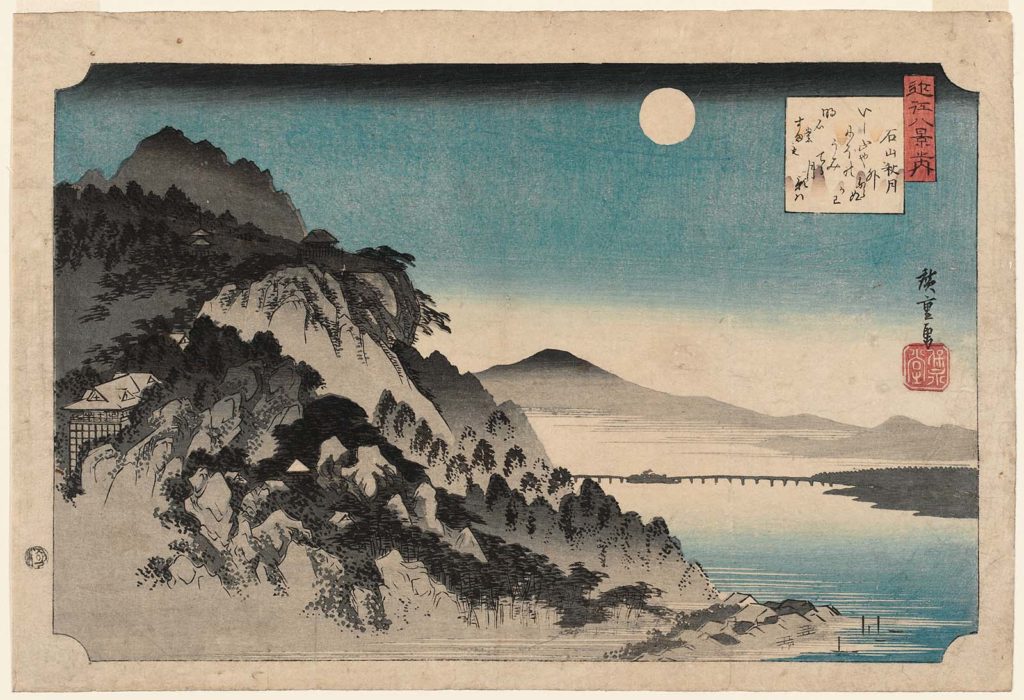
The moon at Ishiyama by Hiroshige, 1834.

I am definitely looking forward to spring, even though the winter this year was quite mild. For now, it is too cool still for hanami, and I have not seen any cherry blossom buds except in very sheltered spots. But, this year’s cherry blossom forecast states that they will start blooming in Kyoto some time early next week. I shall report.

Unsuccessful

Today was not my day, and that’s putting it mildly…

First, I received an email from my friend who’s helping with the What’s up in Kyoto highlights. The museum that I had planned for next month has declined our offer of highlighting, very politely of course, but it’s still a no. Back to square one.

stack of papersSecond, I spent about an hour at the bank trying to transfer money to my account in Austria, and in the end, I was unsuccessful. I forgot – yet again – “My Number”, a sort of personal identification you now need for any kind of international banking. Plus, they want to know where the money came from, what I’m doing with it and that that other account is truly mine. All of which I have already told them before – several times – but they’ll just need to check again for good measure. I did mention before that the Japanese love paperwork, didn’t I?

Third, I went to another little museum that might be another highlight option, but this turned out to be more of a gallery. They are not totally uninteresting, but probably not what I’m looking for after all. I’m a bit unsure whether to feature them, and tomorrow I will visit another museum  and see what they have to offer.

Fourth, after two disappointments in a row, I decided to try out a new cafe in town that sports a large advertisement talking about “Big Apple pie”. Since I’m not allowed to eat chocolate, I’m happy to try that – the next time it’s open, because today they were closed.

Fifth, I then decided to go home, but not without buying one of those interesting “sweet potatoes”, which actually are pastries made with white anko (the only type of anko I like) and have a nice, cinnamon-flavoured dough outside. They are a small handful only, and very, very delicious. but again, the store was closed today, and I had to go home empty-handed.

See, this would be one of the moments where I would be reaching for my jar of Nutella. But of course, Lent and promises and stuff…

*sigh* I’m glad this day – which was definitely not one of my highlights – is over. Tomorrow will be better. I hope.