Sweet Apples

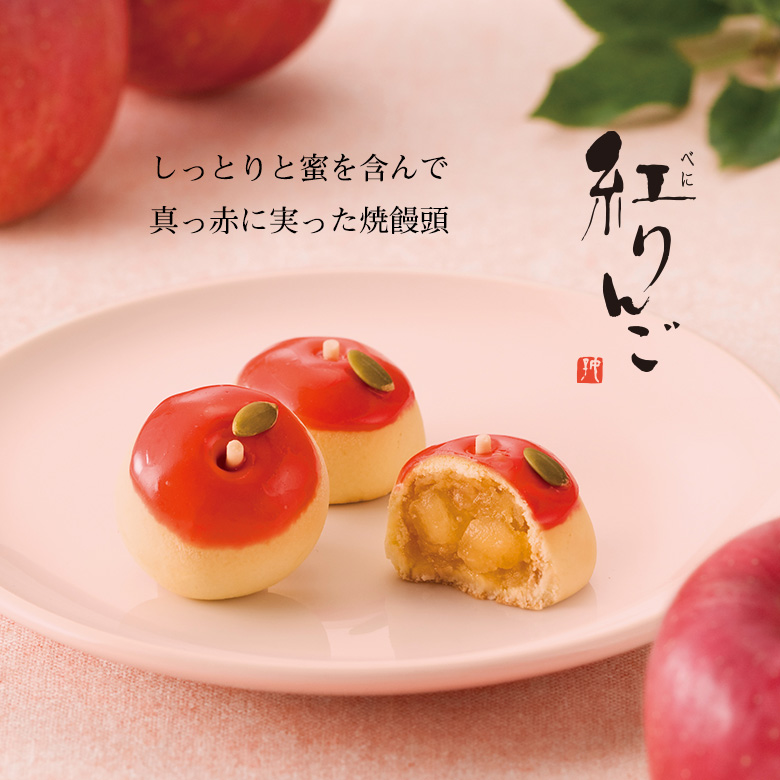
There are countless Japanese sweets. Some are made exclusively for tea ceremony, and others are eaten as desserts. Traditionally, many of these sweets are made with heavily sugared anko red bean paste or they involve matcha. Since I am not a big fan of red anko, I am happy whenever I find sweets that don’t have it. Like these palm-sized apples:

Crimson Apples dessertThese are called beniringo – crimson apples – for obvious reasons, and they are delicious. At first, I thought they would contain white anko (which I do like), but no, it gets better: they have an apple filling! They are a perfect afternoon snack, just two or three bites and very sweet. I have returned to the shop twice now and handed these sweets out to friends, and I’m actually tempted to buy another batch before they start the winter season with their sweets and I have to wait another year.

These wonderful apples are made by Kogetsu, a traditional Japanese sweets shop from Kyoto that opened back in 1945. Today, they have 16 stores in Kyoto and their sweets are sold in 69 shops (including department stores etc.) throughout Japan. If you’re coming to Kyoto and interested in Japanese sweets, both traditional and with a modern twist, I recommend you check them out.

Consolidation

We are having typical December weather in Kyoto. Mornings and nights are pretty cold, but when the sun is out during the day it’s actually nice and pleasant. I could even dry my clothes within just a few hours on my balcony today!

The momiji season is all but over by now. Last Friday, I went to Eikando with a friend of mine and it was just a bit too late for the autumn colors. The temple was packed with people despite everything but it was not unbearably full. Afterwards, we went to the Lake Biwa Canal Museum where I could find out more details about the boating trip I took beginning of October. Even my friend was pleased with the museum, she’s a nerd at heart too.

Now that autumn is more or less over, I have packed all my things and moved them to my living room for the winter. I usually do this just after Christmas, but I’m not expecting any guests to stay with me this year, so I did it today. As I said, the evenings are cool enough to need heating, and I think it’s a waste to heat up one room and go to bed in another freezing one. I don’t need heating during the day yet, especially when it’s sunny, so I’ll keep using my office as long as possible.

Business as usual, so to speak. At least one thing that didn’t break down completely this year.

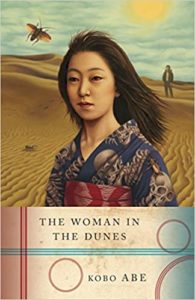
The Woman in the Dunes

The Woman in the Dunes
Kobo Abe

Niki Jumpei travels to a remote beach to catch sand beetles for his collection. On his search, he discovers a village with houses that are overcome by the sand, so much so, that some of them stand on the bottom of pits dug into the dunes. When he misses the last bus home, the village elders allow him to stay with a woman who lives in one of these sunken houses. The next morning, however, Jumpei finds himself trapped down there. Forced to help the woman excavate the sand so as not to be buried by it, he must choose whether to fight against the inevitable or to give in to it – and to the woman.

This is probably the best known book by Kobo Abe and a personal favourite of mine to which I return every so often. We follow Jumpei’s inner journey as he is trapped at the bottom of the pit, and the question “what would I do” is ever present. The ending of this novel is interesting, and depending on your own answer to the question above will either come as a shock or as a natural conclusion of Jumpei’s path.

Kobo Abe, born in Tokyo in 1924, was a Japanese writer, playwright, musician, photographer and inventor. Following his father’s footsteps, he studied medicine in Tokyo and graduated in 1948. In his last year in medical school, he started writing short stories, and already in 1951, he received the prestigious Akutagawa Prize. Woman in the Dunes, published in 1961, earned him the Yomiuri Prize and international acclaim and was turned into a film. Abe was famous for his surreal and modernist style. He died in 1993.

Somehow, I feel that this kafkaesque novel is the perfect ending for 2020. If you want to give it a try, you can get it from amazon.

Biting Bullets

Quite a while ago, I broke another tooth. Essentially it’s a lot of filling in the middle with only the outer rim still tooth enamel – and a part of that finally broke away. It happens. What is not quite normal is that only today I finally bit the bullet and made an appointment at the dentist’s.

schematic of a toothWhat took me so long? Well, I’m terrified of dentists. And while I’m not alone in this, I can pinpoint the reason exactly: When I was a child and our local dentist had to drill down on something, there was smoke coming out of my mouth. I cannot recall whether the procedure hurt, but that blueish smoke wafting in front of my young eyes has scarred me forever.

Over the years, I have grown up and gotten better at going to the dentist, overall, at least. But this time, the hurdle was extra high: the newly broken tooth was the smokey one… I’m not looking forward to this, since it will take several visits to fix this. Not to mention that it will probably cost me a fortune. Thank goodness I haven’t spent all of Shinzo’s money yet.

Labour Thanksgiving Day

Today is the end of a long weekend in Japan, with Labour Thanksgiving Day – kinro kansha no hi – today. This national holiday was established in 1948 and is meant to “praise labour, celebrate production and give thanks to one another”. Especially the “celebrate production” was important after WWII when Japan and its economic miracle took the world (and the car industry in particular) by storm…

When it comes to Kyoto, the most celebrated type of production was going on in the textile industry. For centuries, it was a thriving industry with thousands of people working in it, and even today, it is one of the main industries in Kyoto (after tourism, of course). In Kyoto, the traditional textile industry has seen some of its most interesting innovations, like yuzen, shibori and other types of dyeing, and of course, nishijin-ori weaving for obi. Interestingly, when it comes to looms for weaving, Nagoya’s Toyota company was a large manufacturer, before they moved into the automotive business.

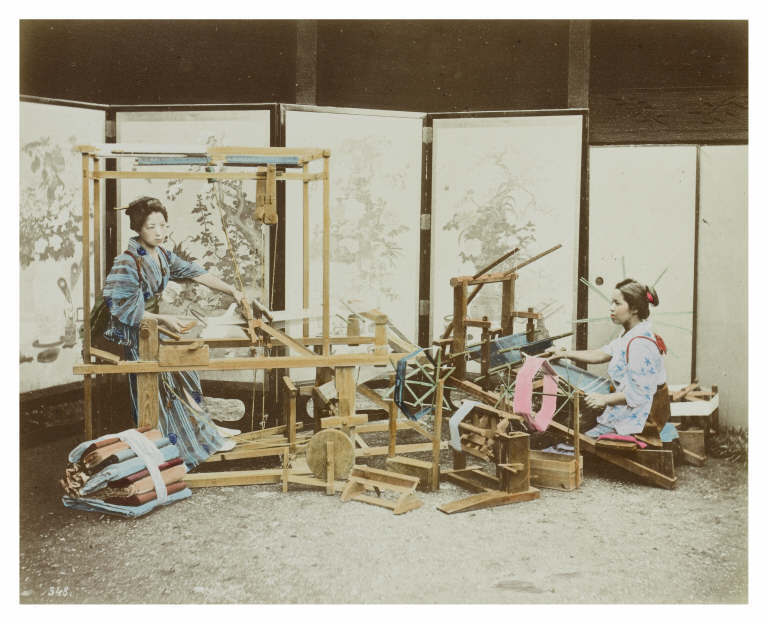
Although modern looms are used almost everywhere, obi are usually still woven by hand with traditional Jacquard machines – which have been modernised from punch cards to computer controls at least. Still, there is something special about seeing a craftsman working on a traditional loom. And even though the photo below was taken in a studio and does not depict the reality of an 1875 weaving workshop, it does come pretty close to how the work is done even today.

Weather Woes

Isn’t it time to complain about the weather again? Last week I wanted to write about how cold it has gotten and that I need to get my winter clothing out. Today, I can write how warm it is during the days – up to 20 degrees and more – and how much I enjoy the sun and the blue skies.

Every year, there seems to be a cold spell at the end of October/beginning of November, and then the sun comes back again until December or so before winter really comes for good. I remember it was the same last year, so this time around I sat it out and did not consolidate my apartment into a single room just yet.

I am still feeling rather depressed though, so I haven’t been out to see the koyo yet. However, I have plans for Friday to go with a friend to Eikando, one of the temples in Higashiyama that is famous for the autumn leaves and usually very busy. I hope the weather will be okay, for now the forecast says it will be raining (and then the momiji are no fun).

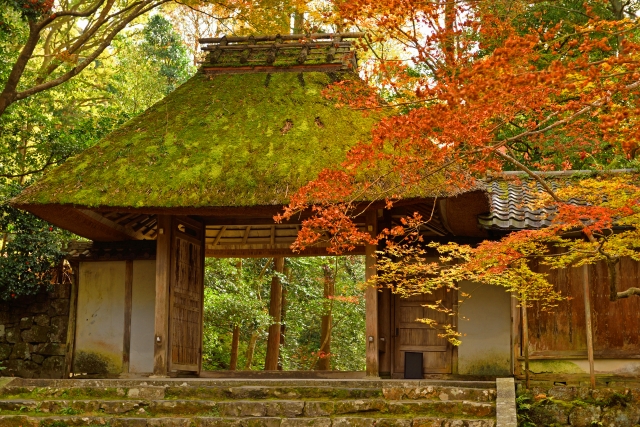
Two weeks ago, I went to the special opening of Honen-in, a temple nearby Ginkakuji that is mostly overlooked by tourists and only opens its doors for two weeks every year. Definitely worth a visit!

The Women I Think About at Night

The Women I Think About at Night
Mia Kankimäki

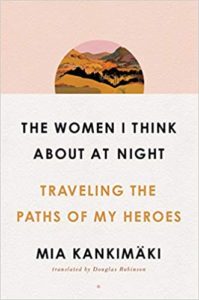
Say, you’re 40-something, no kids or partner, and a job that’s not getting you anywhere. What do you do? Mia Kankimäki leaves everything behind to travel the paths of her heroines – and the result is this book. A large part of the book details her trip to Africa, trying to get a glimpse of Karen Blixen’s life.

Then she follows other female travellers from the 19th century, among them Isabella L. Bird who in 1878 travelled through Japan. In Italy, Mia looks for the works of female painters from the Renaissance and finds their works tucked away in the back rooms of famous museums. Part women’s biography, part travel diary, and part philosophical musings, this book artfully blends the thoughts of independent women of 3 centuries, and they are not as different as you might think!

This is an unusual book review – since the author is a friend of mine. And not only that, we met when she was in Japan working on this very book! (And I am mentioned in it, actually…) I greatly enjoyed reading about Mia’s trip to Africa, and in some of the passages I recognised my own struggles in creating a new life for myself.

Mia Kankimäki is a Finnish author who gave up her old life to become a full-time writer. Her first book – about Japanese author Sei Shonagon – was an instant success in Finland. This is her second book, which has been translated into more than 10 languages.

I read a preprint of this book that Mia sent me a few months ago, since it will be officially published only next Tuesday. You can order it through amazon already and get it as soon as possible though. I hope you’ll enjoy this book as much as I did.

Terror

Today, I thought I’d whine a bit about the weather – it’s that time of the year again after all! And then I woke up to something else yesterday…

On Monday evening, at around 20:00, there was a terrorist attack in Vienna. Four people were murdered by open fire on the streets of the inner city, 25 were injured, among them one policeman. One attacker, a 20 year old member (?) of ISIS was killed. Whether there are any more is subject of investigations. 

I’m happy to tell that all my friends who live in Vienna are safe and accounted for. But somehow, I don’t feel like writing about the weather today. Or anything else much, really.

You too, my beloved Austria?

Pictures From Taisho

I’m very interested in Japanese history, in particular in the time of the Meiji and Taisho Emperors.

The Meiji Era (1868 – 1912) was when the Shogunate was abolished and Japan opened up to the Western world and had to speedily catch up with it. It was an era of extreme modernisation, in particular in the cities, while I would assume that most people in the countryside kept living their lives like they had for the last 250 years.

The Taisho Era (1912 – 1925) that followed saw a similar development, but at the same time, the West’s fascination with the newly discovered Japan lessened and whatever was left was drowned out by WWI.

In any case, below is a video of early film recordings taken in Tokyo in the very early years of Taisho, 1913 – 1915. You can see most of the people, in particular children, wearing traditional Japanese clothing and sporting traditional hairdos (I’m a fan of those!) The streets are crowded (as they are today) and I don’t recognise anything except the big lanterns at Asakusa temple in the very end.

The old film has been colored for this video, and there is an underlying soundtrack. The coloring is pretty good, but I’m not happy with the soundtrack – Japanese people are never so noisy! On the other hand, these are mostly children, and maybe things have changed in the last 100+ years. Anyway, enjoy!

Not My Day…

Have you ever had one of those days that go all wrong from the start?
seiko alarm clockWhen I still had a job that forced me out of the house each morning, such days would inevitably start with my trying to brush my teeth with my face cream. Or to moisturise with my toothpaste. (In my defense: Similar sized tubes standing next to each other. Plus: I’m not a morning person.)

Unfortunately, there are no such simple indicators anymore since now I work from home and often sit in front of my computer already before I think of hygiene. Therefore, I had no clue whatsoever that last Thursday would turn into one of these “I should have gone right back to bed” days.

It started mid morning when I wanted another cup of tea and wondered where all those bread crumbs on my kitchen floor had come from. And why some of them where moving. On closer inspection these turned out to be insect eggs/pupae the size and color of sesame, and some of them had already turned into tiny white larvae.

Thankfully, they were all concentrated around the garbage bin, so I cleaned out the lower kitchen cabinets (more eggs), swept up about a handful of insects-to-be and threw the whole mess out. To date, no further wrigglies to be found, but the whole operation cost me half an hour on a day where I had already several appointments.

The first meeting was rather uneventful, except for the fact that I had ordered hot fruit tea (or so I thought) and was served an iced soda. Nice, tasty and very fruity indeed, but not quite what I wanted on that rainy day.

Next meeting: rehab for my hip pain. The clinic has changed their mode of working, so it’s 40 minutes of manual therapy followed by two or three exercises of five minutes each. Already the first excercise – a stretching of the left hip muscle – was too much for my ancient jeans. They promptly tore at a very improper place and exposed about 20 cm of my inner thigh. No more exercise after that!

However, one more meeting to go, so I had to rush home, and get changed into something less revealing. At which point I found out that I was not only out of jeans, but out of any kind of pants that were both fitting me (thanks Corona!) and suitable for the current season. All I had were thin summery pants and thick woolen ones for mid winter. I did find some sort of workaround though (don’t ask…) and off I went for my last meeting of the day.

I made it just in time and ordered a glass of orange juice. When the staff put the glass in front of me, it was cracked halfway through. Thankfully I noticed it before I left the counter, and I got fresh juice in a new glass without charge. Other than that, this meeting was uneventful as well.

Finally, upon return to my part of town, I went to Uniqlo to shop for pants. It was exactly the painful experience I try to avoid – which is how I came to be pantless in the first place. Having more curves than the standard Japanese girl makes shopping extra difficult, even if the sizes as such appear to be the right ones – I still can’t get the pants to fit over my hips. Anyway, in the end I could find two that fit me rather well and I went home, well, not happy as such, but content.

Mostly content with the fact that the day was over and I could finally close the door behind me and hide under my covers.