Busy!

This week, I have been running around like crazy, organising lots of little things and going here and there – and still I have the impression I did not accomplish anything at all…

I have decided to get a Japanese Hanko or Inkan, the seal that is used in Asia in lieu of a signature. I have ordered one and should get it tomorrow, next week I will have to register it at my ward office.

There are also still some things I need to consolidate in Europe – at least everything can be settled via emails and maybe a short phone call or two.

In view of approaching Christmas (in less than 5 weeks!) I have bought a stack of Christmas cards, which I will have to write over the next two weeks, since they take about a week to reach Europe. It was surprisingly difficult to get Christmas cards that do not feature Santa Claus or Mickey Mouse or the characters of Frozen… In any case, I am very glad I don’t have to buy any presents except those for myself, that makes my life easier, especially as I am not sure there will be any this year.

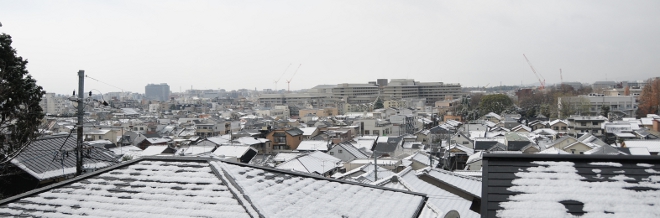
As a way to balance things, I have been walking through my neighborhood to see how far the momiji are. It will take one more week for them to be perfect I think. A friend of mine recommended one of the Imperial Villas (allegedly with the best garden in Japan) to go during the momiji, so I went to the Imperial Household Agency to make a reservation for a tour. The tours are free, but limited to a small number of people, and you have to register with your passport number. I am proud to say that I did (almost) all of it in Japanese, even though the lady at the counter spoke excellent English. On some days I actually think I might be getting there.

Besides that, there was a movie afternoon at the Kyoto International House on Tuesday; it was a Japanese movie from last year with subtitles in English. As subtitles are usually non-existent, I am always happy to go to such special events.

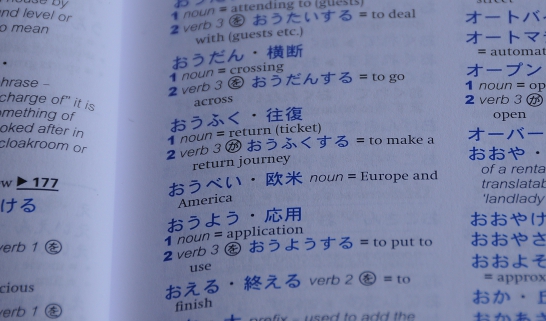
And amidst all this I am trying to keep my soroban studies up and my Japanese studies as well. Well, it’s just the crest of the wave right now, the through – with nothing happening – will come around soon enough again.

Building Blocks

Some time ago, I mentioned the house that was torn down in my neighborhood and how fast they were doing it.

Then, nothing much happened for a few weeks although I have seen tons of concrete being infused into the ground, and I have also spoken to the man who has measured the plot and set up the outline of the new house to be built. Funny talking about Pythagoras in such circumstances…

Then, maybe two weeks ago, builders started with the foundations. Foundations nowadays are made of concrete, of course, and they are essentially a flat slab under the whole house with little walls on which the future walls of the house will rest, maybe 40 cm high, not more. In this basement floor and walls, pipes are laid for water and sewage, and on top of that comes a wooden construction that essentially is the floor of the ground floor. Note that I have not seen any insulation being installed between the raw concrete and the wooden floor, but to be fair, I was not there standing and watching all day.

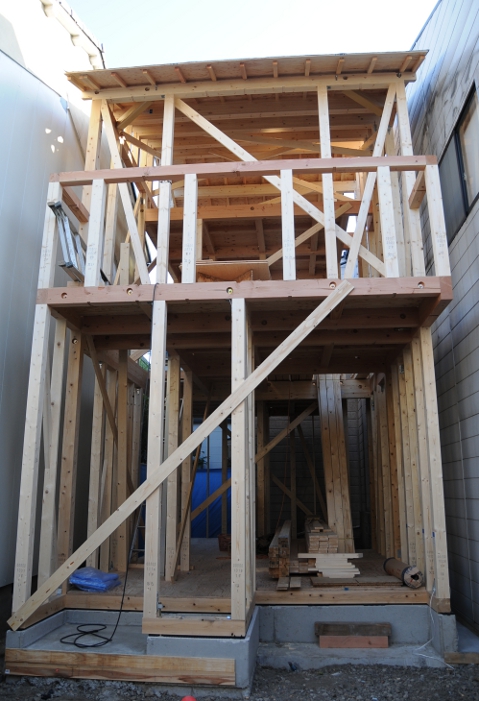
Two days ago, with lots of hammering, they started building the house on top of the foundations. I have heard some hammering and the occasional drilling, but not much more noise throughout the day as it would be usual in Europe. As I had suspected, the house is a fully wooden construction, and yesterday night, the frame was finished and looked thus: Wooden frame of modern Japanese HouseTake a closer look, do you notice the numbers on the timber? Every wooden beam has its individual number, obviously the construction plan contains the same numbers. Thus, the whole house can be prefabricated somewhere off site, and only needs to be assembled with the right pieces in the right place and order. No wonder they can be so fast in building a house in Japan! Numbers on wood beamsTo be quite honest though, the whole thing appears to me rather flimsy. Clearly, the house will gain further strength by adding the walls, so maybe proper joining is not really necessary. Still, I have the impression a really big earthquake and these things are flattened in a heartbeat. Not like that 500-year-old farmer’s house I have seen that survived a very strong earthquake practically intact – albeit 1 metre off its original location…

Life and Death

Today was a lovely sunny day, so I decided around noon to go out. I wanted to take a little hike up to Mount Daimonji, behind Ginkakuji, but I misinterpreted a sign, took a wrong turn and ended up in a cemetery. I like graveyards, so I walked through the rows a little, and it certainly proved worth it.

It was a most interesting cemetery indeed – in front were the normal tombs I have seen so often before on Buddhist graveyards. Many of the tombs were modern, but here and there were old ones, huges stones with inscriptions and here and there a stone torii in front of them.

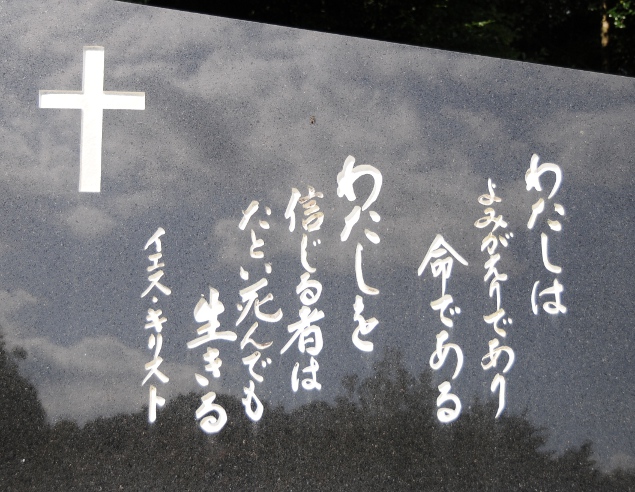
Further towards the back, however, there were tombs of a different kind: Still in massive stone, one could find ones with inscriptions in Hiragana, Latin, and even in English; with names engraved in Katakana. There was even one with an inscription in Portuguese. On one tomb it said “Do not stand on my grave and weep. I am not here, I do not sleep. I am the thousand winds.” Never before in Japan had I stood on a Christian graveyard. It felt odd somehow. Japanese tomb with inscription of John 11:25The inscription above is a translation of John 11:25, by the way.

Guests

My landlady had guests last week – and because she lives in a very small Japanese house, she had them stay overnight with us in, well, the guesthouse. They left in the early afternoon today for Osaka.

Not three hours later we noticed that our toilets were blocked, both of them… Thank goodness my landlady was around and with the help of our usual builder – who came after 6 pm, on a Friday night! – and a lot of running water, we have now at least one fully functioning toilet again.Things like this do happen on occasion of course, but you can imagine my landlady was not entirely pleased.

There were a few other things that made that visit not too pleasant for her, but I am not going to share them here. I can share one of my own experiences with those guests though: When I came down to the bathroom on Monday morning, I noticed – even in that almost brainless state I occupy the first two hours after getting up – that some of my toiletries were gone: shampoo and soap were missing, and somebody had obviously used my hairbrush and face cream. I was glad one of the new guests was there, so I complained; I mean, who else could have done this?

It turned out that her husband had appropriated my stuff because he thought that those were things left behind by former tenants. I’m sorry – what? You come into a shared house, where you know several people are living right now, and the first thing you assume when you enter the bathroom is that the stuff on the shelf is abandoned? I have to give it to him: He was the first one in all my 18 months of living here to have had that glorious idea…

At least they didn’t take much, and when I complained I got everything back. Also, when I checked my kitchen shelf just before, I found two newly abandoned bananas, and we have a large stash of toilet paper. In case of any more geniuses moving in in the future, I have now labelled my basket of toiletries with my name though.

Calendars

One of my favourite places to go is the local Loft store on Sanjo street. It is a Japanese chain selling accessories, small household goods, stationary, travel goods,… For some reason I have always loved paper – the smell, the texture – and I love to browse the stationary goods at the Loft, which occupies the whole third floor. There are notebooks and files, birthday cards and letter sets, fountain pens and pencils, and all the other little things you never even knew you would need on your desk.

And right now, they have calendars. Lots of calendars.

Well, right now is not really true: Those calendars are occupying about a quarter of the third floor space between mid September of any given year to mid June of the next year, that is nine months – three-quarters of a year!

Japanese people seem to love calendars, and they come in every conceivable colour (from decent black to bright pink or gold), in every conceivable size (from palm-sized cuties to sturdy A4 things), for every conceivable customer (from CEO filofaxes to primary student Mickey Mouse agendas). It really seems that everybody in Japan has to have one of those calendars despite everybody having a smart phone these days.

So, why are they sold for such a long period of time? It wouldn’t take any of us that long to decide on a calendar, would it? The reason is that there are two New Years (well, actually there are three, but the middle one is not celebrated much these days). The first New Year is the one the rest of the world celebrates too: January 1st. It is quite a big thing, with lots of ceremonies, some of them religious (first shrine visit of the year not later than January 3rd), others more mundane (visiting relatives, eating particular food, noting the first time of doing something). I am not entirely sure whether this is a traditional time for gifts as well, beyond the ubiquitous New Year’s cards, but a new calendar for the coming year sounds like a very good idea for it.

The second New Year is much less celebrated, probably even dreaded by not a few people. No, it is not Chinese New Year, traditionally at some day in February. I mean the new fiscal year, which starts on April 1st (no joke). Hence, there are calendars in Japan having April as the first month, and I can see that if you are a business owner, or maybe an accountant for a large company, this could be handy.

As I said, I love paper, and I have been wandering through the almost endless aisles with calendars left and right for many an hour in the beginning of this year. I did not really need one this year, but it would have been nice to have one – preferably in froggy-green – and so I thought I would wait until in a month or two they would go on sale. Interestingly, no such thing happened. The January calendars were simply replaced by the April ones, and I only noticed that the hype was over when they did not take up quite as much space than before.

In the end I decided that I would indeed need a 2014 calendar, but I bought only a very cheap one for a few hundred YEN from the Muji store – another favourite place of mine… But that’s for another post.

Gardening

Today was a quiet day, it was very cool and even started to rain a little in the afternoon. Today was also the day the gardeners came, and they took a whole day for their work. Ebisu’s has not much of a garden to speak of, at least not for European conceptions, but here in Japan, even in this neighborhood, it is considered quite large. Our landlady occasionally tends to the garden herself, but once a year she hires the professionals. Or so I hope they are…

I am not sure whether this is because they only come once a year or whether this is the general Japanese concept of gardening, but their approach to the idea can be described as “brutal”. All day the two of them were hacking away at our little jungle outside; I could hear power saws cutting through arm thick branches, leaf blowers, and brushcutters. They even cut the trees and bushes at the top of the steps, although technically this would be the upstairs neighbour’s responsibility (that house is not inhabited though).

When I returned from a quick shopping trip in the early evening, the garden looked more like a sand desert than a green refuge. The trees have been severely cut back, no more grass can be seen at the front of the house (my landlady keeps toying with the idea of simply paving it over) and all the bamboo is gone at the back of the house. It looks quite sad indeed. The only consolation I have is that in this hot climate, it will all grow back again next spring…

Drop

The typhoon last Monday night has thankfully more or less bypassed Kyoto. Unfortunately, we can feel the aftermath: The temperatures have dropped quite considerably since then.

The afternoons are still nice and sunny, with wonderful bright blue skies and temperatures in the mid-20s. Mornings and nights, however, have suddenly become much cooler. Last evening, when I was sitting at my desk in my room, I was for the first time contemplating getting the heater out, but I then opted for a blanket instead. Also, although I am now closing my windows over night, I still wake up in the morning because I feel cold. Don’t worry, I have not yet maxed out the number of blankets I am using, nor the layers of clothing I’m wearing!

I am a bit worried about winter though, how cold it will get. If it will be like the summer was – with a dense blanket of clouds above the city virtually every day – it will probably be relatively warm (for rather cool definitions of “warm”). But if there are lots of clear days, it will become very, very cold indeed. Have I mentioned that I have recently noticed a crack in my wall through which I can look outside…

Repairs

The big typhoon that was supposed to hit Kyoto last Monday night did – just like the last one a week before – bypass the city, thank goodness. Last Sunday, our landlady came to prepare the house: opening all the windows just a little bit, so there would not be too much pressure on any side (apparently, if there is, the whole house could blow out); removing anything from the outside that could be blown around and thus cause damage; tying unremovable things down; securing the bicycles by laying them down… In the end, there was some rain and some heavy gusts of wind, but not in the least as serious as everybody had feared. Towns on the East coast have not been quite that lucky I have heard…

So, our house is still standing, and thanks to the recent repairs on the roof there was no leakage. Or, at least, not in the expected spots… About half a year ago, I told the landlady about leakage on the ground floor: During heavy rain, the drainage on the back of the house cannot quite handle the amount of water, and the overflow came through the back door into the house, into the narrow pathway between the kitchen and the entrance area which is level with the outside (the kitchen itself and the rest of the house are elevated above ground by maybe 40 cm).

construction sign

Then, the problem was fixed, chiefly by installing a new back door with a higher threshold and new floorboards in the pathway inside. I watched as it was done, and already then I was suspicious of the threshold, which is nothing more than a piece of wood laid down and covered with plaster. It looks solid, but it certainly is not!

The proof for this came Monday night: As the drainage problem outside has not really been addressed, the overflow from the heavy rain slowly leaked through the threshold and even seeped up through the floorboards. I have informed our landlady about this – I wonder what is going to happen this time. The solution would be rather simple, but I wonder if I should dare suggest it…

Lost and Found

In the late afternoon on Wednesday, a housemate came to my room, she was quite miserable: She had spent all day in the library doing research, and when she went home, exhausted, she had forgotten her bag in the bus, complete with laptop and the day’s findings. She didn’t know what to do, and because of another appointment in the evening she couldn’t do anything anyway. As she does not speak Japanese, she couldn’t make phone calls either, so I agreed to go to the police station with her on Thursday morning.

There is a rather large police station – not just a neighborhood Koban – nearby on Higashiojidori, and we arrived there at 9:15 on Thursday morning. Only three police cars were parked outside, but when we entered, there were lots of men in uniform. There was an open counter and a young man got up as we approached it. On my question whether he spoke any English he first got pale, then looked around for help from his colleagues, but they did not seem at all eager to assist him. Finally he grabbed a big yellow report pad and a pen and put it in front of us. My friend wanted to explain in English, but I ventured forth – I had had lots of time to practise – and said in slow, deliberate Japanese: “Yesterday, my friend forgot her bag in the bus.”

The policeman’Japanese police logos face lit up as I had never before seen in an adult, only with small children in front of their first Christmas tree. I am not sure what exactly made him so happy: That he could understand what those foreigners wanted, or that this was not his responsibility. In any case, he hastily put the notepad back again and motioned us to follow him. At the end of a dark corridor there was the Lost & Found office, he briefly explained there what we wanted and hurried back to his own counter, visibly relieved.

I repeated my well-rehearsed sentence nevertheless, and we received a form – bilingual in Japanese and English – to fill out. It was quite the expected: Who are you, where do you live, when, and where did you lose what exactly. My friend even went so far to draw a picture of the bag… Anyway, while she was filling out the form, I tried to explain – in a mix of Japanese and English, aided by a prepared list of vocabulary, that she was an author, that her latest book was on the laptop inside the bag, and that it was very, very important indeed to have it back.

While one of the clerks helped us filling out the form, another one called the bus company but it turned out that the bag had not yet been found. My friend got worried, but I tried to calm her by saying that it was quite early in the morning, and that the report and/or the bag may not have made it to the main office just yet.

At that point the office head joined us at the window, asked what all the fuss was about and finally inquired why we had not called the bus company ourselves. I tried to explain that I could make myself understood in Japanese when talking to people face to face, but that I was entirely lost on the phone. Anyway, we left with a note on which three numbers were scribbled: The one of the lost and found office, the number of the report we had just filed, and the number of the bus company, just in case. It was 9:45.

From there, things went uphill. My housemate remembered a Japanese friend and she got her to call the bus company and to inquire for the bag directly there. Also our landlady, contacted the night before, had called the bus company. At 2:30 pm, the relieving message came: The bag had been found and could be picked up at the bus terminal.

When I returned from my soroban class in the evening, my friend already sat in front of her own computer again, relieved and happy. She said that everything had been inside the bag just as she had left it – with one exception: Somebody had gone through the bag – probably to try and find a hint of the owner – and had removed the banana peel that was still inside… What a service!

White Night 2014

Last Saturday was this year’s White Night – Nuit Blanche Kyoto – the all night modern art culture event inspired by its Parisian counterpart. This year, there were 35 locations, and together with a housemate I went to the French Institute not far from Ebisu’s to see an Experimental Tea Ceremony. nuit blanche kyoto 2014 logoThe tea ceremony itself was not experimental at all. Although it was hard to see the details, the ceremony appeared to me very traditional: a woman in formal kimono, traditional tatami and tea utensils,  refined and measured movements that were just so, an attendant to offer the finished tea to a special guest of honour in the first row of the audience. Cleaning of the utensils afterwards.

The experimental part was the surroundings: There was a saxophonist playing music, well, more tones than a melody, really… I liked it, it added something special, although I’m not sure whether he was playing live or the music came from a tape – it was heavily alienated and remixed with other sounds. The other additional thing was a dance performance that started about half way into the tea ceremony. It was a performance similar to the one of last year, but it lasted much longer, and it was more… vigorous, especially towards the end. The dance started when something that looked like stage decoration began to move slowly, then the dancer started to remove the coat he wore (underneath was body paint and a fundoshi, a Japanese loincloth). He seemed to somehow threaten the woman who had just finished the tea ceremony, but he was carefully avoiding to touch her in any way. She left after a while and the dancer then had the stage to himself until the very end. All through his performance, the music kept being played.

This type of modern dance is called Butoh, it has been developed in the 1960s as a rather special Japanese art form, and has since spread to other countries as well. My housemate was really thrilled about this, she likes modern art, and this type of dance especially. I was not so excited about it, to be honest. Different than last year, the performance could not grip me, I did not have the impression there was any story that was told, and I thought it too long; maybe 10 minutes less would have made a greater impact. I can appreciate the great body control that is necessary for a performance like this, but still, it is not quite my thing… My housemate went to another Butoh performance just tonight, but I passed on this one. I think I’ll need a bit more distance before I go and actively seek another one out…