Shock Value

I have a new German student, an almost 60 year old man who wants to learn German because he loves Germany and would like to visit it at some point. We have been studying together for some two months now, and he is eager to make progress and he’s doing very well indeed.

We are using a brand new textbook a friend of mine has recommended, and there is one thing that keeps popping up that seems to shock him greatly every time it’s mentioned: Divorce. The first time it came up was in a scene were students showed family pictures: “Where’s your dad in that photo? – Oh, my parents are divorced.” Another time it was required when filling in a form: “Are you married? – No, I’m divorced.”
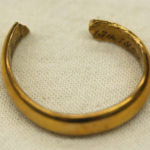
Destroyed Wedding RingBoth times, my student was rather shocked about the directness of the question and the answer. In Japan, this is not a topic to discuss with anyone, he says. He even claims that a question for marital status wouldn’t even come up in a job interview. Apparently, divorcees are seen as “bad” people, in the sense of “you can’t even get marriage right”, and it reflects badly on other plans or pursuits. According to my student, there is still stigma around being divorced, even though about 1/3 of all marriages in Japan fail.

Interestingly, most divorces in Japan happen upon mutual agreement, instead of in court. The paperwork is simple and can be handed in at the city hall directly by the soon to be ex-couple. Also, I have just found that the divorce rate was much higher back in the old days (before WW II), when women’s rights had not been implemented at all, and when men could simply send their wives back home to their families (children would stay with the father’s family, by the way).

I guess in Japan, the only acceptable marital status for an adult of my age is being married. Divorced is not good, never married makes you sound like a leftover, and I don’t think widowed would be a good option either, even though there might be less stigma attached to that one. So, it’s probably good that the Japanese don’t usually ask whether you’re married – they simply assume you are.

Confessions of a Yakuza

Confessions of a Yakuza
Junichi Saga

cover of Confessions of a YakuzaJunichi Saga is a doctor in a town near Tokyo. One winter’s day, an old man comes to his practice, asking for treatment, and a few weeks afterwards, the doctor is invited to Ijichi Eiji’s home, where he begins to tell about his life.

And what a life it was: born in the countryside in the early ears of the 20th century, he finds himself in Tokyo as a teenager and works at a coal-, later at a timber merchant. In 1924, the year after the great Kanto earthquake, Eiji gets to know a local yakuza boss who takes him into his rank and file, and from there, nothing is ever the same. We hear about the internal workings of the gambling places – the only business a respectable yakuza would do at that time – how the system of yakuza brotherhood works, and how to rise in their ranks. We also hear about Eiji’s three times in prison – twice innocently, once for murder – about his short stint in the army, and about his often unlucky dealings with women.

I picked this book up at an airport or other, probably because of the title promising a real-life crime mystery or something like that. The book is nothing like that. Not that Ijichi Eiji’s business was not criminal, but there were no big yakuza wars or standoffs with guns; instead, we hear about a life on the fringes of Japanese society in the first half of the 20th century. As such, I wouldn’t call the book “exciting”, but the story is interesting and worthy of being told.

Junichi Saga (born 1941) is a doctor in Tsuchiura, a little town northeast of Tokyo. He writes chiefly about the lives of his patients. Besides this biography of the head of a yakuza family, he has written a few other books, among them “Memories of Silk and Straw”, which was voted Best Book of the Year by the Foreign Press of Japan.

If you’re interested in the life of a Yakuza, get this book from amazon!

Flea Market

What a lovely time at the moment – it’s been snowing for a few days already! Not much, there’s not too much snow on the ground, but still, it makes me happy every day! And, on top of that, I went to the Kitano Tenmangu flea market with two friends today. It’s also called Tenjin-san, takes place on the 25th of each month, and is the largest flea market in Kyoto. I have been there before, but it’s always nice to see what’s “new”.

We went to the shrine first. Kitano Tenmangu is famous for its plum trees, and despite the cold weather we could see one or two bright red plum blossoms already. Also, there was a woman having a tame monkey doing tricks, and in one hall, there were calligraphies that were done during the first 3 days of the New Year, when people expressly come to Kitano Tanmangu to write their first calligraphies.

Kitano TenmanguThe flea market itself was smaller than usual, but it was also very, very cold today, so I guess many vendors just didn’t show up. Even though I was tempted by a lovely tea bowl, the price was a too steep, and in the end I didn’t buy anything except for some food.

That was yet another day where I didn’t get much done… On Saturday, I have an appointment with the shrine I will feature in February, and on Sunday, I will have yet another go at the soroban shodan level. Do wish me luck for the weekend – I’ll need it!

Kicked Out

As I reported on Sunday, I went to Takeda, in the south of Kyoto, for a purification ceremony at Jonan-gu shrine. Afterwards, I visited a sento nearby because a friend had given me a discount ticket for it. A sento is a traditional public bath, and the difference to an onsen is that the latter usually gets its water from a natural spring nearby, while the former just uses tap water. I like going to either public bath, it always promises an hour or two of total relaxation, and, the best thing about them: somebody else is cleaning the tubs…

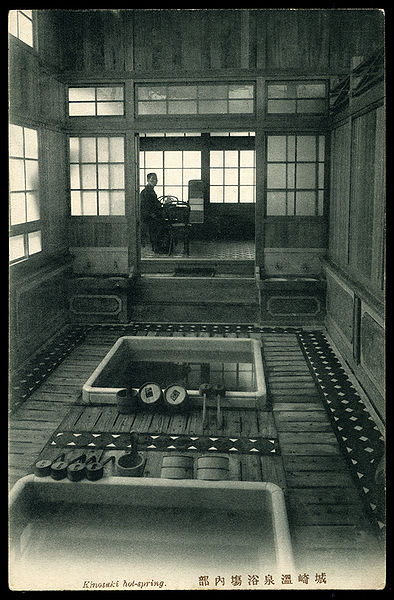
Kinosaki onsen in 1910So, I went to that particular sento, called Chikara-no-yu, “Strenght bath”; I stripped and scrubbed myself thoroughly and then dipped into the hot water. There were seven hot tubs, one with cold water, a sauna, a massage room, and a steam room. I had been at the sento for maybe an hour already, and I just made my way to the steam room, when an attendant came up to me and told me to leave. She said they didn’t allow tattooed people in their establishment, and that I should leave immediately. This rule is old and widespread, and the reason for it is that people want to avoid the yakuza gangsters, many of whom are still wearing quite heavy and elaborate tattoos.

So yes, I do have a tattoo of the size of a 2 EURO coin on my upper arm. It is usually covered by any sleeves, but clearly visible when running around in the nude, of course. I have been to many different sento and onsen all over Japan, but this was the first time I got kicked out because of my tattoo. To be fair to the attendant, I think somebody complained – she had passed me a few times before without saying anything, but once she was told by somebody else, she had to act of course. Also, that part of town is not the very best; on my way to the sento, I passed a whole block with nothing but love hotels…

Anyway, I was pretty much done by that time and ready to go home. And Takeda station is so far away from where I live that going there just for the sento doesn’t make much sense. However, it is probably a good idea to put a large plaster into my sento bag, just in case there are other people intimidated or offended by my tattoo ever again.

Hatsuyuki!

When I woke up on Sunday morning and opened my curtains, I got an immediate surge of happiness: It had snowed over night! Not much though, maybe 3, 4 centimeters, but it was still cold enough for the snow to last all Sunday (and a bit of yesterday). Kyoto doesn’t get much snow usually, so I am always thrilled if there is any for a day or two. If you have seen photos of famous Kyoto landmarks in deep snow, rest assured that this was the case for a few hours only, and the photographer was very dedicated indeed 😉

Of course, other areas in Japan are much more lucky. The interior of Japan is full of mountains – the Japanese Alps – that are nicely covered in snow all winter. And don’t forget Hokkaido! The western coast of Japan is also notorious for deep snow, it is called “snow country” for a reason. Just a few days ago, I have heard a news story about people having been trapped on a train over night – which itself was trapped by the snow in the middle of its route through the snow country. All the people – more than 100 if I remember correctly – were saved the next morning, and there had always been electricity, meaning: heating, but still, it’s not an experience I’d like to make myself I guess.

Anyway, today was a very warm day again, and all the snow is gone. Who knows when we’ll have snow again this year.

Halving

Over the New Year’s period, even Kyoto’s public service people get a week or so off. This means, among others: no garbage collection. A few weeks before New Year’s, you get a detailed schedule of what type of garbage is collected until which day and from which day. The schedule is comprehensive, on top of the usual suspects (standard garbage, plastics, glass, and paper) there are also mentioned slightly more exotic things you might want to get rid of: large household appliances for example, or dead pets.

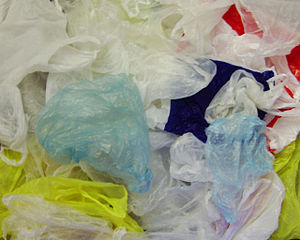
plastic grocery bagsThis year, on the bottom of the page, there was a special appeal to reduce waste. Apparently, the city is making an effort to cut their garbage in half, from a peak of 390.000 tons (per year, I assume?) The rate has slowed down, and now people are encouraged to go the extra mile to reduce 27.000 tons more to meet the target. Particularly suggested are a reduction in food waste (meaning: the throwing out of perfectly edible leftovers or overstocked food) and to be more diligent in separating paper from the general garbage.

Both is fine with me 😉 What was interesting about this appeal was a very simple calculation. They suggest that each person should reduce their waste by 30 grams each day. That sounds rather puny, no? After all, that’s just one PET bottle, or 3 plastic bags, or half a newspaper (probably not the Sunday edition); or one bell pepper, or 1/5 of a carrot or tomato. But when you actually doing the numbers, that little bit does sum up: To 900 grams, i.e., almost one kilo per month, and 10.8 kilos per year. For one person – count the approximately 1.5 million people living in Kyoto alone, and that leads to more than 16.000 tons a year.

Impressive what a tiny little bit can sum up to – if everybody does it!

Returned!

Nice to be back, even though I didn’t go anywhere. Okay, that’s not true, I spent two days in Kobe with a friend of mine having a kind of After-Christmas party with duck and wine and chocolates (of course). And other friends of mine invited me to an After-New-Year’s lunch last Sunday with roast pork and wine and “hot love” ice cream.

And of course, I went on the obligatory hatsumode first shrine visit to Shimogamo Shrine, where I prayed to “my shrine” – meaning the little shrine devoted to my birth year – for a good year to come. Of course, I also bought a new omamori, especially for success in business, and it already seems to have a positive effect: I got a big project on my desk just yesterday! I hope that’s a good omen for the rest of the year.

Other than that, I spent two rather lazy weeks. I always enjoy not having any appointments where I have to go out (still an introvert, I guess), and I took advantage of that time to get a few private projects done. And, of course: planning a bunch of new ones as well! Also, I did my soroban training (almost) daily. The next shodan test will be in three weeks, and I really need to pass it this time, or I’ll have to start all over again (it’s a bit complicated to explain, I’ll do that some other time).

Overall though, I had a nice vacation, and now, I’m rearing to go. Let the New Year begin!

PS: A big hug and thank you to all my friends who sent me Christmas chocolates and other sweets. They were well received and I’ll try to make them last!


Meeting

It’s time to make serious plans for next year, especially with respect to business. The What’s up in Kyoto crowd is slowly (very slowly) growing, and I want to take the page to the next level. First of all, I’m planning a slight upgrade and redesign by New Year’s Day, including a few new pages.

What's up in Kyoto LogoAlso, I will need new highlights each month – and I have decided to feature 12 of the most important shrines throughout next year, or at least: those shrines with the most exciting or fun events. It would probably be fine just to write the articles on my own like I did this year, but since I don’t have photos of all shrines or all their events, I will approach them and ask for information, photos, and help in general. To be honest, I am rather worried about this because, essentially, I’m nobody. And a foreigner to boot!

This afternoon was my first meeting with a representative of the January Highlight shrine (yes, I’ll keep it a secret until then). And I’m proud to say, it went very well! After making a phone call and sending a fax with further details, a friend – working as my translator – and I were received today by a rather young man representing the shrine. He was very forthcoming and friendly, and we could already clarify a few things I got wrong in the preliminary article that I had brought along. I am allowed to use any of the photos available for download from the shrine, and I have a few of my own as well, so it should be fine. The whole meeting was over in 10 minutes or so.

Now we’ll have to finalise the article, including photos and everything, and send it to the shrine for their final okay, since they are keen to have the information correct. Again, this is supposed to happen by fax… We also have to provide a translation into Japanese, even though the young man seemed to have understood me perfectly well (he didn’t let on, of course). Either he feels more comfortable to read and check in Japanese, or he needs it for the records of the shrine.

Either way, the first hurdle has been taken, it was a relatively low one, thank goodness. My friend will be busy the rest of the month, but we have already sent a fax to the February Highlight shrine – no reply from them yet. We think we’ll have a better selling point if we can prove that we’re already working with another famous shrine of Kyoto. Wish us luck!

Countdown

Last week before Christmas, and I’m counting down my to-do list. All Christmas cards sent out, Christmas emails to the rest of the world to follow. All oseibo Year-End presents bought, sent, and return “thank you” emails received. One Christmas present left to buy, but I have ordered a small Christmas cake already. Two bonenkai Year-End parties successfully survived.

One more nengajo New Year card to write, and that only because I had to ask my Japanese teacher for his address again. The others I finished over the last weekend, I’m so proud. I even set up a mass-mail form for all my future business nengajo. That alone took me half a day because when I print them, the post code must fit into the preprinted boxes. I’m greatly looking forward to all the time I’ll save next year though!

And, finally, as of today: 1 more deadline, and 4, maybe 5 more meetings and 2 soroban classes. Year’s End. It’s good things are winding down.

Modernisation

Yesterday I read a short article in an Austrian newspaper about the upcoming 2020 Olympics in Tokyo. To cope with the expected influx of foreign visitors to the country, it is planned to have a number of robot models greet and assist passengers on the airport in Tokyo. The robots are supposedly able to perform easy tasks (like carrying bags), doing instant translations, or answering simple questions. The goal is to show off how modern and cool Japan is.

My first reaction to that one: I laughed out loud. I’m not sure, maybe it’s Kyoto, but somehow the “modern Japan” has still not permeated the whole of my city here… Let me illustrate this:

Recently, I have started contacting companies in Kyoto about the What’s up in Kyoto event calendar (actually, a friend is helping with this one). First contact is per phone, we tell them about the event calendar and what we want and then, at some point comes the “more information” part of the call. When this happens, we inevitably get an “oh, just send us a fax with the details, okay?”

A FAX??

Have you heard of emails? 21st century and such? To be fair, those are not IT companies, but still, all of the places we are contacting have websites, often quite beautiful and elaborate ones. Still, no emails, they want a fax. And finally, they want you to show up in person and do the whole sales pitch again, of course.

This is the fascinating thing about Japan: On the one hand, they have robots in all shapes, sizes and intelligences. And on the other hand, they are holding on to technology from the 1980s because that’s just what they do. This country will never cease to amaze me.