Classes

I had a rather busy weekend. On Saturday there was my soroban class (I learned division), and on Sunday I took my first Japanese cooking lesson.

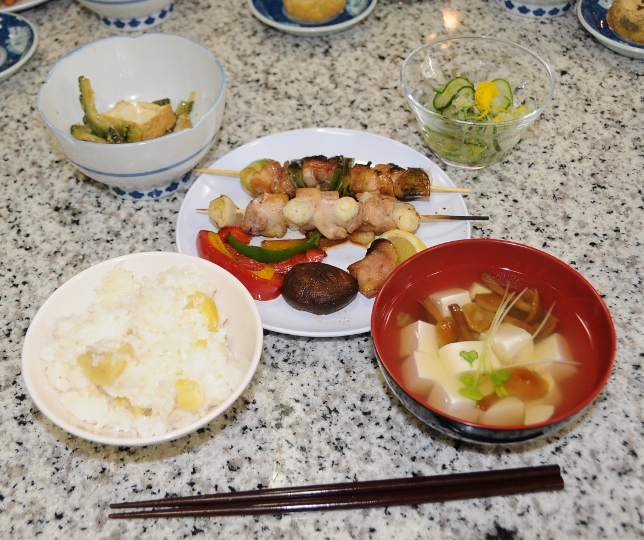
We were about 25 people, both Japanese and foreigners, and we made a variety of Japanese dishes: Chestnut rice, clear soup with mushrooms and tofu, grated radish with cucumber and chrysanthemums, a stir fry with Okinawan bitter gourd and bean curd, yakitori – skewered chicken – as main dish, and the almost obligatory anko rice balls as dessert.

The class lasted three hours and started off with a short introduction by the teacher, an old lady who had lived in many places in Japan, including Okinawa. In the quickest Japanese I have ever heard, she explained how each dish was to be made, and then we were sent off to three tables and were left on our own. English recipes had been provided though, and the groups were mixed so there were always Japanese people to help.

I chose to prepare the dish from Okinawa (I had eaten it in a restaurant a long time ago) which consisted only of bitter gourd goya, pre-fried tofu, miso paste and sugar, fried in a pan. I was in the team with a Japanese man and as we both did not seem to be the chatty type – although he was very friendly – our dish was the first one ready. I then had time to help with other dishes, clean a little, and take photos. final meal prepared in class

When everything was ready, we set the table for everyone – in a cleary prescribed way of course: rice and soup at the bottom, just above the chopsticks, the meat in the centre, the two side dishes to the top left and right of the meat, and the dessert yet a bit further on top. With an additional cup of green tea we were ready to eat – and it was delicious! (Note: In the photo above, there is no desert because we only prepared eight, but the teacher was invited to our table… as I’m not a fan of anko, I gave my desert to her – and was rewarded with my own green tea pudding a bit later on ;-))

I greatly enjoyed the class, I am planning to go there again. Almost everybody spoke both English and Japanese, and the atmosphere was nice and relaxed. The only thing that is not optimal is the limited space for cooking, and that it is difficult to keep dishes that are finished warm until it is time to eat. But then again, my own dish was supposed to be eaten cold anyway, who’d have thought…

Shiroi Koibito

Last week, a friend of mine from Hokkaido (that’s the northernmost of the four main islands of Japan) sent me a little present. It is quite common in Japan to give consumable presents of sake, green tea, even fruit; and when people go on vacation or business trips they often return with local specialities as omiyage – souvenirs. Hence, I received what is considered as the classic present from Hokkaido – a large box of Shiroi Koibito.

an open box of Shiroi Koibito cookiesThose are very thin cookies – cat tongues the French call them I believe – with a layer of white chocolate in between. The name translates as White Lover and the cookies are delicious!

Interestingly, except for the name which is written in Kanji, all other text on the box is in French – not that I speak that language any better than Japanese. Only when you open the box, does the writing indicate the provenance of the gift… I’m so glad my chocolate-free month is over ๐Ÿ˜‰

White Night

Kyoto has 10 sister cities, and one of them is Paris. The idea behind sister cities is to foster cultural exchange, so, last Saturday there was La Nuit Blanche, the white night in Kyoto. For the third year already, there were exhibitions, performances and meetings of French and Japanese artists throughout the city of Kyoto – and Paris as well. The opening ceremony, starting at 7 pm. with the French minister of culture, took place at the Kyoto Manga Museum (of all places), then there was a projection of art onto Kyoto City Hall, and then there were many small events in art galleries and other places around the city. Logo of La Nuit Blanche 2013

I have to admit that I’m not very big on modern or performing arts – although I like photography and sculpture and make the occasional trip to see opera. Anyway, I decided to check out the white night regardless, and there happened to be an interesting performance in a house near Ebisu’s.

I arrived at the house – old Japanese style with a beautiful garden – shortly before one show, and as we were led through the house in a roundabout way to the stage, we had to pass through white woollen threads hanging from the ceiling or having been woven into something resembling spider’s webs. We took seats at the edge of a darkened room furnished only with tatami; there were more threads hanging from the ceiling, and in the middle of the room something lay, covered with a black cloth.

All of a sudden, music started, spotlights came on, and the “thing” began to move. There turned out to be a woman underneath the black sheet, dressed in white, with straight black hair and white makeup (like the one geisha wear) on face and arms, who was “chained” to the ceiling with the wool. She began to move more vigorously, finally broke her chains and disappeared though a side door. The whole performance took less than 10 minutes. As I said I am not very big on modern art, and this one made me shiver… All the time I had the feeling the creature was evil and rightfully in chains, and when she had escaped, that something very dangerous was now at large.

My housemate later explained that this was a special type of Japanese performing art, that it originated some time after the war and that it is centred on depicting primeval forces and on evoking feelings of fear in the spectators. It certainly did that for me, and probably for the Japanese spectators as well, as they were leaving very quietly, nobody clapped or gave any sign of appreciation of the actress. It was interesting, but more interesting it would be to find out why the Japanese are all so fond of ghost stories…

Onsen

Japan lies on the border of the Asian and the Philippine plate in the South and the Pacific Plate in the North. In fact, Japan’s East coast almost coincides with these borders. Obvious proofs of this are the constant little earthquakes (most of them below the perception threshold though), the many volcanoes (Mount Fuji being the largest), and the countless onsen, hot springs, dotting the landscape, which are probably the most pleasant of all evidence. Many of those hot springs are not simply hot water, but the water often has minerals dissolved in it. For example, I have visited an onsen near Nikko with sulphuric water. It had a distinctive yellow colour, and the whole onsen town smelled rather hellishly – as did I for the rest of that afternoon…

Going to an onsen can be considered a national pastime of the Japanese, and there is something for any taste and in any price class. The vast majority of the hot springs can only be accessed through a hotel – may it be a tiny local ryokan or a huge hotel resort with 500 rooms. You need not stay there to enjoy the bath though: Outside guests are always welcome, if only for a small fee, which may or may not include the rent for a towel, which is often tiny and meant only to cover certain body parts when walking between the bathtubs.

From there it is straightforward: First leave your shoes behind at the entrance, then your clothing and other stuff in the changing room – most often in a basket or on a simple shelf, but coin lockers may be available too. And then, off into the bathroom – and the first stop here are the showers. Japanese style of course, which means there is a small stool on which you have to sit and clean yourself. Usually there is some body wash and shampoo available, but many people bring their own anyway. Japanese women especially seem to take a visit to an onsen as a way to really pamper themselves – the amount of little tubes and ointments and other beauty equipment they bring, often in a special plastic basket, is unbelievable, and applying them all before and after the bath can take considerable time! When you feel clean enough, rinse the spot you’ve occupied and then off to the tubs it goes!

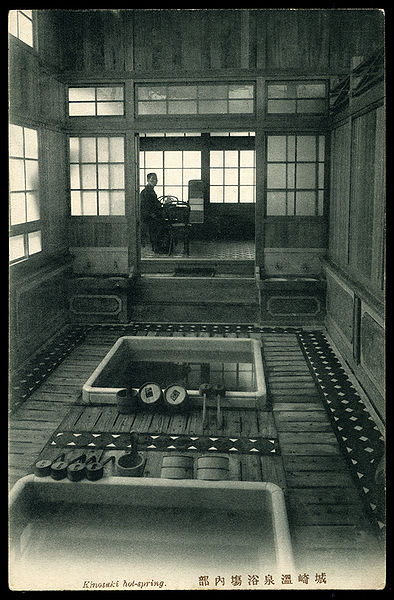
Kinosaki onsen in 1910The water in the tubs is usually not more than knee-deep, so jumping in (head first) is not a good idea. There can be as little as a single tub inside (and sometimes outside), but I have also been to an onsen with 8 bathtubs in total, including two Jacuzzis, two large tubs outside, and one with cold water for after the sauna. When there are more tubs the water often has different temperatures, from the barely lukewarm (or even ice cold if there is a sauna available) to scalding hot for the hardcore onsenista. Take your time and enjoy the hot water as long as you like – or you can stand it!

Once you’re done soaking, you can take another quick shower and get dressed again. The dressing rooms, especially in the high-end onsen, are equipped with hairdryers and seats in front of mirrors; tissues, cotton buds, combs… The only thing that is not provided (and I keep forgetting to bring myself) is body lotion.

To wrap up an onsen evening in true Japanese fashion, there’s only one thing left to do: Have a glass of milk directly afterwards. The Japanese claim that milk drunk after the onsen tastes differently, and many onsen even have vending machines selling milk, but I cannot confirm that. Maybe it’s worth another try?

In general, I find going to an onsen just as pleasant as the Japanese, and it’s possible to do it year-round. Although it sounds counter intuitive, even in the summer going to an onsen is a very refreshing experience. Of course, it is much more pleasant to do it during winter time, when you can slip outside in the snow, freezing with only your towel, and then enjoy the falling snow from inside the hot tub…

Haori

I have to admit that in my Wednesday post about the flea market, I committed the sin of omission. The soroban (which I have put to good use for the first time in today’s class) was not my only purchase. I also bought a haori.

A haori is a kimono jacket that can be as short as waist length but usually goes down to about mid-thigh. Traditionally, it was made in black silk with white family crests on the back and the sleeves, and was worn by men only, together with their standard outfit of kimono and hakama. With the big changes in the Meiji period, however, they became fashionable for women also, albeit in much more fancy colours. I have heard that haori were often made by simply cutting off an old kimono and thus removing damaged parts, for example at the hem. As a haori is a jacket, it is not meant to close in front as a kimono, but is merely held together by two simple ties called haori-himo. The black, most formal haori for men are held together with white haori-himo with a big, feathery tassel in the middle.

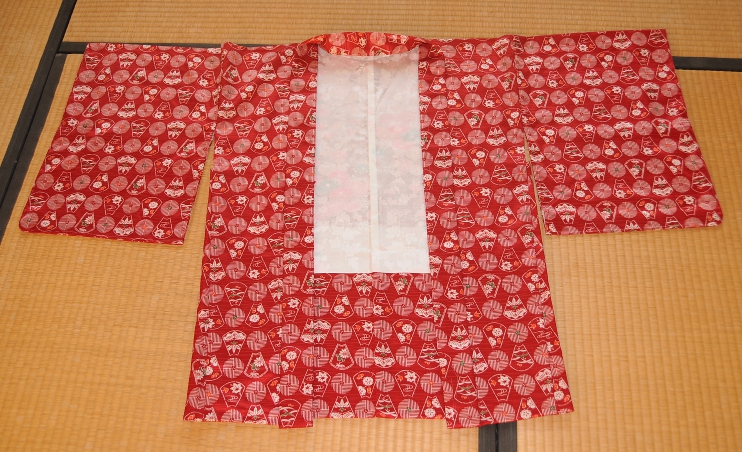
red haori Above is a picture of my brand new second hand haori, made of red silk with a somewhat geometric pattern (yeah, the nerd in me…) and with white lining and long sleeves. It is beautiful, and I hope that it is rather warm as well – it is surprisingly heavy, after all.

Equinox

Today was a public holiday in Japan, the Autumnal Equinox Day or Shubun no Hi. Nowadays the idea is to say thank you for the harvest, a sort of thanksgiving. The holiday is a modernized version of what was called Shu Ki Koreisai, a day to pay respects to past emperors and the imperial family in general, introduced in 1878. And this day in turn probably goes back to ancestor worship in China. Note that the spring equinox is also a national holiday in Japan, with the same idea behind it.

When I was finished with my daily Japanese lesson today, I betook myself to a very small local matsuri in Omiya street, near the crossing with Imadegawa. It is in the old district of the weavers and cloth makers, and you could go into some of the old merchant’s houses and have a look. They are beautifully restored and many old pieces of furniture were on display, together with some of the traditional tools they were using. The houses had a room or two in front that once featured as a shop, then there was a small Japanese garden, and a narrow corridor next to it would lead to the private rooms at the back.

In several houses beautiful kimono were on display, and in one of them, I could watch a kimono painter at work. He was a man of at most 60 years, working in what is called the yuzen dying technique, and he explained that each of his kimonos consisted of 30 meters of silk (strips about 40-50 centimetres wide) and that one hand painted kimono needed 15 different steps of handiwork until its completion. Apparently the price for his garments is reasonable, considered that all of the work is done by hand, but I did not dare ask for a number. Unfortunately he did not answer my question as to how many hours of work one such kimono would need. It seems however, that the demand for this type of work is steadily on the decline, first because people don’t wear kimono anymore, and if they do for a special occasion here or there, the price is probably prohibitive in any case.


Abacus and Sword

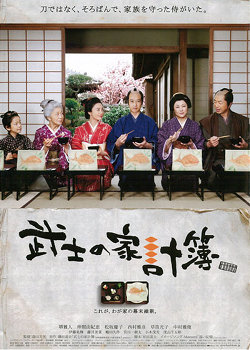
Japanese movie posterThe Inoyama are samurai who for generations have been in the service of the Kaga clan. Their weapon of choice, however, is not the sword but the soroban – they are expert accountants. The current head of the Inoyama family at the beginning of the Meiji restoration is Naoyuki who is called, both derogatorily and admiringly, “Mad Abacus”, for his extraordinary gift with numbers, cultivated since childhood. His pedantic nature allows him to uncover a conspiracy over disappearing rice, but, as is the fate of so many whistle blowers, he falls from grace…

From then on, the Inoyama family learns what it means to be poor, and as Naoyuki refuses to borrow money, their descent into rags is inevitable. Their struggle is not without funny moments, and in the background there is always the clicking sound of the soroban.

Abacus and Sword (Bushi no kakeibo), 2010,129 min.
Director: Morita Yoshimitsu
Cast: Sakai Masato, Nakama Yukie, Matsuzaka Keiko

This movie ties in perfectly with last Saturday’s post. ๐Ÿ˜‰ Also, how Naoyuki and his family make ends meet is timeless and some of their methods to save money, although very harsh, seem applicable even today. It’s not all about economizing though. The Inoyama never lose their humour to make the best out of everything, and not for a single moment do they betray their heritage as samurai. The film is based on the book by Isoda Michifumi.

Unfortunately I could only find Japanese versions of both the book and the movie – they are available from amazon, if anyone is interested.

Yugoya

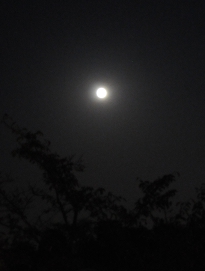
moon over osawa pondYesterday was full moon, and this particular one on August 15th in the lunar calendar, the harvest full moon, is said to be the brightest and most beautiful of them all, and this fact drives many Japanese out to moon viewing parties. There were numerous yugoya events throughout Kyoto last night, some of them with green tea being offered, koto-recitals, or similar. However, we chose to go to Daikakuji and its pond as it is considered the best spot for yugoya. The area around the temple is still rather rural – I walked through rice fields on my way there – and the city forbids development, so the nights are dark and quiet, just perfect for moon viewing.

Daikakuji is one of the big Buddhist temples in Arashiyama, the westernmost part of Kyoto. It was built as detached palace for emperor Saga, and in 876 he designated it to be converted into a Shingon Buddhist temple. The origin as palace is still palpable throughout the compound: beautiful gardens lie between spacious buildings which are lavishly decorated and have amazing paintings on their sliding doors. A large part of the buildings can be visited, and yesterday at dusk, especially the old gardens made a deep impression on me. Then there is Osawa, a large lotus pond, next to the temple, which was specially laid out to resemble lake Tungting in China.

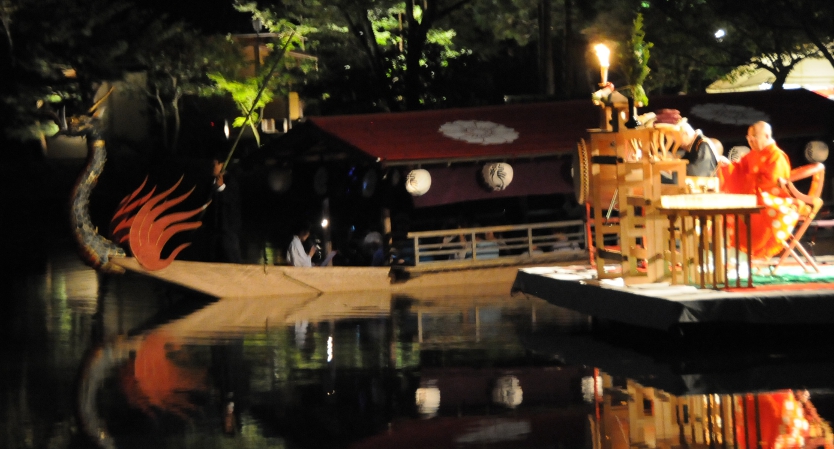
And this pond is what draws people to Daikakuji for the yugoya: Large boats cruise the pond, quietly pushed with bamboo poles, and a ride on one of those, away from the noisy people on shore, with lots of time to contemplate the moon, must indeed be quite an experience. Unfortunately, an experience we were not able to make, because by the time we arrived at the temple, all boats were sold out already.the ceremony with dragon boat in the background

Anyway, we took our time to see the palace/temple and at 6:30 a ceremony started with a long procession of priests taking their place on a platform prepared in the lake, the altar in the direction of the full moon, which had already risen by that time, and did look very beautiful indeed on the cloudless sky. It was an interesting mix of Shinto and Buddhist rites, with shrine maidens and Buddhist priests, something I have never encountered before. There were drums and cymbals, and the ceremony ended with a reading (or rather: chanting) from one of the Buddhist main texts.

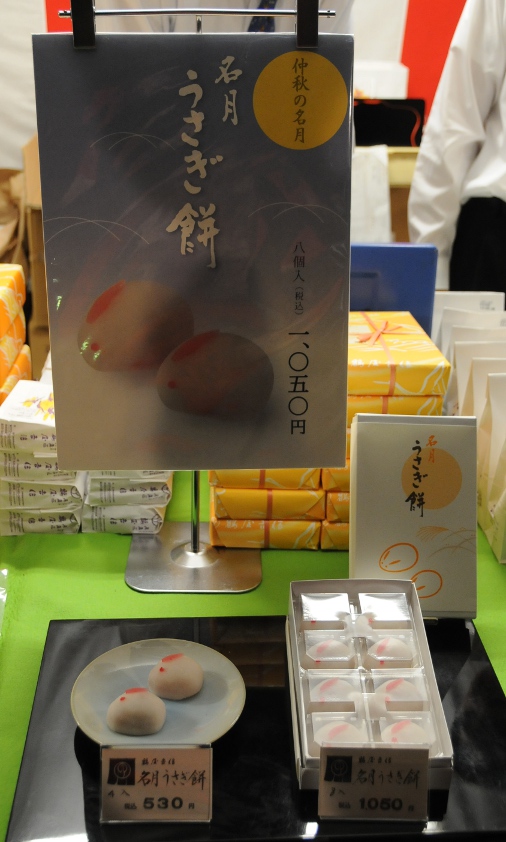
Afterwards, we turned our attention to the food stalls on the shore: Takoyaki, udon and soba, traditional Kyoto style mochi called yatsuhashi and slightly modernized ones with strawberry filling, beer, soft drinks and shaved ice… But of course, special days call for special treats. For example, there are round white mochi with a strip of anko – red bean paste – across them, meant to resemble the moon behind a cloud. More appealing to me, however – remember that I don’t really like anko – were the little sweets in shape of white rabbits. Rabbits? Well, according to Asian tradition, there is a rabbit living in the moon…rabbit shaped sweets for yugoya

Soroban

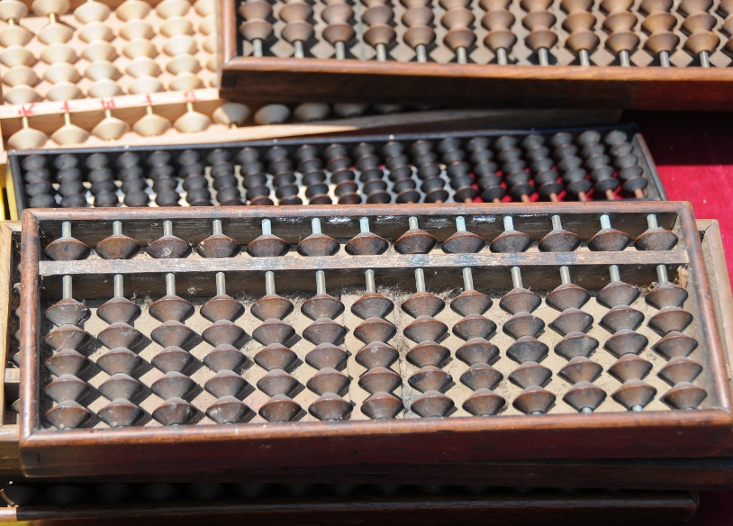
Today was my fourth soroban class. “What ” I hear you ask, “shouldn’t you study Japanese instead of something random?” Well soroban is indeed Japanese, it is the Japanese type of abacus. old style soroban at a fleamarketThe history of the soroban (lit. counting tray) goes back around 400 years, when the Chinese version of it, the suanpan (which itself is about 1800 years old) was introduced to Japan. Japanese merchants were the early adopters and had been using it since then, but it took until the 17th century for it to become popularly known, and Japanese mathematicians started to study it in depth and improve its workings. Only in the early Meiji period, i.e., at the end of the 19th century, did the soroban take its modern shape and has been unchanged ever since. Even today how to use the soroban is taught in primary schools, and you even need to pass a soroban exam to qualify for work in public corporations.

Each soroban has a number of vertical rods or columns, each representing one digit, with five beads each. The beads are separated by a single horizontal reckoning bar into one go-dama (5-bead) on top and four ichi-dama (1-beads) at the bottom. Clearly, the more rods, the more powerful the computations that can be performed. Soroban always have an odd number of rods, the standard size has 13, in class we use soroban with 21, and my teacher gave me a small one with 11 rods to practice at home.

The basic operations of course are the same, regardless of size. The centre rod represents the one digit, the first rod to the left the 10 digit, the rod yet one further to the left the 100 digit, and so forth. To the right of the centre are the 1/10th, 1/100th, 1/1000th… rods. The four ichi-dama beads at the bottom each count as one, the go-dama bead on top counts as five, but only when they touch the reckoning bar. So, to practice a little, can you read the number below?The soroban shows 19602.05

The beads are operated, i.e., flipped up and down, with the thumb and forefinger of the right hand. The go-dama on top is both added (moved downwards) and subtracted (moved upwards) with the forefinger, whereas the ichi-dama at the bottom are added (moved upwards) with the thumb and subtracted (moved downwards) with the forefinger. Not only this, but also the order of the movements is strictly prescribed, the reason for this is simply to increase the speed of the calculation.

There are several ways of adding and subtracting numbers, depending on how many beads are used already on the rod. Here, the concept of complements plays a very important role for computations on a soroban. For example, adding 7 can be done by

  • adding 7 to a single rod (by pinching the go-dama and two ichi-dama together simultaneously), or
  • adding 2, subtracting 5, and adding 10, or
  • subtracting 3 and adding 10.

So far, addition and subtraction are all I can do. The concepts are easy, but it takes a while to do the finger work correctly (and fast), and sometimes, when I am all stuck in thinking about complements, I completely forget about the easy way of addition or subtraction – by simply sliding the right number of beads up or down…

Anime

Last weekend, a friend and I stumbled upon a manga-anime fair. According to this article, it was the annual manga-anime fair that took place in various places in Kyoto, and its main purpose was to recruit new animators. I guess however, that most visitors there were simply fans.

It was an interesting but at the same time somewhat weird experience. The booths were covered in large pictures of anime characters, from cute girls to manly warriors and space captains to scary robots. There were also many flat screens showing the latest episodes of their anime. Some booths had merchandise for sale, others sported several attendants, mostly young, female and dressed accordingly, that is to say, rather scantily. But also the visitors were interesting to watch – a number of them wore the attire of their favourite manga character, regardless of gender: I have seen one guy dressed up as a female anime, short skirt, stockings, and a pink wig included. The booth I found most interesting though, was one where two women were painting a scene; one in the traditional way with watercolors, the other one on a large tablet.

warrior with helpersAnime and manga are an enormous business in Japan. Large sections of bookstores are devoted to all sorts of manga, ranging from well known characters for children like Doraemon, to stories of all sorts for teenagers and adults (there are manga and anime about martial arts, history, cooking!…) to the sexually explicit hentai for the … um … connaisseur (to be perused at leisure in buses and trains). Many people even use manga to study Japanese. The industry’s internet advertising revenue is more than 180 billion yen, and 70% of all DVD’s sold in Japan are anime.

Personally however, I have to admit that I don’t quite get it, certainly because I did not grow up in this culture. I mean, I do fondly remember the series Heidi, Perrine, or Captain Future of my childhood (yes, all of them were produced in Japan, Biene Maja also), but at some point, well … I grew up. Whether that was a good thing or not I am not entirely sure ๐Ÿ˜‰