Last Monday, suitable for the Culture Day, there was a traditional event that goes back about 1000 years, centred on one of Japan’s favourite pastimes taking place in Jonangu shrine which is equally old and lies in southern Kyoto. The event is called kyokusui-no-en and it is a kind of poetry game or competition involving multiple poets, a little stream, and enormous amounts of sake.
The idea is as follows: A number of poets sit on the banks of a little stream that flows through Jonangu shrine. They all have to compose a tanka – a poem of exactly 31 syllables – on a predefined topic, in a predefined amount of time. How long they have is determined by the stream and the sake: Little sake cups are released upstream and when they reach the last person, the poets must be finished, and then all the poems are read aloud.
I arrived at the shrine – after a trip of 90 minutes, and I hadn’t even left Kyoto just yet – about one hour before the event started. The shrine is very large and has two beautiful gardens with stones and trees and big koi ponds and streams in between. It seems that the cherry blossoms are famous there, but even now the gardens are a beautiful sight. When I arrived at the appropriate part of the garden, I was surprised to see that benches had been set up for the spectators, not just for the honorable paying guests, but for all of us. Never before did that happen, maybe the event was just the right size for this to be feasible.
Another nice surprise were five ladies giving a little koto concert before the main event started. Usually, the spectators are expected to wait in silence until the start of the main performance, but I think everybody was pleasantly surprised. The koto is a traditional Japanese instrument, but they played comparatively modern songs – they had a melody…
The main event – I’m still undecided whether to call it a ceremony, a game, a competition… – started at one o’clock with all the participants, all dressed beautifully in elaborate Heian-style costumes, entering the garden from the main shrine building: First a few attendants from the shrine, then traditional musicians and a dancer, then the seven poets who would take part in the game, and two children who carried long bamboo sticks and were charged with an important role during the game. I’ll get to that in a moment. 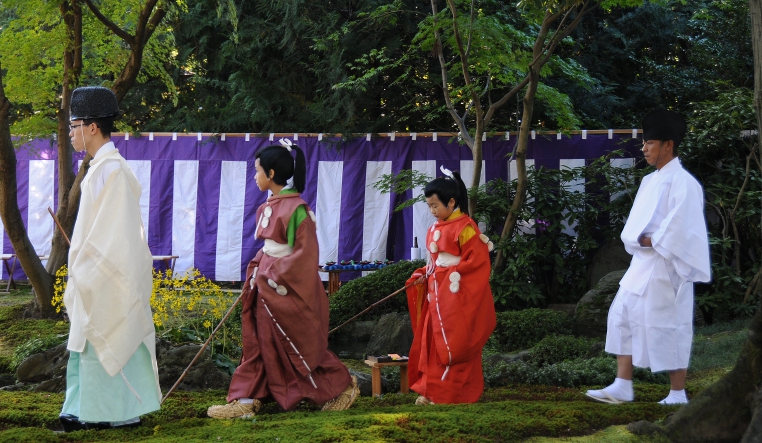 First, there was some traditional Heian-era court music, thankfully short, and a dancer gave a performance, with traditionally prescribed movements, all executed very precisely, and certainly with a lot of meaning behind each gesture, decipherable only for the initiated.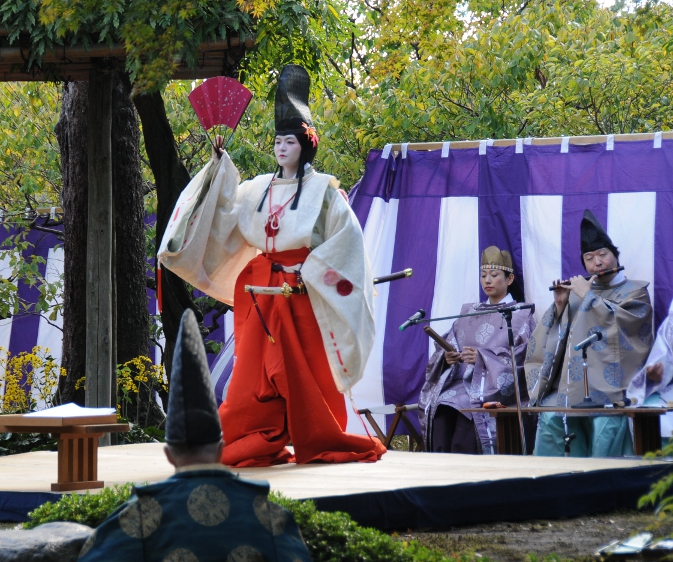
Then, the seven poets were shown a scroll – I assume that the topic of the poem they had to compose was written on it – and then they took their places along the little stream. 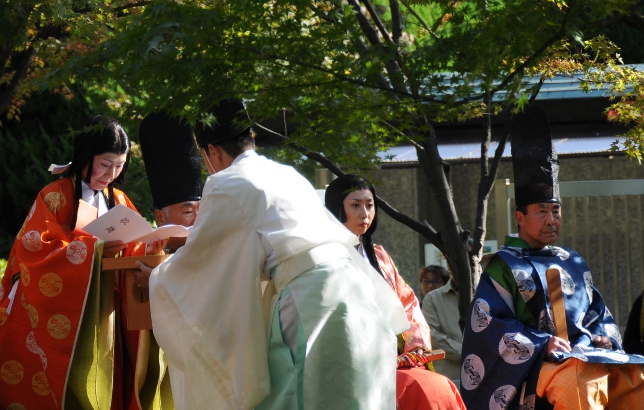
On each place there had been prepared a little cushion and a tiny table with writing utensils: ink, brush, and paper. When they were settled and ready to write, the first cup of sake was released upstream. 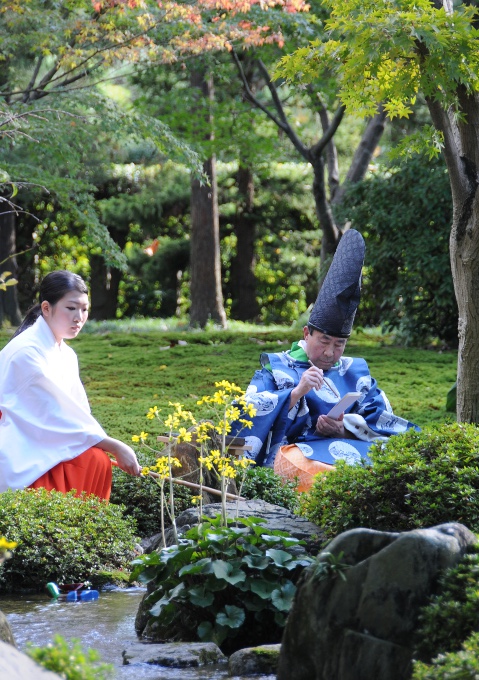
The cups were mounted on little duck-shaped boats and, as the stream was rather rapidly flowing, they picked up quite some speed. Probably because of that, there was not a single sake-duck released, but quite a number of them, although I could not count them from my vantage point. I did notice, however, that, although the stream was comparatively broad, that sometimes the little ducks would get stuck, and this is where the two children came in. With their long bamboo poles they were supposed to help the sake on its way, and they did so by wandering around the stream and the poets with earnest faces and a grave manner.
When the last sake duck had reached the last poet, all poems were collected. A group of five men dressed like priests would sit down on the platform where the dancer had given her performance before, and then would read each poem. First, the name of the writer was announced (and probably also the poetry school he came from, but I am guessing here) and then the poem was read once by one person, and then by all of them, both times in a kind of chant, as I have seen before at religious ceremonies. Obviously the topic had been somehow related to autumn, I could make out words like trees, colours, leaves, autumn, momiji…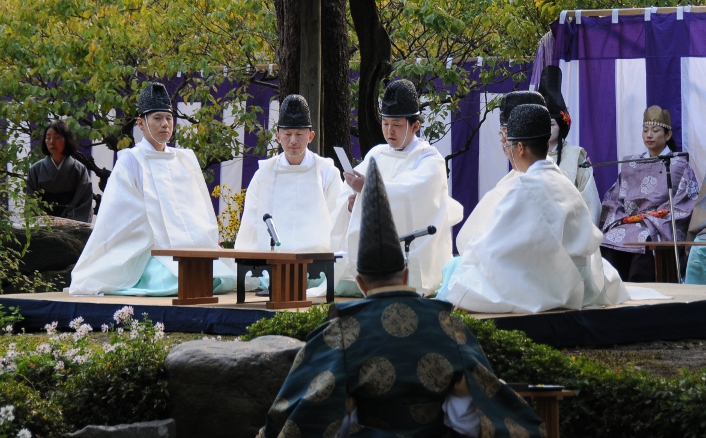 During the reading, more sake was sent down the stream, and this time I could see some of the poets drinking a cup or two. Howver, most of the sake was probably imbibed by the koi in the next pond… Anyway, after all the poems were read, the poets, dancers, and musicians left the garden. I thought there would be an announcement of a winner, a best poem nominated, but I was told that was not the purpose of the meeting. I know, however, that in the Genji Monogatari (*), where this game was already mentioned, there was always talk about people writing good and bad poems, so I think that in the olden days, there was probably lots of judgement going on…
 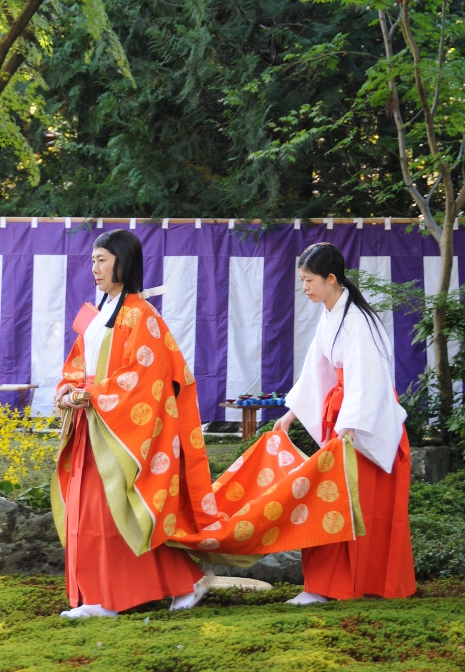 After the poets had left, there was a purification ceremony at the same little stream. People were invited to buy a little piece of paper in the shape of a man or woman, handle it in a prescribed way and then release it into the stream, to the incantations of a priest. Again, the two children were there and gently used their bamboo sticks to guide the prayers and wishes on their way.
(*) The Genji Monogatari, the Tale of Genji, is one of the oldest Japanese novels, written in the 11th century by a lady in waiting on the Heian court. Apparently, the game had already taken place then in the same shrine as now.