Efficiency

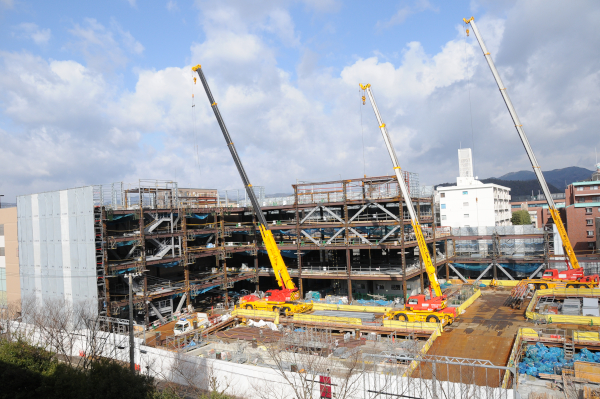
As you all know – because I have complained about it often enough – there is a construction site next door, where the shopping mall is enlarged considerably. Every time I pass by, I marvel at the efficiency of the work crew and how quickly they are getting things done. By now they are starting to erect the steel frame, and they are very fast in doing so. I took the photo below last week, and they have already put up a new section.

One of the guys guarding the gates knows me already and we chat every now and then when I try to get a closer look. He said that the new mall is supposed to open in December this year, and by the looks of it, they are going to achieve this.

I wish I could be just as fast and efficient as they are. Guess I need to work on that a bit more…

Construction Site next door

Work-Life Balance

I’m very sorry for skipping posts again… I was terribly busy the last two weeks, working for 10 hours and more each and every day, so I’m afraid I had to drop a ball or two. But the big deadline was yesterday and now I have a little more time to breathe – in fact, I even took today off – so I hope I can get back to writing here on my usual schedule.

cogwheelsApparently, my absence raised concerns with some of you, because in the weekend I received an email from a friend of mine who essentially said she was hoping I was just busy and otherwise alright. And then she popped the question: “I was wondering if you have a strategy as to how to balance work and life…”

And I thought: Hey, YOU have that cushy 9-to-5 job with weekends off, mandatory holidays and a fixed paycheck at the end of each month, and you’re asking ME about life-work balance? I am literally spending 90% of my waking hours in front of my laptop and didn’t have a day off in 3 weeks and I am your go-to person for this question? You must be kidding me!

But then she went on to say that she’s taking her work home in the form of worries of the “will this turn out okay” variety, and that is indeed an issue I have struggled with myself, in particular during my time in academia. The point is that I am rather perfectionist, and I have troubles getting things done to the standards I set myself, so often it was a problem of “why even bother doing this if you can’t do it right anyway”. And during my time off, I felt guilty for not doing my job properly, so I felt I didn’t deserve that time off. Interestingly, now that I am essentially self-employed, I find it much more easy to satisfy a client and work to their deadline (and standards) rather than doing the same for my own projects, even though they are more important in the long run.

So, I talked about this to a therapist, and the answer was essentially that I put myself under too much pressure to perform at work and that I may have deficits in my private life when it comes to spare time activities, friends, etc. He also said “Sometimes the psyche sabotages because she wants to satisfy her own needs.” 

The answer was spot on. I’m an introvert, which makes it very easy to neglect the human interaction part (“I don’t really need people anyway.”) I thought about this for a while and then implemented a no-computer-day once a week. I could do anything, just lay in bed reading, or cleaning the apartment or going to a museum, or seeing friends, just as long as it didn’t involve the computer.

The important part here was not what I was doing, but to give myself permission not to work and not to worry about it because tomorrow will be early enough. I think this was the main part that helped me relaxing about work and not obsessing about it constantly. The result was that I am now more focused at work so I can get much more done and at the same time, I fully enjoy myself on my days off.

I hope this is useful to my friend, it’s a bit hard to describe what I did, but I have eased up considerably about work. I do what needs to be done, and then I move on and shut down my brain. By now, I can even handle using the computer on my days off, and even though I have been very busy for the last month, I don’t feel as emotionally drained as before. Good luck with it!
The Pillow Book

The Pillow Book
Sei Shonagon

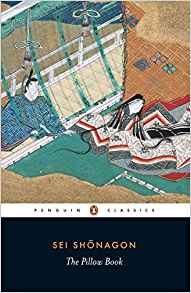
Cover of "The Pillow Book"The Pillow Book is hard to describe. It is an ancient diary, not a novel, so there is not much plot. The entries are undated and although there are references to this or the other festival in this or the other season, it is hard to get a feeling of the flow of time. On the other hand, the little entries tell of a time and place so strange, that whatever moved the writer at her time seems to come from an entirely different universe and sounds like fiction after all. The individual entries talk about the routines of daily court life, interesting outings to festivals, and there is gossip of course, about friends, foes, and lovers alike.
The book is very strange, and every time I read it, I feel differently about it. Her stories, although they seem trivial at times – as diary entries are bound to be – still have an eerie way of drawing you in. I don’t know much about the customs of that time, but I wonder what people with a better understanding of them think about The Pillow Book.

Sei Shonagon (c. 966–1017/1025) was a court lady of the Heian court in Japan at about 970 – 1020. She began writing The Pillow Book when she received a book of fine writing paper as a gift, and her diary ends when the paper was used up. Her little vignettes tell of a time long gone and of strange customs that even at her time only a few people were privy to.

Go find out for yourself and get your copy from amazon!

Winter Greetings

Japanese written correspondence is different from what is done in the West, and it often much more formalised as well.

Take the well-known nengajo New Year’s cards for example. You send them to basically everyone you know or who has done you a favour in the last year, and express your hope of continuing new relations for the year to come. If you send them on time (between December 15 and 25), Japan post will take care that they are delivered on January 1st.

When people are in mourning, they are not supposed to send (and receive) nengajo, so they send mochu hagaki mourning cards in the beginning of December to alert everybody of the situation. I did that with my friends last year, even though they all knew that my grandmother had died and would not have sent me a nengajo anyway.

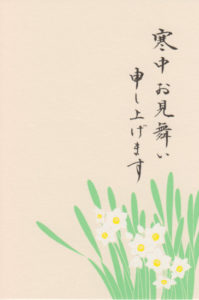
Instead of nengajo, people often send so-called kanchu mimai winter greetings during January. They are slightly less formal and can be sent for any reason really, but still should be sent some time before Setsubun in the beginning of February. This year, I am sending kanchu mimai to all the shrines I visited as a highlight in 2018. A friend of mine suggested this instead of sending nengajo, partly because of the mourning part (even though the shrines would not know that) and partly because she thinks that they would probably receive hundreds (thousands?) of nengajo, and mine would go under.

kanchumimai winter greeting cardSo, I have bought a pack of kanchu mimai cards with a simple design with spring flowers, and as customary, my greetings will go on the front of the card. I asked my friends what to write, and I chose something very simple and short, so that it won’t take hours to write all this. I am not sure I will be able to get it done this week, we will see.

By the way, there is an equivalent card for summer, a summer greeting, called shochu mimai which can also be sent for any reason, really. Interestingly, the idea of sending postcards from holidays has never caught on in Japan, maybe because their holidays are so short anyway? In these instances the Japanese prefer to bring small omiyage presents.

Pressure

Japan’s societal rules put a lot of pressure on individuals. On women more than on men. The country is still very patriarchal, and male-female equality is not something that comes easily to the guys in charge. One very recent incident is now stirring up the media as well as people in Japan, I’m simply posting a link here, so you can read the story of Yamaguchi Maho yourself.

https://ohnotheydidnt.livejournal.com/113542530.html

Transition

As you probably know, this year, Japan will have a new emperor. The current one – the Heisei Emperor – will retire on April 30th, and his son will ascend to the throne on May 1st. There are many preparations for this event, some things are known already, and others have yet to be decided.

It is known that the retired emperor will receive the title Jōkō, which means “retired emperor” and he is the first to hold this title in almost 180 years. It is not known if he will stay in Tokyo or not, although Kyoto people do (more or less secretly) hope that he might come to live in the palace here.

It is known that on April 30, the Heisei Period will officially end, but it is not known which name the new era, starting on May 1, will have. This will be announced on April 1st, and for practical reasons, it is unlikely that the new era name will start with a T, S, or an H.

It is also already known that, on occasion of the enthronement of the new Emperor, there will be 8 national holidays in a row, from April 29 – May 6. That’s because the change will take place during Golden Week, where there are already several holidays to begin with.

  • April 29 is Showa Day, in remembrance of the father of the Heisei Emperor
  • April 30 is a “Sandwich National Holiday” because, according to Japanese law, all work days falling between two national holidays are automatically national holidays as well.
  • May 1 is a Special National Holiday because of the ascension of Still-Crown Prince Naruhito and the celebrations for the occasion
  • May 2 is a “Sandwich National Holiday” like April 30.
  • May 3 is Greenery Day, the first day of Golden Week
  • May 4 is Constitution Day, also part of the Golden Week
  • May 5 is Children’s Day, the last Golden Week holiday
  • May 6 is a “Happy Monday Holiday” because, according to Japanese Law, all National Holidays falling on a Sunday will be celebrated as a day off on the following Monday.

Add to this the weekend before, and (most of) the Japanese are looking at 10 days off in a row.

The ceremonies are not over at this point, the real enthronement will take place only on October 22nd and will probably involve a very private and secret ceremony at Ise Shrine, the highest ranking shrine in Japan.

Already now, ceremonies are being held since this year is the 30th anniversary of the current emperor’s enthronement after the death of his father in 1989. There is a large exhibition organised by the Imperial Household Agency that shows photos of many of the Heisei Emperor’s visits to Japanese and foreign cities, as well as gifts received at those occasions. Also on display are the traditional clothing worn by the current emperor and empress at their enthronement ceremony 30 years ago.

If you are in Kyoto, this very popular exhibition is taking place at the Takashimaya right now, and definitely worth a visit.

Mochitsuki

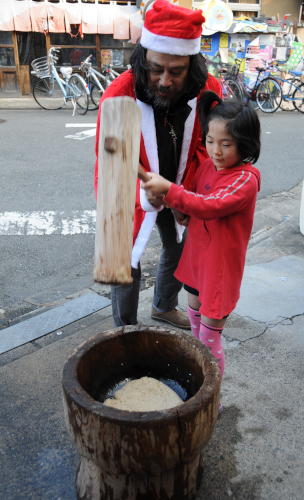
One of the really fun things that happen around New Year is mochitsuki – literally: beating of the mochi – where lots of people pull together and help making mochi.

Mochi are ricecakes, made out of a very sticky rice, that is first boiled and then put into a large mortar (usu) and beaten with large wooden hammers (kine). Once the mochi is finished, the individual rice grains have been broken up, and the whole thing takes on a sticky consistency. This large piece of mochi is then broken up and divided among the participants of the mochitsuki to take home or eat rightaway.

MochitsukiYesterday, there was Seijin-no-hi, the national holiday “Coming of Age Day”. And for some reason that I have not quite figured out, the guys at the large construction site in the neighborhood had organised a mochitsuki. They stopped working in the early afternoon to set everything up, and everybody who wanted was invited to come in and help beating the mochi.

Of course, adventurous me had to try that! I went there and immediately got a wooden hammer (for lack of a better word) put in my hands. It was surprisingly heavy, which makes sense because it is supposed to do some damage after all. And then, me and one of the guys from the construction company were beating away alternatingly. It was not very difficult and I can see that if you manage to find the right rhythm, you can probably go quite a long time. If you are trained, that is, which I am not… but it was fun nevertheless, and I did get some 10 or 15 beats in – which earned me great respect among the guys.

Afterwards, I was invited to soup and mochi, of course. The freshly produced mochi were served with daikon radish and soy sauce, and, as a sweet option that is apparently eaten only during New Year’s, with kinako soy flour, which was surprisingly sweet. And finally, I could take home a whole pack of mochi, which I still have because I have to ask if I could technically put it into soup as well.

Anyway, I had fun – and free lunch – and this was the closest I could get to the construction site. By now, they finished the basement and are now on ground floor level, and about a quarter of the building has already the steel beams completed. It will be interesting to see them grow further, if I remember correctly, they want to be finished by the end of the year.

Making a Katana

This here is a really interesting video about how to make a katana, a traditional Japanese sword. The guys from “Man at Arms” start out with getting and melting the iron ore, and then show all the steps necessary to forge a katana. I’ll leave it to you to discover the intricacies, I surely learned something new!

Don’t be put off by the Kill Bill reference, I guess they just needed an interesting hook for the video. 😉 The video is 18:40 long and safe for work. Enjoy!

Ranting

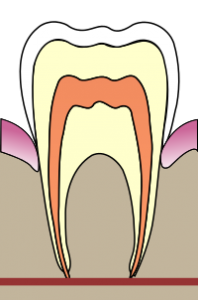
schematic of a toothWhat is wrong with Japanese dentists? I have been living here for five years, and I’m already on my third dentist. and now it seems I need a fourth! I am not complaining about the work they are doing, it’s not as if I could judge that anyway. My teeth are functional, and they do not hurt, so I guess they are fine from a technical professional point of view.

The problem is that they appear to have serious troubles with ethical behaviour towards their patients. Let’s examine the evidence provided by my three dentists:

The first one I went to went with me into the tiny X-ray room, and while putting the lead apron on me said: “You are a beautiful woman”. Don’t get me wrong, I’m not one of those #metoo crazed women who scream sexual harassment at every corner and would now need 15 years of therapy to get over this incident. I like men, and I like receiving compliments. However, I don’t like getting them in an inappropriate situation like this, where I am not free to respond in any way I might wish to. I let dentist #1 fix the broken tooth and did not return.

The second one I went to – an expensive private doctor – loved his “treatment plans”. You would go there with a problem, and after having a close look at it he would come up with a written, English (!) treatment plan that you had to sign before he would start the procedure. Nothing wrong with that – if you have the possibility to decline. Which there wasn’t. Because once he had handed you your personalised treatment plan with your name on it plus a pen, the doctor would leave you in charge of his assistant, who barely spoke English and couldn’t really answer any follow-up questions. I signed one treatment plan, but did not let me bully into agreeing to another one.

When I found the third one, he seemed to be quite alright, and I have gone there for several procedures. The only annoying thing was that everything took at least three visits, but that’s a minor thing. The last time I went, I had another broken tooth requiring an inlay. I also told him that I had lost a filling a while ago and that I wanted this one fixed too. he looked at it and said it was an easy “drill & fill” job. First of all, I had to more or less force him to it on y third visit instead of having to come again. And what I got was this: A new filling replacing the lost one. Plus a replacement for the filling of a neighboring tooth that had nothing wrong with it other than being made of a type of metal he does not approve of. I did not ask for that. I was not asked about it, either.

So: What is wrong with Japanese dentists?

I believe these three instances are serious ethical issues: sexual harassment, bullying, unwanted procedures. Has “informed consent” not trickled through to Japan just yet? I cannot go to a dentist – or any other doctor for that matter – whom I cannot trust to put MY interests first, after all, this is MY body. How come these people can keep working in the long run? Am I the only patient with these experiences? Am I the only one to complain?

Intimidating

A new year brings new challenges, as usual. You may have noticed that over at What’s up in Kyoto, my monthly highlights for this year will be 12 of the many little museums in Kyoto. There are many serious museums (like this month’s Raku Museum and several others dedicated to one artist, one that focuses on netsuke, one for kimono…) and one or two that are more fun (there is a museum for the wigs Geisha are wearing, and one for nagajuban, traditional underkimono). I will have to go to all of them, introduce myself and try to convince them to let me feature them on my webpage.

neon sign spelling ARTAnd: This time I’m doing this on my own. Last year, with the shrines, I had help from a friend of mine, but she has been busy during Decemberand sent me off alone with a “you can do this!” I can definitely see what she’s doing here, and in a sense, I am grateful. She won’t keep doing me favours forever, and eventually I must be able to handle these sort of things myself.

Another reason for her keeping in the background is more Japan/Kyoto related: She thinks that with my foreigner bonus, I might have an easier time approaching these museums. Many of them are family-run or very small businesses, and they probably like to be approached in the proper, roundabout way by introduction through other people that is so common in Kyoto especially. My friend says that if she goes there, she will be expected to know how to do this, while foreign me can just barge in and say “Hi, here I am, and that’s what I want.” So far, it has worked out fine. I have approached two museums already and they were very forthcoming, and I will visit a third one tomorrow.

While I understand her reasoning, and while the first efforts have been encouraging, it is also hugely intimidating, mostly because I don’t know the proper way to do things. One of my life’s mottos is “Rules are there so that you think before you break them” (courtesy of Terry Pratchett), but an important part is knowing the rules first. And better Japanese would help too. We did prepare documents in both English and Japanese of course, but I still have to explain the procedures and what I’m expecting and everything. And while the Raku Museum had one person communicating in excellent English, I had to fumble my way through in Japanese at the first one I visited. I still believe that most Japanese do understand English better than they let on though.

Anyway, I’ll keep trying. My friend says it’s important to stay friendly and hopeful and make the best out of things. And now I have to think about the questions I will be asking the curator of the Raku Museum in my interview with her on Thursday…