It’s cold in Kyoto – apparently we’re in the middle of gokkan, the extreme midwinter season. Well, it certainly feels this way.
Nevertheless, my friend from Tokyo visited me last Friday, and together we braced against the cold and went on a special tour inspired by Hideyoshi. Toyotomi Hideyoshi (1536-1598) was the second of the three great unifiers of Japan, and even though his family ultimately did not retain power, many of his reforms were taken over by the following Tokugawa Shoguns and considerably shaped the Edo period.
Hideyoshi himself spent enormous sums on restoring Kyoto to its glory after most of it was destroyed in the Onin Wars of a century earlier and/or in the Sengoku period that ended with his unifying the country. It is therefore quite easy to find Hideyoshi’s legacy in Kyoto. My friend and I, however, went all the way to find his tomb.
After his death in 1589, Hideyoshi was interred according to his wishes on top of Amidagamine mountain, and below, a huge shrine was built in order to worship him. Once the Tokugawa’s power was cemented in 1615, however, the shrine was destroyed and only the tomb remained. Some 300 years later, both shrine and tomb were restored, and they can be visited.
And that’s what we did; we first went to the shrine and afterwards, all the way up the mountain to see Hideyoshi. More than 200 steps lead to his impressive tomb, and even though the day was rather cool and we walked quite slowly, it was exhausting. The tomb itself is from 1898, a huge five-tier pagoda-type stone monument which, interestingly, bears no inscriptions at all. Only in front, a little altar where people left money, sake, and other offerings, showed the Toyotomi family crest.
It is said that Hideyoshi wanted to be buried there so he could see Kyoto forevermore. This may have been the case in his day, but now the trees are too high to see anything from his tomb directly. On the northern side, however, is a clearing that allows a peek over the city, including a truly special viewpoint over Kiyomizudera Temple.
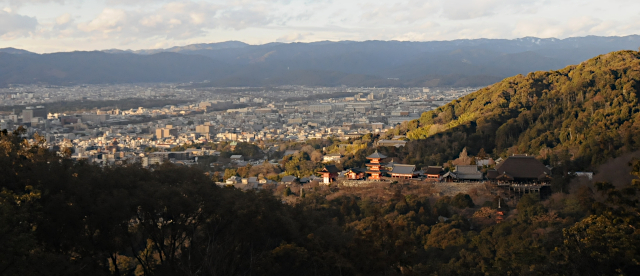
My friend asked the one important question: Was the temple there in the 16th century? Yes, kinda. It was founded in 782, but burned down during the Onin Wars. Only the third Tokugawa Shogun rebuilt the main hall, so the temple as you can see it here dates back to roughly the 1650s.
It seems that many Kyoto people don’t know where Hideyoshi is buried. This may change, however, since the 2026 NHK Taiga drama is called “Toyotomi Kyodai – Brothers in Arms” and tells the story of Hideyoshi and his younger brother Hidenaga. Maybe something to watch?