Visiting Hideyoshi

It’s cold in Kyoto – apparently we’re in the middle of gokkan, the extreme midwinter season. Well, it certainly feels this way.

Nevertheless, my friend from Tokyo visited me last Friday, and together we braced against the cold and went on a special tour inspired by Hideyoshi. Toyotomi Hideyoshi (1536-1598) was the second of the three great unifiers of Japan, and even though his family ultimately did not retain power, many of his reforms were taken over by the following Tokugawa Shoguns and considerably shaped the Edo period.

Hideyoshi himself spent enormous sums on restoring Kyoto to its glory after most of it was destroyed in the Onin Wars of a century earlier and/or in the Sengoku period that ended with his unifying the country. It is therefore quite easy to find Hideyoshi’s legacy in Kyoto. My friend and I, however, went all the way to find his tomb.

After his death in 1589, Hideyoshi was interred according to his wishes on top of Amidagamine mountain, and below, a huge shrine was built in order to worship him. Once the Tokugawa’s power was cemented in 1615, however, the shrine was destroyed and only the tomb remained. Some 300 years later, both shrine and tomb were restored, and they can be visited.

And that’s what we did; we first went to the shrine and afterwards, all the way up the mountain to see Hideyoshi. More than 200 steps lead to his impressive tomb, and even though the day was rather cool and we walked quite slowly, it was exhausting. The tomb itself is from 1898, a huge five-tier pagoda-type stone monument which, interestingly, bears no inscriptions at all. Only in front, a little altar where people left money, sake, and other offerings, showed the Toyotomi family crest.

It is said that Hideyoshi wanted to be buried there so he could see Kyoto forevermore. This may have been the case in his day, but now the trees are too high to see anything from his tomb directly. On the northern side, however, is a clearing that allows a peek over the city, including a truly special viewpoint over Kiyomizudera Temple.
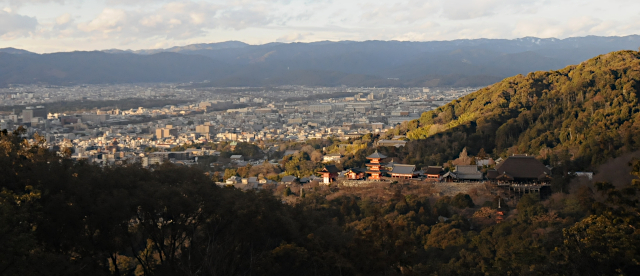
My friend asked the one important question: Was the temple there in the 16th century? Yes, kinda. It was founded in 782, but burned down during the Onin Wars. Only the third Tokugawa Shogun rebuilt the main hall, so the temple as you can see it here dates back to roughly the 1650s.

It seems that many Kyoto people don’t know where Hideyoshi is buried. This may change, however, since the 2026 NHK Taiga drama is called “Toyotomi Kyodai – Brothers in Arms” and tells the story of Hideyoshi and his younger brother Hidenaga. Maybe something to watch?

The Kamogawa Food Detectives

Hisashi Kashiwai

Nagare Kamogawa and his daughter Koishi run a detective agency of a special flavour: From their inconspicuous little restaurant, they track down lost recipes for their clients. Together with the food, they also offer their clients insights into the memories that made the dish so unforgettable in the first place.

This is not so much of a novel, but rather a collection of six loosely connected stories, all centered around a single dish, a single memory. They run the gamut from the funny to the deeply moving, and show how much of our memories are connected to tastes, as well as sights and sounds.

Foodies may want to try and recreate the dishes – from Japanese beef stew and mackerel sushi to Neapolitan spaghetti – and those familiar with Kyoto will enjoy following the Kamogawas on their way through Kyoto’s neighborhoods.

Hisashi Kashiwai was born in 1952 in Kyoto and worked as a dentist. Kyoto city and its neighborhoods features prominently in his writing.

Whether you’re a foodie or a lover of Kyoto, or just somebody who likes escapist little stories, this one’s for you – and available on amazon.

Local Matsuri

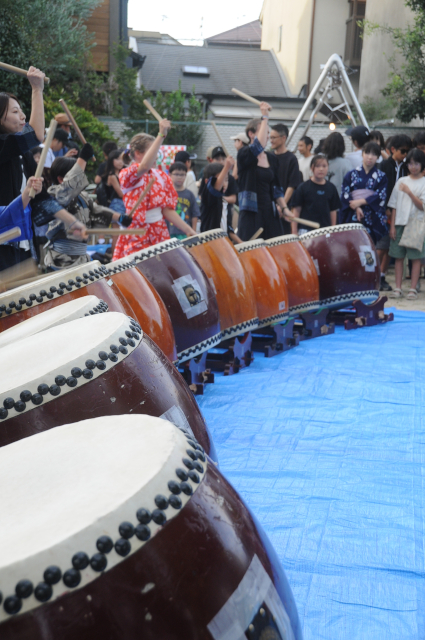
This afternoon, a friend of mine had a taiko performance at a neighborhood festival. The venue was one of those tiny parks/playgrounds surrounded by houses, and the locals had set up booths selling drinks and food (including kakigori) and there were others with games and activities for kids.

A large tarp was set up with 10 taiko drums; the performers were mostly kids from Bati-Holic Kuro-chan’s wadaiko school. They only played three songs, the concert wasn’t perfect, but you could see how everybody had loads of fun, not just the kids playing, but the parents watching too, of course.

I took a few photos and after the concert bumped into another acquaintance whom I met at a Bati-Holic concert. She has now also started up taiko classes and was there as support, as you do here in Japan. We caught up and chatted a bit, and then I went home. On the way, I bumped into my doctor from Kyoto University Hospital. He was wearing his face mask, just like at work (I don’t think I could recognize him without) but he approached me as I waited at a red light.

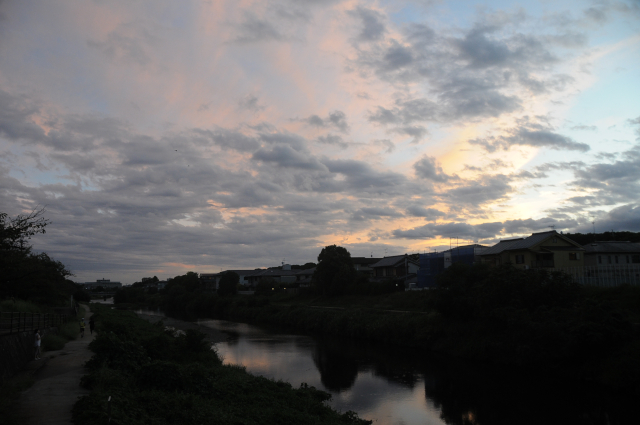
And finally, I bumped into a sunset, well, I was a bit too late. I usually don’t notice it when I’m working, and from my house it’s difficult to watch it anyway. Things are different down at the river. This time of the year is so beautiful.

Flowery Kimono

Yesterday, I went with a friend to the exhibition “Secrets of the Kimono
The Advent of Yuzen Dyeing” currently on at the Museum of Modern Art in Kyoto. Besides numerous kimono created from the Edo period until today, they had maybe 50 “pattern books” from around 1700.

Those are woodblock prints showing kimono designs, and people could use them to order a kimono. All of them were in black and white and didn’t have a huge amount of detail. Many of them had a design centered on plants or floral design.

And my friend could name most of these! For somebody like me who barely knows roses from chrysanthemums, that’s absolutely impressive. If you want to try as well and you’re in Kyoto, the exhibition is until September 15.

End of Summer

Yesterday was Obon, or rather, Kyoto’s Daimonji fires. On five mountains surrounding Kyoto, huge bonfires are lit to send the ancestors back home to the netherworld after their visit to Earth.

For the first time since I moved here, I went to see the Daimonji. Not to the very best spot – that would be too crowded – but just down to the river, where the large “dai” is clearly visible, if a bit from the side. (Old photo below.) As a bonus, I also got to see the two neighboring fires, the “myo-ho”, which are always a challenge to see fully because they are pretty low on their mountains.

daimonji character for "big"

Even though I’m not religious, watching the fires light up is always moving, and I can’t really say why. And I’m not the only one who feels this way. This time, I’ve seen people folding their hands in prayer while looking at the fires, and even small kids are less boisterous than could be expected otherwise. It’s a good feeling, almost like we’re all a big family, united before something bigger, whether we call it god or nature or just death, maybe.

It was drizzling when I was out, and today we had a couple more showers, so I guess summer is over or at least will be taking a back seat for a while. Pumpkin has already started to climb onto my office chair and tuck in behind my back sometimes, but he seems to get too hot rather quickly, so he goes back to sleep underneath my desk.

Time flies – 烏兎匆々(crows and rabbits hurry past).

The World is Always…

Sorry for missing the post yesterday, I was kinda busy going to concerts. Yes, several, on a single day!

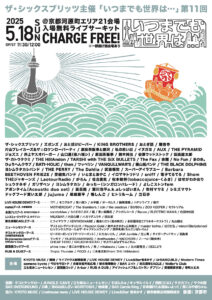
Yesterday, starting around noon, was the 11th edition of the “The world is Always…” (いつまでも世界は…) music festival. This year, there were more than 120 bands and solo artists performing in 21 venues throughout Kyoto’s inner city, including on the square before Kyoto City Hall.

According to the main organizer, Marmoru Nishijima (from “The Six Bullets”), his goal for this free festival was

I want people who don’t know music yet to listen to music.

So, technically, with my ongoing BATI-HOLIC obsession, I wasn’t really the target group for the festival, but I went anyway, and so did many other fans, and lots of people who wanted to try out something new (according to what I’ve seen on x/twitter).

I wasn’t really up for running around all afternoon, so I made my choice of three bands beforehand, all of which I had seen before:

Yuukai Kenchiku from Kyoto play what they call “Multi-Dimensional rocK: sublation of complex rhythm and simple melodies.” I would call it instrumental rock music where a flute is responsible for the main “vocal” of each song; there are also drums, guitar and bass, and a piano. Two years ago or so I saw a full solo concert, and I enjoyed it very much. Sometimes, instrumental music can get a bit monotonous over time and you get bored, but not here. Yuukai Kenchiku – it means “Melting Architecture”, btw. – have plenty of variety that even a 2-hour concert stays fresh and invigorating throughout.

Next on my list was So-on-g, Kyoto’s “Noise Temple”, founded 30 years ago. They play what I would call 70s glamour rock, and the band leader Nabe-san, complete with wig, make-up, and enormous legs (he’s tall even by Western standards) definitely fits the bill. They played at the Kyoto MUSE, one of the larger venues, and it was pretty much full house with lots of dedicated fans who knew all the songs already. The atmosphere was fantastic, it always is when there are many fans around. And I’m sure that even newbies to So-on-g got a kick out of Nabe-san coming down into the crowd during one of their last songs. I wasn’t one of them (newbies, I mean), it was my second time seeing them and hopefully, not the last time.

And finally and of course: BATI-HOLIC, Kyoto’s, no: Japan’s one-and-only taiko drum rock band! They were on after So-on-g, but most of the crowd changed in between. I was a bit worried that there wouldn’t be many people, but the place filled up nicely just before the concert started. However, except for two of my friends, who were standing in the front row with me, I didn’t recognize any other regulars. Then again, BATI-HOLIC often play in Osaka, Nara, and Kobe as well, and I’ve never been there.

I enjoyed myself, as usual, but I’ve since found out that the band weren’t 100& satisfied with their performance yesterday; maybe that’s because leader Nakajima-san was also involved in organizing the festival and was too stressed with other things? As for me, I was perfectly happy, although I would’ve appreciated if they had played longer than just 30 minutes…

Most bands only played 30-40 minutes concerts, and there was just as much time in between them. I guess that was so that visitors could move between the venues without missing (too much) of the fun, and also the bands had to set up their equipment and do a sound check that was longer than usual. Not to mention that they had to clear out the backstage areas, which seems to be tiny pretty much everywhere…

Anyway, I had a fun time yesterday, and I’m looking forward to the 12th edition of “The World is Always…” next year. And who knows, I may even find other bands I’d like to watch more of until then!

Taisai Festival at Go’o Shrine

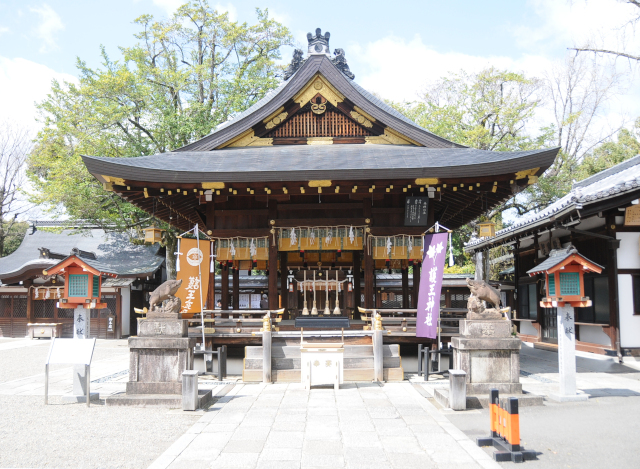
Last Friday, I visited a shrine festival for the first time in ages (thanks, depression…) It was Go’o shrine’s main festival which is held in honor of one of their enshrined deities, Go’o Daimyojin. Go’o shrine lies west of the Imperial Palace, and while the name literally means protect king shrine, it is better known as Kyoto’s pig or boar shrine, thanks to the ubiquitous pig statues on the grounds.

Stage at Go'o Shrine

Go’o Daimyojin has his origins in Wake no Kiyomaro, a court official who, with the help of an oracle, settled a dispute concerning the imperial succession all the way back in 769. In return, he was deified as “Gracious Protecting Deity of the Emperor” and a festival in his honor has been held every year on April 4 since the Meiji era.

Unfortunately, there is not much I can say about the festival, as it is held behind closed doors in the shrine’s prayer hall. Court music could be heard and the customary chant of prayers, but that’s all I can report from this part of the ceremony, which lasted a bit more than one hour.

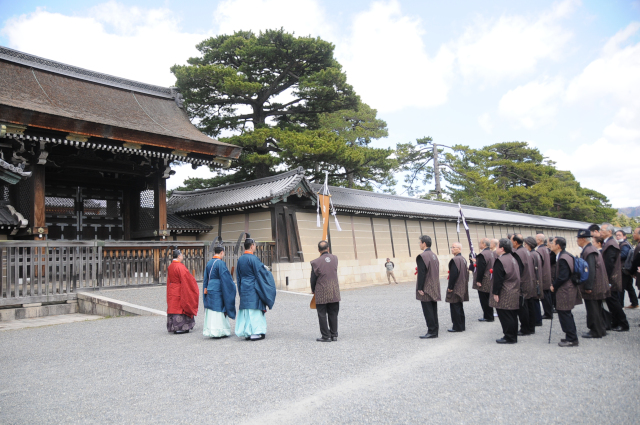
Afterwards, priests and guests gathered in a procession to the palace’s Kenreimon gate. There, the head priest recited a short prayer and read a document, and then everybody returned to the shrine.

Taisai - main festival - at Go'o Shrine.

That’s all I can say about the ceremony itself, but I will write more about Go’o Shrine in due course. However, I didn’t go home empty-handed (headed?): I learned last Friday that the guests wearing the brown happi above, who may take part in the ceremonies, are members of the Go’o Shrine Association, which membership most likely comes with a steep fee, sorry: donation every year.

Also, seeing the head priest in front of the palace gate led to an interesting observation that has eluded me until now: The priests’ clothes look like the dress of aristocrats of the Heian era. Even though I’ve been to many Shinto ceremonies, I’ve never made this connection before, assuming it is even true. I will have to investigate further.

Exhibitions, Art, and Maiko

Thanks to my friend who came down from Tokyo, I had quite a busy weekend. Together we visited two art/crafts markets and two exhibitions, walked under (almost) blooming cherry trees, had kaiseki (lunch), burgers (dinner), chocolate cocktails and other drinks (night out), and watched this year’s Miyako Odori.

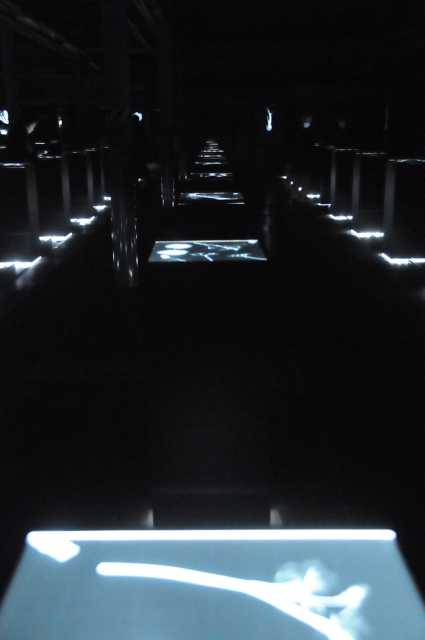
It’s hard to pick the highlight of my weekend, but I think it was the “X-Ray Flowers” exhibition:

The venue was an old newspaper printing plant, everything was dark except the exhibits, there was a darkish-moody background music… The whole thing came together perfectly for a spectacular “experience”, that’s the only way I can describe it.

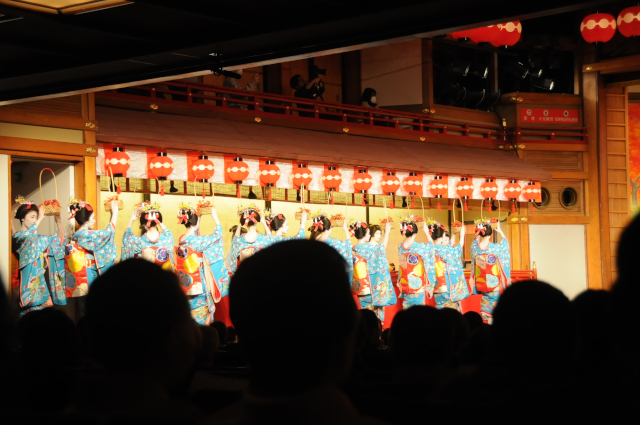
Miyako Odori was just like last year, the final dress rehearsal for the press and invited patrons. Unfortunately, we arrived late, so our seats were not as good, thus my photos aren’t as good either.

As far as sustenance goes, the chocolate cocktail with rum is my #1 this time. I also tried gin for the very first time, it wasn’t popular in Austria when I was a student, or maybe it was too expensive. There seem to be lots and lots of different flavours, one had a strong orange taste with I liked very much. This may require further research. I’ll keep you posted.

Mikane Jinja

Kyoto is said to be the city of 1000 temples and shrines. There are the famous temples dating back to the days when Buddhism first arrived in Japan. There are the tiny shrines enshrining only the gods know who, hidden on steep mountain paths. And there are numerous small shrines at the centre of local neighbourhoods. One of these is Mikane Jinja a few streets west of the Manga Museum.

Mikane Jinja street view

This neighbourhood was once the quarter of Kyoto’s metalworkers. Kamanza dori, for example, was the street of tea kettle makers. In 1588, Hideyoshi started minting gold coins, and when Ieyasu became shogun, he established a Kinza and Ginza (gold and silver mint, respectively) where the Manga Museum stands today.

This led to an influx of skilled artisans who worked at the mints and settled in the area. The mint also attracted money changers (and lenders) as well as people who worked with precious stones and minerals. Over time, the area became very prosperous. People living here could afford expensive clothes and accessories, which gave rise to the term “Ryogaemachi style”, named after one of the local streets.

honden main hall of Mikane Jinja

The main deity of Mikane Jinja is Kanayamahoko-no-Mikoto, the God of metals, minerals, and mining. When exactly the shrine was established is not certain, but it is known, that it started as a small shrine on a private property somewhere in the area. More and more people came to worship at the shrine, and providing access at all times became a burden to the owners of the property. Therefore, in 1883, new land was donated, and the deities were moved to the newly constructed shrine that still stands on the very same spot.

Today, Mikane Shrine attracts people who pray for wealth and prosperity, as well as good fortune in businesses related to metals – mining, steel industry, car manufacturing, electronics etc. – or finance – investments, accounting, banking, real estate etc.

Mikane Jinja night view

The most striking feature of Mikane Shrine is its golden torii. The shiny paint was especially developed by a local company to withstand outdoor conditions for many years. Gold is also the colour of the bell rope used to ring the bell before prayer, and a goshuin slip with real gold leaf is available at the shrine.

At the back of the precincts is a large ginkgo tree, 22 metres tall and 200 years old. In folklore, ginkgo trees are a symbol of prosperity, growth, and longevity and its leaves especially are a symbol of infinite good fortune. This is why many of the shrines’ omamori and omikuji are shaped like or feature ginkgo leaves, and in autumn, visitors may even ask for real leaves from the sacred tree to take home.

Mikane Jinja Ema votive tablets

Mikane Shrine is accessible to worshippers 24/7, but its main festival is the reitai-sai festival in autumn. Held every year on the last weekend in September, it features a children’s procession and mikoshi parade as its main attractions. Food stalls and games for kids as well as a lucky draw add to the festive atmosphere.

If you are in town at this time, it’s a great way to experience a real neighbourhood festival in Kyoto and to mingle with the locals.

Concert

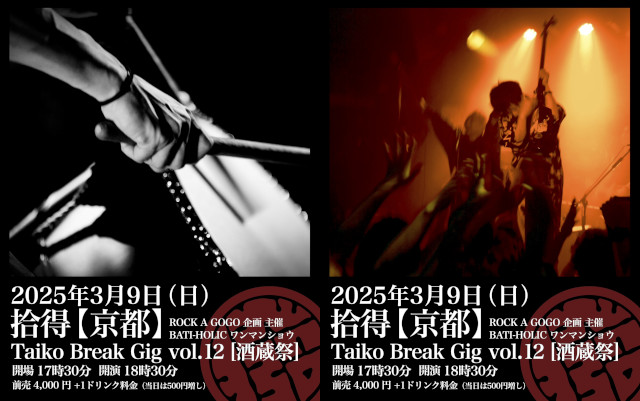
I’m busy today getting ready for this year’s very first BATI-HOLIC solo concert (aka in Japanese: one-man show). The place is fairly small and they sold out last week, and since I’m planning to stand in the first row, thank you, I’ll better be there before the doors open. I’ll check in later!

Later: This was so much fun! It’s great when the people are all fans of the band and go with the music. I didn’t quite make it to the first row, but I could secure a seat on a platform with tatami and small tables, and it’s easy to get up and dance there. It was perfect!

One thing I find always very interesting at such concerts is how quickly people tend to leave when everything is over. Some 15 minutes after the last encore, the place was half empty already. I stuck around with some friends, and I enjoy this part of chatting and drinking and having fun with them and the band members just as much as the music itself.

Goodness, I’m not turning into an extrovert, am I?